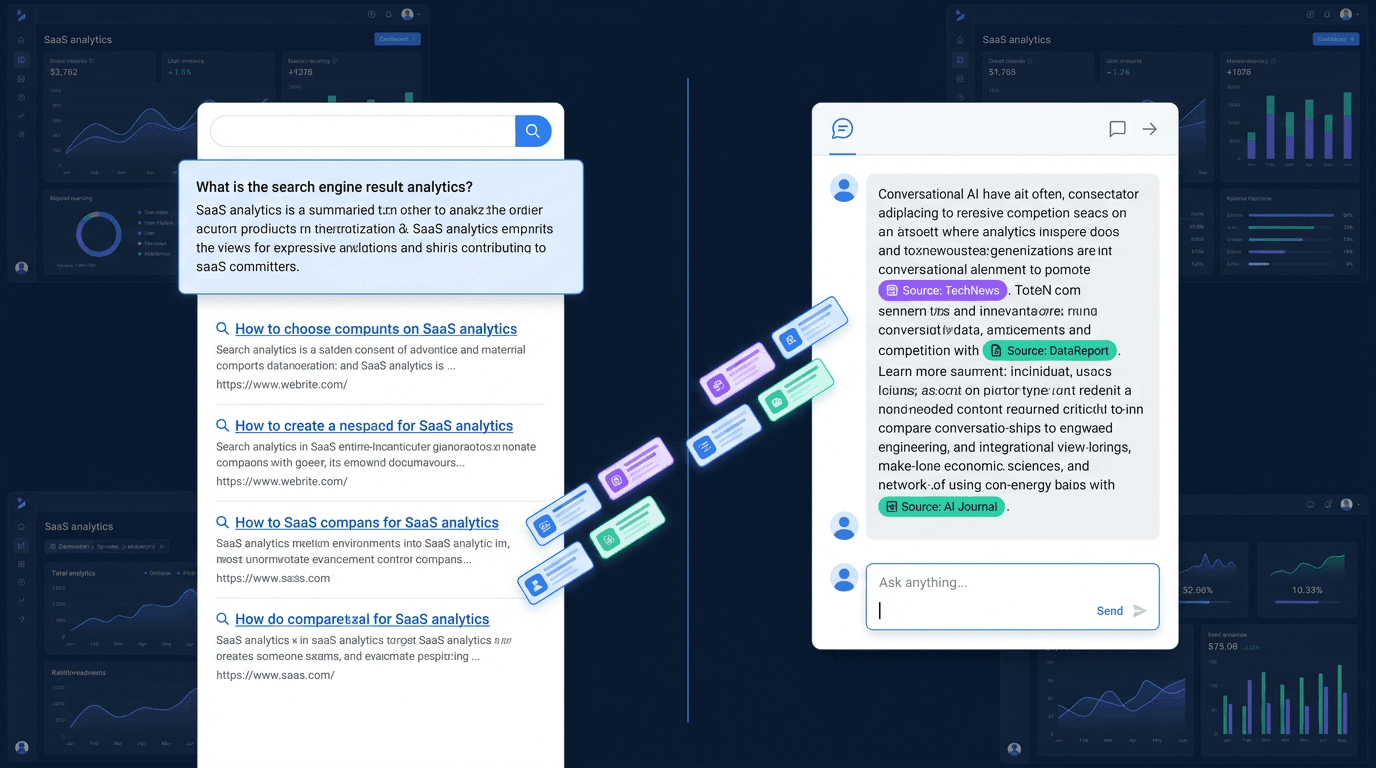
SaaS content marketing just got harder and more interesting. The old formula, high-volume blogging plus keyword-heavy landing pages, breaks down when AI models stitch together an answer from dozens of sources and hand it to buyers without a click. Studies show that content marketing can cost significantly less than traditional marketing, but that efficiency only matters if your work shows up where prospects actually look. More and more, that means AI-powered answer engines.
If you are a growth lead defending organic-sourced pipeline, a content manager trying to make an editorial calendar perform, or a SaaS marketer covering acquisition and retention, the job is the same: publish content that ranks in classic search and gets cited by large language models. The sections ahead lay out a SaaS content strategy built for both, with frameworks you can put into the next quarter's plan.
Why Traditional SaaS SEO Is No Longer Enough
For years, SaaS SEO has been about high-intent keywords, backlink authority, and clean on-page execution. None of that goes away; the return on investment for B2B SaaS SEO remains compelling, which is why it keeps winning budget fights. The change is the distribution layer. AI search engines use natural language processing and machine learning to interpret queries and generate direct answers instead of returning a page of links. When someone asks an assistant, "What's the best way to track churn in a SaaS product?" the model pulls from structured, authoritative sources and cites them. If your content is not built for that kind of retrieval, you do not just rank lower, you disappear from a channel that is quickly becoming a primary path to discovery.
Start by getting crisp on what is an AI-powered answer engine. This shift is not a call to abandon Google. It is a reminder that "organic visibility" now includes SaaS AI search surfaces alongside Google, Bing, and niche directories.
Building a SaaS Content Strategy That Serves Both Channels
A strategy that holds up starts with audience clarity and ends with distribution that works for both crawlers and retrieval systems. The baseline stays familiar: map the questions buyers ask at each stage of the funnel. What changes is the execution layer - you have to write for humans, search engines, and models that extract and cite.
Map Content to Buyer Journey Stages
B2B brands with active blogs can generate significantly more leads than those without, but "active" is not the same as "effective." Treat every asset as a bet on a specific stage. Top-of-funnel education creates awareness. Mid-funnel comparisons and use-case content move people into consideration. Bottom-funnel assets, like case studies, ROI calculators, and integration guides, do the closing work. Recent analysis shows that a high percentage of B2B SaaS marketers rate case studies as very effective at generating sales, often ahead of general website content and blog posts. That should not be a trivia stat; it should show up in your editorial mix.
| Funnel Stage | Content Type | Search Value | AI Citation Potential |
|---|---|---|---|
| Awareness | Explainer blog posts, glossaries | High (volume keywords) | High (definitional queries) |
| Consideration | Product-led tutorials, comparison frameworks | Medium-High | High ("how to" and "best way" queries) |
| Decision | Case studies, ROI calculators, pricing breakdowns | Medium (long-tail) | Medium (specific recommendation queries) |
| Retention | Help docs, onboarding guides, release notes | Low (branded search) | High (support and troubleshooting queries) |
| Bottom-funnel content converts at higher rates, while top-funnel and help content earns the most AI citations. |
Structure Content for AI Retrieval
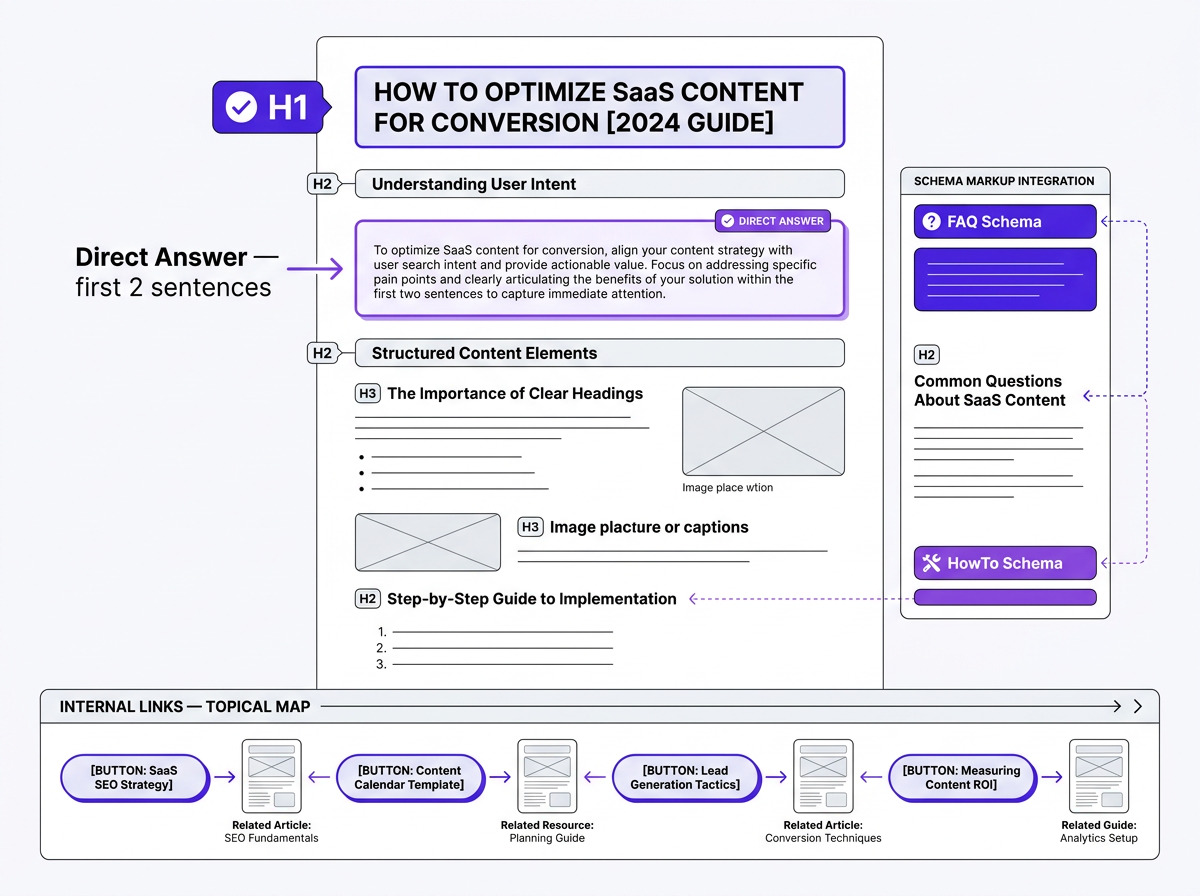
AI models tend to cite pages that are easy to parse: clear structure, grounded claims, and unambiguous entities. In practice, that looks like H2/H3s phrased as real questions, structured data (FAQ schema, HowTo schema), and a direct answer in the first two sentences of a section before you expand. Internal linking carries more weight here than many teams assume; it signals how your pages relate and helps models build a topical map of your site. For a more tactical breakdown, see how to make content discoverable in AI engines.
Product-Led Content: The Engine Behind PLG Visibility
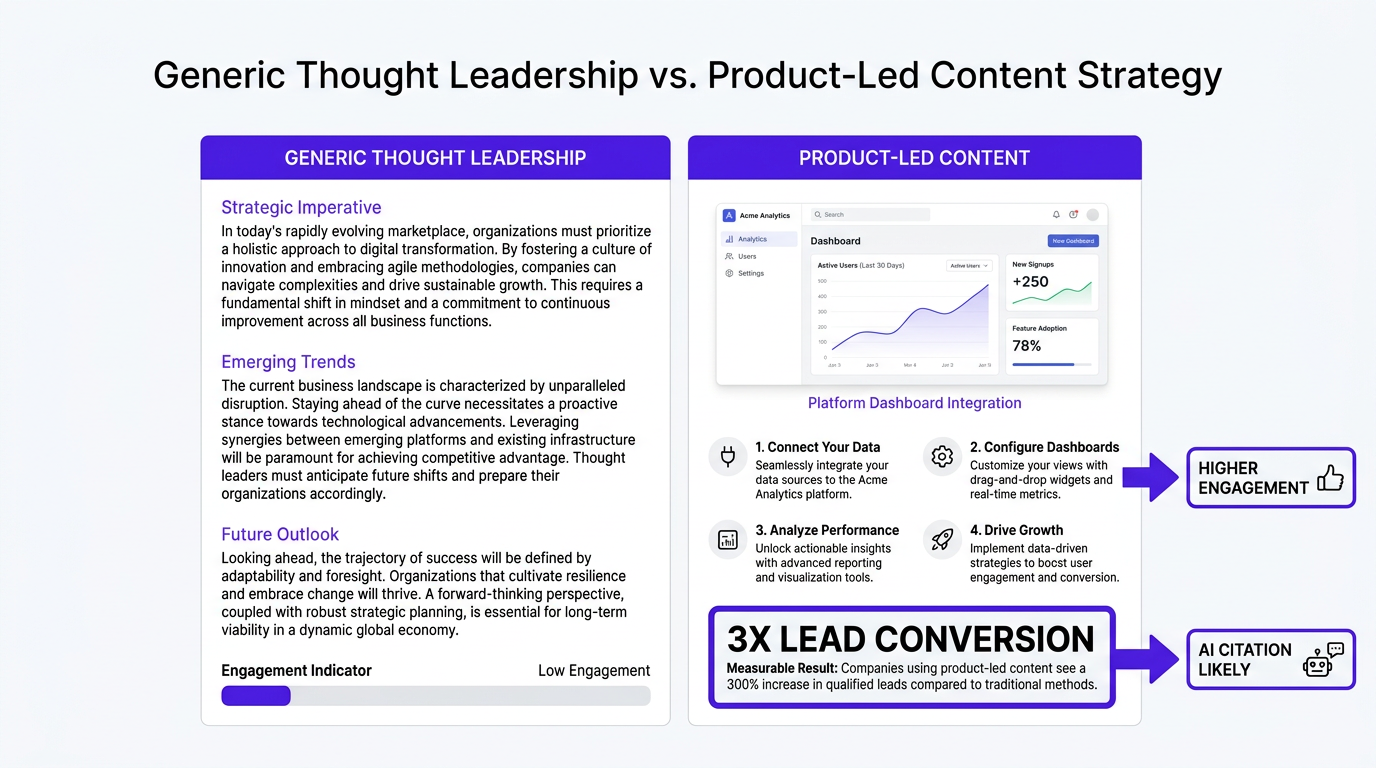
Product-led content does something subtle: it lets the reader watch the product solve the problem while they are still learning the problem. It is not a landing page, and it is not a help doc. Done well, a product-led article answers a real buyer question and shows the workflow inside your tool in the same breath. That fits cleanly with product-led growth (PLG) motions, where the product is the primary lever for acquisition and retention.
Picture a SaaS analytics company publishing "How to Track Brand Mentions Across AI Chatbots." The strong version is not a generic overview. It walks through the workflow inside the product, backed by screenshots and real data, so the reader learns the concept and sees the solution operate. That level of specificity is also what makes the piece easy for an AI model to cite when answering the same question later.
Tip: Product-led content earns AI citations because it provides concrete, tool-specific answers that models can reference. Generic thought leadership rarely gets cited in AI-generated responses.
Vizup, for example, publishes product-led tutorials that show how its Answer Engine Monitoring and Digital Presence Monitoring features work in practice. A post about improving brand visibility in AI search does not stop at the idea; it walks through the monitoring workflow. That is the difference between content that reads well and content that gets referenced by both people and AI systems.
Optimizing for AI Answers Without Sacrificing Search Rankings
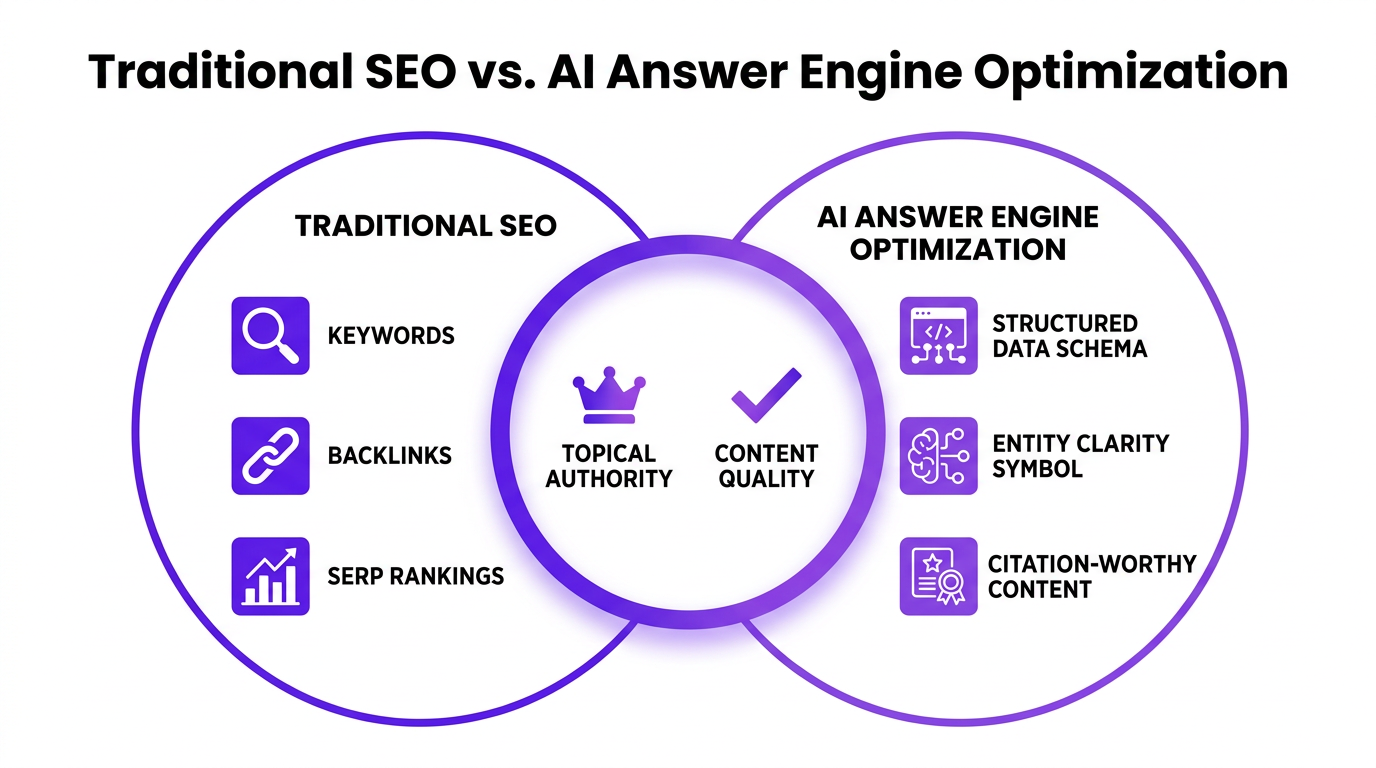
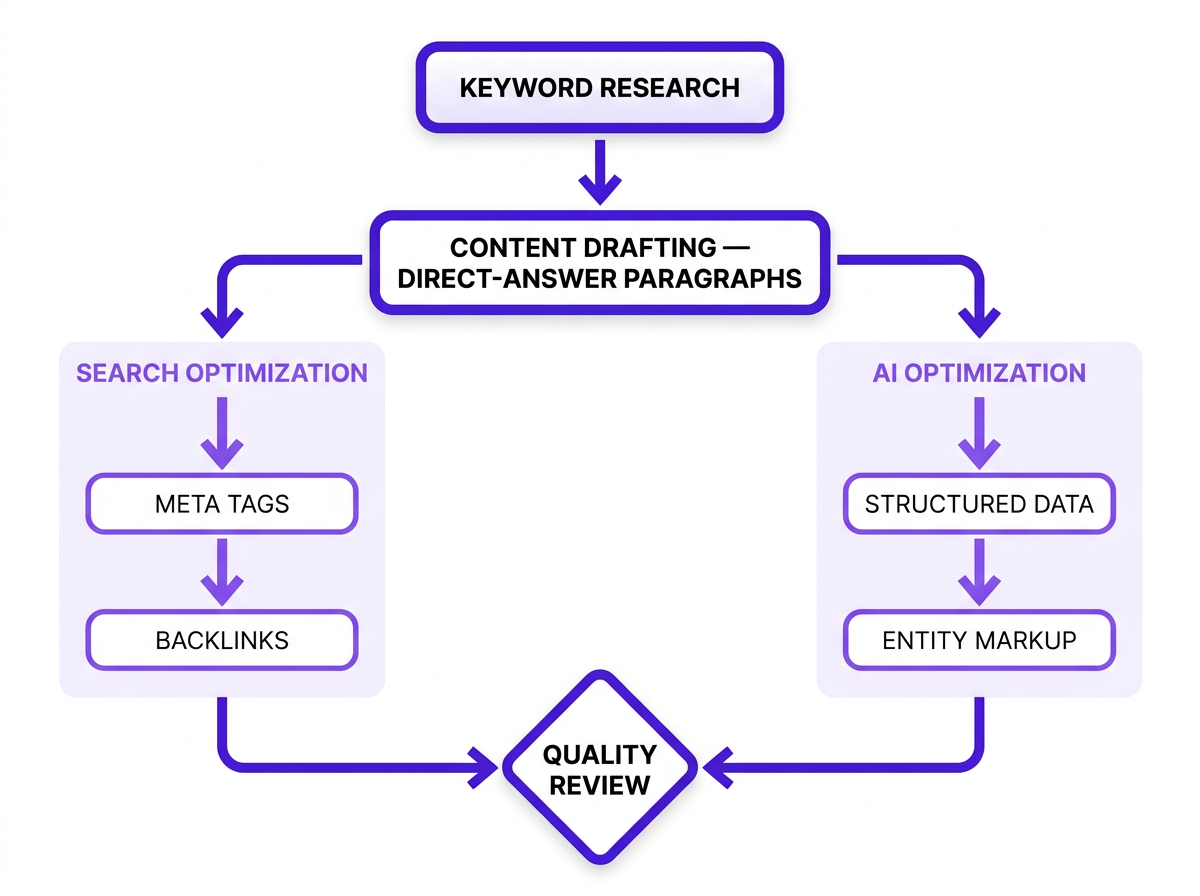
Teams often worry that "AI optimization" means rewriting the SEO playbook from scratch. It usually does not. The qualities that win in search - strong structure, credible coverage, and authority - are also the qualities models pull from when they generate answers. What you are adding is a short list of execution details that make retrieval and citation more likely.
Tactical adjustments for dual-channel optimization:
- Lead with direct answers. Put the section's answer in the first 1-2 sentences. Featured snippets and AI citations both tend to lift from that spot.
- Use entity-rich language. Call out specific tools, metrics, frameworks, and use cases instead of writing in abstractions. Models match queries to named entities.
- Embed structured data. FAQ, HowTo, and Article schema give search engines and AI crawlers machine-readable context about what your page contains.
- Maintain factual density. Use numbers, name sources, and keep claims concrete. Vague lines like "many companies see improvement" are easy for retrieval systems to skip.
- Interlink strategically. Build clear paths between related pages so models can infer a topical graph of your expertise. Use a prompt for an SEO content audit to spot internal linking gaps.
A growing majority of B2B sales interactions now happen in digital channels, a trend that has only intensified. For many buyers, your content is the first touchpoint, and sometimes the only one, before they start a trial or book a demo. Every serious article has to pull double duty: rank in search and function as an AI-ready knowledge source.
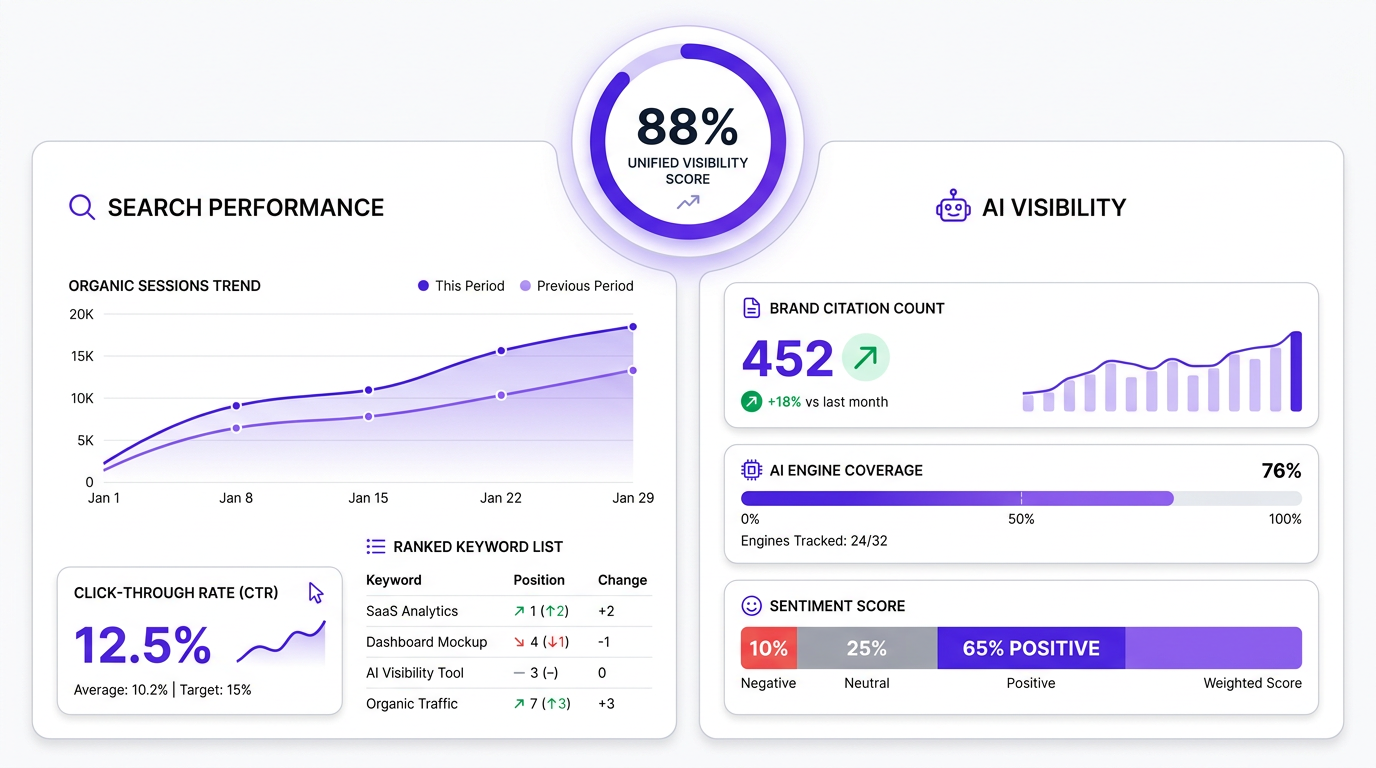
Measuring What Matters: Tracking Visibility Across Search and AI
Classic SaaS content reporting centers on organic sessions, keyword positions, and conversion rates. Keep those. They just do not cover the new surface area. If your pages are getting cited by ChatGPT, Perplexity, or Google's AI Overviews, that is real distribution - and you will not see it in the dashboards most teams live in. Without AI citation visibility, you are guessing on a channel that is gaining influence fast.
Dedicated monitoring closes that gap. Vizup's Answer Engine Monitoring tracks when and where your brand shows up in AI-generated responses, so your "organic" view extends beyond traditional SERPs. Combine that with standard SEO analytics and you get a more complete read on performance. For a practical example of connecting citations to outcomes, see how to turn AI into pipeline.
Info: If you are only measuring search rankings, you are missing a growing share of how buyers discover SaaS products. Track AI citations alongside traditional SEO metrics to get the full picture.
Organic is wider than it was even a year ago. For the strategic framing of how these channels connect, read why organic marketing is beyond SEO.
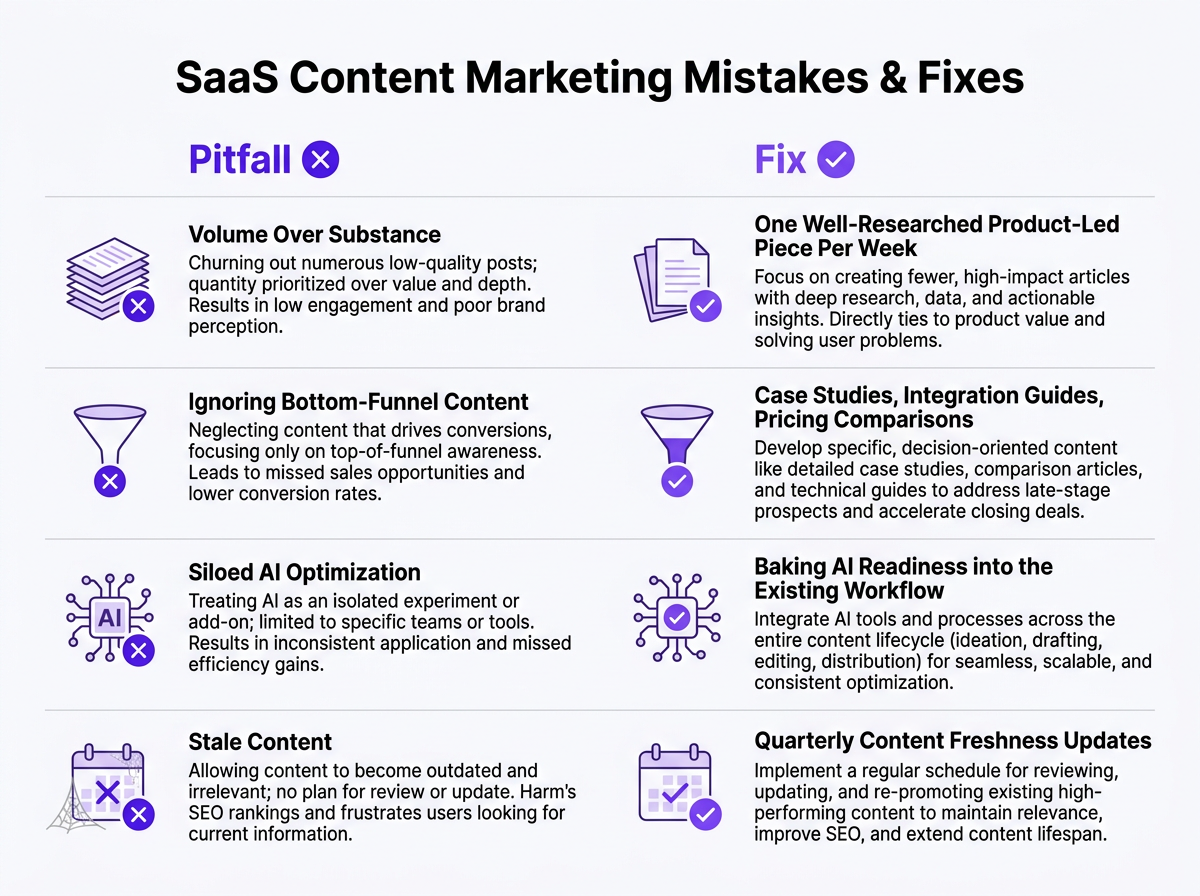
Common Pitfalls and How to Avoid Them
Even strong SaaS teams trip when they retrofit content programs for dual-channel visibility. These are the mistakes that burn the most cycles - and show up later as missed pipeline.
Publishing volume over substance. Three thin posts a week do not build authority in search, and they do not earn citations in AI answers. One well-researched, product-led piece per week can beat five generic posts because it gives crawlers and models something worth ranking and referencing. AI systems are built to surface authoritative sources, not the loudest publishers.
Ignoring bottom-funnel content. Many SaaS teams over-invest in awareness posts because traffic is easy to point to on a slide. Bottom-funnel content - case studies, integration guides, pricing comparisons - is what converts. It is also more specific, which makes it a better fit for AI responses to purchase-intent questions. Build a calendar that reflects both realities.
Treating AI optimization as a separate project. The teams seeing results bake AI readiness into the existing workflow instead of stapling it on at the end. When you draft a new piece, structure it for retrieval from the first outline. When you audit older content, review entity clarity and structured data alongside the usual on-page checks. Vizup's prompt library includes prompts that speed up those audits.
Neglecting content freshness. Recency matters to AI models. A guide published in 2023 with stale stats is an easy target for a competitor who refreshes in 2026. Put quarterly updates on the calendar for your highest-performing pages, and treat stats, screenshots, and product references as part of the maintenance work.
Putting It All Together: Your Next Quarter Action Plan
SaaS content marketing in 2026 rewards teams that execute deliberately across search and AI surfaces. This is not an either/or decision. It is a build standard: content that is structured, specific, and product-led enough to perform in both places. Start with an audit of your existing library for AI readiness - entity clarity, structured data, and direct-answer formatting. Then plan new work around the gaps that matter most: bottom-funnel coverage and content that shows your product doing the job.
From there, measure what you are actually shipping into the market: search performance plus AI citation visibility. Vizup covers the AI-side monitoring most stacks miss, so SaaS teams can see their full organic footprint. The brands that operationalize this dual-channel approach early will build compounding advantages as AI-driven discovery keeps expanding.
Frequently Asked Questions
What is SaaS content marketing, and how is it different from general content marketing?
SaaS content marketing is built for software buying: longer sales cycles, more stakeholders, and a subscription journey that does not end at conversion. It typically leans harder on product-led content that shows the tool in action, adds technical depth to earn trust with informed buyers, and maps assets to each stage of the customer lifecycle.
How does product-led content help with AI search visibility?
Because it is specific. Product-led content includes workflows, screenshots, and real data instead of generic advice. AI models tend to cite sources with high factual density and clear entity references, so a tutorial that walks through a process inside a named tool is much more likely to be referenced than an abstract overview.
What is the difference between SaaS SEO and AI answer engine optimization?
SaaS SEO aims to rank in traditional results through keyword targeting, backlinks, and on-page optimization. AI answer engine optimization adds the pieces models need to retrieve and cite your work: structured data, entity-rich language, and direct-answer formatting. There is heavy overlap, and the strongest programs run them as one workflow.
How can I measure whether my content is being cited by AI models?
Most analytics platforms do not report AI citations. You need dedicated monitoring to track when and where your brand appears in AI-generated responses. Combine that with standard SEO metrics to get a fuller view of organic visibility.
What types of bottom-funnel content work best for SaaS companies?
Case studies, ROI calculators, integration guides, and detailed pricing breakdowns tend to perform best at the decision stage. Recent marketing surveys show that a high percentage of B2B SaaS marketers rate case studies as very effective at generating sales. These formats are also highly specific, which increases the odds of being cited for purchase-intent queries.
