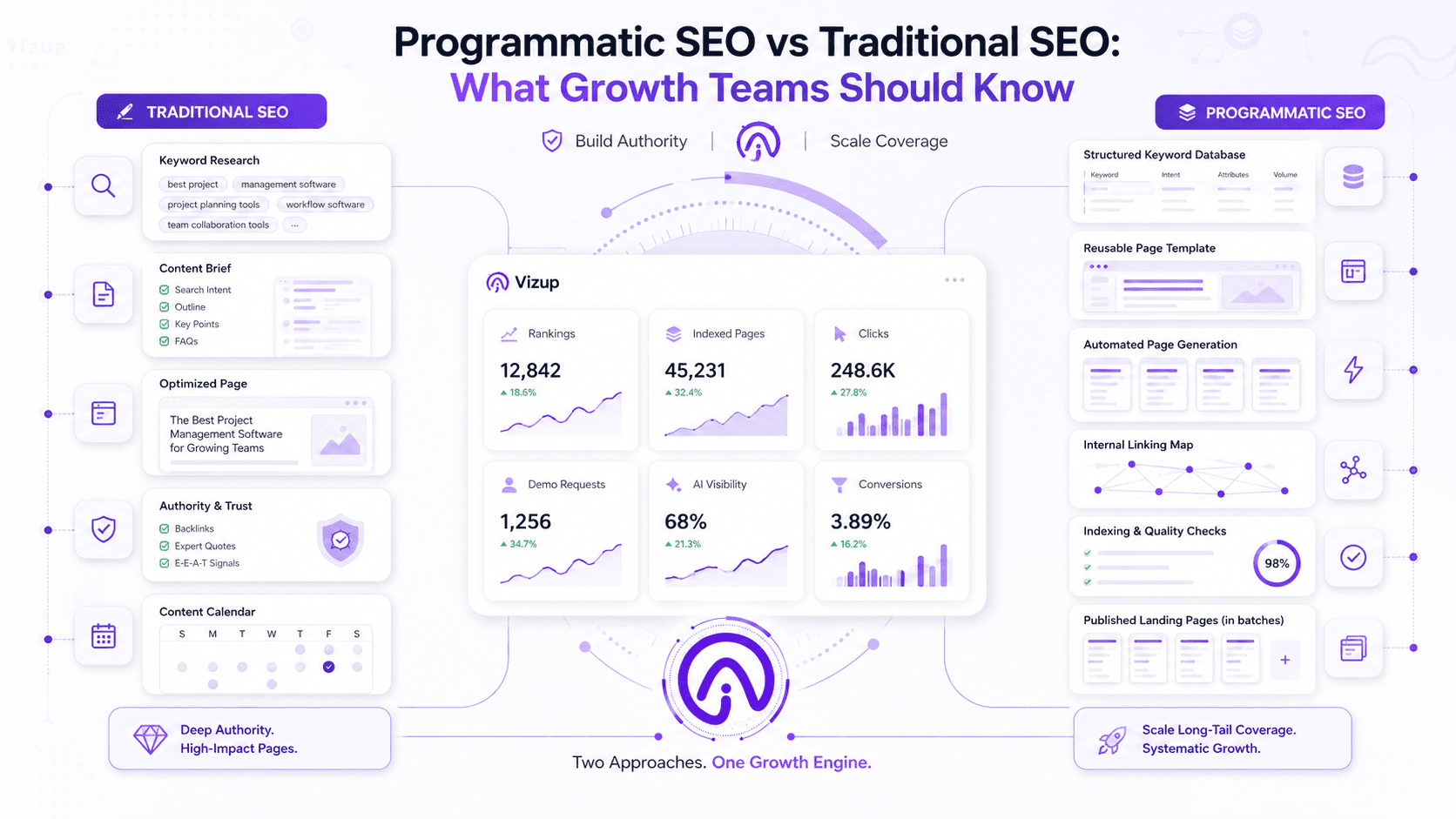
Too many growth teams burn cycles on the same unproductive argument: "Which is better, programmatic or traditional SEO?" That framing is the problem. Asking it is like asking a chef to pick between a paring knife and a cleaver. They're both indispensable - just not for the same cut.
A better question is: "Which SEO system matches the growth goal in front of us?" Traditional SEO is where you earn authority, trust, and depth one page at a time. Programmatic SEO is how you cover long-tail demand without turning your content team into a factory. The strongest teams don't pledge allegiance to one camp; they build a mix that fits the business.
What Is Traditional SEO?
Traditional SEO is the page-by-page craft of winning search visibility. It's what most people mean when they say "SEO": careful keyword research, a bespoke brief for a writer, and a landing page or post built to stand on its own. It's also where link building and ongoing optimization live - the unglamorous work of earning authority and then defending it as the SERP shifts.
It's closer to editorial than automation. The pace is slower, the bar is higher, and the payoff is biggest on competitive, high-intent topics where quality is the differentiator. If you want to be seen as a a category leader - not just a site that happens to rank - this is the foundation. The goal isn't merely a position; it's credibility.
What Is Programmatic SEO?
Programmatic SEO (pSEO) is a way to publish and optimize lots of pages using templates plus structured data. Instead of writing every page from scratch, you design a repeatable layout and fill it with fields pulled from a database or spreadsheet. That lets you produce hundreds or thousands of distinct URLs aimed at consistent keyword patterns. A travel site might generate a page for every city; a SaaS company might spin up a page for every integration it supports.
To be clear, pSEO isn't synonymous with content spam. The spammy version exists, and it tends to end the same way: ignored pages or a painful cleanup. The good version is structured demand capture - a system that creates genuinely useful pages for predictable needs. It still requires real work: template design, internal linking strategy, indexing discipline, QA, and ongoing performance checks.
Programmatic SEO vs Traditional SEO: Quick Comparison
| Factor | Traditional SEO | Programmatic SEO |
|---|---|---|
| Best for | Authority and depth | Long-tail coverage |
| Page creation | Hand-built pages | Template + data |
| Speed | Slower cadence | Faster publishing |
| Scale | Naturally limited | High scale |
| Content style | Editorial, guide-led | Structured, repeatable |
| Main risk | Slow output | Thin or duplicate pages |
| Best team fit | Content + SEO | SEO + content + product + engineering |
The Real Difference Is Not Content, It Is Operating Model
This is the part people routinely miss. They treat the distinction as a writing question - manual versus automated. That's surface-level. The real split is the operating model behind it.
Traditional SEO behaves like an editorial workflow. Writers, editors, SEO specialists, and subject matter experts move work through a calendar, briefs, and standards. The process is human-led, and the output is a set of individual assets you can point to, review, and refine.
Programmatic SEO behaves more like a product. It demands a different team shape and a different kind of rigor: keyword logic, flexible templates, clean datasets, and QA that catches issues before they multiply. You're building a machine, which means engineers, product managers, and analysts end up in the loop. Instead of managing a content calendar, you're managing a system - CMS workflows, analytics instrumentation, and obsessive index tracking included. Teams that treat pSEO like a product, not a content shortcut, are the ones that get durable results.
When Traditional SEO Works Better
Some pages simply shouldn't be templated. You wouldn't automate a heartfelt apology, and you shouldn't automate content that depends on judgment, taste, or persuasion. Lean on traditional SEO for:
- Thought leadership: Pieces that articulate your company's point of view and build reputation.
- BOFU comparison pages: High-stakes pages against a top competitor, where nuance and persuasion matter.
- Product education: Explaining complex features and benefits without flattening the details.
- Core category pages: The primary hubs that need to carry authority for the whole site.
- High-value commercial keywords: Competitive terms where ranking demands expert-led quality.
- Topics needing expert opinion: Anything that requires original insight, strong judgment, or a distinctive perspective.
- Pages where trust matters more than volume: Security, your 'About Us' narrative, and key case studies.
If a page needs original insight, specific examples, annotated screenshots, or a clear point of view, start with traditional SEO. This is the work that compounds into brand trust - and the kind of authority search engines tend to reward over time.
When Programmatic SEO Works Better
Programmatic SEO earns its keep when the keywords repeat and the data is structured. It's built for the long tail: the massive set of specific searches you can't reasonably cover one brief at a time. Common programmatic SEO patterns include:
- Location pages: "service in city"
- Integration pages: "your product integration with other product"
- Use-case pages: "your product for industry"
- Comparison pages: "product A vs product B" at scale
- Directory or marketplace pages: Listings for professionals, businesses, or items.
- "Best X for Y" patterns: "best product category for user type"
A SaaS company selling a CRM, for example, could publish pages like CRM software for real estate teams, CRM software for agencies, and CRM software for healthcare teams. The skeleton stays consistent, but the page gets filled with audience-specific details - relevant data, customer examples, and use-case context. That's the promise of a solid programmatic SEO strategy: scale that still meets intent with something specific.
Why Growth Teams Should Care About Programmatic SEO
For growth teams, pSEO matters because it's one of the few SEO approaches that behaves like a lever. It's not just "more content"; it's a way to turn structured demand into repeatable acquisition.
It starts with speed: long-tail coverage expands far faster than an editorial pipeline can manage, and the marginal cost per additional page drops as the system stabilizes. The bigger payoff comes when those pages are wired to business outcomes. A large set of landing pages becomes a testing surface for both paid and organic, showing which segments, locations, or use cases actually convert. That creates tighter learning loops for the whole team. When programmatic pages are connected to signups, demo requests, and pipeline data, they're no longer "SEO pages" - they're an instrumented demand-gen system you can measure and improve.
The Risks of Programmatic SEO Growth Teams Should Not Ignore
Programmatic SEO has a rough reputation, and it didn't get that way by accident. Plenty of teams have shipped a flood of low-value pages and called it a strategy. The failure modes are predictable: thin content that doesn't help anyone, near-duplicate patterns Google chooses to ignore, and indexation problems that turn months of work into dead URLs.
The problems don't stop there. Keyword cannibalization can pit your own pages against each other. Weak internal linking can strand pages so they never get discovered. And even when traffic shows up, it can be the wrong traffic - lots of visits, little intent. The most expensive mistake is publishing at scale and then not watching what happens next.
Google's spam policies explicitly call out "scaled content abuse." The safe path for pSEO is boring but effective: usefulness, uniqueness, and quality control that holds up at volume. If volume is the goal, you will usually get volume-shaped problems.
How to Decide Between Programmatic SEO and Traditional SEO
Here's a decision framework I use with clients. The point isn't to pick a side permanently; it's to match the approach to the job you're trying to do right now.
Choose traditional SEO when:
- The keyword is highly competitive and requires a best-in-class asset.
- The topic demands deep expertise, nuance, or a strong opinion.
- The primary goal of the page is to build trust and credibility.
- The content needs a strong narrative or persuasive storytelling.
- You are building foundational category authority.
Choose programmatic SEO when:
- There are clear, repeatable keyword patterns to target.
- You have access to clean, structured data to populate templates.
- The page structure can be templated without losing value.
- Each generated page can still be useful and unique to the user.
- You have a system to monitor indexing, rankings, clicks, and conversions.
The Best Strategy Is Usually Hybrid
The teams that look smartest in hindsight rarely treated this as either/or. They build a hybrid SEO strategy, because traditional SEO and pSEO solve different problems - and they reinforce each other when you connect them well.
Traditional SEO becomes your authority layer: pillar pages, definitive guides, and thought leadership that can earn links and set the tone for the category. These are the assets you want people to cite and competitors to begrudgingly reference.
Programmatic SEO becomes your coverage layer: thousands of pages that map to specific industries, use cases, locations, and integrations. The trick is the plumbing. Smart internal linking should route that long-tail coverage back to the authority layer, so the whole site benefits. Done well, you end up with broad topical authority and demand capture across the funnel - without sacrificing coherence.
Who Should Own Programmatic SEO Inside a Growth Team?
A pSEO program isn't a solo mission. It's a cross-functional system, and it fails when ownership is blurry. In a healthy growth team, the responsibilities are distinct but connected.
SEO owns the logic. They are responsible for the keyword strategy, defining the patterns to target, and mapping out the page structure and internal linking architecture. They decide what to build and why it will rank.
Content owns the quality. They craft the messaging within the templates, ensuring each generated page is useful, unique, and on-brand. They're the guardians of quality control, making sure the scaled output doesn't sound robotic or thin.
Product and Engineering own the machine. This team builds and maintains the templates, the CMS workflows, and the data pipelines. They ensure the system is stable, scalable, and fast. Without their partnership, a pSEO strategy is just a collection of spreadsheets.
Analytics and Growth own the results. This function is responsible for tracking everything: indexing, rankings, traffic, and most importantly, conversions and ROI. They answer the question, "Is this working?" and provide the data needed to iterate and improve the system.
How Vizup Helps Growth Teams Scale Programmatic SEO Safely
The concept is easy to like; execution is where teams get burned. The question I hear most is some version of: "How do we scale this without turning the site into a junk drawer?" That comes down to systems, not enthusiasm.
Vizup is built for growth teams that want programmatic SEO scale without stepping on the usual landmines. It helps identify scalable keyword patterns and match them to page templates. Pages can be generated in controlled batches rather than dumped all at once, which matters for crawl budget and for catching template issues early. The monitoring is where it gets practical: Vizup tracks indexing, visibility, rankings, and AI visibility for every page you create, so you can see which templates drive business outcomes and which ones stall. That makes it easier to tighten the template and content inputs before you expand to thousands of URLs.
If you're evaluating programmatic SEO, Vizup is positioned as the workflow that turns keyword patterns into structured pages - and then shows, page by page, whether they're being discovered, indexed, and converting.
Programmatic SEO vs Traditional SEO: Final Verdict
Programmatic SEO doesn't replace traditional SEO; it sits on top of it. Traditional SEO is how you earn trust and authority through expert craft. Programmatic SEO is how you extend coverage across long-tail demand without manually writing every variant. Growth teams get the best results when they stop treating the two approaches as rivals and start treating them as complementary parts of one system. Combine them well and you move faster, capture more intent, and keep quality intact.
If your team wants to scale SEO pages without inviting thin content, indexation headaches, or murky ROI, book a demo with Vizup to see how programmatic SEO can be planned, generated, and monitored in a single growth workflow.
Frequently Asked Questions
What is the main difference between programmatic and traditional SEO?
It comes down to how pages are produced and how far you can scale. Traditional SEO is manual: a smaller number of high-quality, in-depth pages built one by one. Programmatic SEO uses templates plus data to publish hundreds or thousands of pages aimed at long-tail keyword patterns.
Is programmatic SEO considered spam by Google?
It can be if the output is thin, duplicative, or low-value - exactly the kind of behavior Google describes under "scaled content abuse." When pSEO is built around unique, useful pages (not filler) and backed by QA and monitoring, it's a legitimate approach used by many brands.
Can a small business use programmatic SEO?
Yes - especially if it already has structured data, like listings for a real estate agency or products for an e-commerce store. The smart move is to start with a small slice of keywords, validate performance, and make sure you have the technical support to maintain templates and data quality.
Which approach offers better ROI?
ROI depends on the target. Traditional SEO can pay off massively on competitive head terms, but it usually takes longer. Programmatic SEO can show returns sooner across many long-tail queries, with each page contributing a small amount. In practice, the strongest ROI often comes from a hybrid strategy that uses both.
How does programmatic SEO relate to AI-generated content?
Programmatic SEO is a templating-and-data methodology; it isn't inherently about AI. AI can be used to generate parts of template content, but the core of pSEO is the structured, data-driven system for creating and managing pages at scale.
