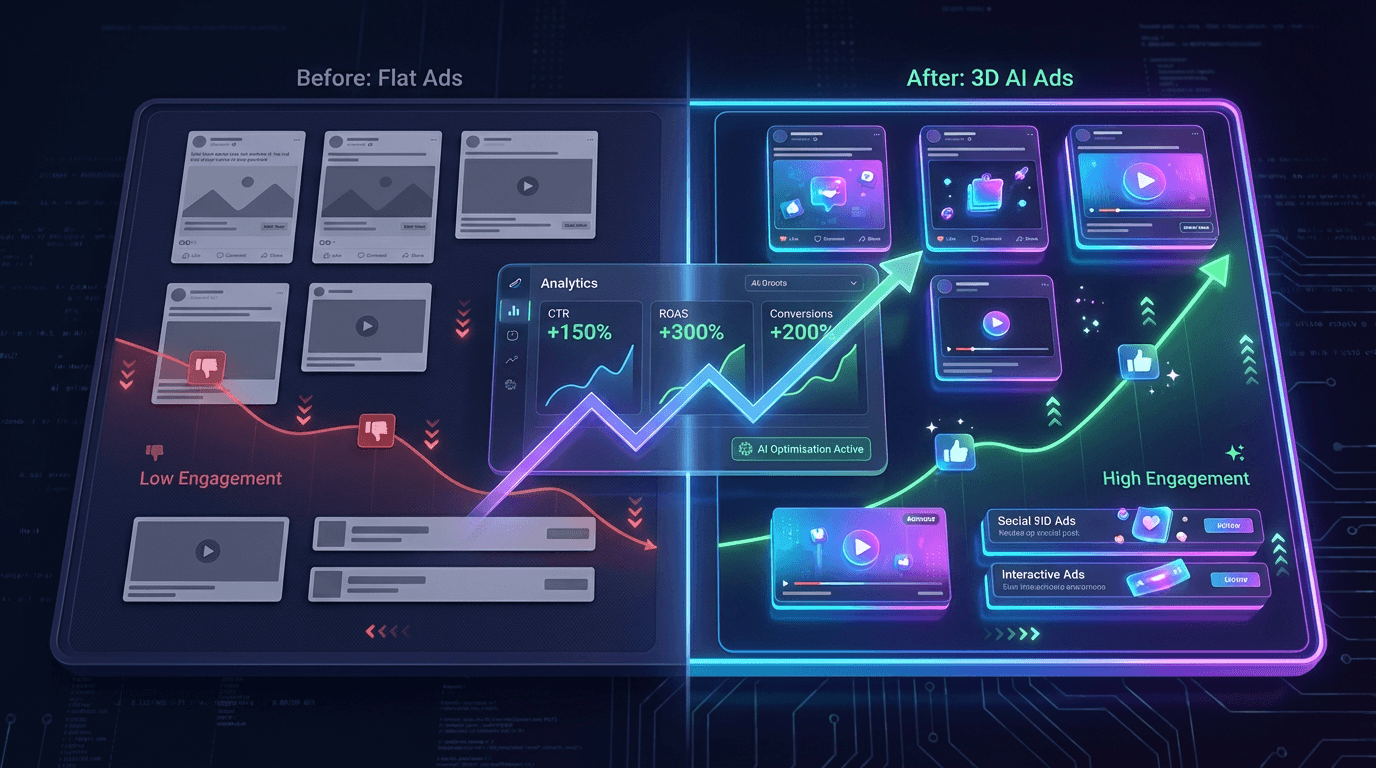
After reviewing thousands of ads across industries, one pattern stands out: the most common reason campaigns underperform isn't targeting or budget. It's the creative. Your audience encounters an overwhelming volume of content every day, yet only a tiny fraction breaks through. In this environment, your ad creatives represent the single most powerful lever for campaign success. For marketers, founders, and creative strategists, the mandate is straightforward: stop relying on guesswork and start engineering advertising that reliably converts.
This guide is not a swipe file. It's a complete framework for building a high-performance creative engine in 2026. You'll find the DNA of a winning ad, a proven strategy-first approach, and a detailed breakdown of the ad structures that drive sales. We also cover winning formats on Facebook, TikTok, YouTube, and LinkedIn, a scientific method for creative testing, and the expert-level nuances that separate the top 1% of advertisers from everyone else.
What Actually Makes an Ad Creative 'High-Converting' in 2026
An "ad creative" encompasses far more than a visual asset. It's the holistic combination of imagery, copy, format, and the psychological trigger they activate together. According to an analysis of hundreds of CPG campaigns by NCSolutions (formerly Nielsen Catalina Solutions), creative quality is the single most important factor in a campaign's success, driving 49% of sales lift. As platforms like Meta and Google increasingly automate targeting with AI, the creative itself has become the primary performance lever available to marketers.
The old "3-second rule" for capturing attention is now outdated. Research from UC Irvine professor Gloria Mark shows that the average time people focus on a single screen has fallen to just 47 seconds, a steep drop from two and a half minutes in 2004. This compression makes your ad's initial hook (the first 1.5 seconds) more critical than ever. That said, "high-converting" is always relative. A 2% click-through rate (CTR) might be elite for a B2B SaaS company but average for a DTC brand. True success is measured against industry benchmarks and, more importantly, your specific business goals.
Ad Creative Strategy: The Framework Before the First Pixel
Top-performing creative teams never begin in a design tool. They start with a strategy rooted in a clear understanding of their audience's pain points, motivations, and decision-making triggers. The most effective ads feel less like an interruption and more like a solution arriving at exactly the right moment. Below is a four-part framework that ensures every creative asset is grounded in strategy before a single pixel is placed.
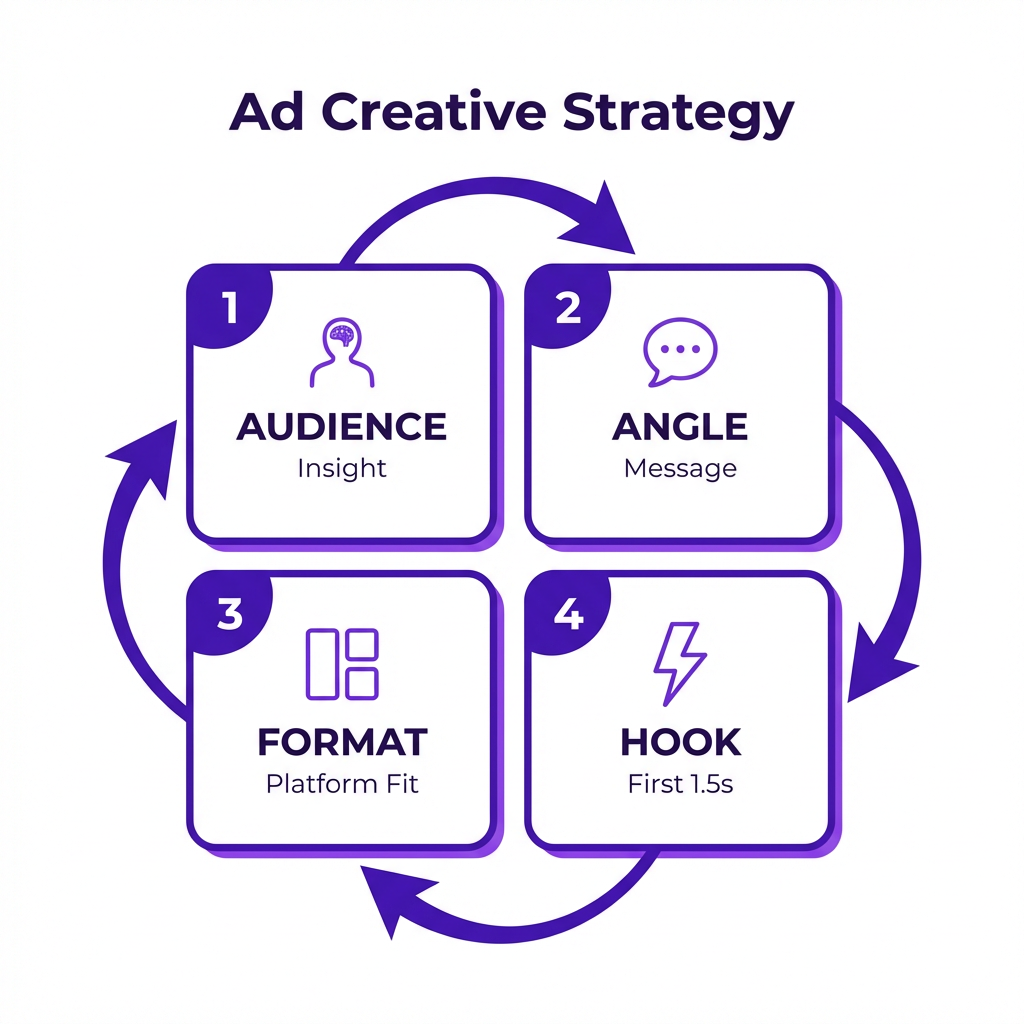
The four pillars of a strong ad creative strategy:
- Audience Insight: Go beyond demographics. Identify the deep-seated problems, desires, and fears your audience carries. What language do they use to describe their challenges? Mining customer reviews, support tickets, and sales call transcripts is one of the richest research methods available.
- Message Angle: Based on that insight, define your core message. Are you agitating a problem, showcasing a benefit, or telling a transformation story? The angle determines the ad's emotional core and shapes every creative decision that follows.
- Format Selection: Will a user-generated content (UGC) style video, a polished static image, or an interactive carousel best deliver your message? The format should feel native to the platform and align with your chosen angle.
- Hook Design: How will you capture attention in the first 1.5 seconds? This could be a provocative question, a surprising visual, or a bold claim in the text overlay. The hook is the gatekeeper to everything else in your ad.
Your own organic content is one of the best (and free) sources of creative research. Posts, videos, and articles that already resonate with your audience are clear signals of what they care about. Analyzing organic performance provides a massive head start on paid creative hypotheses and reveals which angles deserve your ad budget. Exploring how generative AI for marketing can accelerate this discovery process is a smart next step.
Anatomy of Performance Creatives That Actually Work
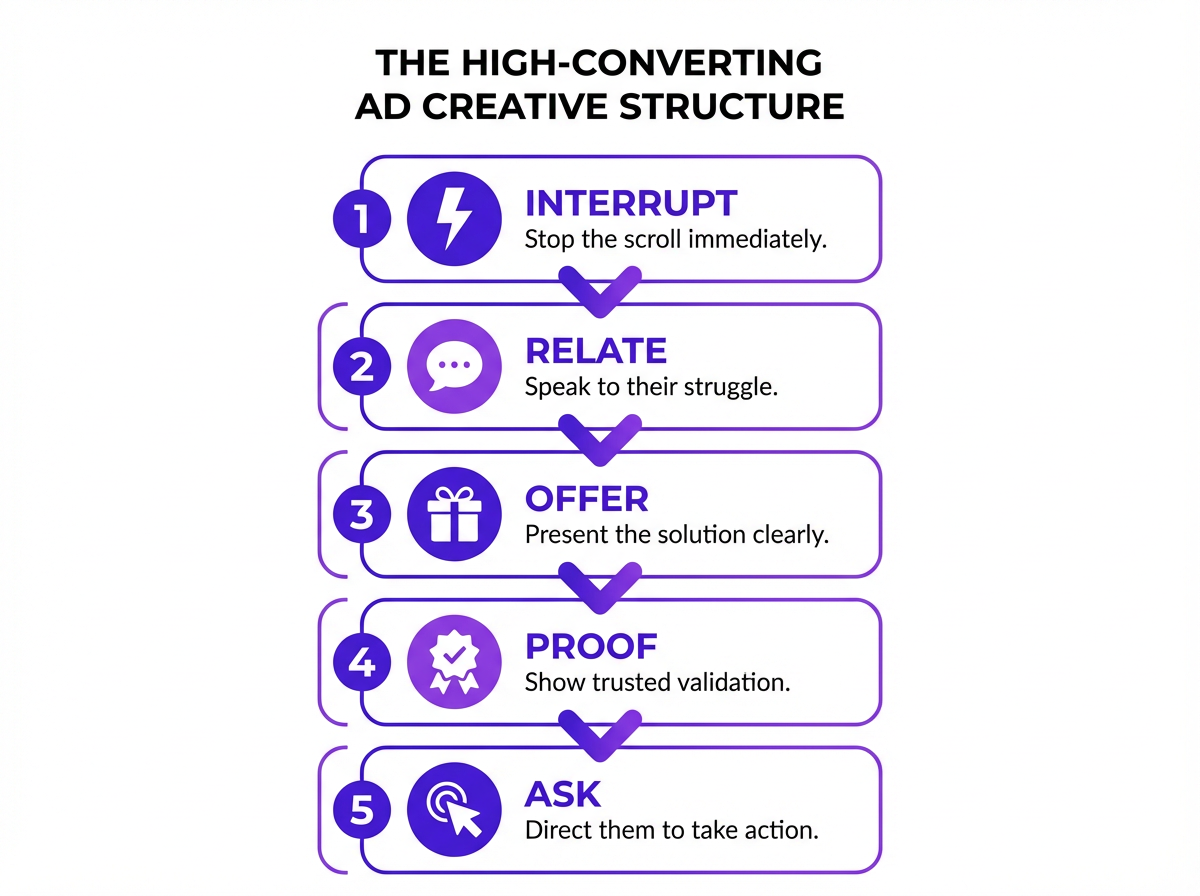
While context and platform vary, the most effective performance creatives share a common architecture. Each element has a specific job to do in a very short window of time, guiding a viewer from passive scrolling to active interest and, ultimately, to action.
The 5 structural elements of a high-converting ad creative:
- 1. The Pattern Interrupt: This is your hook. An unexpected visual, a jarring sound, or a bold text overlay that breaks the user's scrolling rhythm and forces a pause.
- 2. The Empathy Hook: Immediately after grabbing attention, demonstrate that you understand the viewer's problem. A line like "Tired of spreadsheets that don't talk to each other?" resonates instantly with the right audience and earns the next few seconds of their time.
- 3. The Value Proposition: Clearly and concisely explain how you solve their problem. Focus on benefits, not features. Instead of "Our software has AI integration," say "Our software writes your reports for you."
- 4. The Social Proof Micro-Moment: Build trust quickly. A snippet of a 5-star review, a logo of a well-known customer, or a statistic like "Trusted by 10,000+ teams" can compress the trust-building process into a single frame.
- 5. A Single, Clear CTA: Tell the user exactly what to do next. "Shop Now," "Learn More," or "Get Your Free Trial." Ambiguity kills conversion. One action, one button, one outcome.
Ad Copywriting: The Words That Do the Heavy Lifting
In 2026, great ad copy prioritizes clarity and specificity over cleverness. "Save 3 hours every Monday morning" will always outperform "Save time with our tool" because it paints a specific, tangible picture of the benefit. Your ad copy consists of three main components, each playing a distinct role in moving the viewer toward conversion.
The three components of effective ad copy:
- Primary Text: This is where you connect emotionally and tell a story. It can be long or short, but it must be engaging from the first line. For complex products, long-form copy detailing the problem and solution often outperforms shorter alternatives.
- Headline: Your ad's slogan. It should be short, punchy, and benefit-driven. For many viewers, this is the only part they read carefully, so make every word count.
- Description: This secondary text (often appearing below the headline on Facebook) provides an extra detail, adds urgency, or reinforces the call to action. Treat it as a supporting argument, not an afterthought.
| Formula Name | Structure | Best Use Case | Example |
|---|---|---|---|
| Problem-Agitate-Solve (PAS) | [Problem]. [Agitate the problem]. [Present your solution]. | Conversion | Can't find your documents? It's frustrating when files are scattered everywhere. Vizup organizes everything automatically. |
| Before-After-Bridge (BAB) | Imagine a world [Before]. Now, picture a world [After]. Here's how to get there: [Bridge]. | Conversion | Before: Wasting hours on manual reports. After: Getting insights in seconds. The bridge is our AI-powered dashboard. |
| Attention-Interest-Desire-Action (AIDA) | [Grab Attention]. [Build Interest]. [Create Desire]. [Call to Action]. | Awareness/Conversion | Your marketing is guessing. What if you knew what content converts? Imagine having a clear roadmap to higher ROI. Get your free demo. |
| The Specificity Hook | [Do a specific action] and get [a specific, numerical outcome]. | Conversion | Connect your data in 5 minutes and see a 20% lift in content engagement this month. |
| Feature to Benefit | Our [Feature] helps you [achieve specific benefit]. | Retargeting | Our automated content tagging helps you find any asset in under 10 seconds. |
| These copywriting formulas provide a reliable structure for persuasive ad copy across platforms and funnel stages. |
Facebook Ad Creative Examples and What Makes Each One Convert
Studying successful Facebook ad creative examples is one of the fastest ways to sharpen your own work. Below are four common formats with a breakdown of why each one converts. Always check the current Meta ad specs to ensure your assets are optimized for the platform.
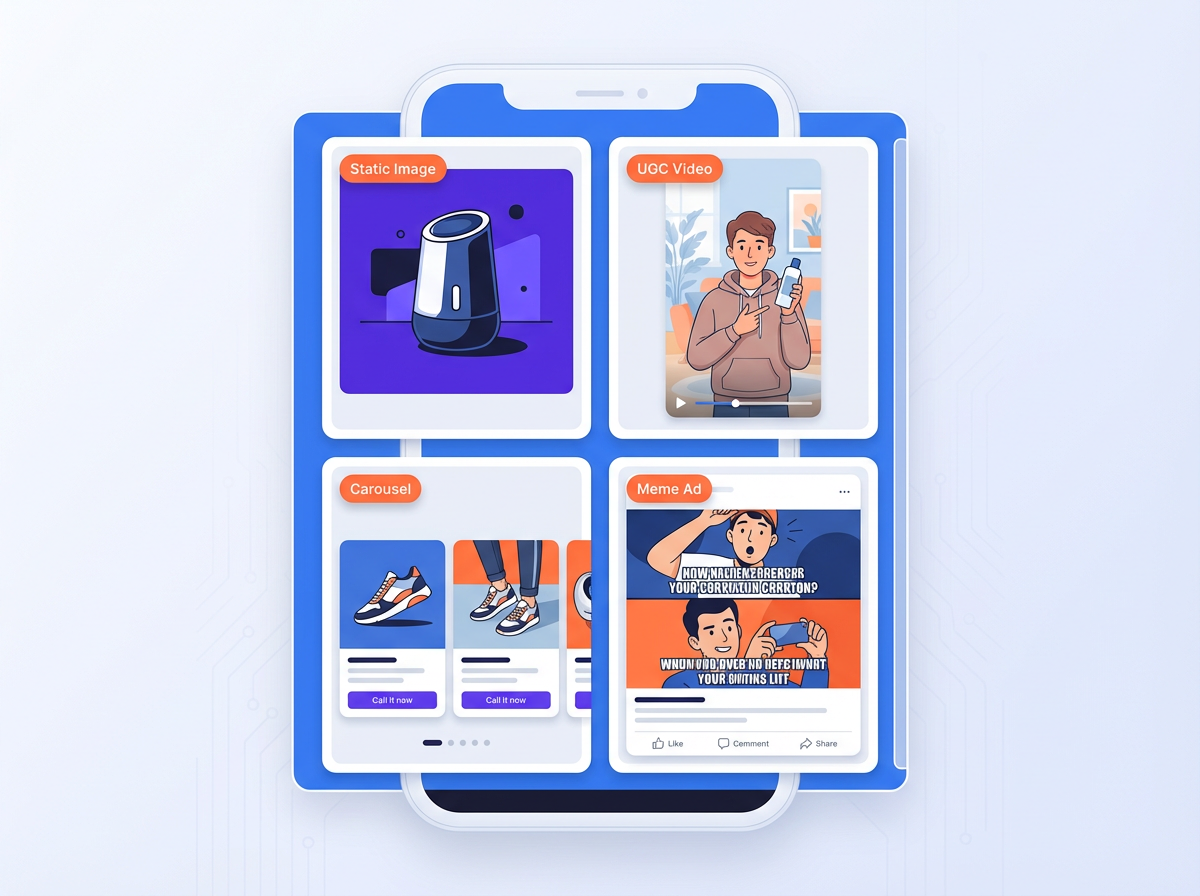
Four Facebook ad formats and why they convert:
- Static Image Ad: A high-quality photo of a product against a bold, contrasting background. A text overlay delivers a single, powerful benefit: "The Last Notebook You'll Ever Need." Why it works: Simplicity and clarity. The value proposition is instant, and the clean visual stops the scroll without overwhelming the viewer.
- UGC-Style Video Ad: A customer films themselves unboxing a meal kit on their phone. The editing is minimal, and the audio captures their genuine reaction. Why it works: Authenticity. It feels like a post from a friend, not a corporation, which builds immense trust with cold audiences who haven't encountered your brand before.
- Carousel Ad: A recipe delivery service uses a carousel to walk through the steps of making a meal: the ingredients, the easy prep, and the delicious final dish. Why it works: It's interactive and tells a sequential story, allowing you to communicate more information without overwhelming the user. Ideal for showcasing a process or multiple products.
- Meme-Format Ad: A familiar meme template is adapted with text relevant to a B2B software's audience (e.g., the "Distracted Boyfriend" meme showing a marketer looking at an automated dashboard instead of their complex spreadsheet). Why it works: Cultural relevance. It grabs attention through humor and signals that the brand understands its audience's online culture.
Creative Testing: How to Stop Guessing and Start Learning
The biggest mistake in creative testing is changing too many variables at once. If you test a new image, headline, and body copy simultaneously, you learn nothing about what caused the change in performance. A scientific approach to creative testing is the difference between burning budget and building knowledge.
Isolate one variable at a time using this testing sequence:
- Test Hooks First: Start by testing 3 to 5 different hooks (the first 1 to 3 seconds of a video or the opening line of copy) against the same ad body. This isolates the most effective scroll-stopper before you invest in other variables.
- Test Angles Second: With a winning hook locked in, test 2 to 3 different message angles (e.g., focusing on a pain point vs. highlighting a benefit vs. telling a transformation story).
- Test CTAs Last: With a winning hook and angle confirmed, test 2 to 3 different calls to action to determine which one drives the most conversions.
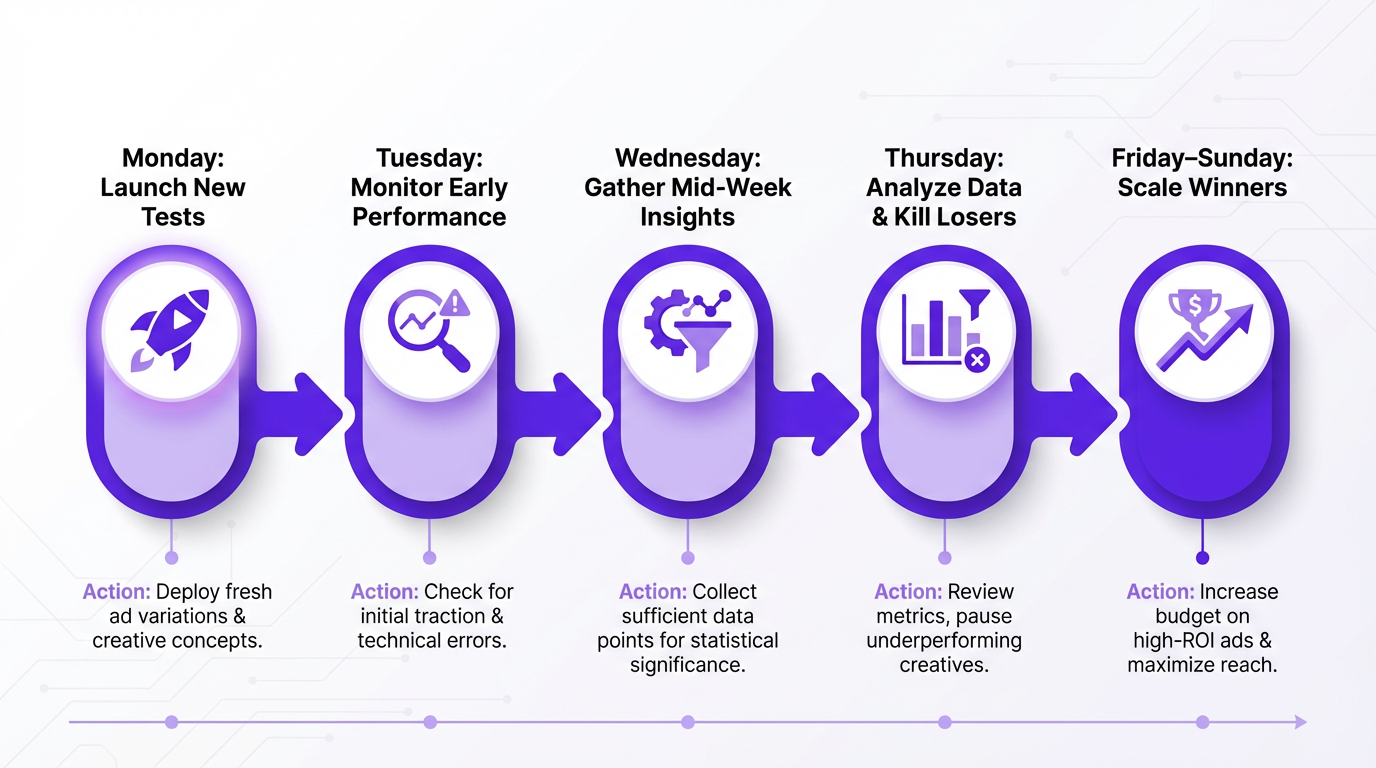
Statistical significance matters. Don't declare a winner after just 1,000 impressions. A proven framework is the 3:2:2 method, where you test 3 creatives, 2 primary texts, and 2 headlines in a dynamic ad set to quickly surface winning combinations. A practical weekly cadence: launch new tests on Monday, analyze early data by Thursday to kill clear losers, and prepare to scale the winners over the weekend.
Advanced Moves: The Edge Cases and Nuances That Separate Good From Great
Once you've mastered the fundamentals of ad creative production and testing, a few advanced concepts can provide a significant competitive edge. These are the tactics that experienced media buyers and creative strategists use to squeeze more performance from the same budget.
Three advanced tactics for experienced advertisers:
- DCO vs. Manual Testing: Dynamic Creative Optimization (DCO) automates testing across many ad combinations, making it ideal for broad discovery. Manual testing, on the other hand, offers precise control for refining proven concepts or for complex B2B products where exact messaging matters. Many top teams run a hybrid approach: DCO for initial discovery and manual tests for scaling confirmed winners.
- Creative Fatigue Signals: Every winning ad eventually loses its impact. Key warning signs include a declining click-through rate (CTR), rising cost per click (CPC), and an increasing frequency metric. When you spot this pattern, it's time to refresh your ad creatives before your return on ad spend (ROAS) erodes.
- Using Organic Data for Paid Hypotheses: Your organic content analytics are a powerful (and underused) source for paid ad ideas. Instead of spending your ad budget to discover what resonates, analyze your organic content to identify which topics, formats, and messages drive the most engagement. Platforms like Vizup are designed to connect these insights, helping you turn organic wins into paid campaign hypotheses with a data-driven foundation.
Frequently Asked Questions About Ad Creatives
How much should I spend on ad creative production vs. media budget?
A common rule of thumb is to allocate 10 to 20% of your total media budget toward creative testing and production. This ensures a steady stream of new assets to combat fatigue and unlock new winning ads without starving your distribution spend.
How often should I refresh my ad creatives?
For campaigns at scale, aim to introduce new creative concepts weekly or bi-weekly. Monitor fatigue signals (rising frequency, falling CTR) to know when a specific ad needs to be retired or refreshed.
Do I need a designer to create high-converting ads?
Not necessarily. In 2026, authenticity often outperforms high production value. UGC-style ads shot on a phone can be extremely effective, and many powerful AI marketing tools can help non-designers create professional-looking assets quickly.
What's the ideal video length for ad creatives in 2026?
It depends on the platform and placement. For TikTok and Instagram Reels, videos under 15 seconds typically perform best. For YouTube pre-roll or the Facebook Feed, you can test longer videos (30 to 90 seconds) if the story is engaging enough to hold attention past the first few seconds.
How many ad creative variations should I test at once?
To start, test 3 to 5 distinct creative concepts within a single ad set. Using Facebook's Dynamic Creative feature, you can provide multiple assets (such as 3 videos, 2 headlines, and 2 primary texts) and let the algorithm find the best combinations for you.
What is the best way to find winning ad creative concepts?
Begin with your organic content performance data. Identify which posts, topics, and formats generate the highest engagement, then translate those insights into paid creative hypotheses. This approach, which platforms like Vizup are built to support, gives you a data-backed starting point instead of relying on intuition alone.
Are static image ads or video ads more effective?
Static image ads work well for simple, benefit-driven messages and retargeting. Video ads tend to outperform for cold audiences and storytelling. The best approach is to test both formats within your specific audience and measure which delivers a lower cost per acquisition.
Opinionated Take: Stop Gambling, Start Learning
Here's a hard truth: most "creative testing" is just organized gambling. Teams throw dozens of variations into an ad set, burn thousands of dollars, and declare a "winner" based on noisy, short-term data, without ever understanding why it won. The real goal isn't to find a winning ad. It's to build a winning system for your ad creatives.
A few years ago, while managing a multi-million dollar budget for a SaaS client, we hit a wall. CPA was climbing steadily, and creative fatigue was setting in. Instead of just producing more ads, we paused and analyzed the top 10 and bottom 10 creatives from the past six months. The pattern was undeniable: every winning ad featured a clear shot of the user's end result (a finished report), while every losing ad focused on the software's interface. That single insight was more valuable than a hundred A/B tests. It gave us a creative doctrine that guided all future production. The next batch of ads, built around this "end-result" principle, cut CPA by 40% in three weeks.
The takeaway: treat your ad account like a research lab. Every campaign is a chance to learn something about your customer. Don't just test ads. Test hypotheses about your ad creatives.
Core principles to carry into every ad creative you build:
- Strategy first, design second. Ground every ad creative in audience insight and a clear message angle before opening a design tool.
- Clarity beats cleverness. Use specific, benefit-driven language in your copy. Vague claims get scrolled past.
- The hook is everything. You have 1.5 seconds to stop the scroll. Obsess over the first frame of video and the first line of copy.
- Test one variable at a time to generate clean, actionable learnings that compound over every campaign cycle.
- Let organic data lead. Your best-performing organic content is a free roadmap to paid creative concepts that resonate. Vizup's platform is built to surface these insights automatically.
Your next move: audit your top three performing ad creatives against the 5-part structure outlined in this guide. Identify the weakest element in each and make that your first testing hypothesis. Tools like Vizup bridge the gap between your organic content insights and your paid ad creative strategy, giving you a data-driven edge from the very first campaign. Its AI-powered platform helps you monitor performance, identify content gaps, and turn audience behavior into winning ad concepts.
