
For years, SEO has run on a quiet assumption: Google can rewrite the rules whenever it likes, and everyone else either adapts or watches traffic disappear. In the UK, that assumption just took a hit. On June 17, 2026, the Competition and Markets Authority (CMA) imposed a legally binding fair ranking conduct requirement on Google, shifting rankings from an internal product decision into something regulators can police. The CMA Google fair ranking requirement is the biggest structural limit ever placed on how organic search can be run.
This is not a friendly set of suggestions. It is a binding obligation under the Digital Markets, Competition and Consumers Act 2024, and Google has to comply or deal with enforcement. If you market to the UK, publish there, or manage SEO for UK-based clients, you need clarity on what changed, what is still undefined, and what to get in motion now.
What the CMA Actually Requires (and What It Doesn't)
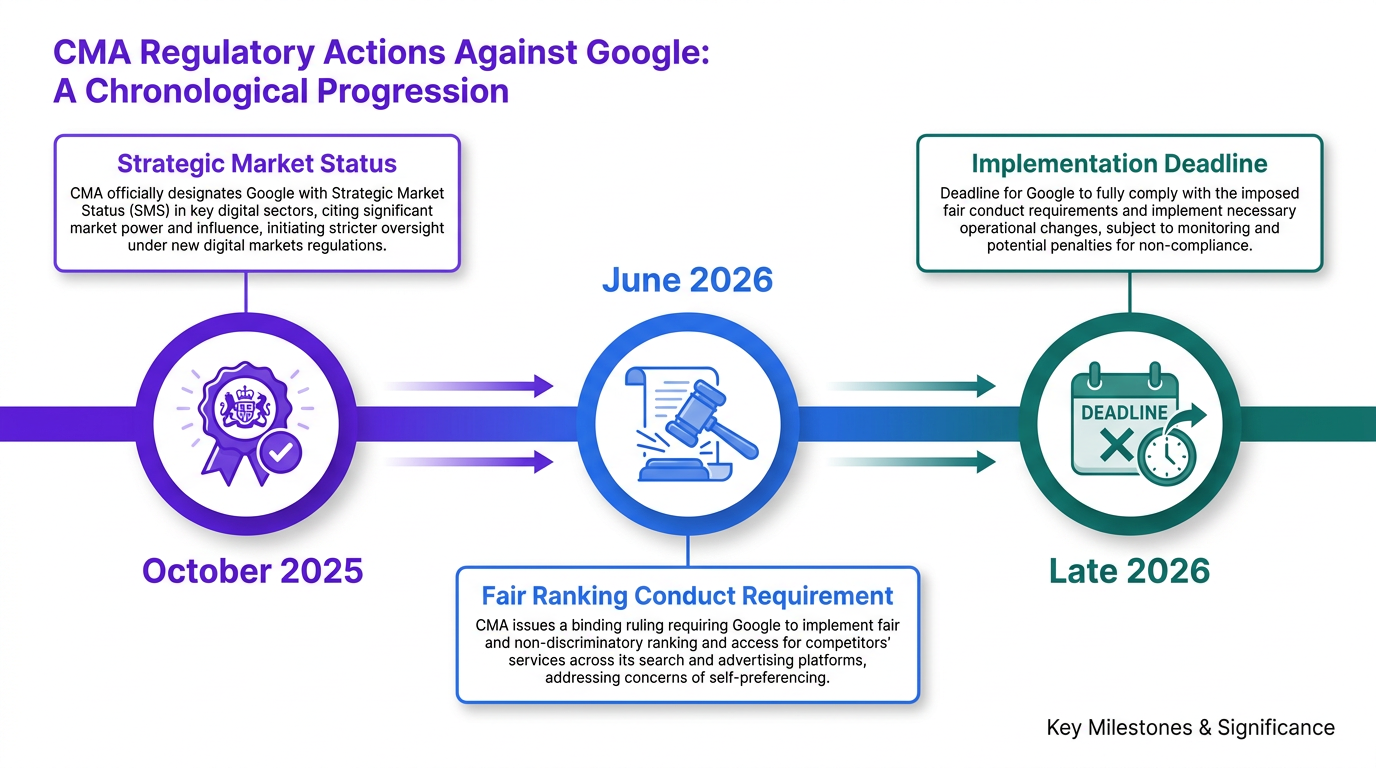
The fair ranking move is built on a step the CMA took earlier: in October 2025, it designated Google with strategic market status for general search and search advertising. With Google sitting on more than 90% of UK search volume, the CMA had the legal footing to intervene under the Digital Markets, Competition and Consumers Act 2024. The designation set the stage; the conduct requirements are where it starts to bite.
The Google fair ranking conduct requirement boils down to four concrete duties. Google has to rank organic results (including AI Overviews) using objective, non-discriminatory criteria. It has to offer more Google ranking transparency about how those systems operate. It has to give advance notice before significant ranking changes go live. And it has to stand up a formal process for businesses to raise concerns about how they are treated in rankings. Sponsored results are explicitly out of scope. Separately, the CMA also made Google's UK Data Portability API a legal obligation rather than a voluntary program.
Info: Google has six months from June 17, 2026 to implement the fair ranking requirement and three months for the data portability requirement (GOV.UK, 2026). The deadline is clear; the exact plumbing is not.
Just as useful is what the CMA did not do. It did not prescribe ranking factors. It did not order Google to publish the full algorithm. It did not touch paid ads. And it did not promise any business a better position. This is structural and procedural regulation, not a set of SEO tips handed down by government. Google still decides how pages are ordered; it just cannot do it in ways that are discriminatory or needlessly opaque.
Why This Matters More Than Any Core Update
Google ships recent Google core updates and Google's spam updates several times a year, and each one can reshuffle the deck overnight. Businesses told the CMA these changes often land without warning, without a usable explanation, and without any path to challenge the outcome (GOV.UK, 2026). None of that is news to anyone who has lived through an update cycle. The difference now is that a regulator with enforcement power has decided that pattern is a market problem, not just a product choice.
For day-to-day SEO work, the advance notice obligation is the part that changes the operating model. If Google has to warn businesses before significant changes take effect, teams are no longer stuck in the familiar loop of diagnosing a traffic drop after the damage is done. With real notice, you can plan releases, adjust monitoring, and brief stakeholders before the graph falls off a cliff. That is a fundamental shift in how search risk gets managed.
The scope also matters: AI Overviews are explicitly included. As Google pushes AI-generated answers that can siphon clicks from traditional listings, the CMA has made visibility in Google's AI search subject to the same fairness expectations as classic organic results. That matters because AI Overviews are moving from an experiment to the default interface for plenty of queries. By pulling them into the UK Digital Markets Act Google framework, the CMA is signaling that "search" now includes the AI layer on top.
The Counterargument: Could This Backfire?
The most credible pushback is simple: regulation could slow search down. If Google has to justify changes as objective and non-discriminatory and also provide advance notice, the fear is that iteration gets bogged down in compliance. Spam response, in particular, thrives on speed; long lead times can make enforcement easier to evade. Even new ranking signals tied to how AI is changing SEO could arrive later because they have to clear process hurdles first.
That concern deserves airtime, but it does not outweigh the status quo. Google's habit of unilateral, poorly explained change has not produced a healthy ecosystem; it has produced an industry that spends billions trying to interpret a black box. The CMA is not telling Google to stop improving search. It is telling Google that, with 90%+ market share, it cannot treat dependent businesses as acceptable collateral. "Objective criteria" does not mean "no innovation." It means Google should be able to articulate why a change serves users, rather than quietly optimizing for its own commercial priorities.
Open Questions That Will Define the Real Impact
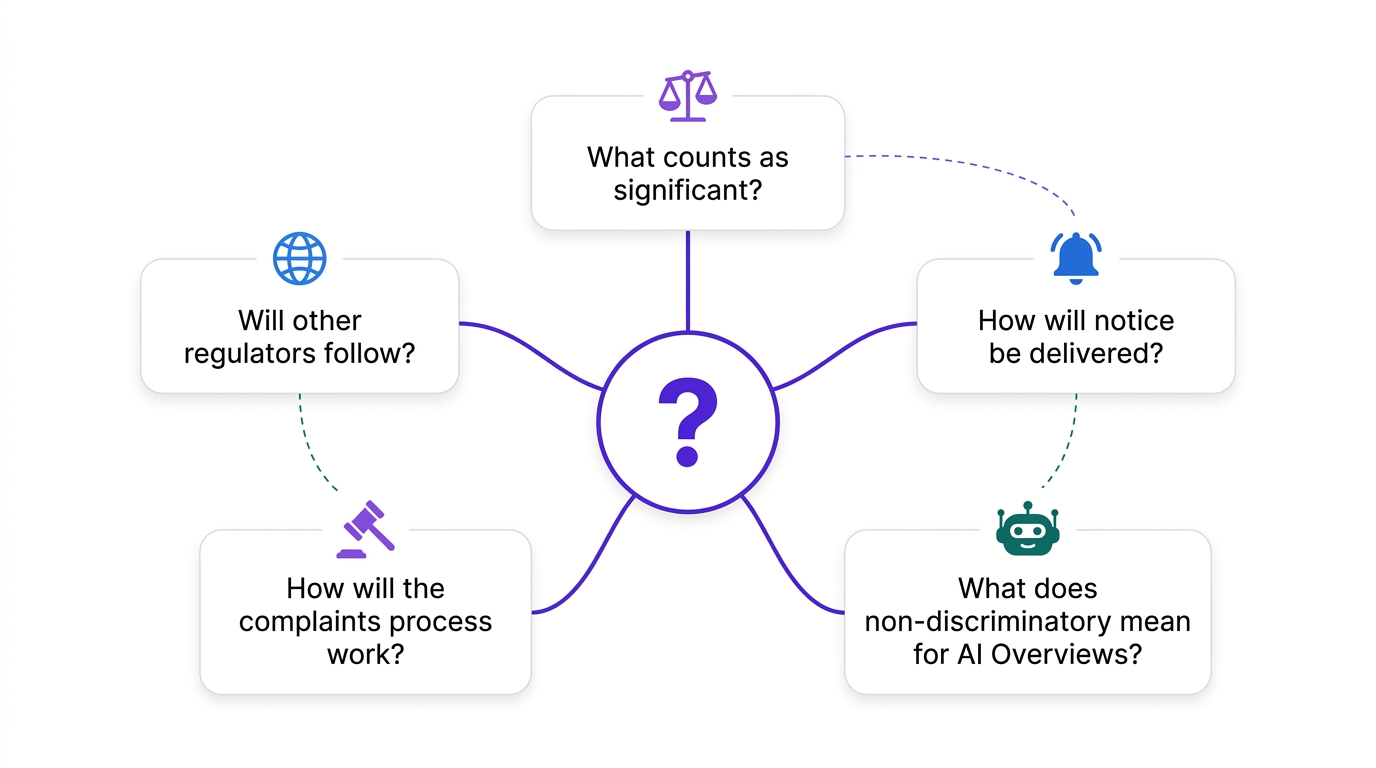
The obligation is binding; the implementation details are still mostly out of view. A handful of unresolved decisions will determine whether this changes how SEO teams operate or just adds paperwork around the edges.
- What qualifies as a "significant" ranking change? Nobody wants advance notice for every micro-adjustment. Where the CMA and Google draw the line will decide whether notices are actionable or just noise.
- What form will the notice mechanism take? A blog post is not the same as a Search Console alert, and neither is the same as direct outreach to affected sites. The delivery channel will shape who actually benefits.
- How will "objective, non-discriminatory" be interpreted for AI Overviews? AI-generated answers pull from multiple sources and compress them into one interface. Defining fairness there is genuinely new territory.
- What teeth does the complaints process have? A form to submit concerns is easy; remedies on a useful timeline are harder. The value of the process will hinge on escalation and resolution speed.
- Will the EU and other jurisdictions follow? The UK moved first, but the European Commission and other regulators are paying attention. If ranking rules fragment by country, compliance becomes its own discipline.
What Your Team Should Do Now
The big obligations land later in 2026, but teams that wait for the enforcement date will be playing catch-up. Regulatory shifts tend to reward the marketers who show up with clean baselines and a process, not the ones who scramble after the rules are already in force. If I were prioritizing an SEO roadmap with UK exposure, I would start here.
Document your current ranking positions and traffic patterns obsessively. When Google starts issuing advance notice, you will need a baseline to prove what changed and when. If you end up using the complaints process, historical performance becomes evidence, not trivia. Tools that track organic visibility across search, AI answer engines, and local discovery (like Vizup's organic monitoring workflow) help preserve the audit trail that this kind of regulation quietly demands.
Watch for the notice mechanism. As soon as Google explains how it will deliver advance notice of significant ranking changes, plug that channel into your operating rhythm. Do not rely on secondhand chatter after rankings move. Subscribe to the CMA's case page for Google search and keep an eye on Google's own announcements so you see the signal when it arrives.
Tip: If your organic strategy spans Search, AI Answer Engines, Social, and Local Discovery, a single monitoring layer across all channels is no longer optional. Vizup combines AI agents, human experts, and live SEO, pSEO, AEO, and GEO tools to give brands that unified view, with paid amplification available only as an add-on.
Prepare to use the complaints process. The CMA has created a formal route for businesses to challenge how Google treats them in rankings. Start by defining the patterns that have historically hurt you, then gather specifics. Keep examples where Google's own properties appeared to get preferential placement, or where a drop lined up with changes that came with no public explanation. If you file a complaint later, this is the record you will be leaning on.
The Bigger Picture: Organic Search Is Now a Regulated Market
The CMA Google fair ranking requirement is not a one-off headline. It is the endpoint of years of pressure from businesses, publishers, and regulators watching one company consolidate control over how information gets found online. Google's strategic market status designation created the legal pathway. The conduct requirement is the moment that pathway turns into day-to-day reality.
For SEO leaders, agency owners, and publishers, the takeaway is practical: organic visibility is no longer only a technical fight. In the UK, it is also a regulated one. The skill set that matters now stretches beyond keyword research and on-page work into regulatory literacy, evidence-grade documentation, and the ability to operate across every discovery surface, not just the ten blue links. Teams that treat this purely as compliance will move slower and learn less. Teams that build monitoring, keep clean records, and diversify across organic channels will be better positioned for whatever Google and regulators do next.
The CMA has put a boundary around Google's discretion. Ranking changes now carry legal consequences. Plan like they do.
Frequently Asked Questions
What is the CMA Google fair ranking conduct requirement?
It is a legally binding obligation from the UK's Competition and Markets Authority, imposed on June 17, 2026. It requires Google to rank organic results (including AI Overviews) using objective, non-discriminatory criteria, increase ranking transparency, provide advance notice of significant changes, and run a complaints process for businesses.
Does the fair ranking requirement apply to Google Ads?
No. Sponsored results are explicitly excluded. The requirement applies to organic search results and AI Overviews only.
When do Google's obligations take effect?
Google has six months from June 17, 2026 to implement the fair ranking requirement and three months for the separate data portability requirement (Search Engine Journal, 2026). The main obligations are expected to be fully in force by late 2026.
How does Google's strategic market status relate to this?
In October 2025, the CMA designated Google with strategic market status for general search and search advertising under the Digital Markets, Competition and Consumers Act 2024. That designation is what gave the CMA the authority to impose binding conduct requirements, including the fair ranking obligation.
What should UK businesses do right now to prepare?
Lock in baselines for organic rankings and traffic across your discovery channels, then keep them updated. Track the CMA's case page for Google search and Google's communications for details on the advance notice mechanism. Start cataloguing past ranking issues that could support a formal complaint. An organic-first platform like Vizup can help maintain continuous monitoring across Search, AI Answer Engines, and Local Discovery.
