
AI audience targeting uses machine learning to analyze behavioral, demographic, and contextual data to identify which audience segments are most likely to engage with your content. Instead of relying on paid distribution, it surfaces that content through organic channels like search, social, and email. It’s an approach that turns marketing into a compounding asset, yet it remains largely underused by the organic marketers who stand to benefit most.
Most discussions on this topic fixate on paid media: how Meta's algorithm finds buyers, how Google adjusts bids in real time, or how smart ads optimize creative at scale. The organic side is where the strategy becomes a durable asset. When you earn attention instead of buying it, you own the resulting audience relationship. This article explains how the mechanics work, where the approach breaks down, and when it is worth pursuing for your organic growth strategy.
Why AI Audience Targeting Matters More for Organic Than for Ads
In paid media, platforms like Meta and Google handle most of the targeting work. You set a budget, define a broad objective, and rent their algorithms. Organic marketing offers no such shortcut. You decide what to publish, where to publish it, and for whom. This is precisely where AI audience targeting shifts from a simple platform feature to a genuine strategic advantage.
Organic reach has declined across every major platform. The brands still growing are those matching content to micro-segments with precision, doing it faster than manual analysis allows. The ROI case is straightforward: organic traffic compounds over time. Getting targeting right early produces an outsized long-term payoff compared to paid campaigns that stop the moment the budget runs out. For growth marketers managing finite resources, that compounding effect is the strongest argument for investing in AI-driven organic segmentation now.
How AI Audience Targeting Actually Works
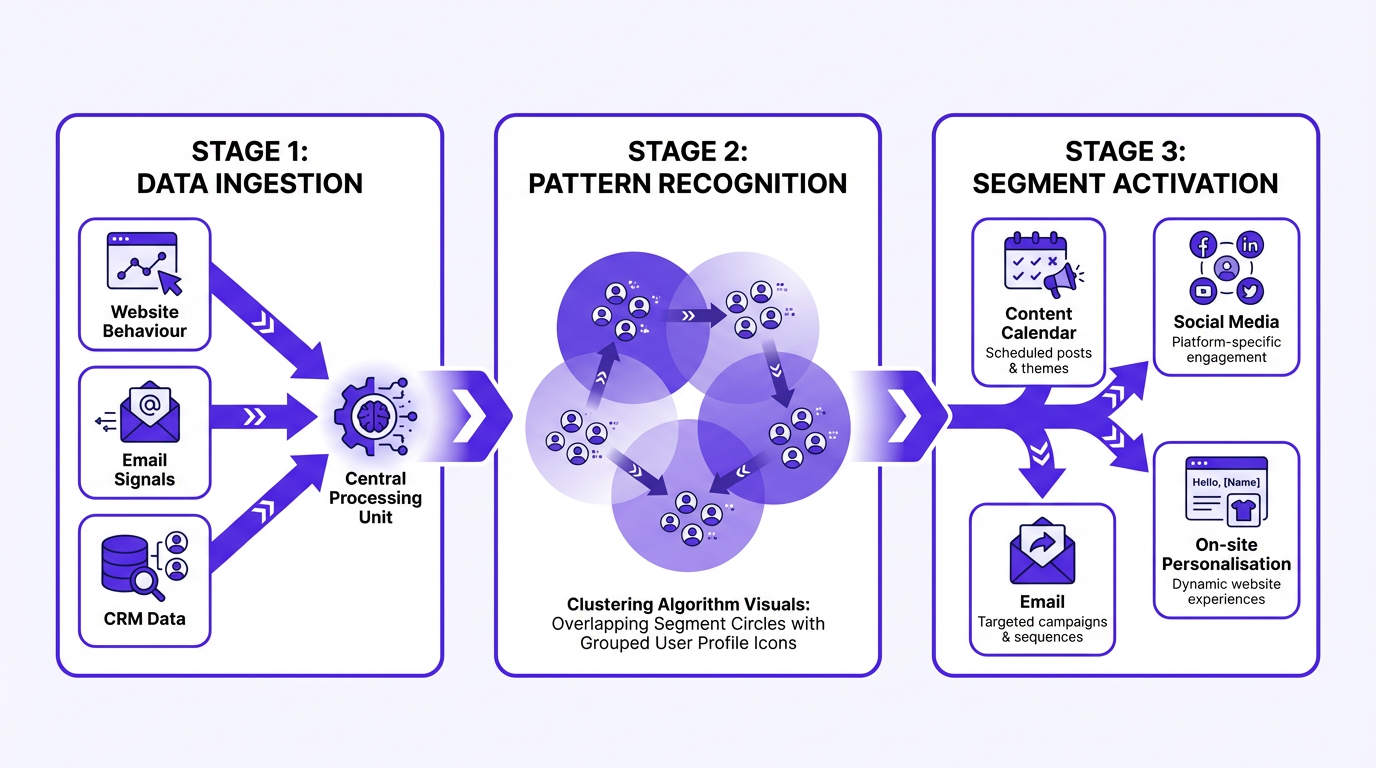
The process involves three phases: data ingestion, pattern recognition, and segment activation. Many explanations stop at “the AI learns from your data.” Here is what that means at each stage and why each phase is critical for organic performance.
Data Collection: What the Models Actually Consume
Organic AI targeting models ingest first-party behavioral data, such as on-site click patterns, scroll depth, content consumption sequences, email open and click behavior, and search query data from tools like Google Search Console. CRM data adds purchase history and lifecycle stage, while social engagement signals (shares, saves, and comment sentiment) complete the picture.
A high-signal input many teams underuse is zero-party data: information customers intentionally share through surveys, preference centers, or quizzes. Unlike behavioral data, which is inferred from actions, zero-party data is explicitly given by the customer. AI models that combine this explicit data with behavioral signals tend to produce sharper, more accurate segments. This distinction is more critical for organic marketing than for paid channels, where auction dynamics often play a larger role. If you are not collecting zero-party data today, a simple preference center or post-signup survey is an effective way to start. The improvement in segment quality often outweighs the implementation effort.
Audience Segmentation AI: From Clusters to Content Decisions
Machine learning models use clustering algorithms (like k-means and DBSCAN) to group users by behavioral similarity. For organic marketing, this means grouping by content affinity and intent stage rather than just purchase likelihood. Predictive targeting then scores each segment's probability of engaging with a specific content type, topic, or format, and recommends what to create or redistribute.
The key distinction from traditional segmentation is its temporal direction. Traditional segmentation is retrospective, telling you who engaged last quarter. AI-powered audience segmentation is prospective, predicting who will engage next week and with what. That shift from reporting to prediction is where most of the value lies for CMOs trying to allocate content resources efficiently.
Activation: Turning Segments Into Organic Reach
Segments become actionable through four organic levers:
- Content calendar prioritization: Determine what to publish next and for which segment based on predicted engagement.
- Email optimization: Adjust send time, subject lines, and content blocks by segment behavior to maximize opens and clicks.
- Social distribution: Match post format, messaging angle, and timing to each audience segment's patterns.
- On-site personalization: Serve different content modules, CTAs, and recommendations to different visitor profiles.
This process uses the same behavioral signals as paid media logic but with a different delivery mechanism that requires no ad spend. The key is connecting your segmentation output directly to your content operations workflow so insights translate into published assets, not just dashboards.
Traditional Targeting vs. AI Audience Targeting: A Side-by-Side
The gap between manual segmentation and AI-powered targeting is not just about speed. It is a structural difference in what each approach can know and when it can know it. The table below makes the contrast concrete across six dimensions relevant to organic marketers.
| Dimension | Traditional Manual Segmentation | AI Audience Targeting |
|---|---|---|
| Data Sources | CRM fields, survey responses, basic demographics | First-party behavioral data, zero-party signals, search intent, engagement patterns |
| Update Frequency | Quarterly or campaign-by-campaign | Continuous, updates as new behavioral data arrives |
| Segment Granularity | Broad personas (3-5 segments) | Dynamic micro-segments (dozens, auto-generated) |
| Scalability | Manual effort increases linearly with segments | Scales without proportional human effort |
| Personalization Depth | Same content variant per segment | Content format, topic, and timing tailored per segment |
| Primary Channel Fit | Paid media (static audience lists) | Organic channels (content, email, social, on-site) |
| AI targeting enables organic marketers to operate with the precision previously reserved for paid media teams. |
The bottom line is that manual segmentation tells you who your audience was. AI-driven segmentation tells you what your audience needs next and which organic channel to deliver it through.
Real-World Examples of Behavioral Targeting AI in Organic Channels
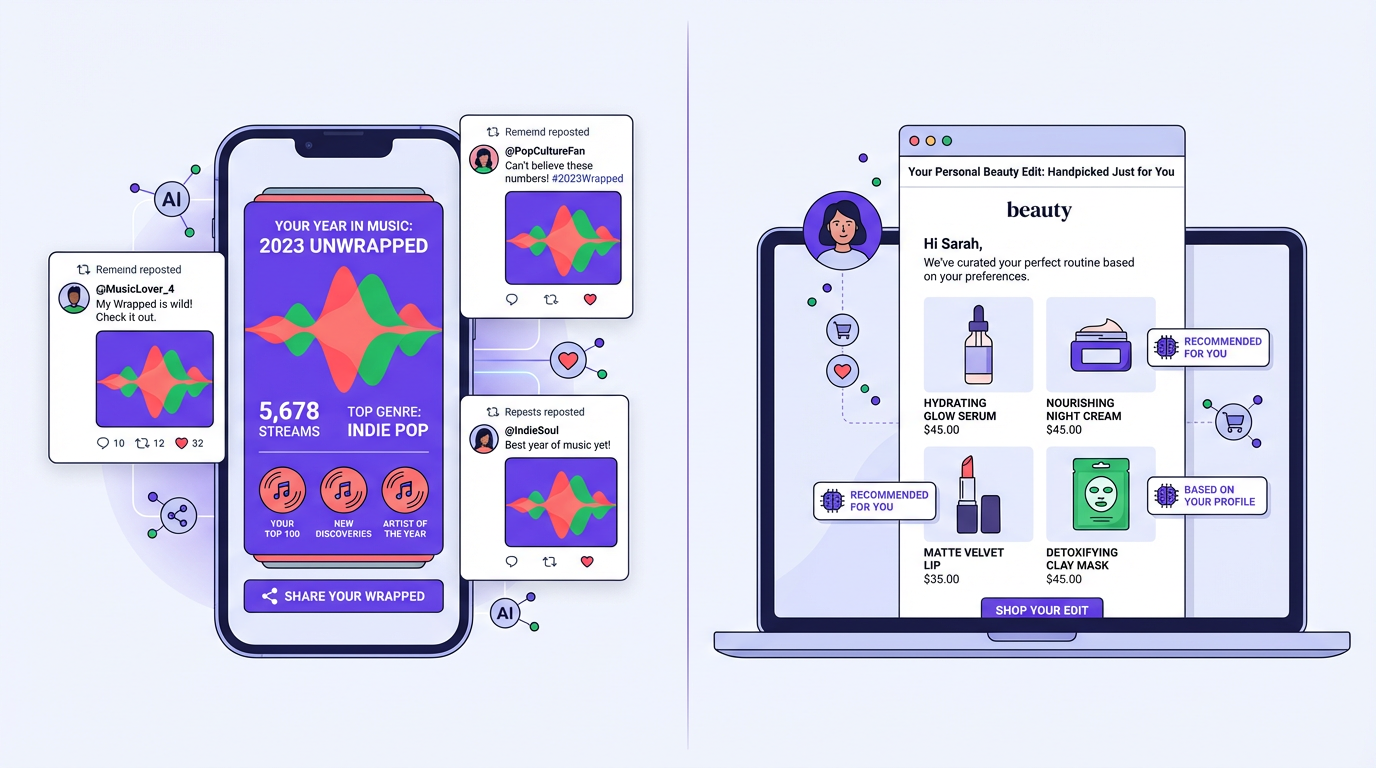
Spotify Wrapped is the most-cited example for good reason. It uses behavioral targeting AI on listening data to generate hyper-personalized organic content that users voluntarily share. The 2025 campaign was a viral marketing success, engaging over 200 million users in its first 24 hours. The targeting intelligence was built into the product, not the ad buy. For marketers, the lesson is clear: when personalization is valuable enough, your audience becomes your distribution channel.
Some marketing platforms use smart content modules to serve different blog CTAs and recommendations based on AI-scored visitor segments, which can lift email signups from organic traffic. For instance, Vizup's Content Engine feature helps achieve this by matching content to visitor behavior in real time. Sephora's Beauty Insider program applies machine learning to segment its millions of members by purchase behavior and browsing patterns. It then delivers personalized organic email content that generates higher engagement and revenue compared to mass sends, a strategy widely recognized for its effectiveness. Two very different businesses, same underlying principle: behavioral data, fed into ML models, produces organic content that reaches the right person at the right moment.
What AI Audience Targeting Is NOT
Three common misconceptions are worth clearing up before you build a strategy around this approach:
- It does not replace knowing your audience. AI optimizes targeting; it does not define your market positioning or brand voice. Teams that skip foundational audience research and jump straight to AI tools build precise campaigns aimed at the wrong people.
- It is not the same as AI ad optimization. Ad optimization adjusts bids, placements, and creative in real time within paid platforms. AI audience targeting for organic is upstream: it shapes what you create and who you create it for, before distribution decisions happen.
- It is not surveillance when done right. First-party and zero-party data, used transparently, is fundamentally different from third-party cookie tracking. After Google reversed its plan to deprecate third-party cookies in July 2024, the reliance on first-party data became even more critical for sustainable growth.
Getting these distinctions right early prevents misaligned expectations and wasted investment. AI audience targeting amplifies good strategy; it does not substitute for it.
When to Skip AI Audience Targeting (Seriously)
If you have fewer than 5,000 monthly visitors, AI models will not have enough signal to outperform basic manual segmentation. The algorithms need data volume to find meaningful patterns. Build the data asset first with clear personas, consistent content themes, and basic engagement tracking. Trying to run predictive models on thin data leads to overfitting and unreliable segments that can do more harm than good.
If your content production capacity is only one or two posts per month, the bottleneck is not targeting, it is volume. Knowing that a specific micro-segment wants long-form video is only useful if you can produce it. For teams at this stage, the organic marketing fundamentals guide is a better starting point than any targeting tool. Invest in building a consistent publishing cadence and first-party data collection infrastructure. Once both are in place, AI-driven segmentation becomes a force multiplier, not a distraction.
How Vizup Approaches AI Audience Targeting for Organic Growth
Most AI advertising tools are built for paid media workflows, assuming a budget, a campaign structure, and a conversion pixel. Vizup is built for the organic marketer who needs the same targeting intelligence without the ad budget dependency. Our platform applies predictive targeting and audience segmentation AI specifically to organic channels (content, social, and email) rather than treating organic as an afterthought to a paid strategy.
The core differentiator is that Vizup's models are trained on organic engagement signals, not auction data. The segments it surfaces are built for content decisions, not bid adjustments. For growth marketers and CMOs who want to enhance their digital presence with AI marketing tools, this is a meaningfully different starting point. Instead of reverse-engineering paid media logic for organic use, Vizup starts with organic behavior and builds outward.
Key Takeaways
- AI audience targeting uses machine learning to identify which segments are most likely to engage with your content, activating insights across organic channels without paid spend.
- In paid media, platforms do the targeting for you. In organic, AI-driven targeting is the only way to achieve comparable precision at scale.
- The three-phase process includes data ingestion (behavioral, zero-party, CRM), pattern recognition via clustering algorithms, and segment activation across content, email, and social channels.
- Predictive targeting is prospective, not retrospective. It tells you who will engage next week and with what, not just who engaged last quarter.
- Skip AI targeting if you have fewer than 5,000 monthly visitors or cannot act on recommendations. The data asset must exist before the models can work.
- The biggest misconception is that AI targeting replaces audience understanding. In reality, it amplifies it. Strong foundational research remains essential.
Frequently Asked Questions About AI Audience Targeting
How is AI audience targeting different from traditional demographic targeting?
Traditional demographic targeting groups people by static attributes like age, location, or job title. AI audience targeting groups people by dynamic behavioral patterns and intent signals. For example, a 45-year-old CMO and a 28-year-old growth analyst might fall into the same AI-generated segment because they consume the same content at the same intent stage, despite different demographics.
Can you use AI audience targeting without a large budget for ads?
Yes, which is the core premise of applying it to organic marketing. AI audience targeting for organic channels relies on first-party behavioral data you already collect (site analytics, email engagement, CRM records). The investment is in tooling and data infrastructure, not ad spend. Platforms like Vizup are built specifically for this use case.
What data do you need to get started with audience segmentation AI?
At a minimum, you need website behavioral data (page views, scroll depth), email engagement metrics (opens, clicks), and basic CRM data (lifecycle stage). Zero-party data from surveys or preference centers adds significant signal quality. You do not need a massive data warehouse to start, but consistent first-party data collection must be in place.
Does predictive targeting work for small businesses with limited traffic?
Predictive targeting requires enough behavioral data to find statistically meaningful patterns. Below roughly 5,000 monthly visitors, models tend to produce unreliable segments. Small businesses are better served by manual segmentation and strong content fundamentals until they build sufficient data volume. Once you cross that threshold, the models improve quickly.
How does machine learning improve audience targeting over time?
Machine learning models update segment definitions as new behavioral data arrives. Early on, segments may be broad due to limited signal. As engagement data accumulates, the model identifies finer-grained patterns, like which content formats resonate at which intent stages. This creates a compounding advantage over paid campaigns, which reset with each budget cycle.
What are the first steps to implement AI audience targeting for organic marketing?
Start by auditing your existing first-party data sources: website analytics, email engagement metrics, and CRM records. Ensure tracking is consistent and captures behavioral signals. Implement zero-party data collection through preference centers or surveys. Once you have a few months of behavioral data and at least 5,000 monthly visitors, evaluate platforms like Vizup that can ingest this data and produce actionable segments.
Ready to apply AI audience targeting to your organic strategy? Start with Vizup.
