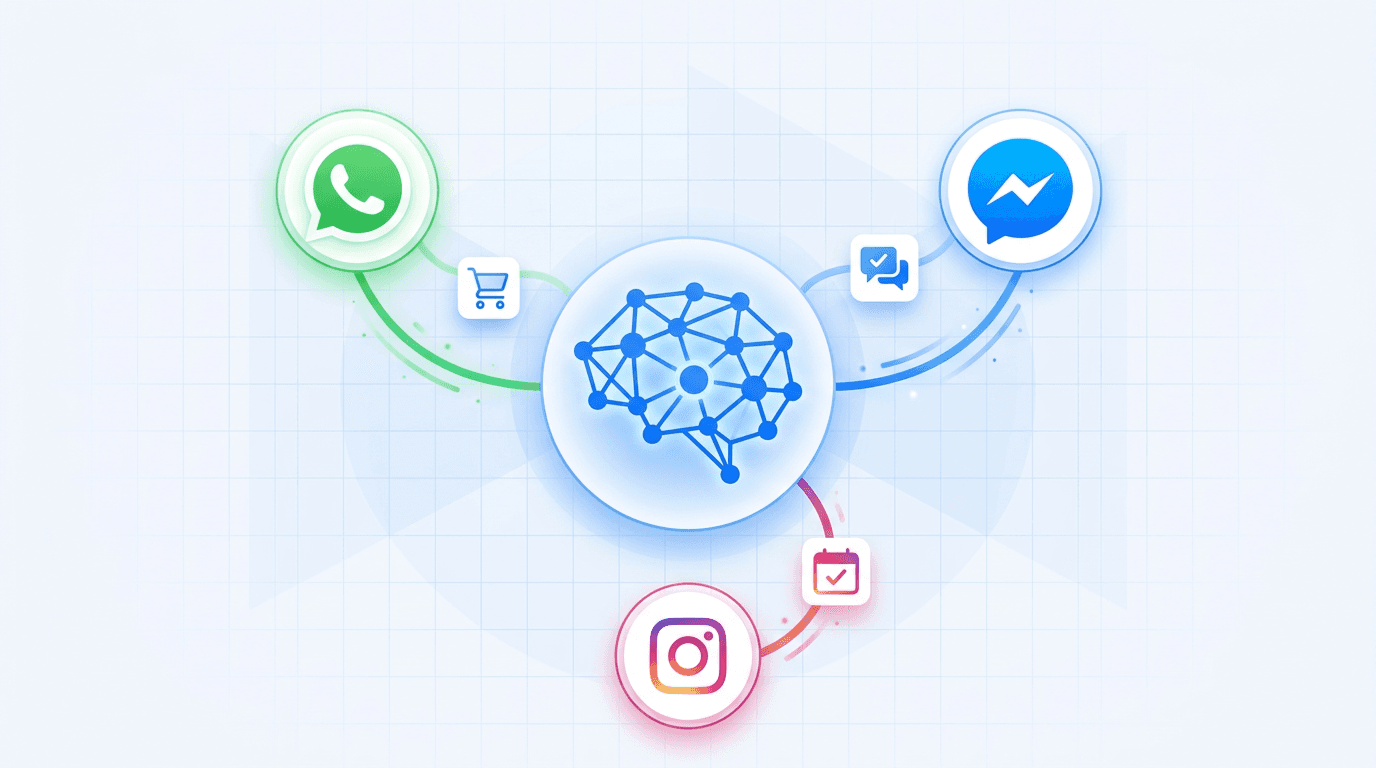
Meta Business Agent is an AI tool inside Meta's ecosystem that automates customer conversations, sales workflows, and support tasks across WhatsApp, Messenger, and Instagram. Announced on June 3, 2026, at Meta's Conversations conference in London, it signals a move from basic messaging automation to AI-driven commerce and service operations.
Businesses have spent years using Meta's messaging apps as a kind of informal front desk: answering questions, sending links, and closing deals one DM at a time. Meta Business Agent is meant to change the math. Instead of a person babysitting every inbox or a brittle bot stuck to a script, Meta's AI business agent trains on a company's own data (catalogs, FAQs, past conversations) and can run multi-step interactions on its own. Ahead of the global launch, more than one million businesses are already using a Meta Business Agent on WhatsApp and Messenger. Now the real question is what that ambition looks like in day-to-day operations for teams already juggling customer engagement across three apps.
What Is Meta Business Agent, Really?
Calling it a "chatbot" misses the point. Meta Business Agent is positioned as a persistent, generative system living inside Meta Business Suite, with one brain that can work across WhatsApp, Messenger, and Instagram rather than three separate setups. It pulls in a business's product catalog, site content, and historical chat transcripts to form a usable knowledge base, then answers customers in natural language using that internal context.
In practice, that means an Instagram DM about sizing gets a specific, brand-accurate answer drawn from the company's own product data, not a generic canned reply. If the customer wants to buy, the agent can move the conversation toward checkout. If the request gets messy, it can hand off to a human and include a clean summary so nobody has to start over. If you want the mental model, understanding what AI agents are helps explain why this sits in a different class than the rule-based bots most businesses have lived with for the last decade.
Meta is pitching this as a response to rising demand for AI customer support and conversational commerce. The business strategy is straightforward: keep discovery, qualification, purchase, and post-sale support inside Meta's apps, instead of letting users drift out to websites and third-party tools where Meta has less control (and less revenue).
How Meta's AI Agent Transforms Business Messaging
The pitch is not "it answers FAQs faster." Meta built the agent to cover three jobs that usually live in different tools and teams: sales, support, and proactive marketing.
Automated Sales and Lead Qualification
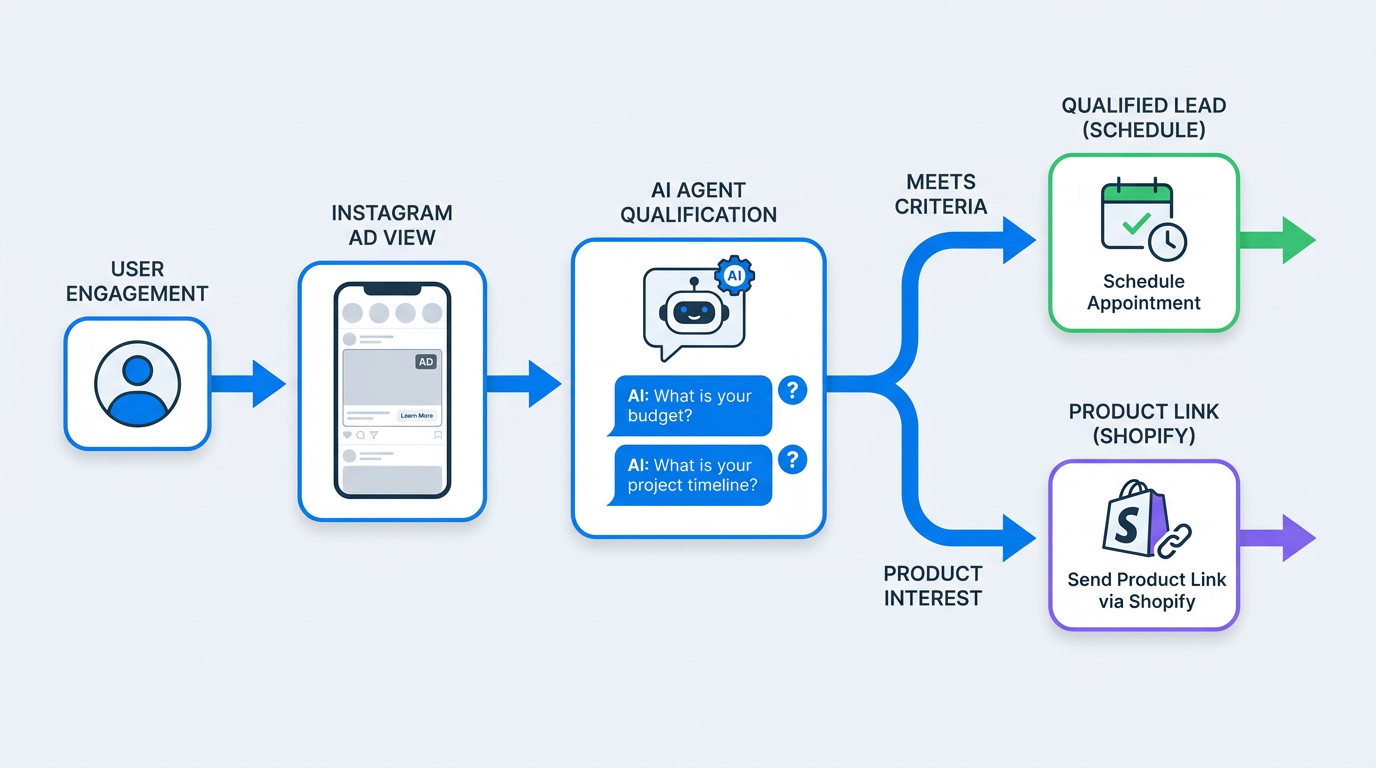
When someone comments on an Instagram ad or messages on WhatsApp, the agent can start the conversation, ask qualifying questions (budget, timeline, preferences), then route high-intent prospects to sales or straight to a product page. That lead qualification AI layer is meant to separate curiosity from intent, cutting down on manual triage. For e-commerce brands, the Instagram AI agent can recommend items directly from a catalog and guide a customer through purchase without leaving the DM thread. Tie it to Meta's lead nurturing tools, and you get a pipeline that runs from ad impression to qualified lead with far fewer human touches.
24/7 AI Customer Support and Escalation
On the support side, the Messenger AI agent and WhatsApp Business AI features can handle predictable requests such as order status, return policies, and product specs instantly, regardless of time zone. When the agent cannot confidently resolve an issue, it can escalate to a staff member and include a full conversation summary so the customer is not stuck repeating details. Meta also announced third-party business system integration capabilities through the Meta Business Agent Platform, allowing larger teams to connect customer conversations with ecommerce, CRM, and support workflows. Instead of pushing someone to a tracking page, the agent can surface order or support information directly inside the chat.
Proactive Marketing and Re-engagement
The agent is also built to follow up, not just respond. If a customer asked about a product in Messenger or WhatsApp and then disappeared, the agent can re-engage with a tailored promotion or an availability update. That shifts messaging automation from pure cost containment (deflecting tickets) to revenue recovery (bringing back abandoned intent). To measure whether those nudges actually pay off, you need clean attribution, which is where tracking conversions with the Meta Pixel and CAPI matters for ROI.
Meta Business Agent vs. Traditional Chatbots
This is not a minor upgrade over the chatbots businesses have been bolting onto inboxes for years; it is a different design. Traditional chatbots live on decision trees: if a customer says X, the bot replies with Y. Meta Business Agent generates responses from a learned understanding of the business, which lets it handle new, unanticipated questions instead of forcing every conversation through a menu.
| Capability | Traditional Chatbot | Meta Business Agent |
|---|---|---|
| Conversation Style | Scripted, rule-driven | Generative, natural-language replies |
| Learning Ability | Static unless manually updated | Uses connected business data and updated source material |
| Task Complexity | Basic Q&A and menu routing | Sales flows, booking, and order handling |
| Channel Coverage | Typically one platform at a time | One agent across WhatsApp, Messenger, Instagram |
| Primary Goal | Reduce support volume | Resolve issues and drive revenue |
| Escalation | Handoff with little context | Handoff with a summarized history |
| The shift from scripted responses to generative, multi-channel AI represents a new category of business tool. |
Who Is This For? SMBs vs. Enterprise
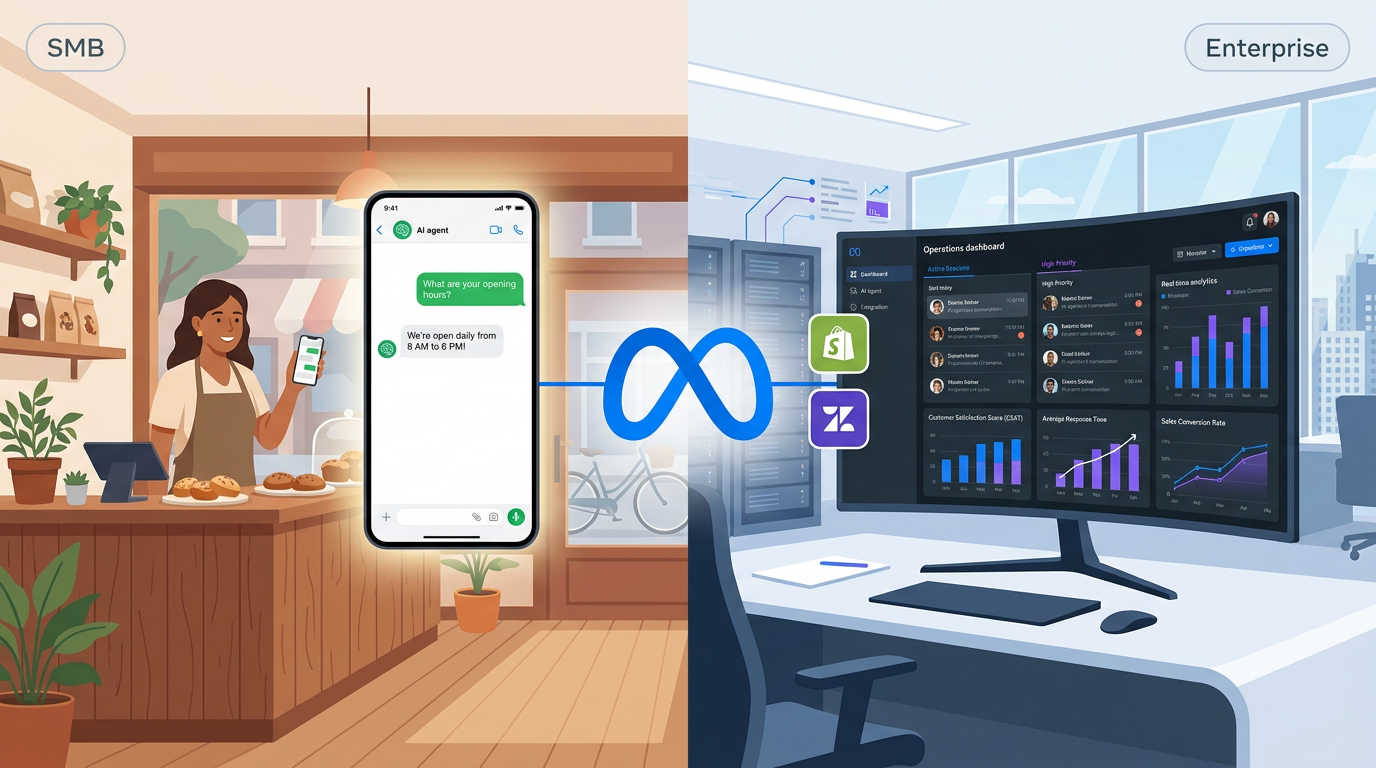
Meta is rolling this out in two tiers. The out-of-the-box version, configured in the WhatsApp Business app or Meta Business Suite, is aimed at AI for small businesses. A bakery owner can train the agent on their catalog and past chats in minutes, without writing code. Setup is free at launch, and Meta says paid subscription tiers are coming later.
For larger organizations, the Meta Business Agent Platform is the layer for custom enterprise AI agents. It supports integrations with third-party systems like Shopify, Zendesk, and Shopee, which opens the door to more complex workflows: returns processing, cross-warehouse inventory checks, or CRM sync. If a company is already investing in business automation on Meta's platforms, this slots in as a logical next step. The split is stark: small businesses get a ready-made assistant; enterprises get a platform they can wire into the rest of their operation.
The Risks and Limitations to Watch
A serious evaluation has to start with what can go wrong. First: hallucinations. If the agent confidently makes up a product claim or invents a return policy, the brand eats the reputational fallout. Meta says the agent tells customers when they are interacting with AI, but disclosure does not make incorrect answers harmless.
Warning: WhatsApp's Help Center confirms that customers are told when they are interacting with the Meta Business Agent, not a human. Businesses should still monitor conversations regularly, especially in the first weeks after setup.
Second: lock-in. If you build your customer communication layer entirely inside Meta's walled garden, you are tying a core business function to Meta's pricing, policy shifts, and platform reliability. If paid tiers get aggressive or API access changes, companies without alternative channels will have little negotiating power. Third: privacy and compliance. The agent learns from customer conversations and business data, which means regulated industries (healthcare, finance) need to pressure-test whether that data handling matches their requirements. Making your business AI-ready is as much about governance as it is about tooling.
Where Vizup Fits Into the Meta Business Agent Shift
Meta Business Agent may automate conversations inside Meta's apps, but businesses still need a system for visibility, content strategy, attribution, content creation, and organic growth across search, social, communities, and answer engines. That is where Vizup fits: helping teams monitor where demand is shifting, identify content opportunities, create and optimize content, publish faster, and measure whether AI-era visibility is turning into revenue.
In other words, Meta Business Agent can help manage customer interactions once people are already inside Meta's ecosystem. Vizup helps businesses understand how those opportunities emerge in the first place, what content to create around them, how to optimize that content for SEO, AEO, and GEO, and how to turn platform changes like this into measurable organic growth.
Key Takeaways for Your Business
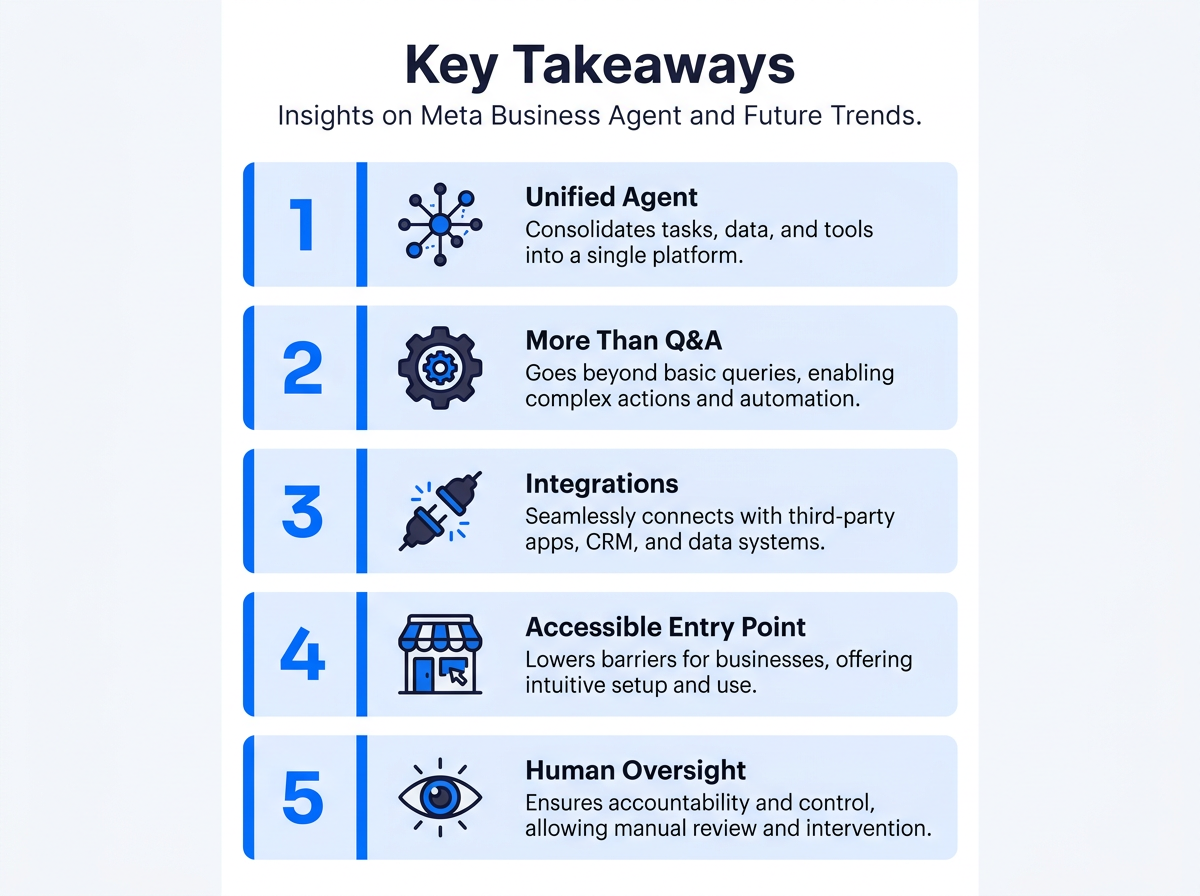
- Unified agent, not a single-channel bot. Meta Business Agent runs across Messenger, Instagram, and WhatsApp, managed from Meta Business Suite.
- More than Q&A. It can run sales flows, qualify leads, book appointments, and re-engage prospects, not just deflect support tickets.
- Integrations expand its value. Third-party business system integrations make it operational, not just conversational.
- Accessible entry point. Small businesses can launch without developers, and setup starts free.
- Human oversight is non-negotiable. Review conversations, audit responses, and keep a clear escalation path. Treat it as automation, not a replacement for your team.
Frequently Asked Questions
Is Meta Business Agent enough on its own?
Meta Business Agent can help automate conversations inside Meta's ecosystem, but it does not replace the need for organic visibility, content strategy, attribution, and cross-channel growth workflows. Businesses still need a platform like Vizup to understand where demand is emerging and turn that into publish-ready content and measurable organic growth.
Does Meta Business Agent cost money to use?
Setup is free at launch. Meta has said paid subscription tiers are planned, likely based on usage volume or advanced capabilities on the Meta Business Agent Platform. As the product matures, teams should plan for those costs to show up on the roadmap.
Can the Meta AI agent place orders for customers directly in chat?
Yes. The agent can suggest products from a business's catalog, guide customers through selection, and support checkout inside the chat thread. For Shopify merchants, the integration lets the agent use real-time product and inventory data to complete transactions.
How does the Meta Business Agent get its information about my business?
WhatsApp's Help Center says the agent learns from the sources you provide: your product catalog, website content, past chat transcripts, plus any FAQs or documents you upload during setup. It does not independently scrape external sources. Response quality will track closely with how accurate and complete your inputs are.
Do I need to be a developer to set up a Meta Business Agent?
No. The standard setup is built for non-technical teams inside the WhatsApp Business app or Meta Business Suite: choose data sources, review initial outputs, then turn it on. The Meta Business Agent Platform is the developer-oriented option for enterprises that need custom integrations with ecommerce, CRM, and support systems, but basic deployment does not require coding.
