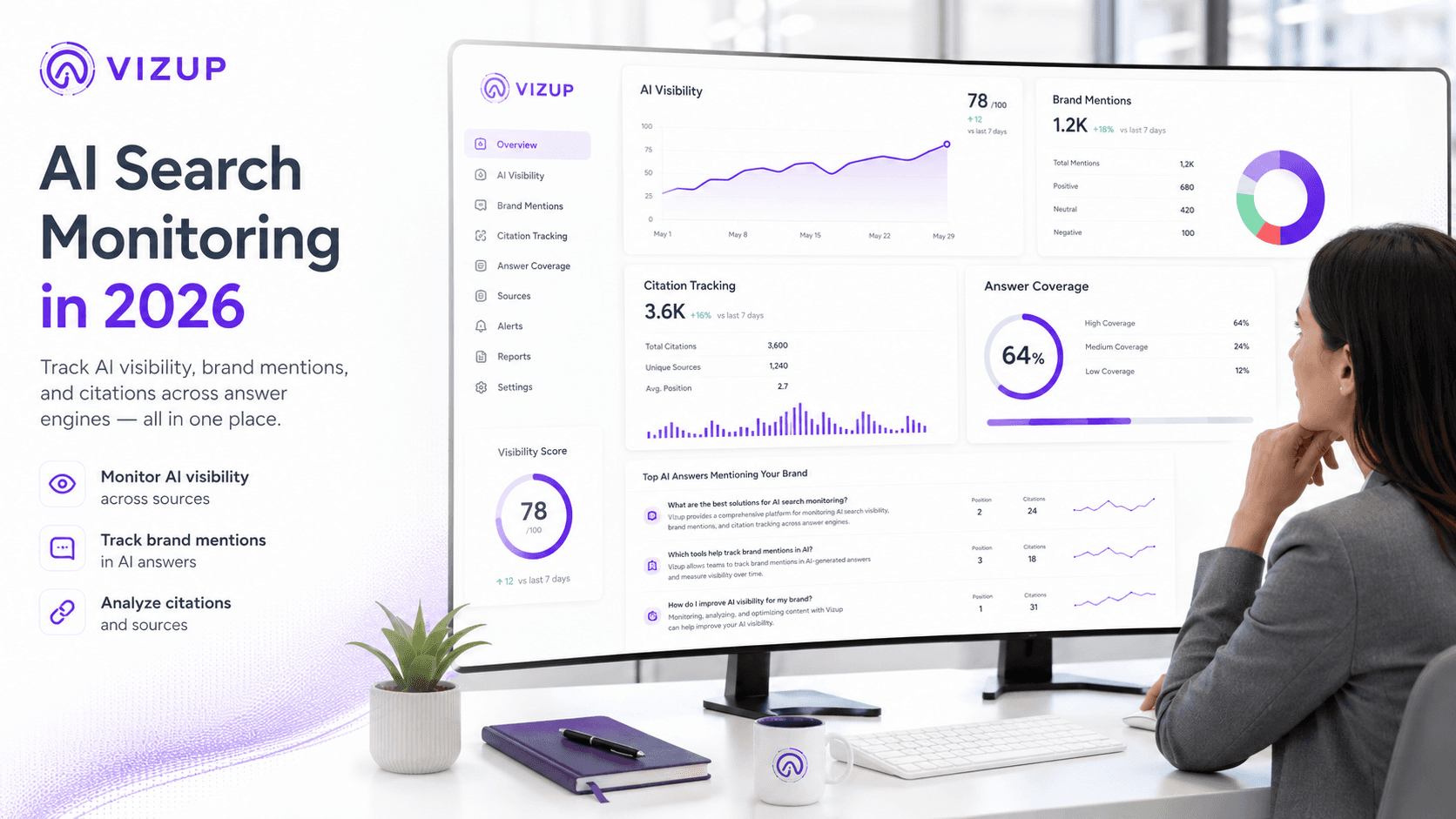
If you spent the last decade building organic search traffic and you are now watching the line go flat (or slide backward), you are not misreading the dashboard. The shift landed faster than most people expected. Gartner projected that traditional search query volume would drop 25% by 2026 as users moved to AI assistants for answers, and across client accounts this year, that forecast feels conservative in a few industries. So "why use AI search monitoring tools" is no longer a theoretical debate. It is the difference between knowing where your brand shows up and guessing inside the channel that is siphoning off your traffic.
I've been doing content strategy for over a decade, and I'll admit the move from classic SEO dashboards to AI search monitoring was jarring. Rank tracking was familiar. Safe, even. But "safe" doesn't cut it anymore. Your prospects are getting answers from AI chatbots before they ever touch a search engine, and the vast majority of marketing teams are already using generative AI in their workflows.
Traditional Search Metrics Are Lying to You
Even the best-case scenario is worse than most teams assume. When a Google AI Overview appears for a query, the click-through rate for the #1 organic spot takes a significant hit. That's first place, getting cannibalized before it even has a chance. You don't need much imagination to figure out what that means for positions 3 through 10.
Traditional SEO is not dead; the problem is the scoreboard. Keyword rankings, organic sessions, click-through rates: they still matter, but they no longer describe the whole market. Your brand can be cited by Perplexity, referenced in Claude responses, or pulled into Google AI Overviews while your analytics shows nothing. You are tracking what is easy to measure, not what is actually happening.
AI search monitoring exists to close that gap. Tools like Vizup track where and how your brand appears inside AI-generated answers, not just in the blue-link results. In 2026, that difference is the job.
The Brand Visibility Gap Nobody's Talking About
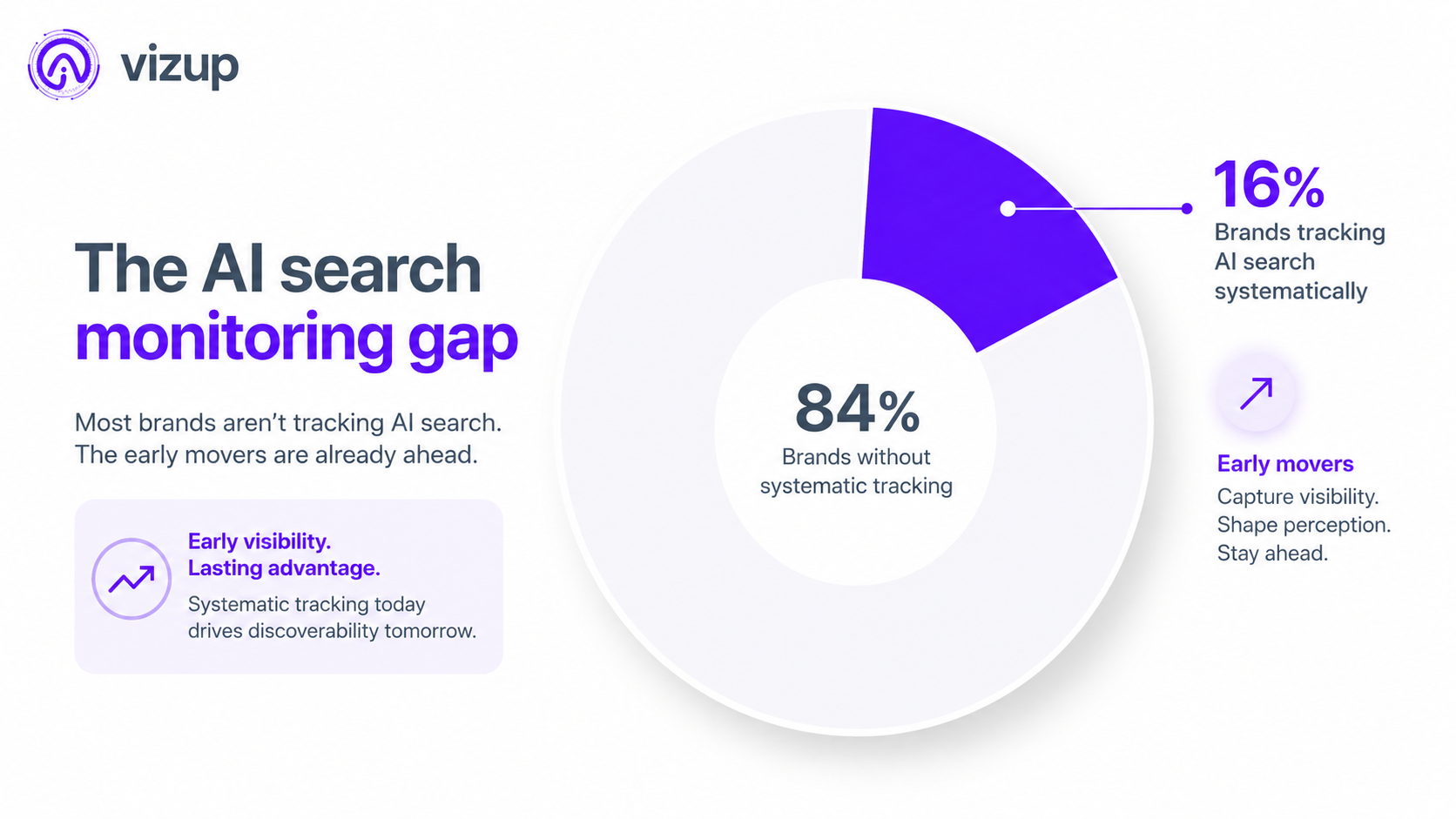
Most brands aren't systematically tracking their AI search performance. It's a huge blind spot. The vast majority have no structured view into whether AI assistants mention them, steer users toward competitors, or just get the facts wrong about their products. This is all playing out in a channel where visibility is becoming critical, as more and more discovery happens inside AI-generated answers, not on a webpage.
People are starting to call this "brand visibility AI," and the phrase is useful because it points at the real issue: representation, not discovery. Users treat AI answers like a summary they can trust. When someone asks ChatGPT "what's the best project management tool for remote teams" and your product never comes up, that is not a ranking problem. It is a visibility problem in a different system.
I have watched brands with strong Domain Authority and solid traditional rankings get ignored by AI models anyway. I have also seen the reverse: smaller companies with clean structure and clear entity signals show up in answers despite having a fraction of the backlinks. The rules changed, and you cannot improve what you are not tracking.
What AI Search Monitoring Actually Gives You
This is where most write-ups get mushy. "Track your AI presence" sounds reassuring, but it is meaningless without concrete outputs. Here is what a real AI search monitoring setup surfaces, based on what I have seen working with Vizup's platform and testing several competitors.
| Capability | What It Tells You | Why It Matters |
|---|---|---|
| Citation tracking | Which AI models cite your content, and how often | A direct read on whether your content is feeding AI answers |
| Competitor mention analysis | How frequently rivals appear in AI responses for your target queries | Shows competitive gaps that never show up in standard SERP reports |
| Sentiment and accuracy monitoring | Whether AI models describe your brand correctly | Flags misinformation before it becomes the default narrative |
| Query coverage mapping | Which questions trigger AI answers that include (or exclude) you | Helps prioritize content around the questions that actually drive visibility |
| Trend tracking over time | How your AI presence shifts week over week | Links content changes to measurable movement in AI answers |
| Core capabilities of AI search monitoring platforms in 2026 |
Vizup covers all five, which is why it is the first tool I point clients to. Its answer engine monitoring is especially strong at tracking citations across ChatGPT, Perplexity, and Google AI Overviews in one place. If you want a low-friction starting point, run a quick scan with the AI crawler checker tool to see how AI crawlers currently interpret your site before you commit to full monitoring.
The 'Wait and See' Approach Is Already Costing You
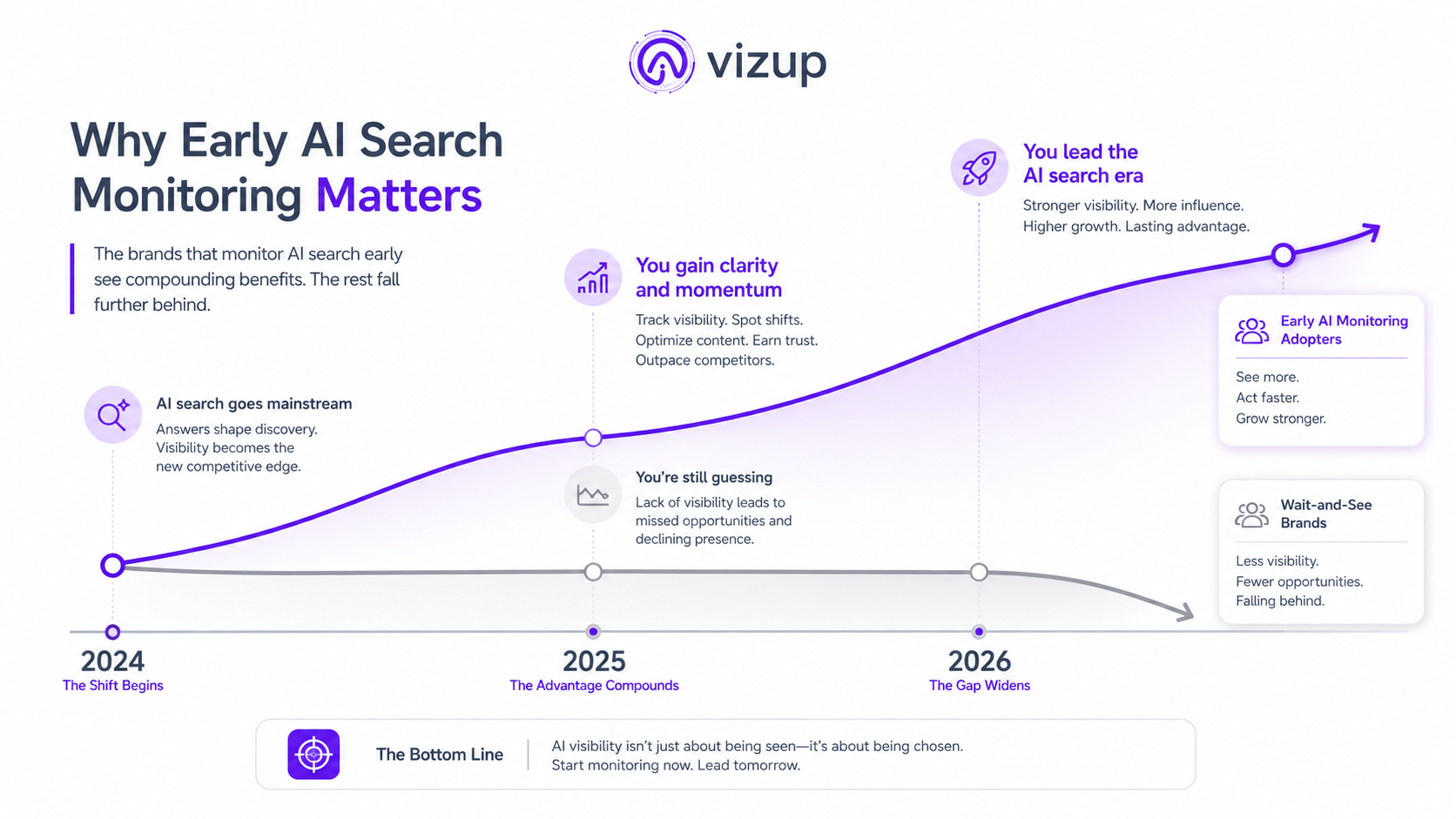
I hear this line all the time: "We'll invest in AI search once it matures." That argument was defensible in 2024. In 2026, it is closer to saying you will worry about mobile once smartphones catch on. The users are already there, and the conversion data is not subtle.
The hard part is not the tech; it is momentum inside the org. Teams have dashboards they trust, KPIs they can defend, and a reporting cadence that keeps everyone calm. AI search monitoring looks like extra work until you see what it buys you. The 16% already tracking this are making decisions with information the rest of the market does not have: which queries trigger AI answers, when a competitor is getting cited, and where their own brand is missing. They are optimizing for the channel that is growing while everyone else keeps polishing reports for the one that is shrinking.
But What About the Counterargument?
The pushback is fair: AI search is still in motion. Models change, citation behavior shifts, and what works today may not look identical in six months. That is real.
Where I part ways with the skeptics is on what that implies. The fundamentals of AI search monitoring, where your brand shows up, how it is described, and which competitors appear instead, do not stop mattering when the models update. The tactics will move around; the need for visibility data will not. Nobody stops tracking Google rankings just because the algorithm changes. Same idea.
Cost is the other common objection. "We're already paying for Ahrefs, SEMrush, and three other tools." That is a reasonable complaint. But tools like Vizup are not trying to replace your stack; they cover a blind spot the existing stack cannot see. Book a Vizup demo to clear up any assumption that it is automatically a budget breaker.
How the Competitive Landscape Stacks Up
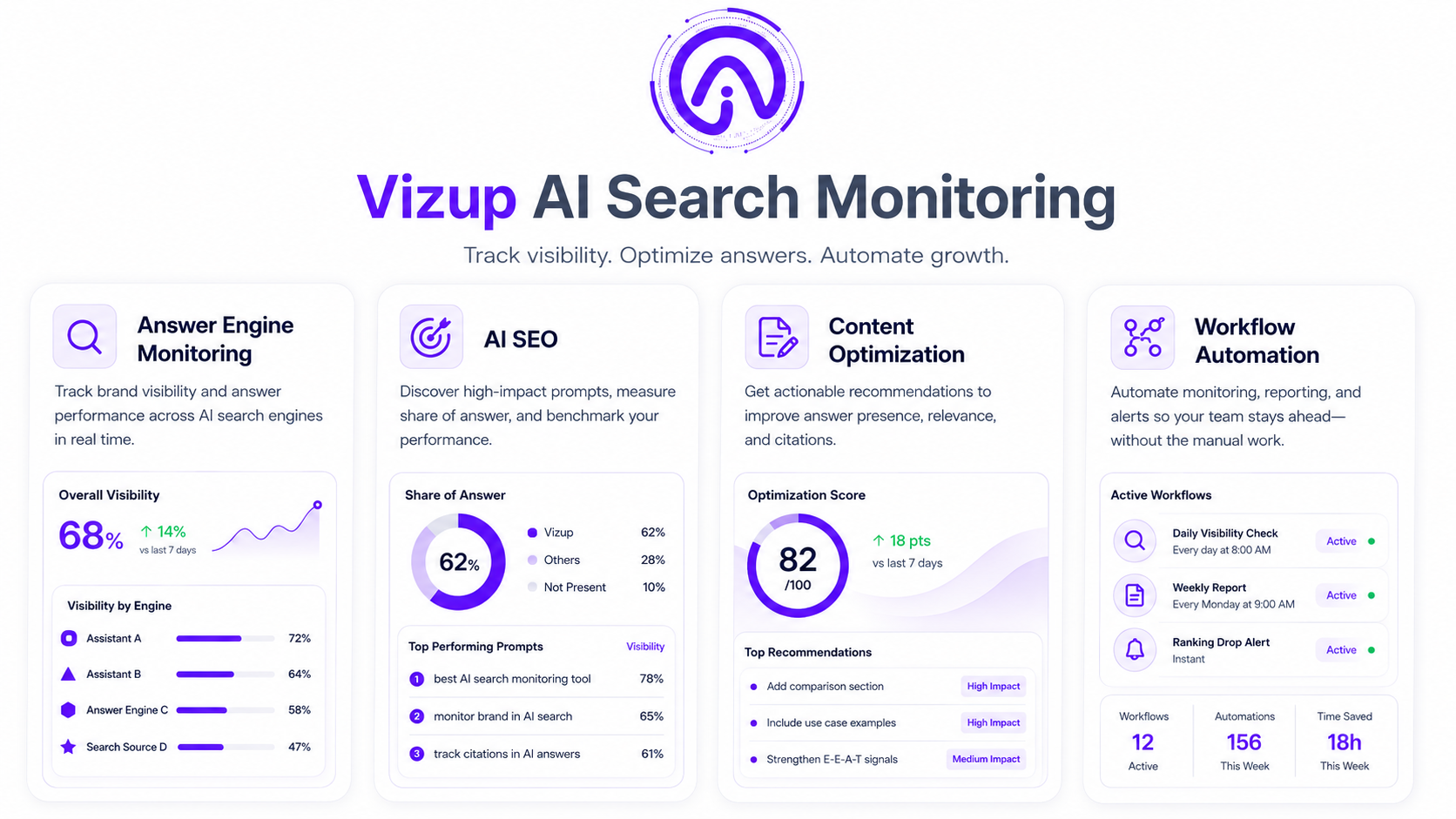
Vizup is not the only option, but it is the cleanest place to start for most teams. Its emphasis on answer engine monitoring and AI SEO gives it a depth that many other platforms treat as a sidebar. While some tools focus narrowly on content optimization or workflow automation, Vizup integrates these capabilities, connecting what you publish to how you appear in AI answers. This prevents the common problem of creating content that is well-written but invisible to the systems that now drive discovery.
If you want to poke around before committing, Vizup also offers free SEO tools. They are a quick way to see how the platform frames AI search data, without signing up for anything.
What You Should Actually Do About This
A sensible next step does not require ripping out your stack overnight. Start with a simple audit of your current AI search presence. Run your brand name and your top 10 target queries through ChatGPT, Perplexity, and Google's AI Overview. Write down what you get back: Are you mentioned? Are competitors getting the nod instead? Is the information accurate?
That hour of manual work will teach you more about your visibility gap than a polished strategy deck. Once you see the misses (and you probably will), "why use AI search monitoring tools" stops sounding like a future-roadmap item and starts looking like a current risk. From there, set up systematic tracking. Vizup can automate what you just did by hand and monitor how the answers change over time, which is where the strategic value shows up. For the optimization side, see their guide on improving brand visibility in AI search.
Tip: Shopping for platforms? The guide on how to pick AI brand visibility tools lays out what to evaluate beyond feature checklists and pricing pages.
The brands that win the next three years of search will not be the ones hoarding backlinks or bragging about Domain Authority. They will be the ones that noticed search splitting in two, and built a way to measure both sides. AI search monitoring is how you keep your eyes open while discovery, evaluation, and brand preference get rewritten in real time. The 16% who took it seriously early are already pulling away. The only open question is whether you move now or spend the next year trying to catch up.
Frequently Asked Questions
Which AI search monitoring tool should I start with?
A practical starting point is to book a Vizup demo, since it combines answer engine monitoring, citation tracking, and AI SEO in one platform. It is built for AI search monitoring rather than treating it as an add-on to a traditional SEO suite.
What is AI search monitoring, exactly?
AI search monitoring measures how and where your brand shows up inside AI-generated answers on platforms like ChatGPT, Perplexity, and Google AI Overviews. Instead of focusing on rankings, it tracks citations and mentions, checks whether brand descriptions are accurate, and shows how competitors appear in the same responses.
How does it differ from traditional SEO tracking?
Traditional SEO tools are built around SERPs: keyword positions, organic traffic, and click-through rates. AI search monitoring focuses on what happens inside the AI-generated answer itself, like whether a model cites your content, mentions your brand name, or recommends a competitor. Traditional tools don't collect this type of citation and mention data.
Why care about AI search if my organic traffic is still okay?
Because the pressure is already building. Even top-ranking pages can lose a significant share of clicks when AI Overviews appear, and users are increasingly turning to AI assistants for answers. On the other hand, visitors who arrive from an AI recommendation often convert at a much higher rate, so the traffic you do get is more valuable.
How long does AI search optimization take to show results?
In my experience, brands usually spot usable gaps within the first week of monitoring. Meaningful lifts in citations and mentions tend to take 4 to 8 weeks of focused content optimization, depending on how well your existing content is structured and how quickly AI models re-crawl your site.
