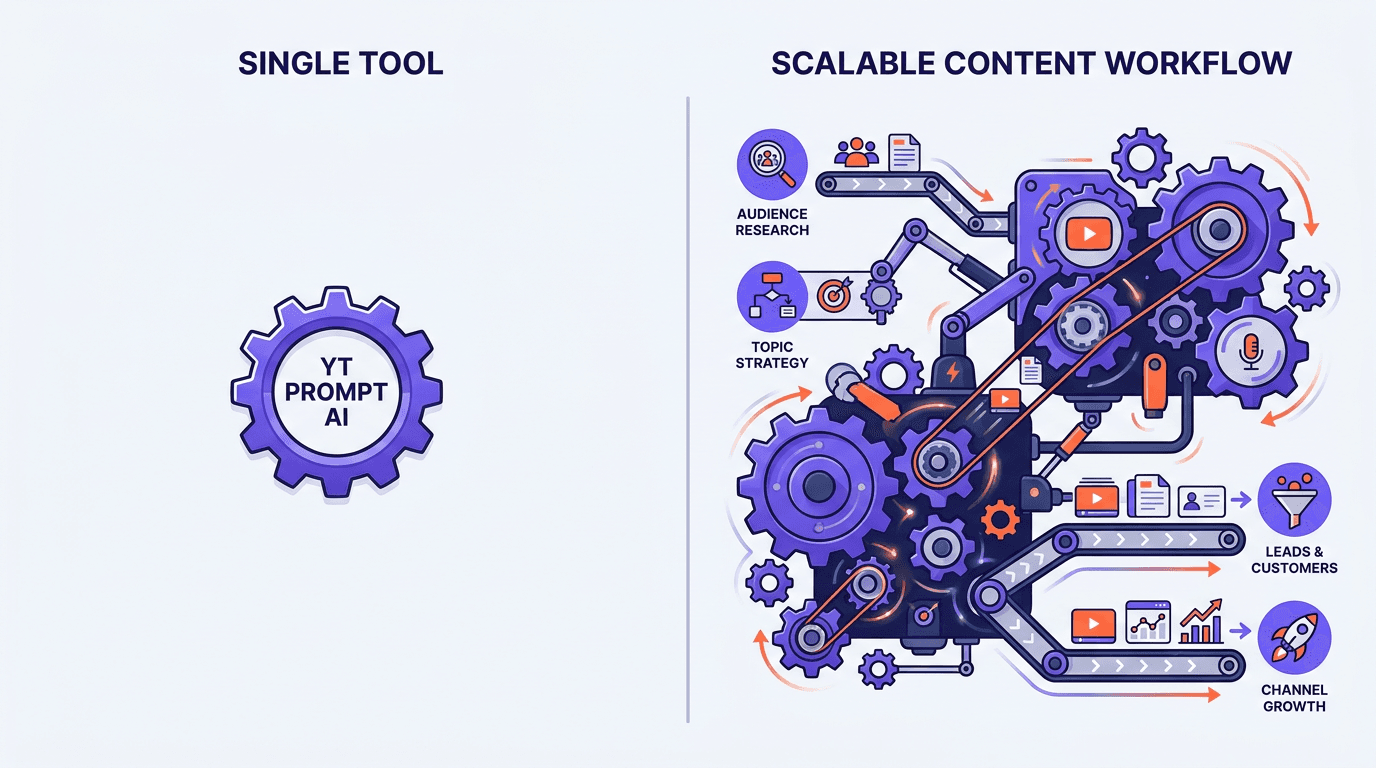
You're using AI to crank out YouTube scripts. The question is whether it's translating into repeatable growth. If your channel feels like a series of one-off bets with unpredictable outcomes, you're in familiar territory. "YT prompt AI" is the default move for marketers and founders who want speed and a quick fix for writer's block. The catch: a strong script is table stakes, not the strategy.
This isn't a prompt dump. It's a workflow you can actually run: the kind marketing teams and founders use when they want organic to behave like a system, not a mood. You'll see where prompts stop being useful on their own, and what a scalable YouTube content workflow looks like when the goal is visibility that turns into leads and customers.
Why YT Prompt AI Is Getting Attention
AI took off in content because it removes friction. On YouTube, an AI prompt for YouTube videos gives you something concrete fast: topics, outlines, first drafts, and angles you would have otherwise debated for days. That speed matters, especially when the real enemy is the blank page and a calendar that keeps slipping.
If you're still getting your bearings, a solid prompt for YouTube scripts is a good place to start. It helps teams see what generative tools do well, and where they fall apart. And if you need the basics, What are YouTube prompts? covers the concept clearly. The common failure mode is stopping here and calling it a strategy.
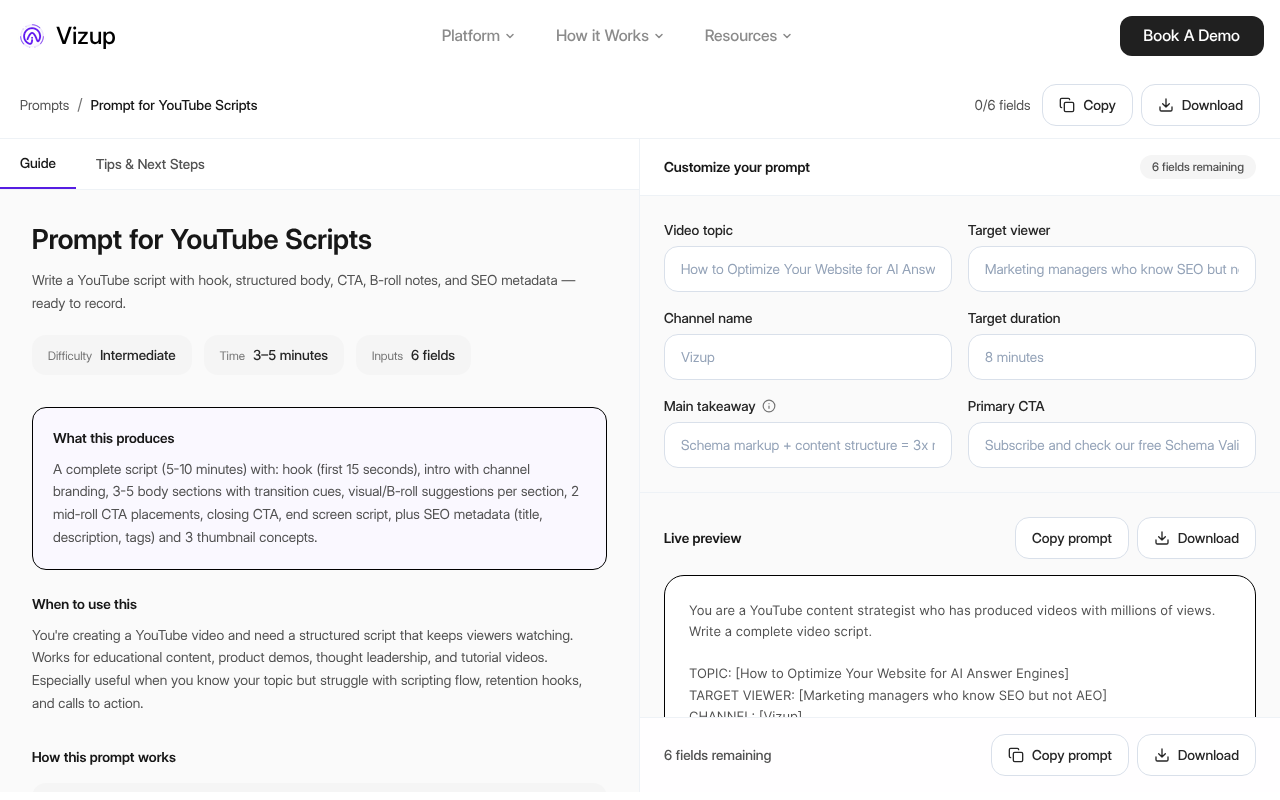
Vizup's structured prompt template turns key inputs into a ready-to-use YouTube script draft.
The Problem: Prompts Create Drafts, Not Growth Systems
A polished AI script doesn't mean much if it's disconnected from the business. Prompts produce drafts; they don't produce demand. When you lean on a standalone AI YouTube script writer without the surrounding workflow, you're basically revving an engine bolted to the floor. Lots of output, no direction, and nothing compounding.
That's how you end up in a "Content Void": the script reads fine, but it isn't attached to an objective you can measure or a path a buyer actually takes. Here's where the one-off prompt approach breaks down:
- It doesn't know your funnel: A standalone prompt has no memory of your customer journey. It can't tell you what lead magnet to point to, which pain point to press on, or where the video belongs in the path to purchase.
- It can't prioritize by business impact: A prompt will happily write whatever you request, even if it's the wrong fight. It can't separate low-intent, high-volume topics from the high-intent questions that correlate with pipeline.
- It doesn't build content clusters: One-off videos rarely add up to authority. A real YouTube content strategy is connected: videos that reinforce each other and signal expertise to viewers and the algorithm, which matters for a strong YouTube SEO workflow.
- It can't measure performance or convert traffic: The prompt stops at generation. It doesn't watch retention, CTR, or lead conversion. The work that drives organic growth starts after the script exists.
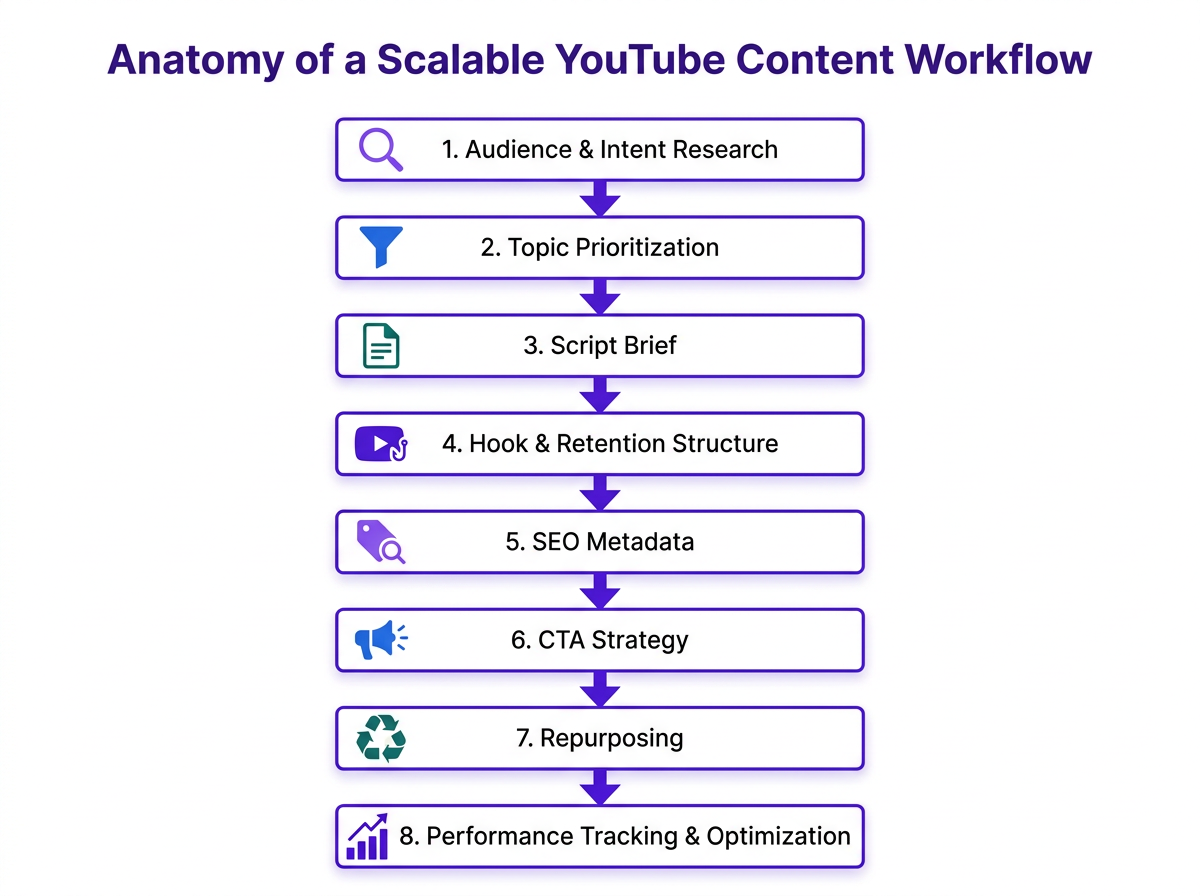
A scalable YouTube strategy connects research, scripting, SEO, and performance tracking, not just AI-generated drafts.
What a Real YouTube Content Workflow Needs
To get out of "random acts of content," you need a process you can repeat and improve. This is the shape of what strong growth teams run, and it's worth noticing where scripting sits: it's one piece, not the whole machine.
A Practical Workflow Framework:
- 1. Audience and Intent Research: Who are we trying to reach, and what are they trying to solve right now?
- 2. Topic Prioritization: Out of everything we could publish, what is most likely to move the business and match our strategic goals?
- 3. Script Brief: Give the AI (or writer) a real brief: target audience, key takeaways, target keywords, tone, and the specific call-to-action.
- 4. Hook and Retention Structure: Design the first 5-10 seconds to earn attention, then keep it with loops, open questions, and a clear narrative thread.
- 5. SEO Title, Description, and Metadata: Write metadata based on keyword research and SERP analysis so the video has a fair shot at discovery on YouTube and Google.
- 6. CTA Strategy: Place calls-to-action with intent, mapping each one to the next step in your funnel (download, demo, or the next video).
- 7. Repurposing: Decide upfront how the long-form video becomes Shorts, blog posts, social posts, and landing page assets. A prompt for content repurposing can help here.
- 8. Performance Tracking and Optimization: Read the data. Which videos earn attention? Which ones create leads? Use that to drive the next round of prioritization.
One-Off YT Prompt AI vs. Scalable Content Workflow
Put the two approaches side by side and the gap is obvious. One is a tool that outputs text. The other is a system that turns content into business results. A workable AI content strategy connects them so the script is the middle of the pipeline, not the finish line.
| Activity | One-Off YT Prompt AI Approach | Scalable Content Workflow with Vizup |
|---|---|---|
| Topic Selection | Picked from a single idea or a whim. | Ranked by audience intent, business value, and competitive gaps identified by Vizup's Strategist Agent. |
| Scripting | Creates a script as a standalone artifact. | Built for retention and anchored to a content brief inside an end-to-end AI content workflow. |
| SEO & Visibility | Metadata is written manually, disconnected from search performance. | SEO metadata is generated from real-time SERP analysis; optimized for search and AI Answer Engine visibility. |
| Conversion | No CTA plan; traffic is treated as the outcome. | CTAs are mapped to funnel stages so viewers can become leads and customers. |
| Repurposing | Optional, and usually skipped when things get busy. | Designed from day one, so each video feeds blogs, Shorts, and social campaigns in one system. |
| Measurement | Measures success by script output. | Tracks visibility, engagement, and conversion to close the loop and steer the next strategy cycle. |
| Comparison of a prompt-only approach versus a systematic workflow. |
How Vizup Helps Teams Move Beyond One-Off Prompts
Vizup is built for teams that have outgrown one-off prompts and spreadsheet glue. The platform acts as the connective tissue for a real organic growth workflow. The point isn't just to produce more content; it's to produce content that earns attention and converts.
Rather than shipping only an AI YouTube script writer, Vizup ties the workflow together. The Watcher Agent tracks your brand's visibility across search, social, and AI answer engines. The Strategist Agent turns that signal into prioritized content opportunities. The Operator Agent helps you execute, moving from insight to published, optimized content inside one connected system. That's what scalable content automation looks like when it's actually usable by a team.
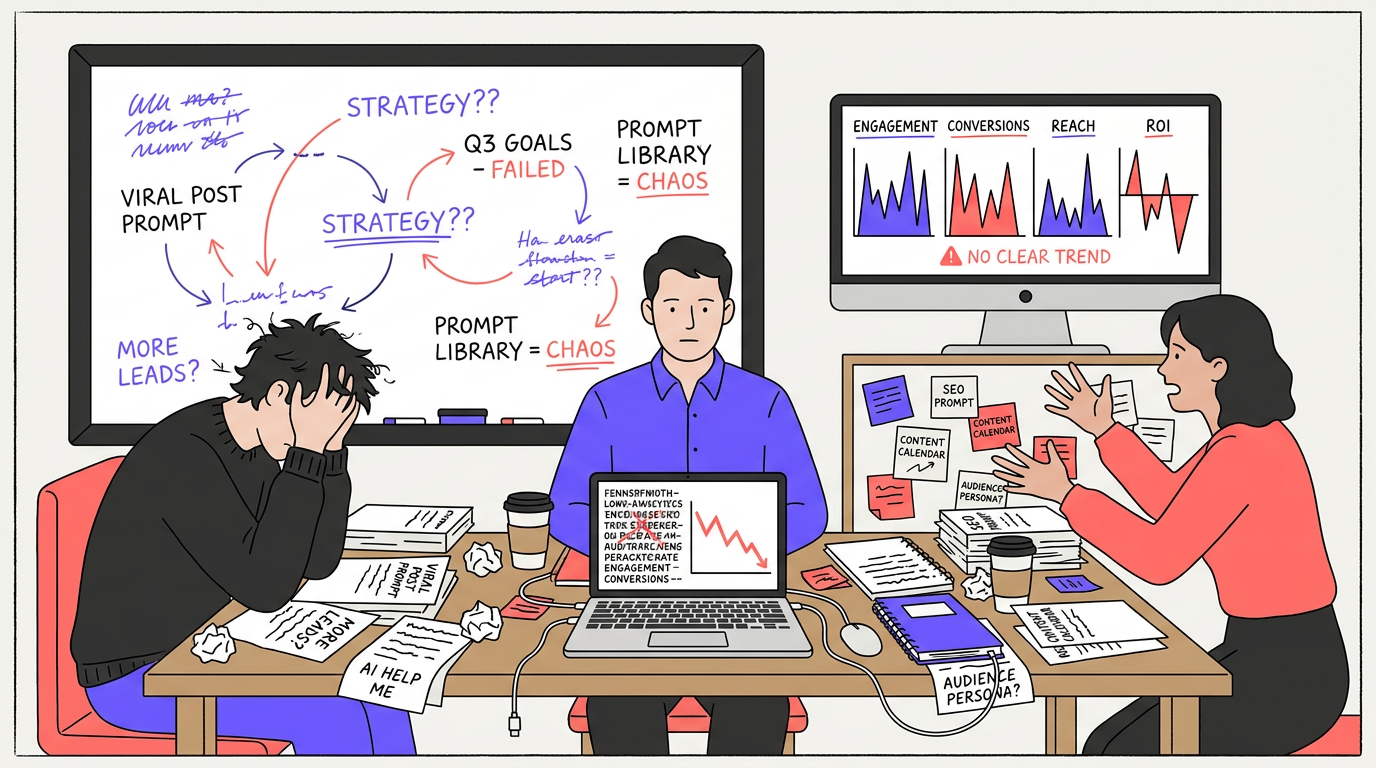
One-off prompts create chaos, scattered workflows signal it's time for a connected system.
When Should You Stop Using One-Off Prompts and Talk to Vizup?
Messing around with YouTube prompts is useful early on because it teaches you what AI can and can't do. But the ROI drops fast once you need consistency. If you're a founder or marketing lead, you want a system that performs without relying on one person's ability to "prompt well" on a good day.
These are the signals you're ready for a real AI content workflow:
- You're publishing regularly, but views and leads swing wildly from video to video.
- You're getting traffic, but too little of it turns into qualified leads or customers.
- Your "workflow" is a fragile stack of Google Docs, spreadsheets, and random prompt threads.
- Quality and brand voice vary depending on who touched the script last.
- You want search, AI visibility, and conversion to reinforce each other instead of living in separate silos.
If that list describes your week, you don't need more prompts. You need a system. Want to turn YouTube scripts into a repeatable organic growth workflow? Talk to Vizup.
Frequently Asked Questions
Can a better YouTube script prompt fix this on its own?
A stronger prompt can improve the draft, but it won't fix the system around it. Prompts don't do audience research, they don't rank topics by revenue potential, and they don't measure what happens after you publish. They're execution support, not strategy.
What's the difference between a YouTube content workflow and a content calendar?
A content calendar tells you what ships and when. A content workflow defines how an idea becomes an optimized asset: research, prioritization, briefing, production, SEO, distribution, and measurement. The calendar is scheduling; the workflow is the operating system.
Does the workflow change for YouTube Shorts vs. long-form videos?
The steps stay the same: research, prioritize, brief, script, publish, and track. Shorts just compress the cycle. Hooks matter even more, and repurposing can run both directions, including bundling winning Shorts into a long-form video.
Is content automation just another name for using an AI YouTube script writer?
No. An AI script writer is content generation. Content automation is the full workflow, systemized: planning, briefs, SEO optimization, publishing, repurposing, and performance analysis. One is a task; the other is the engine.
When should a business invest in an AI content strategy platform like Vizup?
When the goal changes from "we should publish a video" to "this video needs to generate X leads." If you have someone responsible for content marketing and you're tired of inconsistent ROI, a platform like Vizup provides the structure and intelligence to make the work repeatable.
Conclusion: From Content Crafter to Growth Architect
YT prompt AI is useful. It's also not a strategy. Growth doesn't come from landing one perfect script; it comes from the workflow that makes good decisions repeatable. A scalable YouTube content workflow moves you from shipping videos as isolated outputs to running content as a business system with outcomes attached.
Connect audience research, topic prioritization, SEO, and conversion into one loop you can run every week. That's how views become revenue and how organic starts compounding. If AI prompts are getting you traffic but not enough leads, Vizup can help you build the system behind the traffic.
