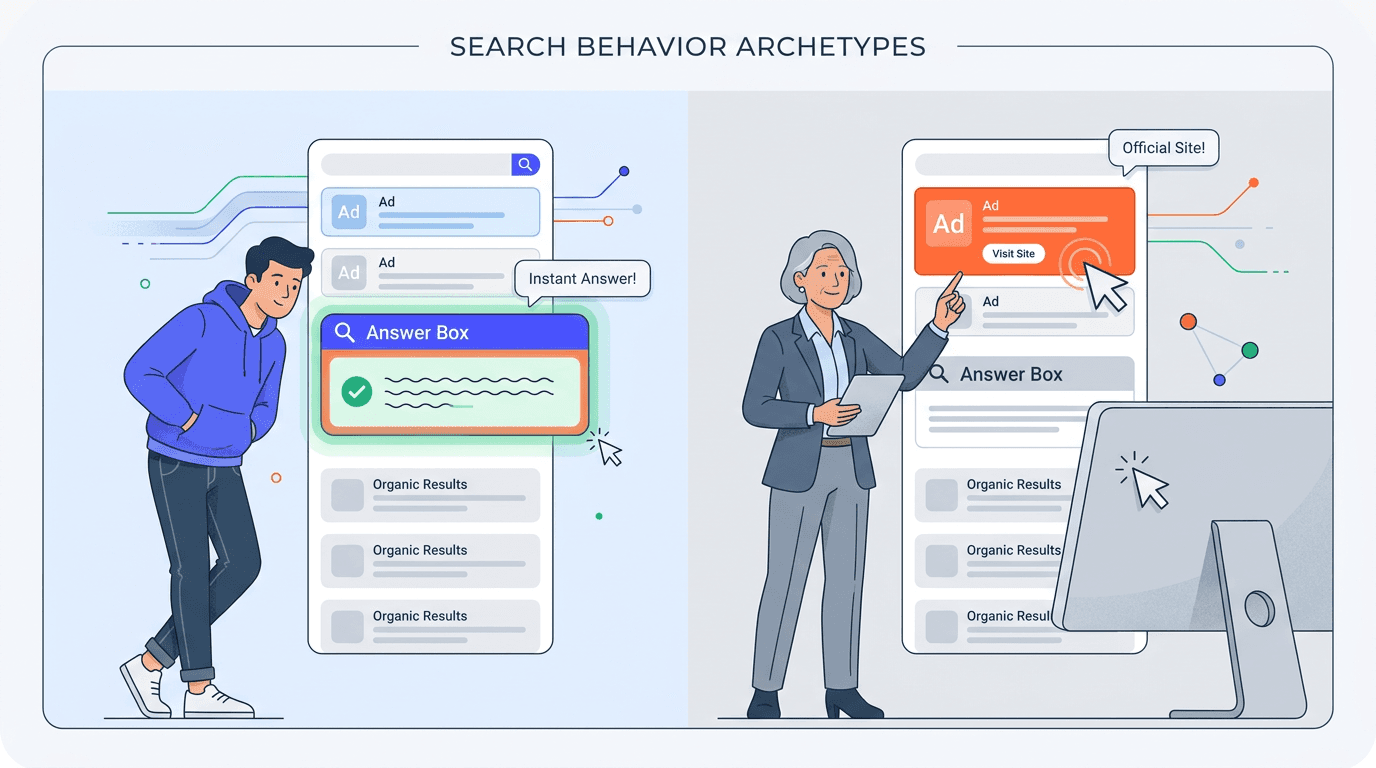
Zero-click search by age group is the simplest way to describe a complicated truth: different cohorts use Google's results page in fundamentally different ways. Younger users often get what they need straight from the SERP and move on. Older users are more likely to click through, and they are disproportionately willing to click paid ads. Once you can measure that split, a single national average stops being a planning metric and starts being a trap.
Marketing teams still anchor forecasts to one tidy statistic: about half of Google searches end without a click. The number holds up in aggregate, but applying it to every audience is like building a budget off someone else's customer mix. iPullRank's clickstream study (published July 2026, spanning 13.1 billion search events from October 2024 through December 2025) shows age is one of the strongest predictors of whether a searcher clicks at all, and where that click lands. The same pattern varies by geography and by device, but age is the segmentation most teams skip even when they have the data to do better.
How Search Behavior Changes with Age
Using the Datos clickstream panel (9.1 million users, 10.2 billion sessions), iPullRank reports that 46.96% of Google searches ended without a click overall. The age cut is where the headline average breaks down. Zero-click rates step down with each older bracket, creating roughly a 10-point spread between the youngest and oldest groups. The progression is steady: each cohort clicks a bit more than the one below it.
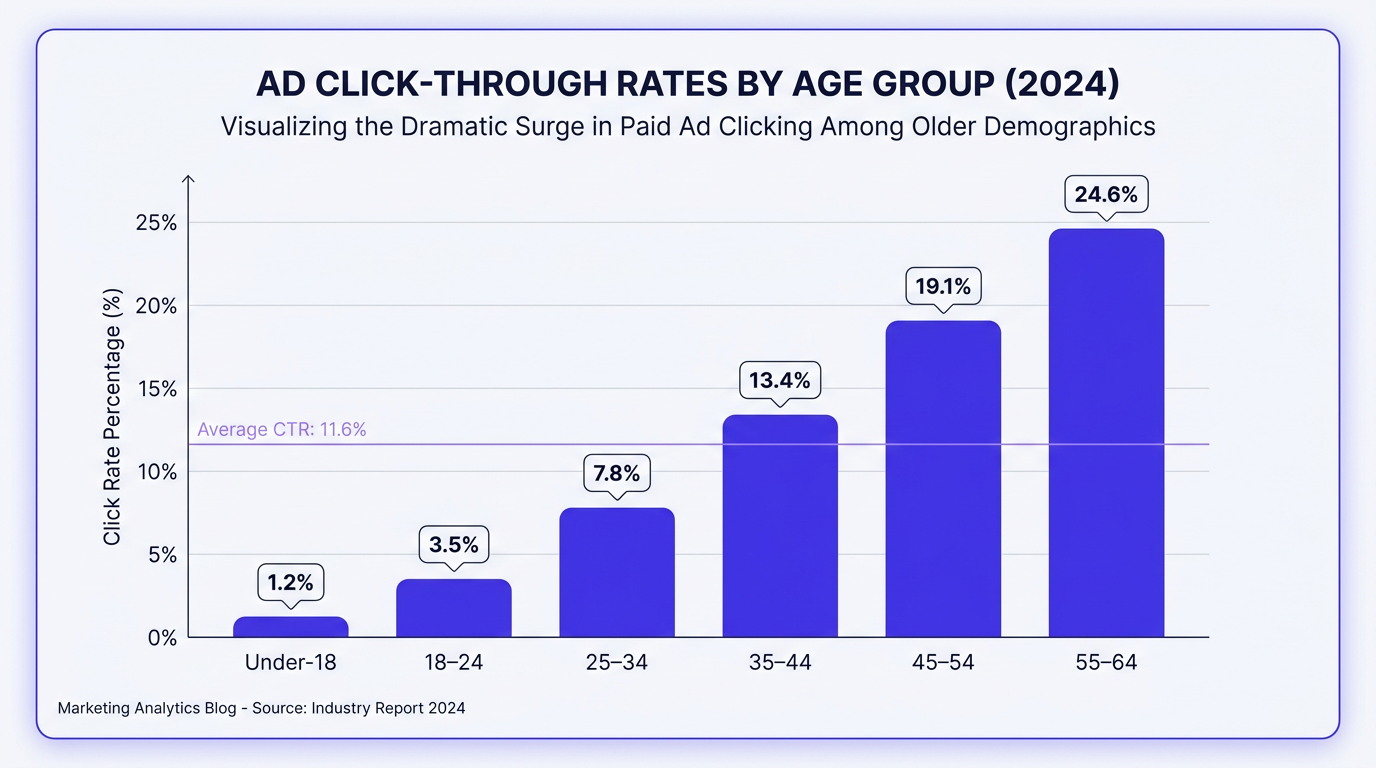
Paid clicks swing even harder. Searchers aged 55-64 clicked paid ads about seven times more often than 18-24 year olds, and more than twenty times more often than under-18s. Gender, by comparison, barely moves the needle on zero-click: men and women were nearly the same (around 47.0% and 47.5%). The one meaningful gap is on ads, where women clicked about a third more often (roughly 2.4% versus 1.8%).
The Generational Divide: Gen Z vs. Boomers on the SERP
Why Younger Searchers Click Less
Younger users often treat Google as a fast verification tool rather than simply a gateway to other websites. Featured snippets, knowledge panels, and AI Overviews can surface an answer before a click becomes necessary. The iPullRank age analysis supports this directional pattern, although it does not establish why younger users click less. Discovery also extends beyond Google: Adobe Express reported that 49% of surveyed U.S. consumers used TikTok as a search engine in 2026, although 89% of Gen Z respondents still preferred Google over other platforms.
If you're trying to reach that audience, the implication is blunt: a large slice of demand gets satisfied before your site ever has a chance. That is why how AI mode changes SEO matters; AI-generated answers on the SERP push the same trend harder. Pew Research Center reported in 2025 that when Google's AI Overview appears, users click a traditional result only 8% of the time, versus 15% when it is absent.
Why Older Searchers Click Ads
Older cohorts showed a greater propensity to click from the SERP, including paid results. In iPullRank's demographic slice, the 55–64 bracket clicked paid ads about seven times as often as the 18–24 bracket. A separate Colling Media analysis reported that 55.9% of Boomers use Google to find products. These findings support age-aware channel planning, but they do not establish conversion rate, CPA, or return on ad spend.
That difference is a channel-planning signal, not proof that paid search will perform better for every older audience. Use age-segmented campaign data to test whether higher ad engagement translates into conversions and efficient acquisition costs before shifting budget.
What This Means for Your Audience Cohort SEO Strategy
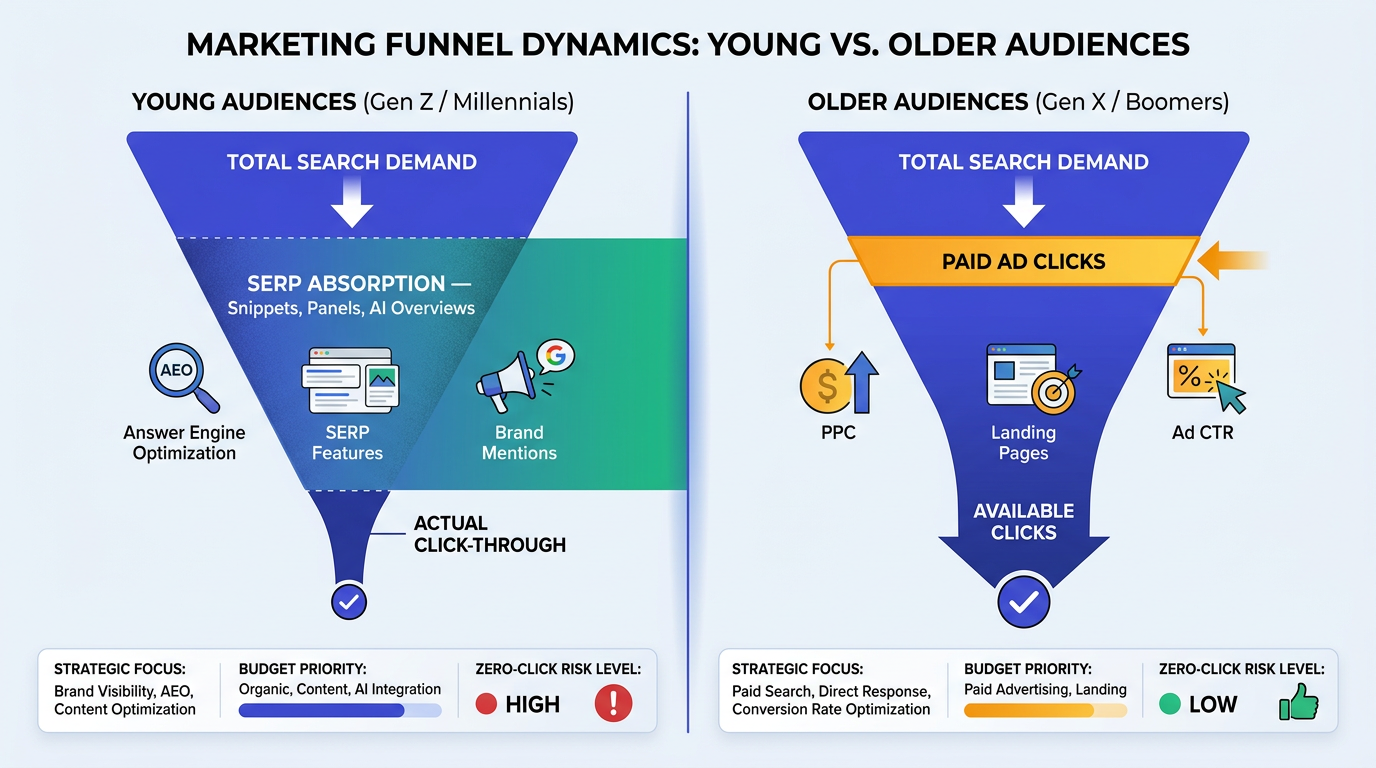
The value of zero-click search by age group is not academic; it is a budgeting lever. A younger audience means more of your reachable demand gets absorbed by the SERP itself, so your visibility work competes with the snippet, the panel, and the overview. An older audience shifts the math: paid search deserves more weight because clicks, including ad clicks, are simply more available. This is where Vizup's Organic Autopilot for modern discovery fits. It helps brands monitor, create, optimise, publish, and learn across Search, Social, Communities, AI Answer Engines, and Local Discovery using AI agents, human experts, and live SEO, pSEO, AEO, and GEO tools. Paid ads remain an optional amplification add-on, allowing paid activation to support (not replace) the organic discovery system.
| Dimension | If Your Audience Skews Young (Gen Z, Millennials) | If Your Audience Skews Older (Gen X, Boomers) |
|---|---|---|
| Primary strategic focus | Answer Engine Optimization (AEO) and winning SERP features | Paid search (PPC) and landing pages built for clicks |
| Budget priority | Spend on visibility and brand presence on the SERP | Allocate more to paid search with tighter audience targeting |
| Key metrics | SERP feature share, brand mention frequency, AI citation rate | Ad CTR, CPA, conversion rate from paid clicks |
| Zero-click risk | High: a meaningful share of demand ends on the SERP | Lower: users are more likely to click through |
| Paid-ad click propensity | Lower among younger cohorts in the iPullRank age slice | Higher among older cohorts in the iPullRank age slice |
| Audience age should drive channel allocation, not a single national zero-click benchmark. |
If your organic clicks are sliding, the reporting model has to change with them. Measuring traffic alone is a dead end when a growing share of queries never produce a click. That is why visibility metrics matter: they let you account for outcomes that happen on the SERP, not just on your site. Treating traffic as the only scoreboard is how teams convince themselves nothing changed while the funnel quietly moved upstream.
Critical Caveats: What This Data Can and Cannot Tell You
Warning: The iPullRank study's demographic slice comes from a single week of data, with a panel that is 72% male and where the 25-34 and 35-44 age bands represent 97.4% of the sample. The 18-24, 45-54, and 55-64 bands are smaller (though still statistically large at 147,000+ sessions each). The overall panel is 94.5% desktop, so headline figures are effectively desktop-weighted. Treat the age pattern as directionally clear, not as precise per-cohort percentages.
Those constraints are not hidden, and they matter. The broad direction (younger users zero-click more; older users click ads more) lines up with Forrester, WordStream, and Pew, which is the point: the pattern is real even if the exact spread is not portable. Your category, your audience composition, and your device mix will change the magnitude. Zoom out and the larger argument is straightforward: zero-click is not one number; it is a set of behaviors that shift by country, device, query type, and cohort. Google queries are at record highs even as clicks fall, so demand is not disappearing. What is changing is how that demand turns into measurable outcomes.
That is why first-party data still wins. Benchmarks can tell you what to suspect; they cannot tell you how your users behave. Combine segmented first-party performance data with AI search performance analytics to compare traffic, mentions, citations, and visibility without treating a desktop-heavy industry panel as your forecast.
Key Takeaways for Your Next Strategy Meeting
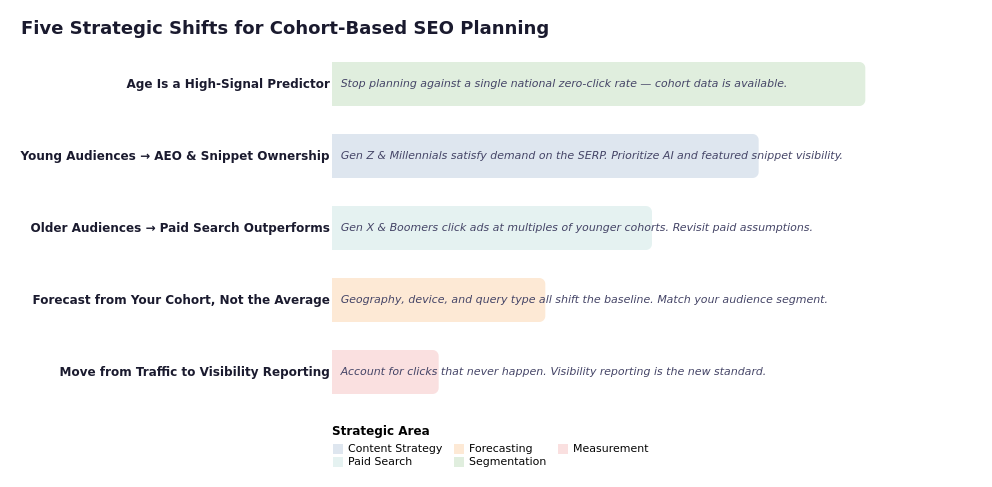
- Age is a high-signal, routinely ignored predictor of search behavior. Stop planning against a single national zero-click rate when cohort data is available.
- If your audience is young (Gen Z, Millennials), a large share of demand gets satisfied on the SERP. Put weight behind AEO, snippet ownership, and improving brand visibility in AI search.
- If your audience is older (Gen X, Boomers), paid search is likely outperforming your assumptions. These users click ads at multiples of younger cohorts.
- Zero-click search by age group is one slice of a bigger segmentation problem. Geography, device, and query type all move the baseline. Forecast from the cohort that matches your audience, not the average.
- Moving from traffic reporting to visibility reporting is not a trend piece. It is how you account for the clicks that never happen.
Frequently Asked Questions
What counts as a zero-click search?
A zero-click search happens when someone runs a Google query, gets the answer directly on the results page (featured snippets, knowledge panels, AI Overviews, and other SERP features), and leaves without clicking a link. In iPullRank's 2026 clickstream analysis, 46.96% of Google searches ended that way overall.
Why do younger searchers click less on Google?
Younger searchers, especially Gen Z, use Google more like a fast fact-check than a gateway to websites. They are comfortable pulling answers from SERP features and AI summaries instead of clicking through. Forrester Research (2026) found 93.1% of Gen Z users depend on zero-click results, driven largely by speed. Many also spread search activity across social platforms, including TikTok.
Are older audiences more likely to click on Google Ads?
Yes, by a wide margin. iPullRank found the 55-64 age group clicked paid ads about seven times more often than 18-24 year olds. WordStream data (2023) cited by Colling Media (2025) also reports Boomers are 19% more likely to click Google Ads than younger generations. The simplest explanation is habit: older users learned search in an era where clicking through was the default.
How should zero-click search by age group change an SEO strategy?
It should change your channel mix assumptions. If your audience skews young, more demand gets satisfied on the SERP, so you need to prioritize Answer Engine Optimization and SERP visibility. If your audience skews older, paid search deserves more budget because your users are actually clicking ads. A single national benchmark blurs the differences that matter.
What is the overall zero-click search rate?
iPullRank's study (13.1 billion search events from October 2024 to December 2025) reports that 46.96% of Google searches ended without a click. That headline number is effectively desktop-weighted (the panel is 94.5% desktop) and it hides major variation by age, geography, device, and query type. Treat it as a baseline, not a target.
