
Google Ads in 2026 operates on two automation philosophies that sit at opposite ends of the control spectrum. The AI Max vs Performance Max comparison is one every paid media manager needs to understand before allocating another dollar of budget. AI Max exited beta in April 2026, delivering search-first, intent-driven automation with the granular controls advertisers have long demanded. Performance Max, on the other hand, continues to excel at cross-channel delivery, with some advertisers seeing an average increase of 27% more conversions at a similar cost per action.
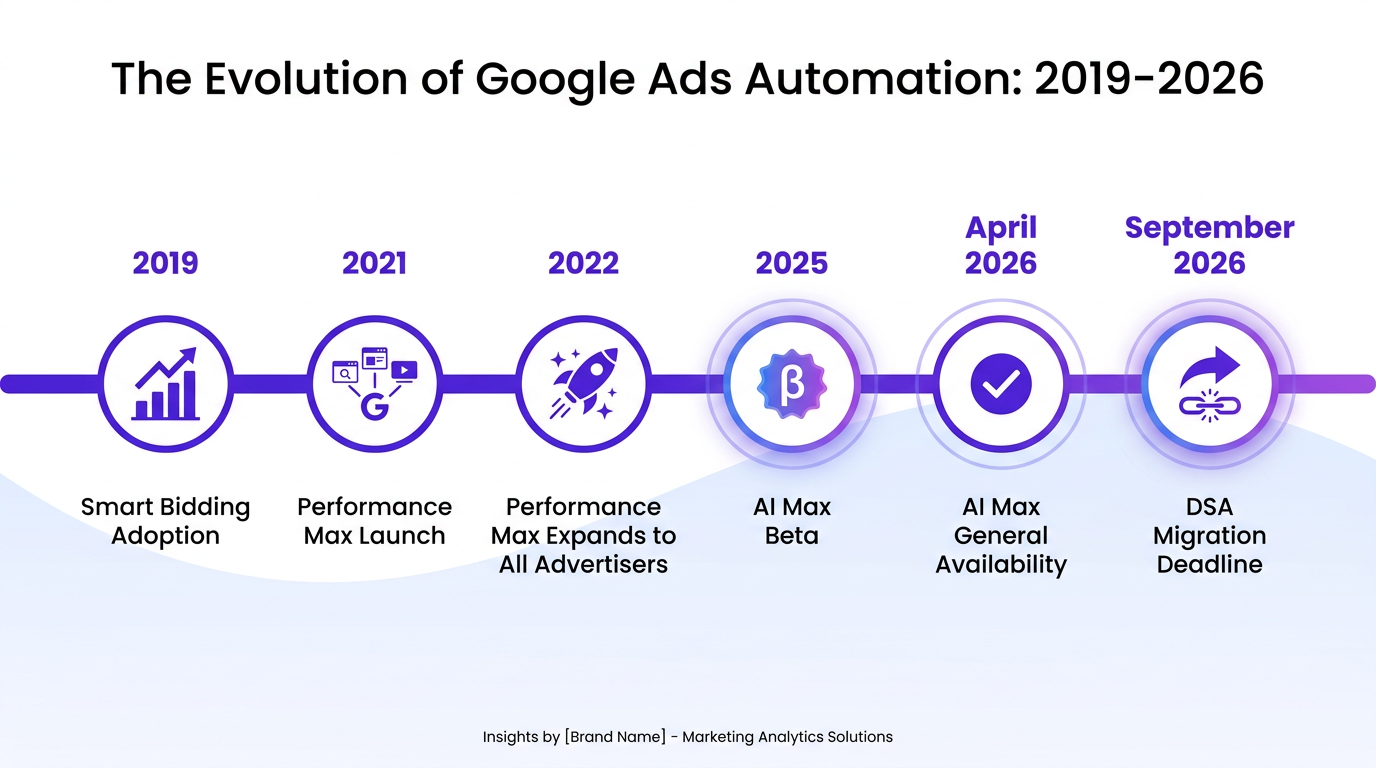
The timeline pressure is real. Google will begin automatically migrating Dynamic Search Ads (DSA) campaigns into AI Max starting September 2026, which means advertisers need to finalize their campaign architecture now. Below, we break down the strategic differences across six critical criteria and provide a clear verdict based on budget size, team maturity, and industry vertical. If you're still running DSA campaigns, the migration clock is already ticking.
The Google Ads Automation Landscape in 2026
Google has spent years steering advertisers away from manual keyword bidding and toward AI-driven campaign management. Smart Bidding laid the groundwork. Performance Max, launched in 2021, pushed automation further by unifying all Google channels under a single goal-based campaign. AI Max for Search campaigns is the latest step in that evolution, purpose-built for capturing search intent with greater advertiser oversight. You can use Vizup's Campaign Manager to monitor both campaign types and ensure your ad spend is allocated effectively. For a detailed migration plan from DSA, see our guide on how to replace Dynamic Search Ads.
Here's the architectural distinction that trips people up: AI Max is not a new campaign type. It's a suite of AI-powered features layered onto existing Search campaigns. Performance Max remains a standalone, goal-based campaign type spanning YouTube, Display, Search, Discover, Gmail, and Maps. Every strategic decision downstream depends on understanding this difference. Google's own recommended "Power Pack" strategy calls for running both: AI Max for high-intent search queries and Performance Max for broader ecosystem reach.
Performance Max: The Cross-Channel Powerhouse
Performance Max delivers on a straightforward promise: hand Google a conversion goal and creative assets, and the system finds customers across every Google property. By 2026, PMax has matured considerably. Asset group optimization is sharper, audience signals carry more weight, and budget allocation across channels responds to real-time performance data with noticeably better precision than even a year ago.
E-commerce advertisers running product feeds still have no real alternative. PMax consolidates what used to require separate Shopping, Display, and YouTube campaigns into a single workflow. Lead generation businesses benefit too, especially from PMax's ability to surface conversion-ready audiences in placements a traditional Search campaign would never reach.
Where Performance Max Excels
Key strengths of Performance Max in 2026:
- Full-funnel coverage. A single campaign spans Search, Shopping, YouTube, Display, Discover, Gmail, and Maps, eliminating the need to manage separate campaigns for each channel.
- Shopping integration. Product feed campaigns run natively within PMax, making it the default choice for e-commerce advertisers who need Shopping ads alongside prospecting placements.
- Automated budget allocation. Google's algorithm shifts spend across channels in real time based on where conversions are most likely, which benefits advertisers optimizing for total volume rather than channel-specific returns.
- Audience signal amplification. Custom segments, customer match lists, and demographic signals guide the algorithm toward high-value prospects across all channels simultaneously.
- Scale at higher budgets. Accounts spending $50,000+ per month often see PMax outperform individual channel campaigns on total conversion volume.
AI Max: Search-First Automation with Real Controls
AI Max takes the opposite approach. Instead of spreading across every Google channel, it doubles down on what Search does best: capturing high-intent queries at the moment of decision. Since going generally available in April 2026, it offers advanced query understanding, dynamic ad generation, and (finally) the improved negative keyword capabilities and transparent search term reporting at the ad group level that PMax advertisers have been requesting for years.
The strategic value comes from how AI Max expands keyword matching without removing the steering wheel from your hands. You define the intent parameters. The AI finds semantically related queries you wouldn't have targeted manually. But unlike PMax, you can see exactly what's happening, adjust negatives on the fly, and control the process at a granular level. If your team has invested in understanding search behavior through SEO research, AI Max is where those insights translate directly into paid strategy.
Where AI Max Excels
Key strengths of AI Max for Search campaigns:
- Search term transparency. Full visibility into which queries triggered your ads, reported at the ad group level. No more guessing what PMax's search component is doing behind the scenes.
- Negative keyword precision. Comprehensive negative keyword controls let you block irrelevant queries in real time, protecting budget from wasted spend.
- Semantic query expansion. The AI identifies related search terms you didn't explicitly bid on, expanding reach without sacrificing intent quality.
- SEO-to-PPC alignment. Organic search data feeds directly into AI Max targeting, creating a feedback loop between paid and organic strategies.
- Budget efficiency on constrained accounts. Every dollar targets search queries with demonstrated intent, making AI Max the stronger option when budgets are tight.
The DSA Migration to AI Max: Preparing for September 2026
Google is retiring Dynamic Search Ads and will automatically migrate eligible DSA campaigns to AI Max in September 2026. This isn't optional. The migration happens whether you've prepared or not. Here's how to get ahead of it:
Steps to prepare for the DSA-to-AI Max migration:
- Audit your website content now. AI Max uses your site's content to generate ads and match queries. Thin content, outdated information, or poor page structure will produce poor results. Prioritize quality on your highest-converting landing pages.
- Clean up your page feeds. If you use page feeds for DSA targeting, verify that URLs are accurate, properly categorized, and pointing to pages you actually want traffic on.
- Document current DSA performance. Capture baseline metrics (CTR, CPA, conversion rates, top search terms) before migration so you have a benchmark for AI Max.
- Build negative keyword lists proactively. AI Max offers better negative keyword controls than DSA ever did. Compile comprehensive lists now so they're ready to apply the moment migration completes.
- Test AI Max before September. Run it alongside existing DSA campaigns on a subset of your account. Don't wait for the forced migration to discover how it behaves with your data.
For a detailed walkthrough covering feed management and testing frameworks, see your 2026 migration guide.
AI Max vs Performance Max: Head-to-Head Comparison
Neither option is universally better. The right choice depends on your campaign goals, the channels you need, and how much control your team demands. Here's how they compare across the criteria that matter most to paid media professionals:
| Criterion | AI Max (Search Campaigns) | Performance Max |
|---|---|---|
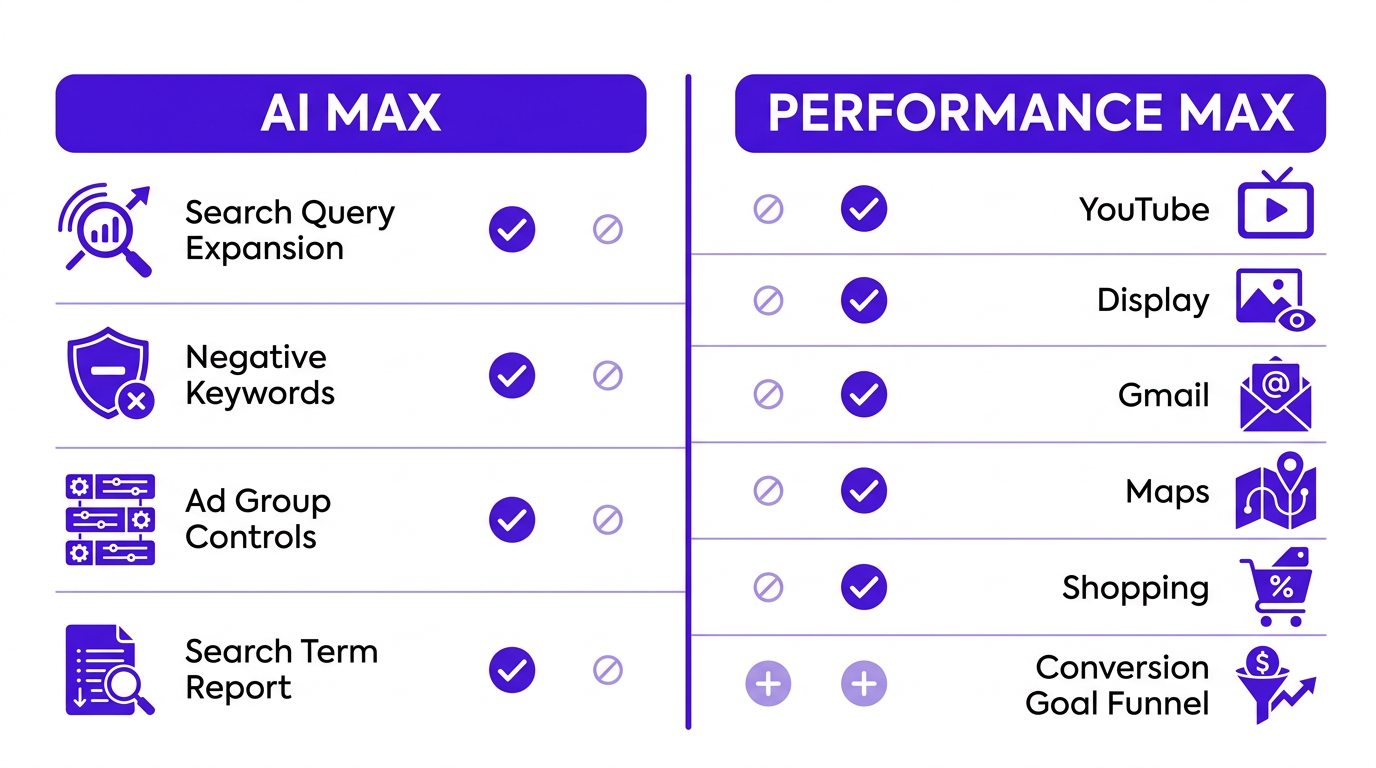
| Campaign Scope | Search only (Google Search, Search Partners) | All Google channels (Search, YouTube, Display, Discover, Gmail, Maps) |
| Control Level | High. Ad group controls, negative keywords, search term visibility | Low. Goal-based inputs, limited placement and keyword controls |
| Automation Depth | Moderate. AI handles query expansion and ad generation; advertiser sets guardrails | Full. Google controls budget allocation, targeting, creative rotation, and channel mix |
| Targeting Capabilities | Keyword-based with AI-expanded semantic matching; audience signals optional | Audience signals, asset groups, and conversion goals; no keyword-level targeting |
| Reporting Insights | Granular search term reports, ad group performance, query-level data | Aggregated channel-level data, limited search term visibility, asset performance reports |
| Best Use Cases | High-intent search capture, B2B lead gen, competitive niches, SEO-to-PPC alignment | E-commerce (Shopping), brand awareness, multi-channel lead gen, scale-first strategies |
| DSA Migration Impact | Direct successor to DSA. All DSA campaigns migrate here by Sept 2026 | No direct impact. PMax already incorporates Shopping and Display functions that DSA never covered |
| Comparison based on Google Ads capabilities as of April 2026. Feature availability may evolve. |
Control Levels and Automation Depth: What You Actually Get
This isn't a nuanced difference. It's a fundamental one. AI Max operates at the ad group level: you see which search terms triggered your ads, add negatives in real time, and adjust targeting based on actual query data. The AI expands your reach by finding related queries you didn't explicitly bid on, but you retain the ability to shape and constrain that expansion at every step.
PMax works on an entirely different model. You feed it conversion goals, audience signals, and creative assets. Google decides where, when, and how your ads appear. Google improved PMax's asset-level reporting in 2026 and added some search term visibility, but the core architecture hasn't changed: goal in, results out. You can't tell PMax to stop spending on YouTube and redirect budget to Search. The system makes those calls autonomously. For teams that need to justify every dollar to stakeholders with channel-level ROI breakdowns, this remains PMax's most significant limitation.
Signal Cannibalization: A Critical Warning for Hybrid Strategies
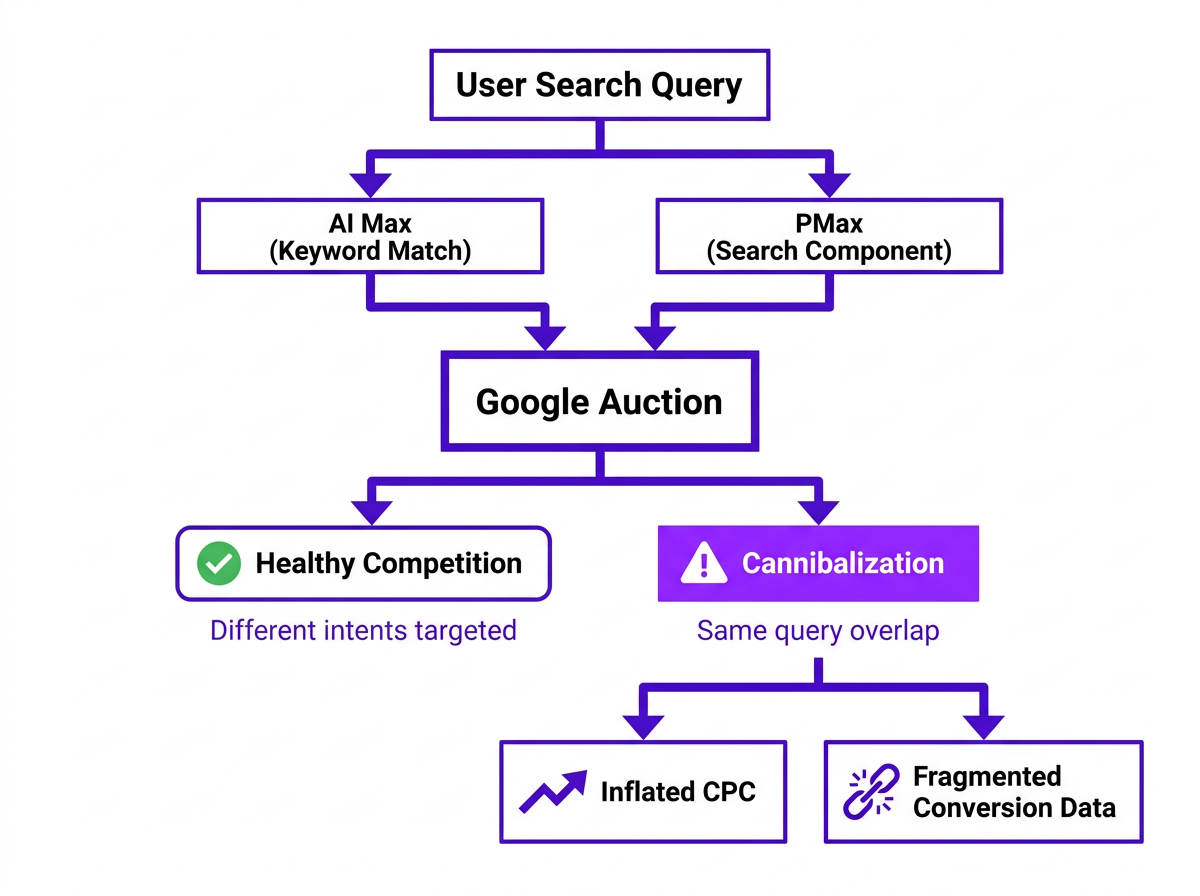
Running AI Max and PMax simultaneously is Google's recommended play, but it introduces a real and underappreciated risk: signal cannibalization. When both campaign types compete for the same search queries, they can bid against each other, inflate CPCs, and fragment your conversion data. This hits hardest in accounts where PMax's search component overlaps with AI Max's expanded keyword matching on the same high-value terms.
Consider this scenario: your AI Max campaign targets "enterprise CRM software" with expanded matching. Your PMax campaign, optimized for the same conversion goal, also serves search ads for similar queries. Google's auction system resolves this internally, but the outcome is often that one campaign siphons conversions from the other, making it impossible to evaluate either campaign's true incremental value. Tools in the Vizup Marketing Suite can help you track these overlaps and attribute conversions accurately.
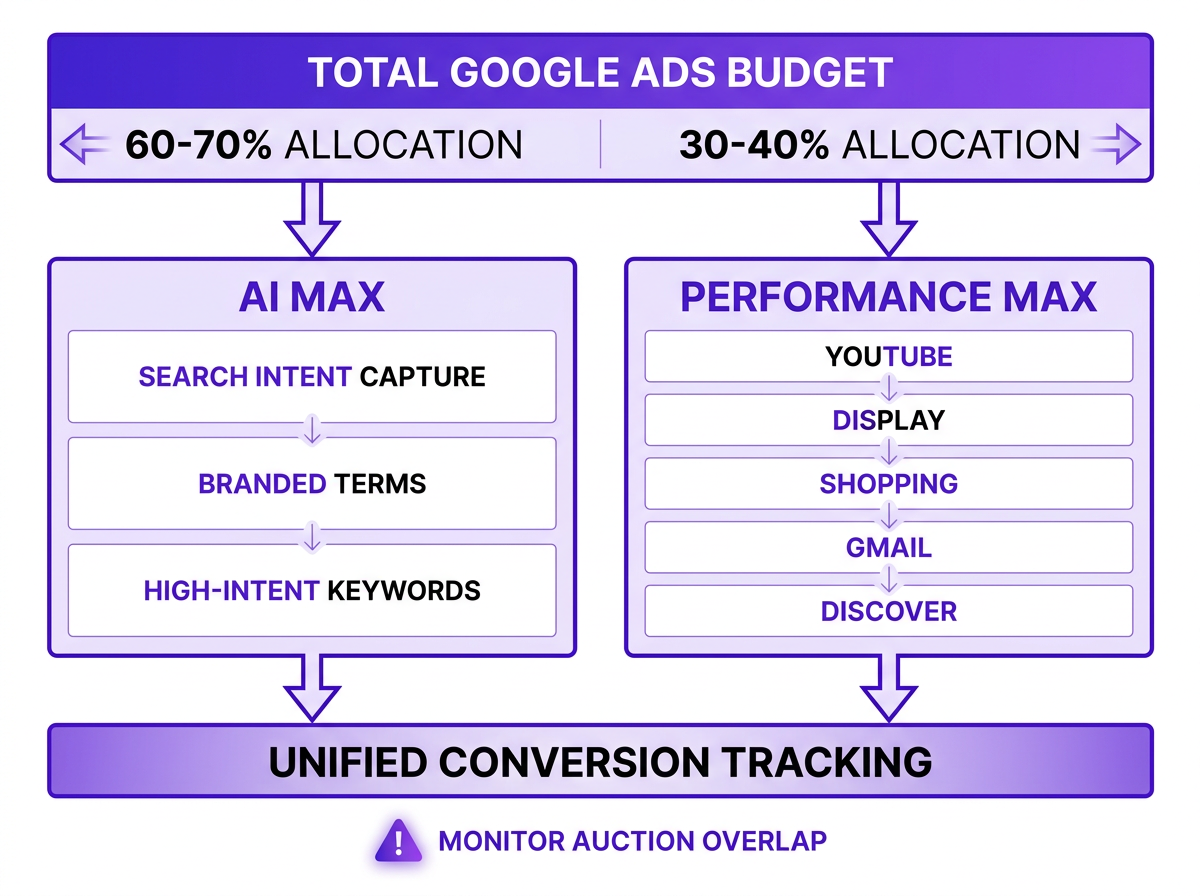
How to mitigate it: Segment by funnel stage, assigning AI Max to bottom-funnel, high-intent queries and PMax to mid- and top-funnel awareness across non-search channels. Apply brand exclusions in PMax so it doesn't bid on branded terms your AI Max campaigns already capture efficiently. For budget allocation, a solid starting framework is 60-70% of search budget to AI Max for intent capture and 30-40% to PMax for incremental cross-channel reach (adjust after 4-6 weeks of data). Monitor auction overlap reports weekly without exception.
Which Campaign Type Should You Use? The Vizup Verdict
The short answer: AI Max wins for advertisers who prioritize search intent, need granular query control, and want to align paid search with SEO insights. Performance Max wins for advertisers focused on cross-channel scale, e-commerce conversions, and reaching audiences beyond search. Most mature advertisers should run both, using AI Max for search capture and PMax for everything else, with careful budget segmentation to prevent cannibalization.
When to Choose AI Max
AI Max is the right call when search intent drives your conversions. B2B companies, professional services, SaaS businesses, and anyone operating in a competitive niche where query precision determines ROI will see the biggest returns. If your team has invested in keyword research and knows which queries convert, AI Max lets you put that intelligence to work directly.
It's also the stronger option for tighter budgets. Because AI Max doesn't scatter spend across six channels, every dollar targets search queries with demonstrated intent. Teams with strong SEO programs can feed their organic search data into AI Max targeting, creating a genuine feedback loop between paid and organic. For context on how search visibility is shifting with AI-driven results, AI search visibility optimization is worth reading. Smaller teams (one to three people managing ads) will also appreciate the transparency. When something breaks in AI Max, you can diagnose it without reverse-engineering a black box.
When to Choose Performance Max
PMax earns its spot when your goal is maximum conversion volume across every touchpoint Google offers. E-commerce businesses with product feeds are the clearest case: PMax's Shopping integration, paired with YouTube and Display prospecting, builds a full-funnel engine no other single campaign type replicates. If you're spending $50,000+ per month and your KPI is total conversions or revenue (not channel-specific ROAS), PMax delivers at a scale that's hard to match.
Larger teams with dedicated creative resources extract more value from PMax because the system rewards high-quality, diverse asset groups. More headline variations, image options, and video assets mean better performance. If your team can produce high-converting ad creatives at scale, PMax's automation will distribute them across channels you might never have tested manually.
| Factor | Choose AI Max | Choose Performance Max |
|---|---|---|
| Budget Size | Under $20K/month or tightly constrained | Over $20K/month with room for cross-channel testing |
| Team Maturity | Small teams needing transparency and control | Larger teams comfortable with goal-based automation |
| Industry Type | B2B, SaaS, professional services, competitive niches | E-commerce, DTC, local services, brand-driven categories |
| Primary Goal | Efficient search capture, CPA control | Maximum conversions across all channels, revenue scale |
| SEO Integration | Strong. Direct alignment with organic query data | Indirect. Audience signals and creative assets matter more |
| Use this framework as a starting point. Test and adjust based on your account's actual performance data. |
Running Both: The Hybrid Strategy That Works
Google's "Power Pack" recommendation exists for good reason. AI Max and PMax aren't competitors inside your account; they fill different roles. AI Max captures demand that already exists (people actively searching for what you sell). PMax generates and captures demand across channels where users aren't searching but are receptive to your message.
The hybrid approach works when you draw clear boundaries. Give AI Max ownership of branded terms, high-intent non-branded queries, and any keyword segments where you need precise CPA control. Assign PMax responsibility for prospecting, remarketing across Display and YouTube, and Shopping campaigns. Brand exclusions in PMax prevent overlap on terms AI Max already handles efficiently.
Hybrid Strategy Implementation Checklist
Practical steps for running AI Max and Performance Max together:
- Set up unified conversion tracking. Both campaign types must report against the same conversion actions. Inconsistent tracking creates misleading performance comparisons.
- Apply brand exclusions in PMax. Prevent PMax from bidding on branded terms that AI Max already captures at a lower CPC.
- Segment by funnel stage. Assign AI Max to bottom-funnel, high-intent queries. Assign PMax to mid-funnel and top-funnel awareness across non-search channels.
- Allocate budget with intention. Start with 60-70% of search budget to AI Max and 30-40% to PMax for cross-channel reach. Adjust after 4-6 weeks of data.
- Monitor auction overlap reports weekly. Identify where both campaigns compete for the same queries and adjust negatives or audience signals accordingly.
- Review asset group performance in PMax monthly. Replace underperforming creatives and test new variations to keep the algorithm fed with fresh inputs.
Continuous monitoring is non-negotiable. Google's AI evolves constantly, and what performs well in Q2 2026 may need recalibration by Q4. Tools like Vizup help marketing teams monitor their digital presence across search environments, providing the visibility needed to understand how paid and organic signals interact as algorithms shift. For teams managing complex, multi-channel strategies, Vizup's competitive intelligence tools offer complementary capabilities. For content-driven paid approaches, Vizup's AI content workflows can feed better assets into both campaign types.
The AI Max vs Performance Max decision isn't about picking one system and ignoring the other. It's about understanding what each does best and building an architecture that eliminates redundancy. Start with clean conversion tracking, segment your budget with intention, and review performance weekly. The advertisers winning in 2026 treat AI Max and PMax as complementary instruments, not interchangeable ones. For teams still refining their messaging, resources on writing compelling Google Ads copy can sharpen the creative inputs both campaign types depend on.
Frequently Asked Questions About Google Ads Automation in 2026
Will AI Max completely replace standard Search campaigns?
No. AI Max is a set of AI-powered features applied to existing Search campaigns, not a replacement. Your standard Search campaigns remain the foundation. AI Max enhances them with expanded query matching, dynamic ad generation, and improved automation. You can enable or disable these features within your Search campaigns based on your needs.
How can I prepare my website for the DSA migration to AI Max?
Focus on content quality, site structure, and page feeds. Make sure your landing pages have clear, relevant content that accurately describes your products or services. Fix broken links and improve page load speed. If you use page feeds for DSA targeting, audit every URL for accuracy and relevance. AI Max uses your website content to generate ads and match queries, so poor content produces poor results. Start testing AI Max features on a few campaigns before the September 2026 deadline.
Is it possible to run both AI Max and Performance Max campaigns simultaneously without issues?
Yes, and Google recommends it as the "Power Pack" strategy. That said, you need to manage signal cannibalization carefully. Apply brand exclusions in PMax, segment campaigns by funnel stage, and monitor auction overlap reports weekly. Without these guardrails, the two campaign types can bid against each other on the same queries, inflating costs and fragmenting conversion data.
What's the biggest difference in reporting between AI Max and Performance Max?
Granularity. AI Max provides detailed search term reports at the ad group level, showing exactly which queries triggered your ads and how they performed. Performance Max offers aggregated, channel-level reporting with limited search term visibility. You can see asset performance and overall conversion data in PMax, but drilling into specific queries or placements with the same precision AI Max provides isn't possible.
How much control do I truly have over targeting in Performance Max in 2026?
Limited, by design. You provide audience signals (custom segments, customer lists, demographics) and conversion goals. Google's system decides how to use those signals across channels. You cannot set keyword-level targeting, exclude specific placements with full precision, or control budget distribution across channels. Google has improved audience signal weighting and added some placement reporting in 2026, but PMax remains fundamentally a goal-based system where the algorithm makes most targeting decisions.
Which campaign type is better for small budgets?
AI Max is typically the better fit for smaller budgets. Because it focuses exclusively on search, every dollar targets queries with demonstrated purchase or conversion intent. PMax spreads budget across multiple channels, which requires higher spend thresholds to generate enough data for the algorithm to optimize effectively. Accounts under $20,000 per month generally see stronger cost efficiency from AI Max.
How does AI Max handle keyword expansion differently from broad match?
AI Max expands your keyword targeting by identifying semantically related queries you didn't explicitly bid on. It uses Google's understanding of search intent to match your ads with relevant variations, synonyms, and related phrases. The key difference from broad match alone is that AI Max pairs this expansion with transparent search term reporting and negative keyword controls, so you can see exactly what it's matching and block irrelevant queries in real time.
