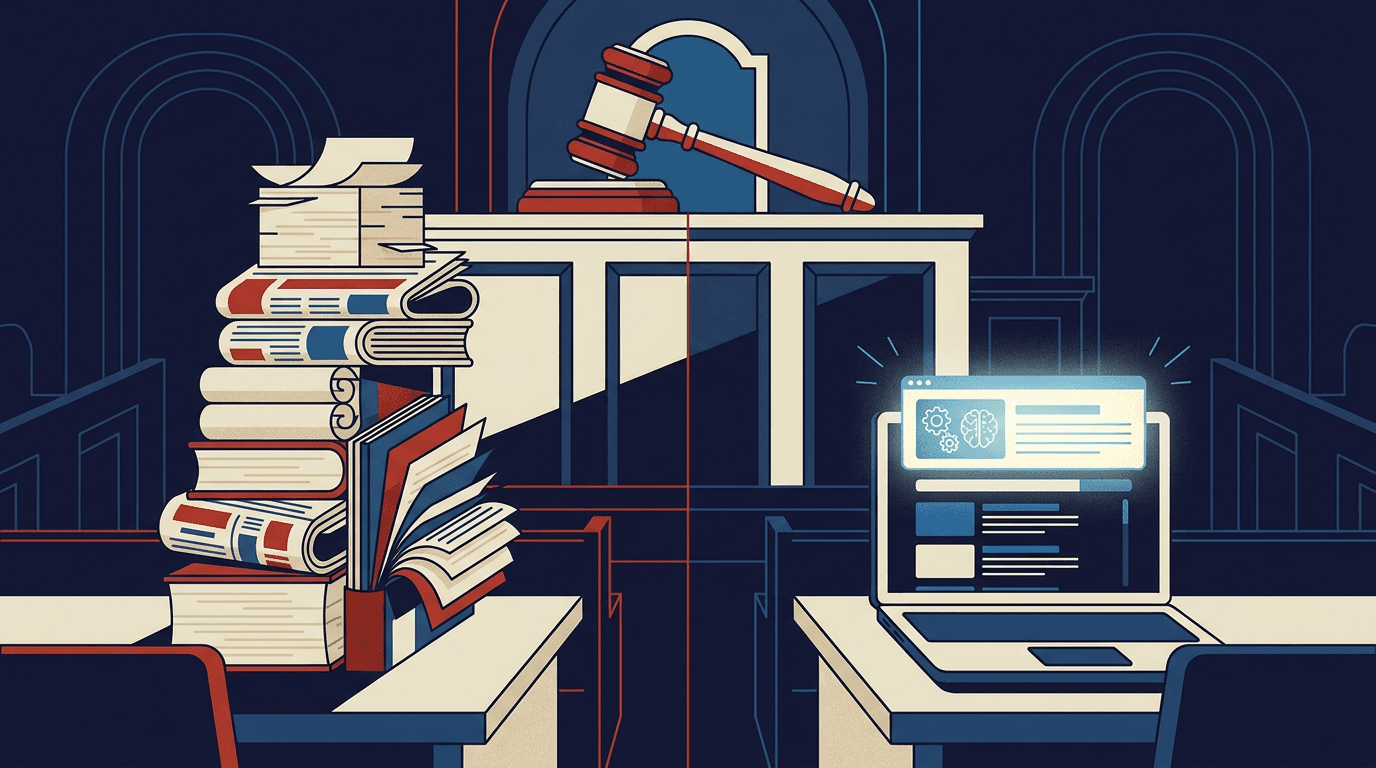
U.S. District Judge Amit P. Mehta's September 30, 2026 dismissal of the AI Overviews lawsuits did more than dispose of one dispute. It rejected an assumption that has guided publisher strategy for two decades: that letting Google crawl a site created a reciprocal obligation to send traffic back. In the court's view, that content-for-traffic bargain never existed in law. Publishers may have expected referral traffic in exchange for free access to their pages, but an expectation, Mehta wrote, "is not an agreement. It is simply how a general search engine works" (U.S. District Court Memorandum Opinion, 2026).
Publisher SEO leads, content directors, and founders should read the decision without either fatalism or wishful thinking. It closes neither every legal route nor tomorrow's publishing calendar. It does remove the antitrust premise on which publishers hoped to force compensation for content used in AI Overviews. The practical task is to separate what the court decided from what remains unresolved, then build a strategy that does not depend on a bargain a federal court says was never made.
The Core of the Ruling: Why the Implied Agreement Failed in Court
The Penske Media Google lawsuit and Chegg's parallel antitrust case, filed in 2025, shared a theory. Publishers said Google used its search monopoly to impose an exploitative choice: permit crawling or disappear from search. When Google used that material in AI Overviews that answered queries without a click, they argued, it had broken the implicit arrangement (Reuters, 2026).
Mehta rejected that theory at the threshold. The court found no evidence of an implied crawling agreement between Google and publishers. Publishers permit crawling because indexing advances their own commercial interests, the ruling says, not because Google promised a return. Google's access to their pages is therefore not a contractual exchange; it is part of the operating model of open-web search.
The Sherman Act claims therefore failed for a basic reason: antitrust law requires an agreement, express or implied, that restrains trade. Without one, there is no restraint for the court to assess. Mehta acknowledged the publishers' predicament, saying the court was not "unsympathetic to the situation publishers now find themselves in, and the knock-on consequences to journalists, educators, and other online creators whose content Google takes and repurposes without compensation" (Press Gazette, 2026). Sympathy was not enough to establish an antitrust claim.
Info: The ruling does not hold that publishers lack rights in their content. It holds that the specific antitrust theory based on a broken implied bargain fails. Copyright, regulatory, and other claims are separate questions.
What This Means for AI Overviews and Your Traffic
The suits responded directly to AI Overviews, which turn publisher material into answers on the results page and can reduce click-throughs. Publishers had reason to worry that AI Overviews publisher traffic would fall as Google resolved more searches without a visit to the underlying source. Their legal strategy sought either compensation or a redesign of the product. That route is now stalled.
Following the AI Overviews lawsuit dismissal, Google faces less immediate litigation pressure to change how it sources or presents generative answers. Reputational and regulatory pressure remain, but the leverage supplied by these cases is gone for now. Content teams should plan accordingly: their work may feed answers that generate no referral visit, and no near-term court order is likely to reverse that arrangement.
Knowing how AI search engines retrieve and cite content is no longer optional background knowledge for publishers. When a page appears in an AI Overview, citation mechanics, attribution, and link placement determine whether any value returns to the source. The ruling offers no legal assurance that it will.
Publisher Legal and Strategic Options After the Ruling
One dismissal does not exhaust publisher legal recourse, and treating it as a final settlement would overread the opinion. Penske and Chegg tested a particular antitrust theory. Other claims, courts, and regulators remain relevant. Still, waiting for a later legal win is not an operating plan. Publishers need to work on several fronts at once.
Technical Controls: The Self-Help Route
Publishers now have separate controls for search visibility and AI model use. Google's Search Console generative AI control lets verified site owners include or exclude their content from supported generative AI features in Google Search, including AI Overviews, AI Mode, and generative AI features in Discover, without using that choice as a ranking signal for other parts of Search. Google-Extended serves a different purpose: it allows publishers to limit certain uses of crawled content for Gemini model training and grounding outside these Search controls. Robots.txt and noindex remain broader crawling and indexing controls, so publishers should understand the visibility trade-offs before using them.
Future Litigation: Copyright and the Broader Antitrust Case
Publisher legal options for AI extend beyond the dismissed claims. Copyright cases argue that training on copyrighted work and producing derivative outputs amount to unauthorized reproduction. That is a different theory from an implied bargain, and several cases are moving through federal courts. Publisher legal options extend beyond the dismissed claims. Copyright and other content-use disputes rely on different legal theories. Separately, the Department of Justice's broader Google search monopoly case has already moved through liability and remedies, with implementation and compliance activity continuing in 2026. That proceeding remains relevant to competition in search, but it should not be described as an upcoming 2026 trial. The UK's CMA is pursuing its own enforcement actions; see legal and regulatory challenges to Google for international context.
Commercial and Strategic Pivots
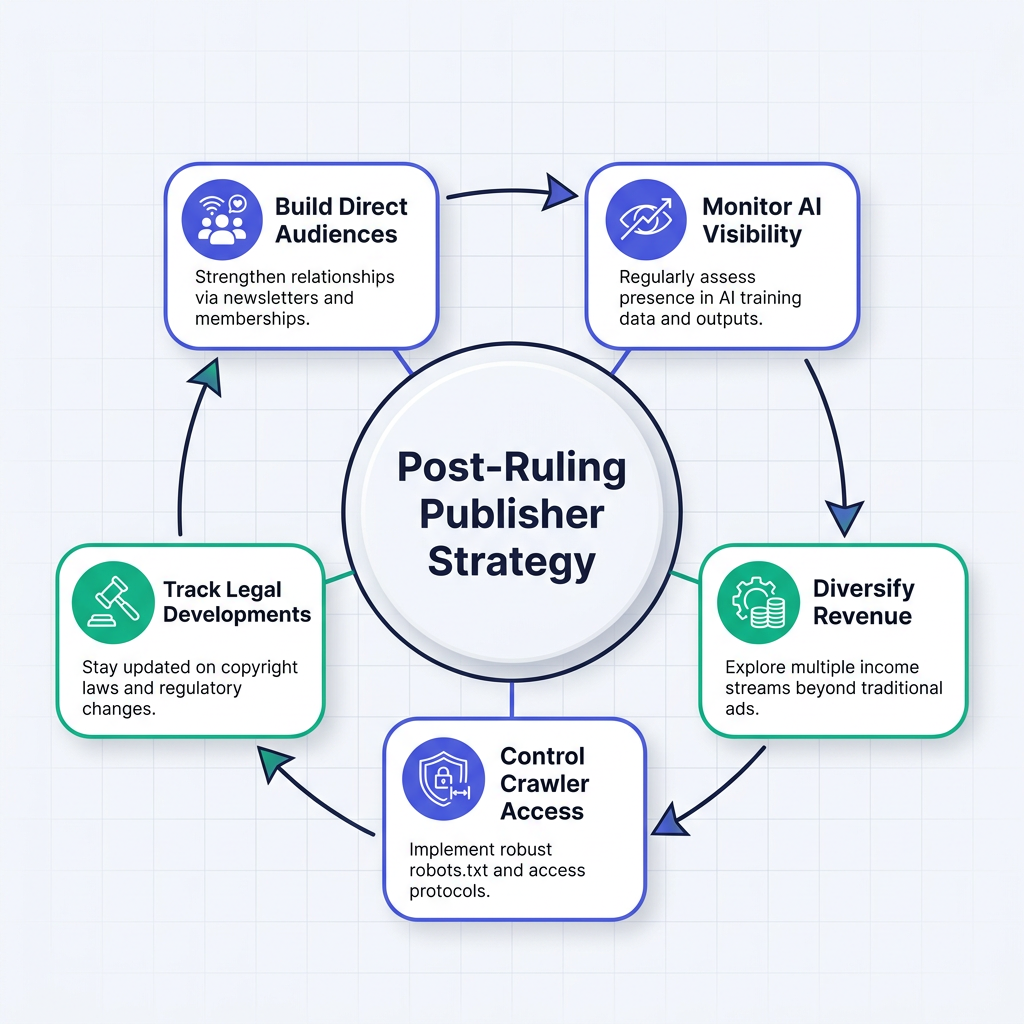
The sturdier response is operational rather than legal. Publishers whose revenue rests on programmatic ads and Google referrals carry obvious exposure. Direct relationships - newsletters, memberships, and communities - alongside first-party data and diversified revenue make a business less vulnerable to any one court or platform decision. Google should be treated as a discovery channel, not the business's foundation. Monitoring visibility in search, AI answer engines, social platforms, and community discussion provides the signal needed to adapt. That broader view of presence underlies Vizup's approach to making content discoverable in AI engines.
This is where Vizup's Organic Autopilot approach becomes useful. Instead of treating Google rankings, AI citations, social visibility, community presence, and local discovery as separate problems, Vizup helps brands monitor, create, optimise, publish, and learn across Search, Social, Communities, AI Answer Engines, and Local Discovery using AI agents, human experts, and live SEO, pSEO, AEO, and GEO tools. Paid ads can be layered on as amplification, while the core system remains focused on building sustainable organic discovery.
How to Talk to Your Leadership About This Ruling
SEO leads and content directors will likely need to explain this decision to non-technical leadership. Avoid the two easy errors: "We lost, Google wins forever" and "It is one case, so nothing changes." Neither describes the decision. Frame the conversation around immediate operations and longer-term exposure.
Short-term reality: Daily SEO does not stop. Content production, technical work, and performance monitoring remain necessary, and Google says Search continues to send billions of clicks to websites each day, even as AI-powered search experiences change how those clicks are distributed. The decision did not change ranking systems or erase organic traffic. It does not invalidate your team's present work.
Long-term strategic shift: Retire the assumption that Google is a stable partner obliged to return traffic for access to content. Revenue from AI search will depend more on whether users seek out your brand, whether your work is structured for citation, and whether other revenue streams survive a referral decline. Ask not only "how much traffic did Google send this month?" but "how visible and valuable is our brand across discovery surfaces?" Rethinking traffic metrics explains why that distinction matters.
The leadership message is plain: the rules of engagement have shifted, but the work continues. The playbook must assume that no court will require Google to send traffic and that value from content must increasingly be captured through channels the publisher controls.
Common Misconceptions About the Ruling
Misconception 1: "Publishers have no legal options left." One antitrust theory was dismissed. Copyright claims arise under different statutes and are being litigated, while the broader DOJ antitrust case proceeds independently. The implied-bargain claim is finished; publisher legal options are not.
Misconception 2: "The ruling says Google can do whatever it wants with publisher content." It does not. The court found no antitrust agreement to violate. Copyright, fair use, and regulatory compliance were not decided in this proceeding. Google's use of content in AI Overviews remains contested on other grounds.
Misconception 3: "Blocking Google's crawlers is now the only option." Technical controls are one lever. Treating them as all-or-nothing misses the purpose of Google-Extended, which can preserve standard indexing while restricting AI training use. Diversification, commercial negotiation, and industry coalitions remain parallel options.
Key Takeaways for Publishers and Content Businesses
- The content-for-traffic bargain is no longer a viable antitrust argument. The dismissed cases show that an expectation of referral traffic, by itself, is not enough to establish the reciprocal agreement required for the antitrust theory the publishers advanced.
- The law treats Google's crawling as a publisher's voluntary, self-interested choice, not one side of a reciprocal agreement.
- Dismissing the Penske Media and Chegg AI Overviews suits reduces the immediate pressure on Google to redesign the product or compensate publishers.
- Legal options remain: copyright claims and the 2026 DOJ Google search antitrust trial rest on separate theories.
- Move litigation out of the role of primary strategy. Combine crawler controls, audience and revenue diversification, and close monitoring of legal and regulatory developments.
- Build a brand and content operation people seek directly, reducing dependence on any single discovery channel.
Frequently Asked Questions
What was the 'content for traffic bargain' that the judge dismissed?
It was the assumption that publishers let Google crawl and index their pages in return for search referrals. Judge Amit Mehta held that this was an expectation, not an enforceable agreement. Publishers made content available because indexing served their interests, and Google made no formal promise to send traffic back.
Does this AI Overviews lawsuit dismissal mean publishers have no legal options against Google?
No. The dismissal concerns Sherman Act claims built on the implied-bargain theory. Copyright cases alleging unauthorized reproduction through AI training and output rest on a separate basis. The Department of Justice's broader 2026 antitrust trial against Google concerns monopoly maintenance in search distribution and could still produce remedies relevant to publishers.
Why did Judge Amit Mehta rule against the publishers in the Penske Media Google lawsuit?
Mehta found no explicit or implied agreement between Google and the publishers. Sherman Act claims require an agreement that restrains trade. Because the court viewed crawling permission as voluntary and self-interested rather than contractual, there was no agreement to assess and no antitrust violation under that theory.
Can I stop Google from using my content in AI Overviews?
You have partial technical control. Google-Extended can block use for AI training and generative features while preserving standard indexing. Robots.txt and noindex offer further controls. A full block may also reduce visibility in AI-powered search, leaving a real trade-off between control and discoverability. Google's Preferred Sources feature is another mechanism to watch.
How does this ruling affect publisher revenue from AI search?
It removes an antitrust lever publishers hoped might force compensation for AI Overview use or guarantee referral clicks. Revenue from AI search now depends more on execution: structuring material for citation, building direct audience relationships, diversifying beyond search-dependent programmatic ads, and tracking visibility across discovery channels.
