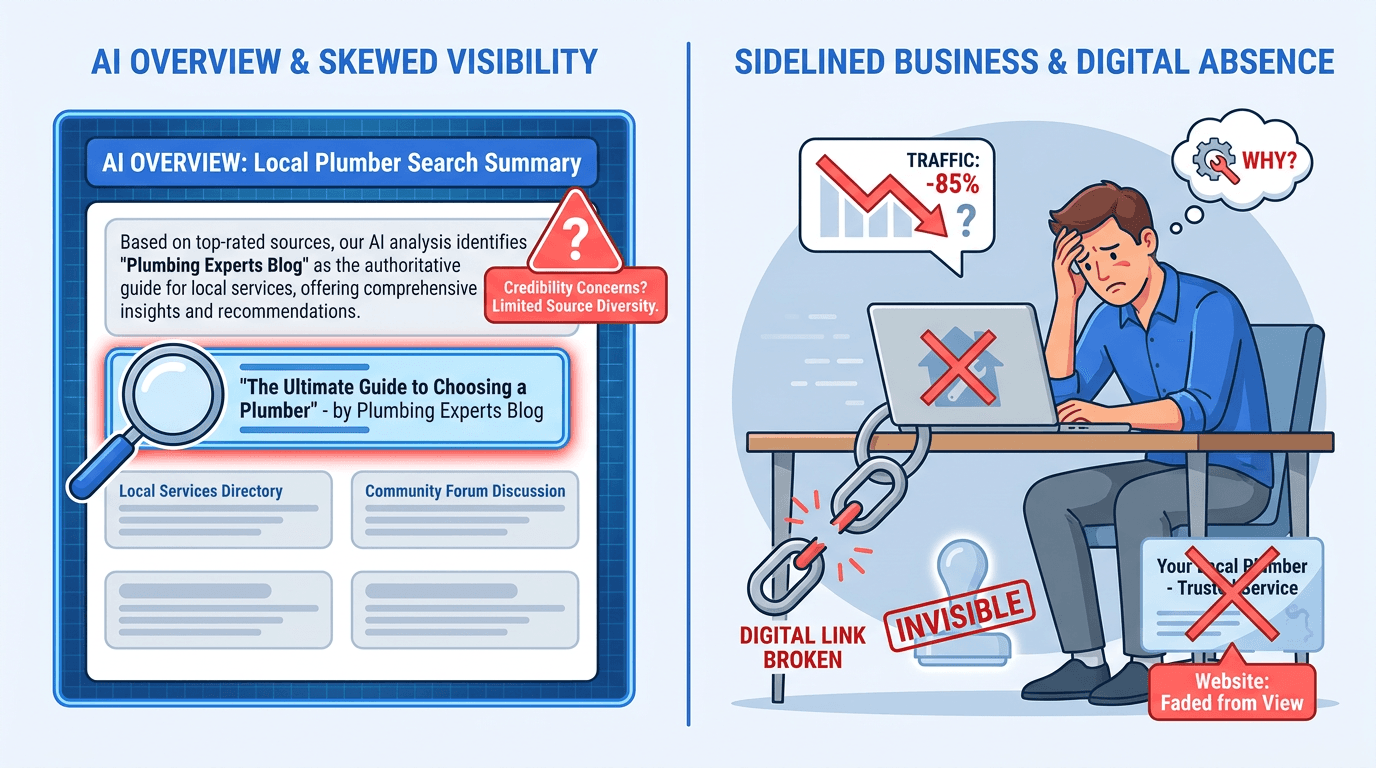
AI Overviews local search listicles can become a problem when Google's AI Overviews treat a biased 'best of' post as an authoritative local source. Often, the business that wrote the article ranks itself first. The resulting summary misleads searchers and gives skewed content an advantage over more credible local competitors.
You have probably seen it: an AI Overview for 'best plumbers in Brooklyn' cites a plumber's own post naming itself the top choice. That is more than an AI Overview oddity. It is a risk for any brand competing for local discovery. AI Overviews now appear for 68% of local queries (Search Engine Land, March 2026), making citation quality consequential.
Why AI Overviews Local Search Listicles Can Surface Biased Sources
Google's AI Overviews synthesize top-ranking pages into a direct answer. Their source selection still leans heavily on familiar SEO signals: backlinks, keyword density, structured data, and topical relevance. Editorial intent is harder to detect. How AI engines retrieve and cite content helps explain the local-search gap.
An optimized post with internal links, schema markup, and a title such as 'Top 10 HVAC Companies in Phoenix (We Ranked Them)' can resemble an independent review to the system. Then the loop starts: it ranks, earns an AI citation, collects more authority signals, and ranks again. That is AI answer source bias: availability and optimization beat accuracy and trustworthiness.
Warning: In August 2026, Search Engine Roundtable documented a case where Google's AI Overview for a local legal query cited a single attorney's self-promotional blog post as the primary source for every law firm listed in the summary. The AI presented this as objective guidance.
What Does This Look Like in Practice?
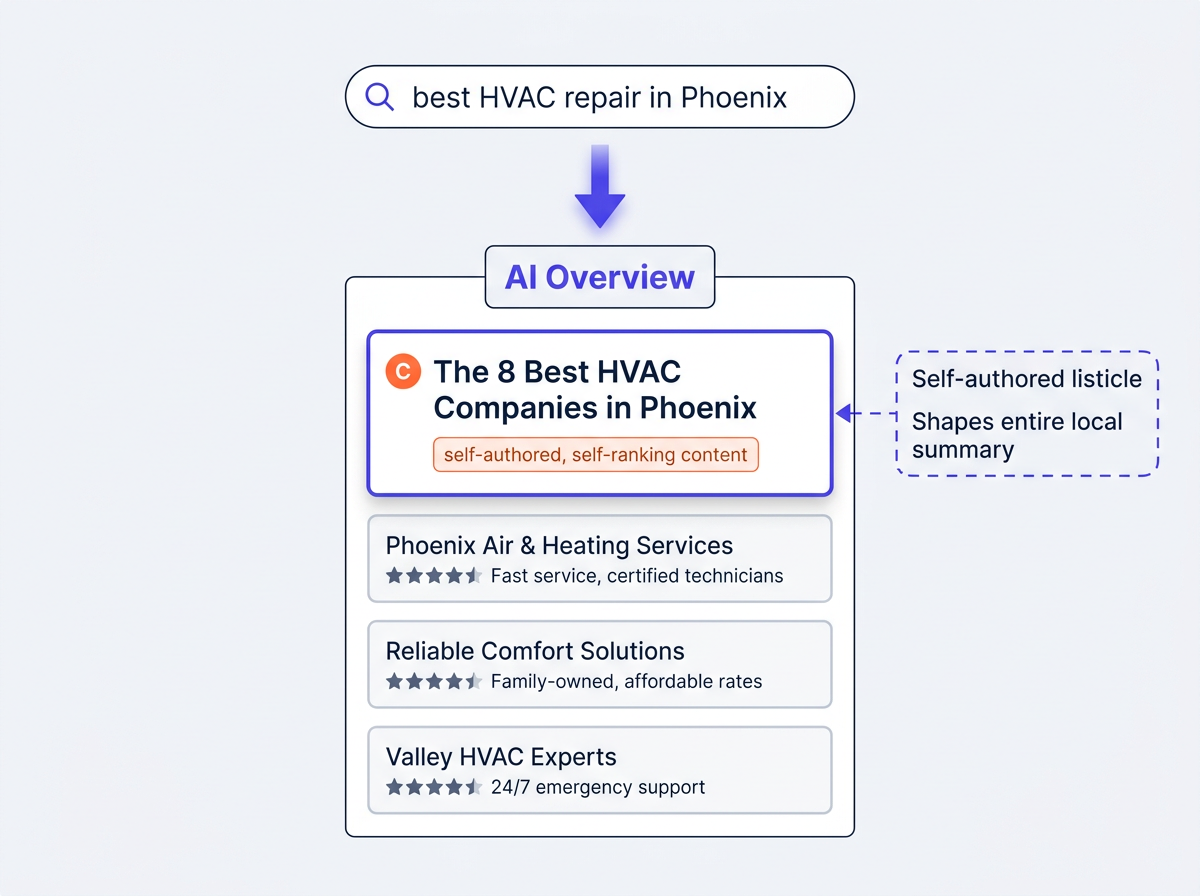
Search for 'best HVAC repair in Phoenix.' One company publishes 'The 8 Best HVAC Companies in Phoenix' and puts itself first; that page becomes the AI Overview's backbone. The local pack summary now reflects its ranking rather than an independent assessment. Competitors with better reviews or service may vanish from the answer.
A June 2026 analysis of B2B software queries found 323 instances where AI Overviews cited self-promotional listicles. In 224 of those cases, about 69%, Google cited the publisher's page but did not recommend that publisher in the answer. The experience is odd: Company A's source is cited, while B, C, and D are recommended. The mismatch exposes the tension between citation quality and ranking signals. See the local search impact of AI citations.
Is My 'Best Of' Content a Liability Now?
It depends on how the page was made. Google continues to refine both its ranking systems and spam protections, while its spam policies explicitly cover attempts to manipulate generative AI responses in Google Search. That makes thin or deceptive self-promotional listicles a risky long-term strategy, especially when they are designed primarily to influence rankings or AI-generated recommendations rather than help readers make an informed choice.
The Defensible Listicle: What GEO Content Integrity Actually Looks Like
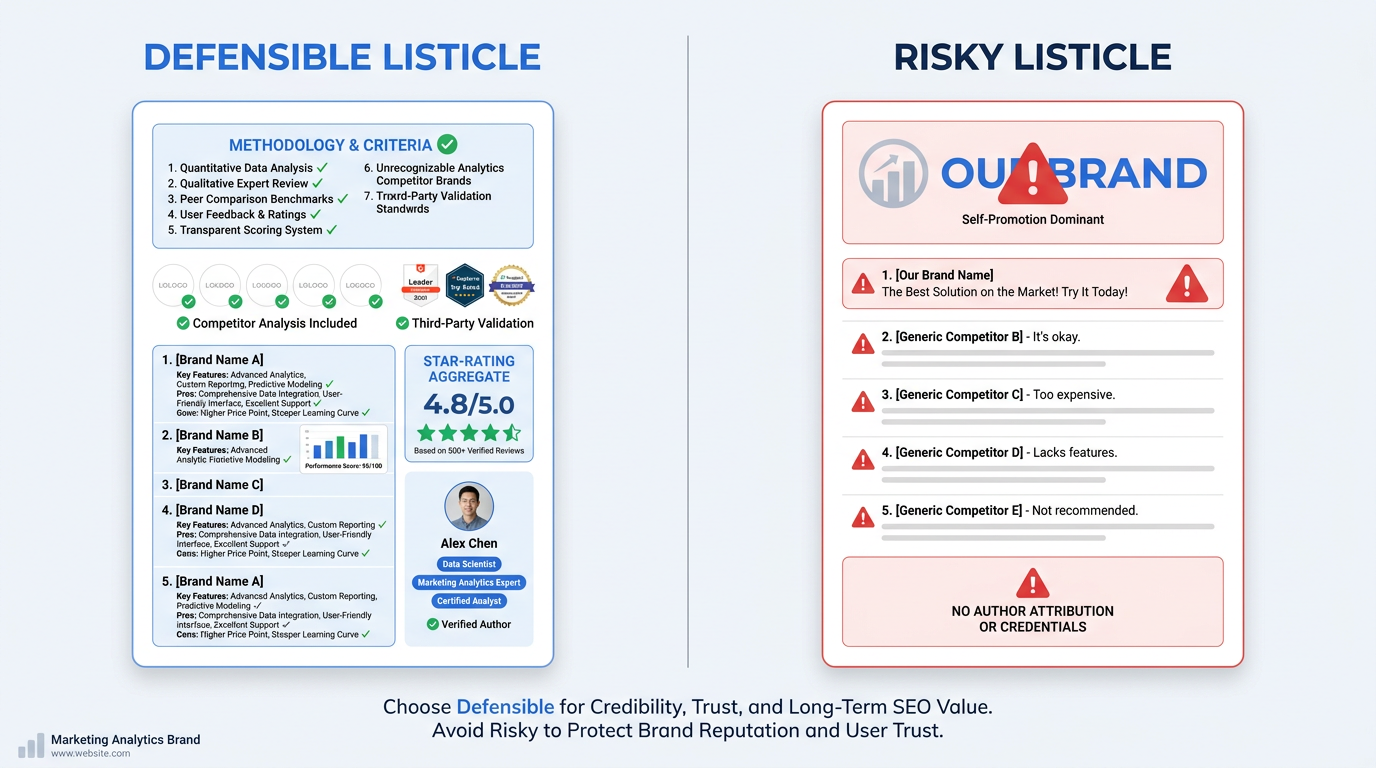
A defensible listicle shows its editorial work: a stated methodology, honest competitor assessments, external sources for claims, and a named author with relevant expertise. If the post would withstand a journalist's or Google quality rater's scrutiny, it is more defensible. That is the material AI Overviews should cite, and it supports sustainable improving brand visibility in AI search.
The Risky Listicle: Red Flags That Signal Self-Promotion SEO Risk
Audit existing listicles for these warning signs:
- Your business is always number one, regardless of the query or category
- No methodology explains how businesses were selected or ranked
- Competitor entries are thin or dismissive while yours is detailed and glowing
- The page targets a keyword rather than helping a reader decide
- It cites no external sources, review data, or third-party validation
Pages with these traits carry a growing search and credibility risk. Google has acknowledged concerns around low-quality self-serving 'best of' content, while its broader spam policies target content designed to manipulate Search or generative AI responses. The safer approach is to make rankings transparent, evidence-based, and genuinely useful to readers.
What Can You Do If a Competitor's Biased Listicle Is Being Cited?
Seeing a competitor's self-promotional post drive local AI citations is frustrating. Document and report the issue, but treat those measures as temporary. A proactive content strategy is what changes the underlying result.
A practical response framework:
- Document everything. Capture dated screenshots of the AI Overview, cited URL, and disputed claims for internal reporting and Google feedback.
- Submit feedback via the AI Overview. Use thumbs-down or 'More about this result' to flag AI answer source bias, explaining why the source is self-promotional.
- Build demonstrably better content. Publish a comprehensive, transparent listicle that genuinely evaluates competitors. This is the durable way to displace a biased citation.
- Monitor proactively. Vizup for Local can alert you when your brand appears or disappears in AI-generated local answers, rather than weeks later.
Tip: Feedback to Google rarely changes results quickly. The dependable way to displace a competitor's biased listicle is to outrank it with content that is more trustworthy, comprehensive, and useful.
For teams handling this across many locations, AI search visibility management tools track the sources AI Overviews use and reveal coverage gaps before competitors exploit them.
Key Takeaways
What SEO and content strategists should know about AI Overviews local search listicles:
- AI Overviews do not reliably separate independent editorial pages from self-promotional listicles, leaving local citations open to manipulation
- Google's spam policies cover attempts to manipulate Search and generative AI responses, making transparent, reader-first listicles a safer strategy than thin self-promotional rankings.
- Defensible listicles state their methodology, cover competitors fairly, and name an author; risky pages rank their publisher first without justification
- When a competitor is cited, document and report the result, then create content that earns the citation on merit
- Monitoring brand presence in local pack AI summaries is now part of local search strategy
Frequently Asked Questions
What is a self-promotional listicle in SEO?
It is a 'best of' or 'top X' post published by a business that names itself the top option. Rather than offering an independent assessment, it promotes the publisher's products or services. In AI Overviews local search listicles, that built-in bias matters because the page can still be cited as an authority and shape a misleading answer.
How does Google's AI Overview select local-search sources?
Google's AI Overviews synthesize information from web sources into direct answers. Traditional SEO fundamentals still matter, but being highly ranked does not guarantee that a page will become an AI Overview citation. Retrieval relevance, clarity, usefulness, and the supporting sources Google selects for a particular query can all affect what appears in the answer.
Will Google penalize my site for 'best of' articles that include my company?
Not automatically, though the risk is growing. Following Google's December 2025 and February 2026 core updates, sites with many self-promotional listicles saw visibility declines. The June 2026 spam update also extended policies to content meant to manipulate generative AI responses. Transparent methodology, real competitor coverage, and demonstrable E-E-A-T reduce exposure compared with thin, self-serving pages.
How should I report a biased or inaccurate AI Overview?
Use the feedback control in the AI Overview panel, usually thumbs-down or 'More about this result.' Identify the cited source, explain the bias - for example, that it was written by the business ranked first - and describe the accuracy problem. Reports are worth filing, but Google does not guarantee a quick change; stronger competing content is the more reliable response.
How can I increase my chances of being cited correctly in local AI Overviews?
Build GEO content integrity: state an evaluation methodology, assess competitors honestly, cite external sources and review data, and use an author with verifiable category expertise. Use relevant structured data where it accurately represents the visible page content, but do not treat schema as a shortcut to AI Overview citations. Google says no special structured data is required for its generative AI search features. Monitoring citations with Vizup for Local shows when your brand is missing so you can make targeted improvements.
