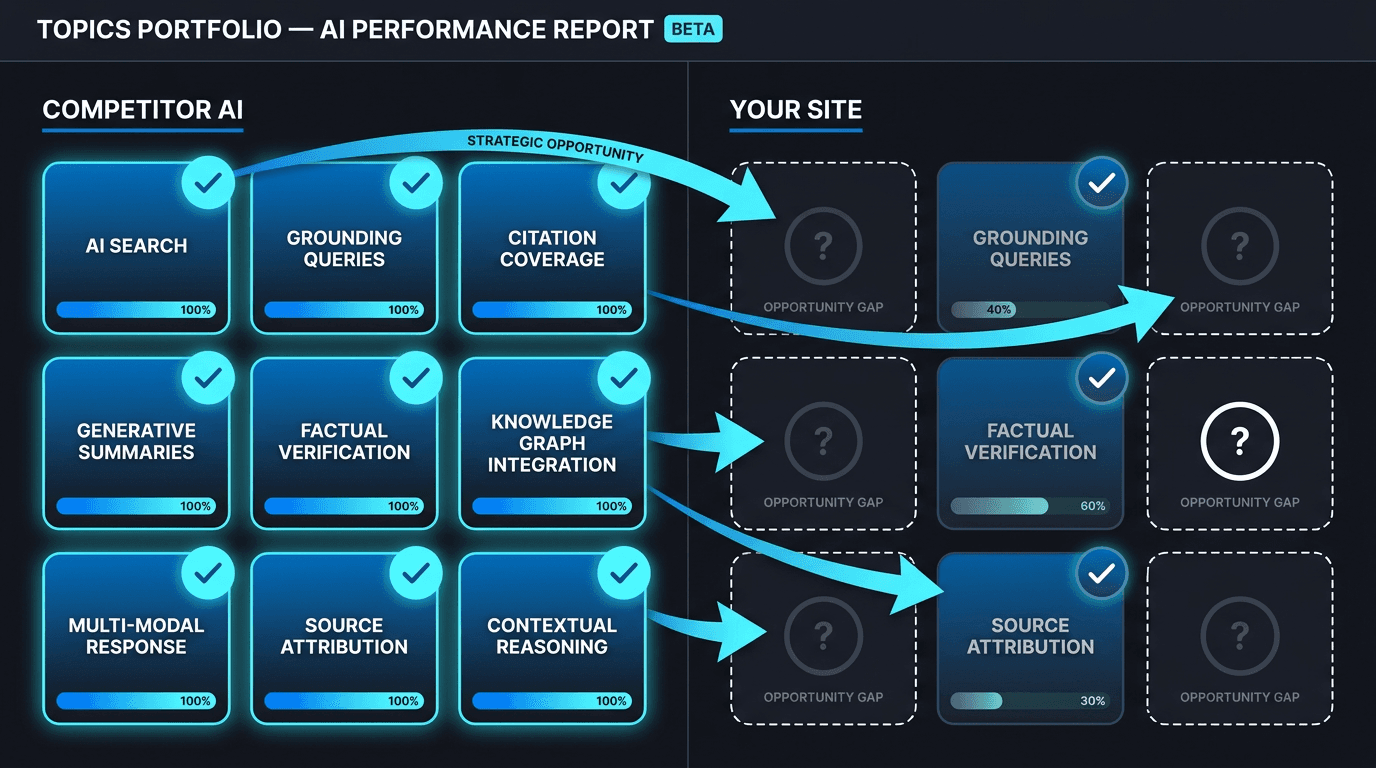
On October 13, 2026, Microsoft announced Topics Portfolio, a beta addition to the AI Performance report in Bing Webmaster Tools. It clusters grounding queries by theme and surfaces opportunity queries where other sites appear while yours does not, giving publishers a clearer view of where their AI visibility could grow. That final layer is the useful one: a visible list of AI citation gaps.
The existing Topics dimension tells you the broad subjects attached to cited pages. Topics Portfolio adds ownership: your share, the domains taking the remainder, and a ranking that points toward the next editorial bet.
Steps at a glance:
- Open AI Performance in Bing Webmaster Tools.
- Select Topics Portfolio.
- Review the Top Opportunity Queries section.
- Open a topic to review grounding queries and cited competitors.
- Review the competitor pages and turn the findings into a brief.
First: Are You Eligible? The Beta Caveat
Topics Portfolio is part of the bing ai performance beta rollout. Microsoft says Topics Portfolio appears when there is sufficient data for the site. Topics with insufficient site presence or ecosystem activity may not appear, and some sites may not see the feature at all. An empty or limited report can therefore reflect insufficient site presence or ecosystem activity rather than a problem with the feature itself.
Warning: Empty report? Focus first on getting more content indexed and cited in Bing's ecosystem, then return to this tab. Bing AI visibility insights covers the baseline work.
Step 1: Navigate to the AI Performance Report
Select your property in Bing Webmaster Tools, then go to Performance > AI Performance. This is where Bing reports citation activity, cited pages, grounding queries, and related AI visibility data across supported Microsoft AI experiences. Anyone already using the Topics dimension is in the right report; Topics Portfolio sits beside the familiar views.
Step 2: Open the Bing Topics Portfolio Tab
Click Topics Portfolio inside AI Performance. The Topics Portfolio view organizes thematic clusters using Topic, Topic Size, Sites Cited, and Queries, giving you ecosystem context around each area where your site already has meaningful presence. A row is a contested subject area, with a measurable position for your domain, rather than a label attached to a page.
That distinction matters. A single bing ai citation topic is too narrow to anchor an editorial plan; a cluster is large enough to expose demand, competition, and your missing coverage. The detail beneath it supplies the actual queries. The same citation pattern appears across engines, as what gets cited in AI search explains.
Step 3: Decode the Metrics and Find Your Opportunities
Start with bing top opportunity queries, the default Topics Portfolio sort. Use Topic Size, Sites Cited, and the available opportunity queries together to prioritise clusters. Larger topics with meaningful opportunity coverage may deserve more attention, but Bing does not publish a universal citation-share threshold for prioritisation.
Topic Size is Bing's approximate measure of total citations in a cluster. Sites Cited is the number of distinct source domains. Neither is a ledger-grade count, so use both for prioritisation rather than forecasting. A large topic with few cited sites deserves a different response from a small, crowded one.
| Topic Size | Sites Cited | Classification | Recommended Action |
|---|---|---|---|
| High | Low | Goldmine | Prioritise it. Demand is high and few competitors are entrenched; one strong piece can materially shift citation share. |
| High | High | Crowded Field | Enter with a distinct angle: original data, a different format, or a more current treatment. |
| Low | Low | Niche Opportunity | An easier win with limited upside. Useful for building citation history in an adjacent area. |
| Low | High | Avoid | Too much competition for a small citation pool. Put resources elsewhere. |
| topic size sites cited bing: use this matrix to rank your Topics Portfolio rows before writing a single word. |
Step 4: Drill Into a Topic for Competitor AI Citation Analysis
Open any Topics Portfolio row for the detail view.The topic detail view separates the queries where your site already appears from opportunity queries where other sites appear and yours does not. Those queries are the inputs behind Copilot's answers. Grouped this way, they move the work from a vague visibility problem to a defined assignment.
The opportunity-query view makes Bing AI citation analysis more useful for planning. It shows where your site is missing from citation activity even though other sources are appearing, rather than leaving competitor ai citation analysis as a black box. Use a prompt for competitor analysis to review the cited pages consistently before drafting.
Step 5: Turn a Topic Into a Content Brief
Choose two or three priority opportunity queries from the selected topic, then independently review the pages currently earning visibility for those searches where appropriate. Begin with format: is Bing selecting a how-to, FAQ, data study, or comparison table? That pattern indicates the retrieval shape working for this cluster. Meet that standard, then give readers a reason to prefer your version.
Turn the detail-view grounding queries into proposed sections or H2 targets. Each query signals a sub-intent. A piece that answers the full set with appropriate depth has a stronger structural case for citation than one that covers only the obvious questions. That is how to find ai citation gaps and close a coherent cluster with one well-scoped article.
Tip: Bing geo reporting in AI Performance filters citation data by region. Apply it before briefing market-specific work, so the grounding queries and competitor set reflect local AI answers rather than global averages.
Vizup's Strategist agent handles this process at scale: it reviews cited competitor content, identifies topical and structural gaps, and produces an AI-optimised brief. Manual review becomes difficult when a team is managing dozens of opportunity topics. benchmark LLM visibility for competitors for a repeatable AEO workflow.
From Reactive to Proactive AEO
Bing Topics Portfolio gives AEO a workable operating loop: ranked topics, citation share, underlying queries, and the domains ahead of you. Audit five priority topics, publish a pilot, then watch bing citation share over 90 days. It is a practical create-measure-learn cycle grounded in citation data rather than prompt speculation.
Keeping that loop running across a full organic programme is the harder job. Vizup acts as an Organic Autopilot for modern discovery, helping brands monitor, create, optimise, publish, and learn across Search, Social, Communities, AI Answer Engines, and Local Discovery using AI agents, human experts, and live SEO, pSEO, AEO, and GEO tools. Its Answer Engine Monitoring extends visibility analysis beyond Bing to help teams understand where their brand is appearing, missing, or competing across AI answer engines. Paid ads are available as an amplification add-on.
Frequently Asked Questions
What is the difference between grounding queries and topics in Bing Webmaster Tools?
Grounding queries are grouped phrases representing the retrieval activity associated with content cited in AI-generated answers. They are not necessarily the exact question or prompt entered by a user. Topics group related grounding queries into broader thematic clusters. Topics group related queries into a planning unit. The older Topics dimension showed the cluster label; Topics Portfolio adds citation share, competitor data, and the underlying queries.
Why is my Topics Portfolio report empty in the Bing AI Performance Beta?
Microsoft requires enough impressions, clicks, and citation events to cluster queries and identify competitors. An empty report means your site has not reached that threshold. Build the baseline through indexing, clear entity signals, and Copilot citations; Bing AI visibility insights covers that work.
How is Citation Share calculated in the Bing Topics Portfolio?
Microsoft has not published the formula. Citation Share is the proportion of citation events in a topic cluster that reference your domain, expressed against total citations for that topic. Treat it as a relative signal: 40% is meaningfully stronger than 5%, even if the exact number is approximate.
Can I see data for specific regions using Bing Geo Reporting in this tool?
Yes. Bing geo reporting filters the AI Performance report, including Topics Portfolio, by country or region. The grounding queries, citation share, and competitors then reflect that market. This matters when US results differ from the UK, Germany, or Australia.
How often should I check the Bing Top Opportunity Queries report?
Monthly is enough for most teams. Rankings move as citations accrue and competitors update pages, while weekly checks rarely capture meaningful change. Use a 90-day cycle: audit at the start, publish mid-sprint, and assess citation-share movement at the end. Vizup's Answer Engine Monitoring automates that watch.
