For years, SEO teams lived and died by the usual scoreboard: rankings, impressions, clicks, traffic. Entire roadmaps got built around those numbers. Then AI answers showed up and started rearranging the furniture. People now meet brands through summaries, citations, side-by-sides, and recommendations that appear before a single visit happens. Visibility is no longer just "are we #1"; it's "are we part of what the model uses to assemble the answer."
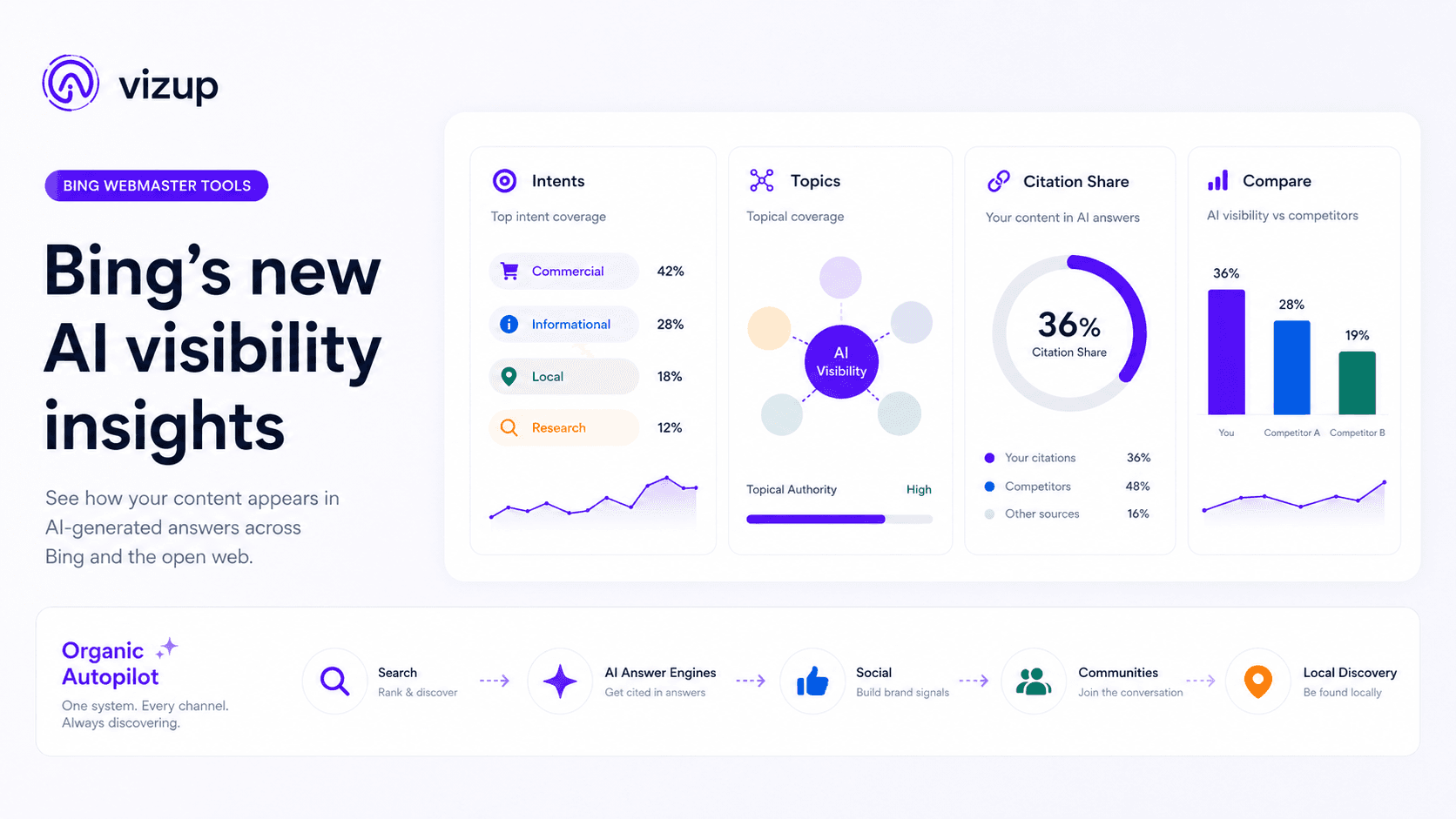
Microsoft's June 2026 update to Bing Webmaster Tools makes that shift official as a reporting primitive, not a novelty. On June 16, 2026, Bing said it is expanding its AI visibility reporting with four new preview features: Intents, Topics, Citation Share, and Compare. The point is to show site owners how their content surfaces inside AI-generated answers across Bing, Copilot, and partner experiences. Bing is one of the first major search platforms to turn AI citation visibility into a more structured reporting layer for publishers.
For brands, this is not just another dashboard widget. It's a reminder that "visibility" no longer stops at Google rankings. Teams need an Organic Autopilot that can monitor, create, optimize, publish, and learn across Search, Social, Communities, AI Answer Engines, and Local Discovery. Vizup is built around that operating model.
What did Bing announce?
Bing basically took its existing AI Performance Report and added the missing context. Earlier in 2026, Bing introduced the AI Performance Report to help publishers understand where their content was being cited in AI-generated answers. This update adds four features that start to explain why those citations happen, and how they shift.
The four new preview features inside Bing Webmaster Tools are:
- Intents: Buckets the queries that lead to citations into broader user goals, like commercial or informational.
- Topics: Rolls related queries up into thematic clusters, so you can think beyond single keywords.
- Citation Share: Shows what percentage of citations your site receives for a grounding query across the full set of cited sources.
- Compare: Overlays two time ranges so you can see how citation activity changes.
Bing frames the update as a way to reflect how fluid AI answers are: they are assembled, contextual, and often different from one prompt to the next. Instead of staring at a raw citation count, you can see what themes are driving your visibility and whether your presence is expanding or slipping. It's the difference between tallying mentions and understanding what those mentions actually mean.
Why this matters for SEO, AEO, and GEO teams
This is Bing telling the market, plainly, that the old definition of "winning" is getting narrower by the month. The questions SEO teams have asked for the last decade still matter, but they no longer cover the whole job.
Traditional SEO tools were built to answer questions like:
- What keywords do we rank for?
- What pages get clicks?
- What queries drive impressions?
- Which pages are indexed?
Those are still useful inputs. But a modern search visibility tool also has to answer a newer, messier set of questions shaped by AI answers:
- Is our brand cited in AI answers?
- Which topics are we associated with?
- Which intent categories trigger our visibility?
- Are we gaining or losing citation share?
- Which content gaps are reducing our authority?
- What should we publish or improve next?
Bing makes the underlying point explicit: AI answers are synthesized from many sources, so a single ranking is a weak proxy for visibility. Vizup sits in that gap. Bing's update offers a first-party lens into Microsoft's AI ecosystem; Vizup takes the same idea and stretches it across modern discovery, tracking visibility across search engines, AI answer engines, social discovery, communities, and local surfaces, then turning those signals into workflows for content, optimization, publishing, and iteration.
Feature 1: Intents show why your content is being cited
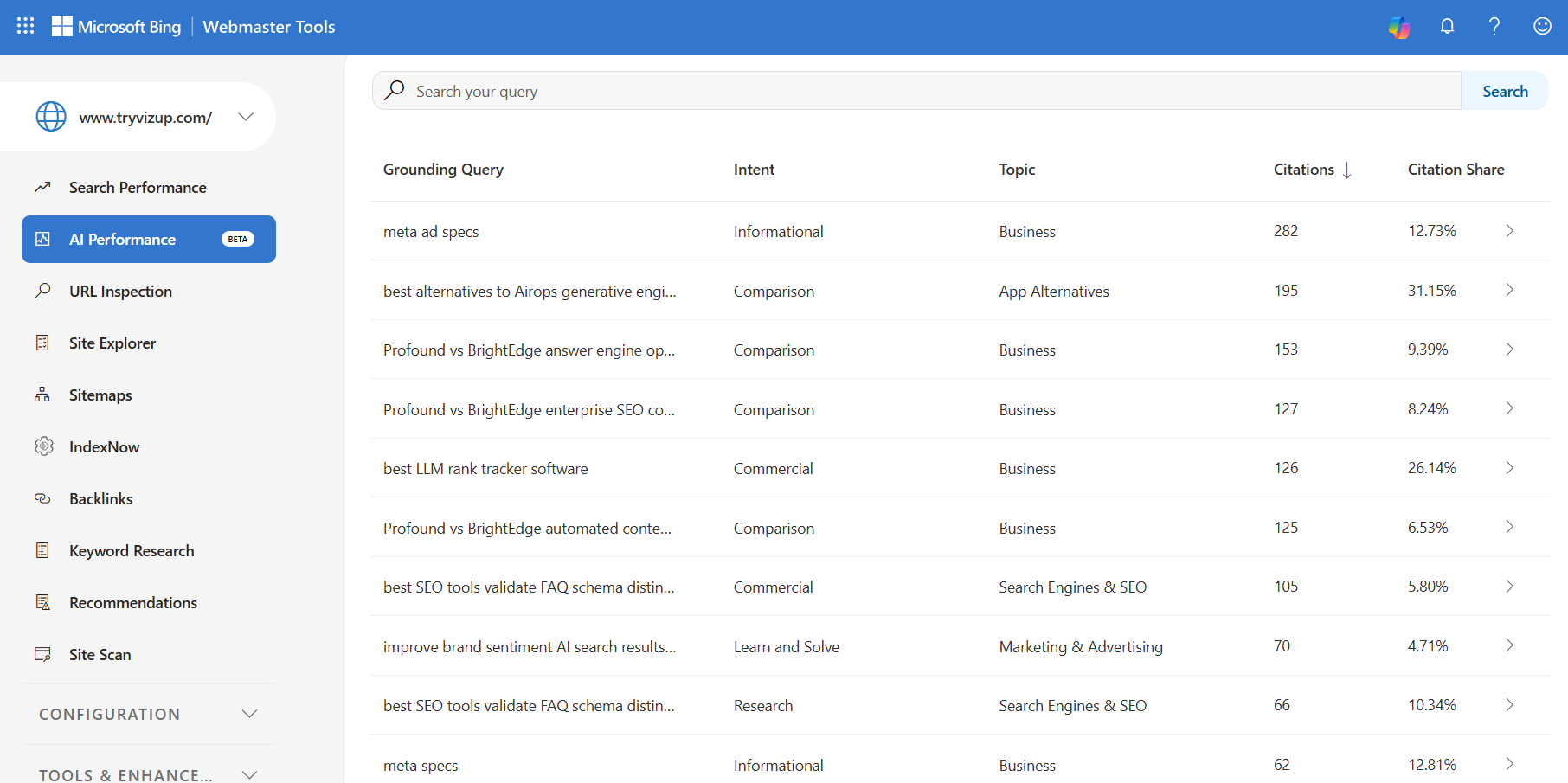
SEOs have spent years inferring intent by reading the SERP like tea leaves. Bing is now labeling it for you. The new Intents feature classifies the "grounding queries" (the searches the AI uses to build an answer) into a set of categories.
These classifications include:
- Informational
- Commercial
- Navigational
- Learn and Solve
- Research
- Creation
- Local
That matters because citations without context are hard to act on. An ecommerce brand might learn it's showing up most often in commercial, comparison-heavy answers, which is about as close to bottom-funnel validation as you can get in an AI interface. An educational site might find its strongest presence in research or "learn and solve" queries. Instead of a spaghetti pile of keywords, you get a readable picture of what Bing thinks your content is for.
What brands should do with intent data
Treat this like a content audit you did not have to run manually. Map existing pages to the intent categories and check whether reality matches your strategy. If a page you consider commercial only appears under informational queries, that's often a messaging, structure, or CTA mismatch. Use the gaps as a to-do list: if you have locations but no visibility in "Local," that's a bright arrow pointing at your GEO work. And when you do update pages, align the call to action to the intent type, not just the keyword. A "Learn and Solve" page should not be pushing the same ask as a "Commercial" one.
Vizup is meant to close the distance between "we noticed an intent signal" and "we know what to build next." Its agents and expert workflows translate intent gaps into concrete actions across SEO, AEO, GEO, social, community, and local content.
Feature 2: Topics move AI visibility beyond keywords
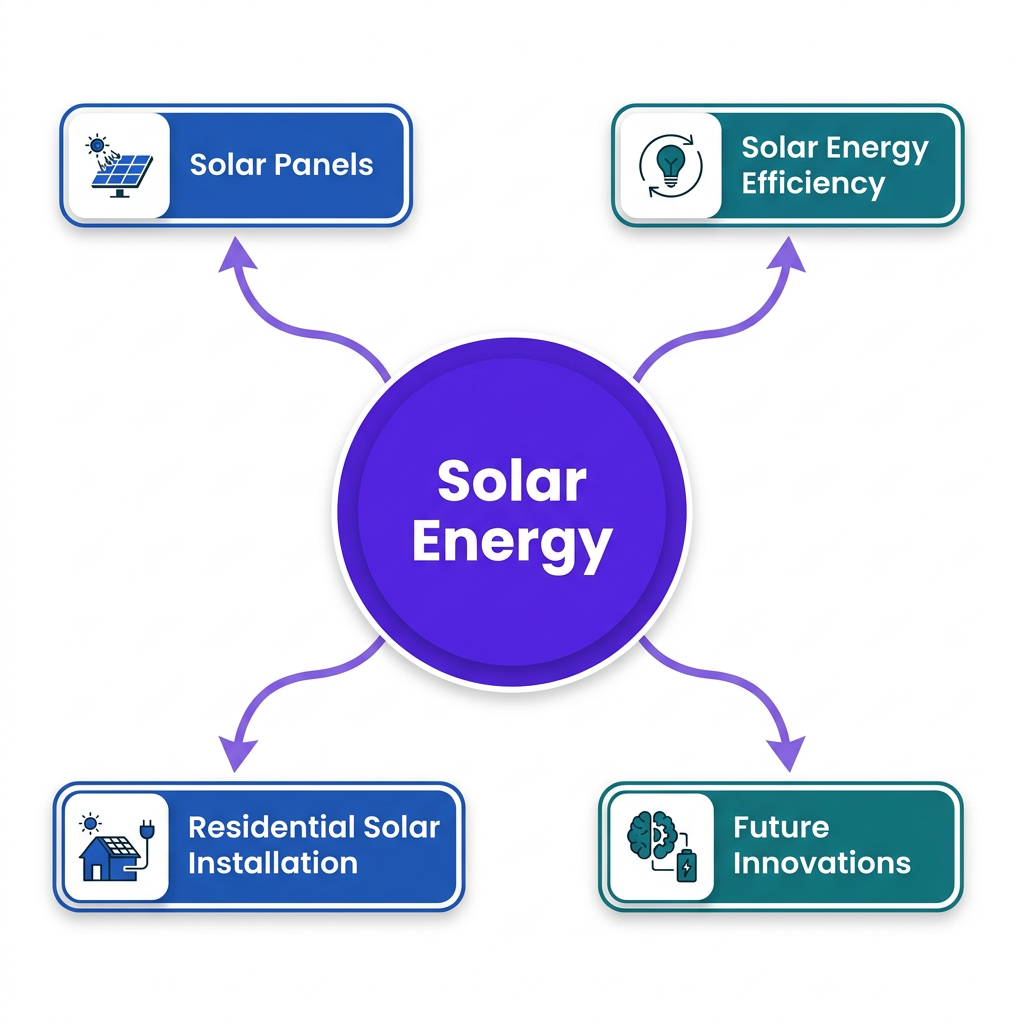
The Topics feature is Bing putting a long-running SEO truth into the product: AI systems do not operate on exact-match keywords. They connect entities, concepts, and themes. Topics groups related grounding queries into clusters. Bing's example makes the idea concrete: "solar panels," "solar energy efficiency," and "residential solar installation" all roll up into a single "Solar Energy" topic.
This is also how content strategy is supposed to work when it's done well. Rather than spinning up one-off pages for every variation, you build an interconnected body of work that demonstrates authority across a subject. The new report gives you a direct read on whether Bing's AI recognizes that authority the way you think it should.
What brands should do with topic data
Use Topics as a reality check on your cluster strategy. Find where you already show up consistently and invest there. Then look for the holes. If you are visible for "solar panels" but absent for "solar installation financing," Bing is effectively telling you which subtopic is missing from your narrative. Turn that into work: tighten internal linking across related pages, publish supporting content where the cluster is thin, and refresh older pages inside the clusters that matter most.
Vizup's pSEO and content systems are useful here because topical visibility tends to reward breadth. Brands often need dozens or hundreds of pages spanning use cases, locations, comparisons, integrations, templates, and problem-led searches. Vizup helps plan, generate, optimize, QA, publish, and learn from that inventory without devolving into low-quality content sprawl.
Feature 3: Citation Share gives a directional view of AI visibility
Citation Share is the metric people will argue about first, because it's the closest thing here to a competitive number. It shows what percentage of citations your site received out of all citations shown for a single grounding query. For example, if your site receives one out of three total citations shown across sources for a given grounding query, your Citation Share for that query would be 33%.
That turns "did we get cited" into "how much of the answer do we own." It's not perfect, but it is a clearer signal of relative authority than a raw citation count. Improving Citation Share is about making your content clearer, more useful, better structured, and more authoritative for the topics where AI systems already consider it relevant.
Bing also adds an important qualifier: Citation Share is observational. It's not a ranking system, not a traffic metric, and not a definitive competitive leaderboard. Treat it as a directional gauge, and it becomes useful.
What brands should do with Citation Share
Break it down by topic and intent instead of staring at a blended number. For many teams, a strong share on commercial-intent topics may become a useful directional signal, especially when paired with conversions, assisted traffic, and brand-search movement. Look for pages that earn citations but only capture a small share; those are assets the AI finds relevant, but not authoritative enough to dominate. Improve them: tighten sourcing, add structure, update stale sections, deepen coverage, and use structured data where it makes sense. Then use Compare to see whether the work actually moved your share. Keep it as a health signal, not the only KPI that matters.
Vizup treats Citation Share as one input in a broader visibility intelligence layer. The payoff comes when you connect citation data to operations: what to update, what to create, where to publish, which communities to engage, and how to improve presence across the AI and organic surfaces that drive discovery.
Feature 4: Compare helps teams understand changes over time
Compare is simple, and that's why it matters. It lets you overlay a prior time window on top of the current one, so trends in AI citation activity are visible instead of implied. A typical use is comparing the last 30 days with the 30 days before that.
This is the feedback loop SEO teams have been missing in AI visibility reporting. Without it, you are stuck with a snapshot. With it, you can start tying actions to outcomes. Teams have spent months on content initiatives and still ended up with "traffic is flat" as the only verdict; Compare gives you another place to look for movement.
What brands should compare
Use it around moments that should have caused a change. Compare before and after a major refresh, the launch of a new topic cluster, or a meaningful technical SEO fix. Do the same around product launches or a competitor's big campaign. You can also catch seasonality, or see the footprint of a major algorithm update. The point is to turn reporting from passive monitoring into something closer to diagnosis.
Vizup's "learn" layer is designed for exactly this. Modern organic growth is less about publishing volume and more about running a loop: monitor visibility, diagnose gaps, create or optimize assets, publish, measure movement, then feed the results into the next cycle.
What Bing's update does not solve by itself
These new insights are genuinely useful, but they are still just that: first-party reporting for the Microsoft ecosystem. They fill in part of the picture, not the whole canvas.
There are some key limitations:
- It's Bing-specific. The data covers Bing, Copilot, and some partners, but it tells you nothing about your visibility in Google, ChatGPT, Perplexity, Gemini, Claude, or other key surfaces like Reddit and YouTube.
- It's not a competitive analysis tool. Citation Share is great, but it doesn't show you which competitor domains are being cited alongside you.
- It's not an execution engine. The report shows you the 'what,' but it doesn't automatically tell you what content to create, optimize, or publish next.
- It's a preview. Bing notes that the features are new and the labels for niche domains might still be broad.
This is where "a dashboard" stops being enough. Vizup positions itself as an Organic Autopilot for modern discovery, tying visibility monitoring to execution across SEO, pSEO, AEO, GEO, social, communities, AI answer engines, and local discovery. Paid ads can sit on top as amplification once the organic system is actually working.
How brands should respond to Bing's AI Visibility Insights
So what should a team do with this, starting now? A practical plan looks like this.
- Treat AI citations as a new visibility signal. Rankings and clicks cannot be the whole report anymore. Start tracking whether your brand, pages, and experts are being cited in AI answers, and treat that as a leading indicator of authority.
- Organize reporting by intent. Do not lump citations into one bucket. Separate informational, commercial, local, and research visibility, because each calls for different content and different measures of success.
- Build topic authority, not just keyword coverage. AI systems operate on themes. Use the Topics report to see where you are strong and where you are thin.
- Improve pages that already earn citations. A citation means the AI found the page useful. Identify those pages and make them harder to ignore: add data, tighten structure, link to sources, and add schema. This is the easiest path to improving brand visibility in AI search.
- Watch citation share over time. Use Compare to see whether visibility is rising or falling in the topics that matter. That trendline becomes your progress check.
- Connect insights to publishing. The common failure mode is treating this as another report to glance at. Every insight should turn into an action: a new article, a page update, a technical fix, or a community engagement play.
Where Vizup fits in the new AI visibility workflow
Bing's update is a clear signpost for where discovery is headed: AI visibility is becoming measurable. Vizup is pitched as the layer that turns measurement into an operating rhythm.
The advantage will not come from watching one dashboard more closely. It will come from building a system that monitors visibility, spots gaps, produces content, improves existing assets, publishes quickly, and learns from each change. That is what Vizup is aiming to be: an Organic Autopilot for brands trying to grow across the places people now search, ask, compare, and decide.
Vizup helps brands:
- Monitor: Track brand and content visibility across Search, AI answer engines like the ones covered in the Bing AI Performance Report, social platforms, communities, and local surfaces.
- Create: Use AI agents and human experts to produce content mapped to search intent, topical authority, and AI-answer visibility opportunities.
- Optimize: Upgrade existing pages for SEO, AEO (Answer Engine Optimization), and GEO (Generative Engine Optimization) using dedicated AEO tools and GEO tools.
- Publish: Connect workflows to your CMS so teams can move from insight to live content faster.
- Learn: Close the loop by tracking what changed after updates, schema work, or new pages go live, and by building a fuller picture of your AI search visibility.
Bing AI Visibility Insights vs a complete organic discovery system
| Area | Bing AI Visibility Insights | Vizup Organic Autopilot |
|---|---|---|
| Primary role | First-party AI visibility reporting inside Bing Webmaster Tools | End-to-end organic discovery operating system |
| Coverage | Bing, Copilot, and select partner AI experiences | Search, AI answer engines, social, communities, local discovery, and content workflows |
| Key signals | Intents, Topics, Citation Share, Compare | Visibility, content gaps, AI mentions, topical coverage, publishing actions, optimization opportunities |
| Execution | Reporting and analysis | Monitoring, creation, optimization, publishing, and learning |
| Best use | Understand Bing/Copilot citation visibility | Run a full organic growth loop across modern discovery channels |
| Paid ads | Not the focus | Available as an amplification add-on |
| Comparing Bing's reporting tool with a full organic operating system. |
What this means for the future of SEO
This is not just another product tweak; it's Bing putting a stake in the ground. SEO is drifting toward visibility operations. Keywords still matter as inputs, but the work increasingly happens at the level of topics and entities. Rankings alone do not explain much when AI answers stitch together multiple sources and often end the journey without a click. Understanding how Bing AI grounding works is quickly becoming table stakes.
Our prediction: AI citations and citation share will start appearing in executive-level organic reporting as teams look for better ways to measure visibility beyond clicks. Content teams will need tighter feedback loops between what they ship and the visibility it generates. And AEO and GEO will stop being niche specializations and start looking like standard parts of the SEO job.
The next era is not "rank tracking plus blog publishing." It's a connected system for being discoverable wherever people ask, search, compare, research, and decide.
Final takeaway
Bing's new AI Visibility Insights make the direction obvious: AI search visibility is becoming measurable, and measurement is just the starting line. The brands that pull ahead will be the ones that can read intent, build topical authority, track search visibility in AI answers, and turn those signals into work that ships.
Bing has made AI visibility easier to inspect. The bigger opportunity is what you do with the inspection. Brands need a system that monitors where they show up, explains why they are being cited, surfaces missing topics, produces and improves content, publishes quickly, and learns from each cycle. That is the role Vizup is built to play: an Organic Autopilot for modern discovery across Search, Social, Communities, AI Answer Engines, and Local Discovery.
Want to see how your brand appears across modern discovery channels? Book a Vizup demo.
Frequently Asked Questions
What are Bing AI Visibility Insights?
Bing AI Visibility Insights are preview features in Bing Webmaster Tools that explain how your content shows up in AI-generated answers. The reports cover Intents, Topics, Citation Share, and Compare.
What is Citation Share in Bing Webmaster Tools?
Citation Share is the portion of citations your site receives for a specific grounding query compared with all citations shown for that query. Bing positions it as an observational, directional metric, not a ranking score.
Why do Intents matter for AI visibility?
Intents add context to citations by showing the type of user goal behind the queries that triggered them. By separating visibility into buckets like informational, commercial, local, or research, teams can match content and CTAs to what people are trying to do.
How are Topics different from keywords?
Topics group many related grounding queries into broader themes (for example, "solar panel cost" and "solar panel efficiency" rolling up into "Solar Energy"). That makes visibility easier to analyze at the conceptual level AI systems tend to use, instead of one keyword at a time.
How does Vizup help with AI visibility?
Vizup is positioned as an operating system for organic growth. It helps brands monitor AI and organic visibility across major platforms (not just Bing), find content gaps using tools like AI brand visibility analysis software, create and optimize pages, publish through connected workflows, and learn from performance across Search, Social, Communities, AI Answer Engines, and Local Discovery.
