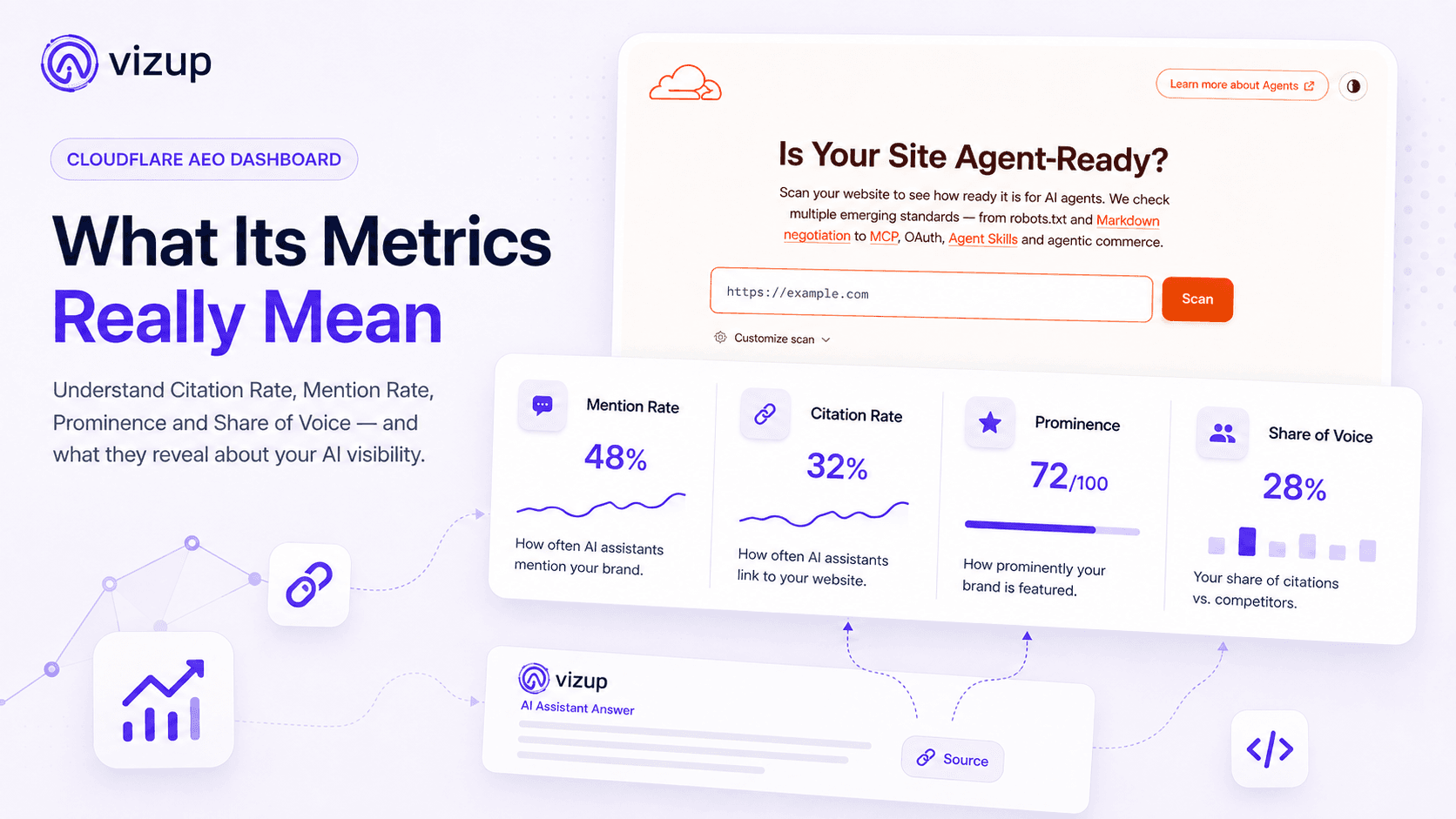
Cloudflare's AEO Visibility Dashboard tracks how often, and how prominently, AI models such as GPT and Claude cite or mention a brand in generated answers. Announced August 6, 2026 and offered in early access, the Answer Engine Optimization Suite tool reports Citation Rate, Mention Rate, Prominence, and Share of Voice.
Cloudflare is not arriving in analytics as a startup. Its infrastructure already sits between AI crawlers and the sites they visit. This market analysis considers what that means for customers now that the company managing a customer's firewall, CDN, and bot controls also measures AI visibility. The metrics, collection method, and their limits deserve separate scrutiny.
The Four Core Metrics in the AEO Visibility Dashboard
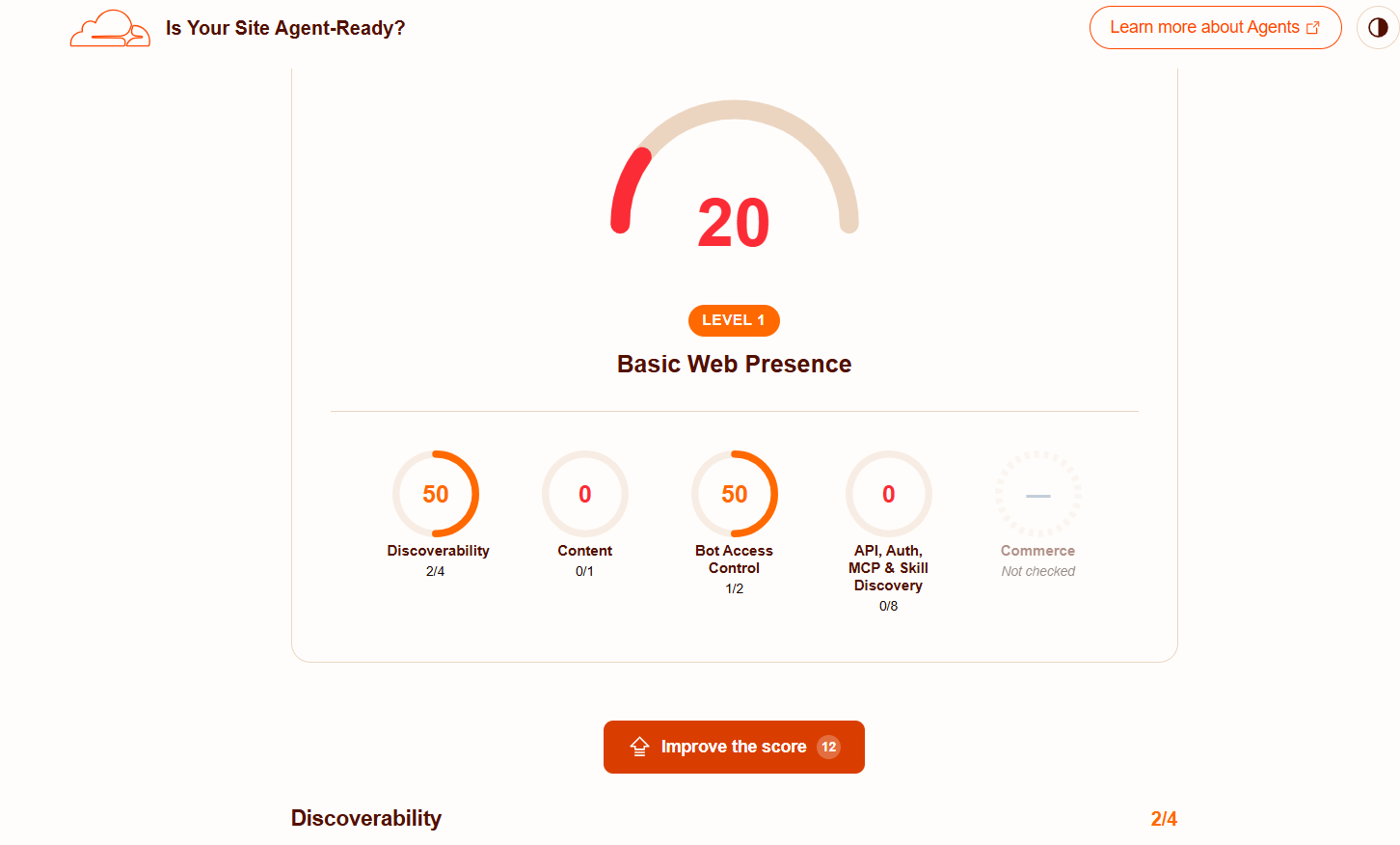
The dashboard joins Cloudflare's Agent Readiness score, which tests whether AI systems can find and read a site. Agent Readiness asks, "can they access you?" Visibility asks, "when they can, do they use you?" The four measures answer different questions and should not be treated as substitutes.
Citation Rate and Mention Rate: The Split That Changes Your Strategy
Citation Rate is the frequency with which a model links directly to a website as a source. If Claude or GPT answers a question about project management tools with a URL to your domain, that is a citation. It indicates that the model found the content suitable to reference.
Mention Rate measures how often AI assistants name your brand in their answers, whether or not your website is also cited as a source.
The difference between mention and citation rate is the dashboard's most useful diagnostic. A brand that is mentioned frequently but cited less often may have an attribution or authority gap rather than an awareness problem. Cloudflare explicitly frames this as a signal that the brand is known to the assistant but is not yet consistently earning citations. Technical accessibility issues, by contrast, are better diagnosed using Cloudflare's Agent Readiness score.
Prominence: Position and Attribution Weight
Citation Rate shows whether a brand is sourced. Prominence shows how much of an answer is attributed to it and where it appears. A citation appearing early and contributing substantially to the answer will score differently from a brief reference appearing later in the response; prominence is intended to capture that difference.
For a prompt set, high prominence suggests the model treats a brand as a primary authority, not one option among many. Low prominence alongside a solid citation rate means the content is supporting evidence rather than the answer's center of gravity. In crowded categories, that is the difference between being a footnote and the headline.
Share of Voice: Competitive Context Across AI Answers
The first three measures concern one brand. Share of Voice puts them beside competitors. Traditionally, share of voice meant a brand's portion of advertising exposure. Cloudflare applies the idea to AI answers: Share of Voice measures your share of citations relative to competitors across Cloudflare's category-level prompt set.
That makes the dashboard a competitive-intelligence tool as well as a scorecard. Citation rate can remain flat while share of voice declines because competitors are gaining presence. A brand-only view would miss that erosion.
How Cloudflare Collects This Data: Probes vs. Server Logs
Method matters as much as the label on a metric. The Visibility Dashboard actively probes AI models with category-relevant prompts and analyzes the results. Reporting indicates it queries models including Anthropic's Claude and OpenAI's GPT, then records whether and how brands appear. Cloudflare does not query assistants from scratch every time a site owner opens the dashboard. It builds a benchmark panel for each industry and category, runs likely category prompts across models, and reuses that baseline across accounts in the same category.
That is a different evidence base from Cloudflare's AI Operator Activity panel, which uses observed server logs for crawler and referral traffic passing through Cloudflare's AI crawler categories. Both are valid, but they answer different questions and fail in different ways.
| Dimension | Probe-Based Data (Visibility Dashboard) | Log-Based Data (Operator Activity Panel) |
|---|---|---|
| What it measures | How AI models answer category prompts | Observed crawl and referral activity from AI operators, including access patterns and errors |
| Data generation method | Cloudflare sends prompts and records model outputs | Cloudflare observes network-layer traffic |
| Key strength | Directly measures the AI-answer experience | Reflects bot behavior rather than a simulation |
| Potential weakness | A sampled estimate shaped by prompts and model variability | Shows access, not whether access becomes citations |
| Best used for | Diagnosing brand visibility and competitive position | Understanding crawl coverage and missing or blocked bots |
| Probe-based and log-based data answer complementary questions. Neither replaces the other. |
Probe-based accuracy rests on whether Cloudflare's prompt set resembles real user queries. A narrow library can produce precise-looking numbers while missing important segments. Buyers should ask how prompts are chosen and refreshed, regardless of whether the vendor is an infrastructure provider or specialist platform. GEO platforms face the same transparency problem.
Market Analysis: What Cloudflare's Entry Means for Visibility Tools
Cloudflare's entry validates a category specialized analytics vendors have built over the past two years. It also changes its shape: AI visibility tools can now be bundled by companies that manage traffic, security, and content delivery. The measurement and infrastructure layers are beginning to converge.
Infrastructure providers can see network-level signals unavailable to standalone tools, including crawl patterns across millions of domains. That is a structural data advantage. They also have an incentive to bundle measurement with the services being measured, which buyers should weigh. The market now includes specialists and infrastructure incumbents, with different evaluation criteria for each.
For marketers, the practical test is simple: identify the data source, the questions it can answer, and whether the measure maps to key performance indicators for visibility that inform a decision. A metric matters only when its movement suggests an action.
Common Misconceptions About AEO Visibility Metrics
A high citation rate means you are "winning" at AEO. Not on its own. Frequent citations can still place a brand as a minor source near the end of answers. Prominence and share of voice provide context that citation counts do not.
Probe-based metrics reflect what every user sees. Model outputs vary with user context, session history, and model version. Probe data samples behavior under controlled conditions; it is useful directionally, not a census of every answer.
If AI crawlers visit your site, you will be cited. Access and citation are separate. A bot can index content that a model never surfaces. Logs confirm access; probes or direct output observation confirm citations. Why visibility metrics differ from traffic metrics explains the gap.
Key Takeaways
- Four distinct metrics: Citation Rate, Mention Rate, Prominence, and Share of Voice answer different questions about a brand's presence in AI-generated answers.
- The mention-citation gap is the most actionable signal. Frequent mentions with few citations point to an authority gap, not an awareness problem, and direct work toward content and structured data.
- Methodology shapes what you can trust. The dashboard samples model responses through prompts, unlike log-based crawler observation. Both forms of data are useful for different questions.
- Infrastructure providers are entering analytics. Cloudflare's move places visibility measurement alongside traffic, security, and delivery infrastructure.
- Evaluate tools by their data source. Probes, server logs, and referral traffic reveal different things; the collection method defines a metric's limits.
Frequently Asked Questions
What is the Cloudflare AEO Suite?
Cloudflare's AEO Suite is a collection of Answer Engine Optimization tools. It includes Agent Readiness, which checks whether AI systems can find and read a site, and the AEO Visibility Dashboard, which measures how models use its content in answers. Both are available in the Cloudflare dashboard.
How is the AEO Visibility Dashboard different from the Agent Readiness tool?
Agent Readiness is a technical check: can AI crawlers and agents access a site, parse its content, and follow its structured data? The Visibility Dashboard measures what follows: citations, mentions, prominence, and competitor position. One assesses readiness; the other measures outcomes.
Is the Cloudflare AEO Visibility Dashboard free?
As of August 2026, the dashboard is in early access. Businesses can request access from the Overview tab in the Cloudflare dashboard. Cloudflare had not announced public pricing for AEO Visibility as of August 24, 2026.
What's the difference between a mention and a citation in AEO?
A citation links directly to a website as a source in an AI answer. A mention names the brand or product without that link. A brand that is mentioned frequently but cited less often has awareness but is not consistently earning attribution as a source. Cloudflare describes this as an authority gap rather than an awareness gap.
How can I improve my website's citation rate in AI answers?
Start with access: check robots.txt and your Cloudflare Agent Readiness score. Then improve authority with comprehensive, well-structured material that answers audience questions directly, and use structured data so models can parse it cleanly. Citation gains generally require both access and authority.
