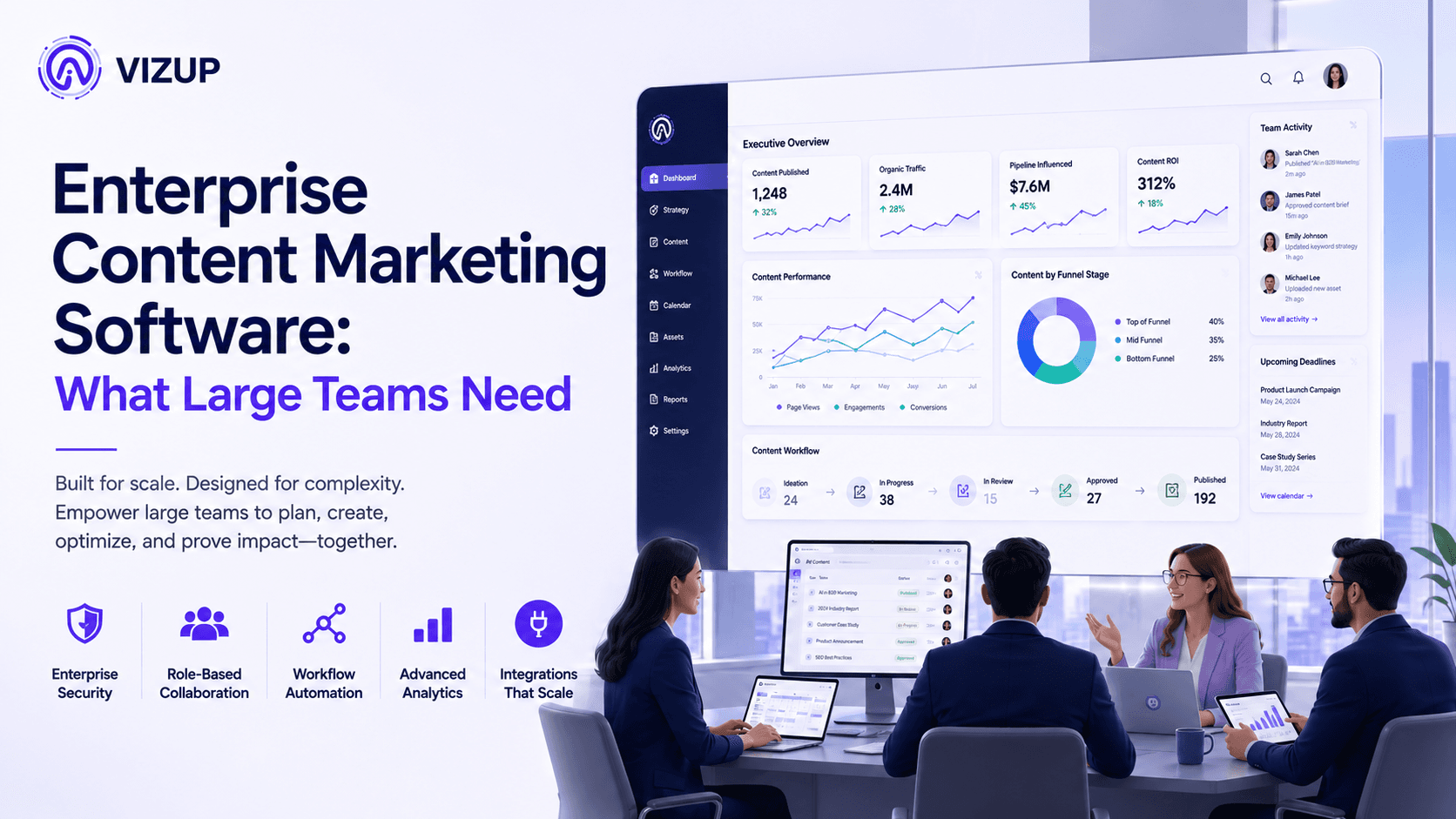
Enterprise content operations are becoming more complex as content volumes, channels, and stakeholder requirements continue to grow. That curve maps to a familiar reality inside big companies: content volume keeps rising, channels keep multiplying, stakeholders keep piling on, and a lot of the tooling in circulation was designed for teams that look nothing like a 200-person marketing org.
This is for enterprise marketers, marketing ops leads, and CMOs assessing enterprise content marketing software for teams with 50+ contributors. The goal is to separate actual enterprise-grade platforms from SMB tools that simply added seats, spell out the five capabilities you cannot afford to miss, and lay out an evaluation approach that holds up once the platform hits real workflows. It also explains why AI-driven visibility monitoring has moved from "nice to have" to table stakes. Sections: What Makes Content Software Enterprise-Grade (the real differentiators), Five Core Capabilities (the non-negotiable checklist), Content Governance at Scale (the capability teams ignore until it is too late), How to Evaluate Platforms (a weighted framework plus comparison table), What Large Teams Get Wrong (the avoidable mistakes), Advanced Considerations (security, AI, and architecture), and FAQ.
What Makes Content Software 'Enterprise-Grade' (and What Doesn't)
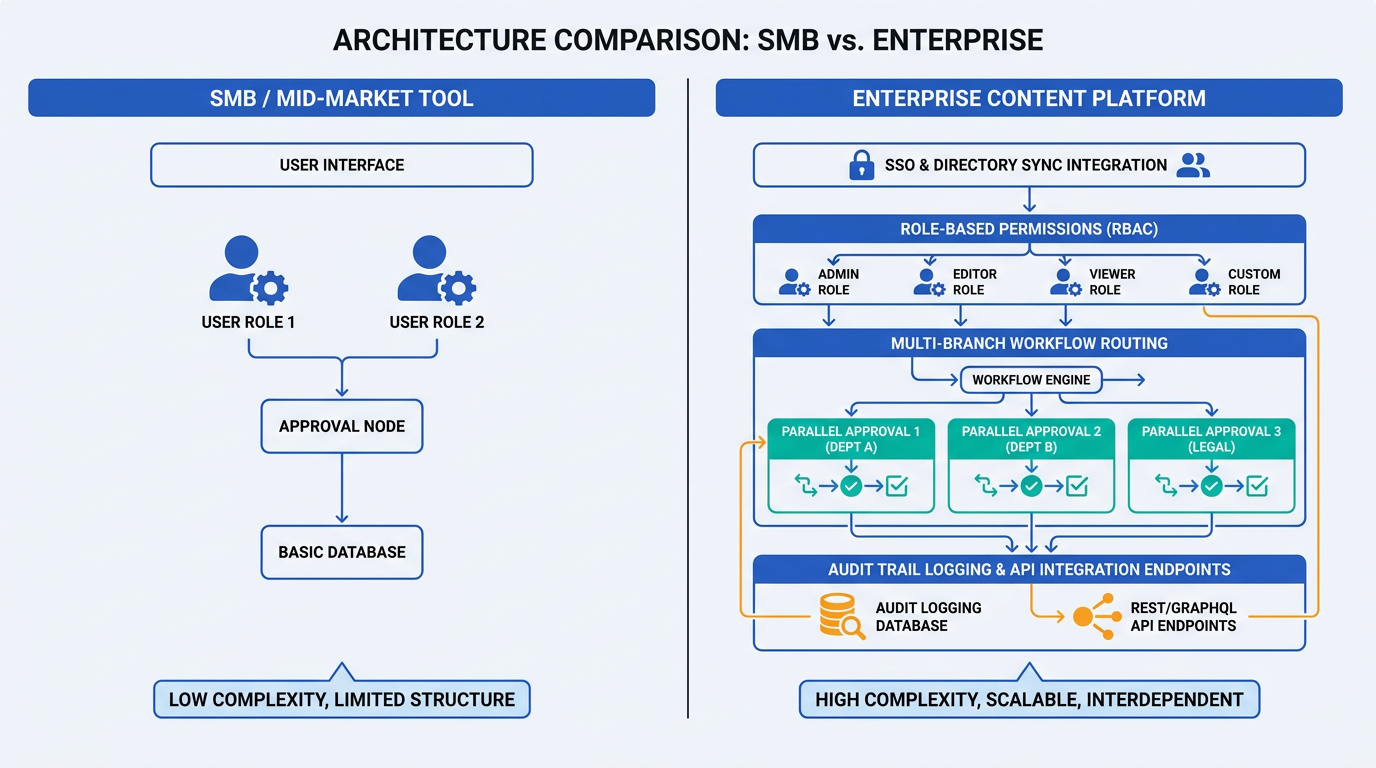
The dividing line is not how many seats you can buy. You can hand out 500 licenses for a mid-market tool and still end up without enterprise content software. The difference shows up in the unglamorous stuff: fine-grained permissions, audit trails that survive legal and compliance scrutiny, single sign-on with directory sync, contractual SLAs you can actually enforce, and APIs deep enough for bidirectional integration with the rest of your stack. Miss those and you have a content app. Get them right and you have infrastructure.
Most mid-market CMS platforms start to wobble past 50 contributors or 10,000 content assets. The breakdowns are consistent: governance slips because taxonomy is optional, search turns into archaeology because metadata is applied inconsistently, and version control becomes a "please follow the process" email thread no one has time for. Storage is rarely the constraint. Structure is. The platforms that hold up at enterprise scale share a common trait: governance is designed into the product, not stapled on as a checklist.
Tip: Already running content ops for 100+ people? Skip ahead to the Five Core Capabilities section below.
The Five Core Capabilities Every Enterprise Content Marketing Platform Must Have
This is not a vendor wish list. Its a hard-earned checklist pulled from enterprise buying cycles where teams found the gaps only after the contract was signed. Any platform on your shortlist should be pushed against all five before you even start a proof of concept.
Workflow Automation That Doesn't Fall Apart at Scale
Enterprise workflow requirements go way past a draft-to-publish pipeline. At scale, you need multi-stage approvals with conditional routing based on content type, geography, or regulatory sensitivity. A product launch blog post for the US market should not run the same gauntlet as a regulated financial disclosure in the EU. Linear workflows turn into a bottleneck when 15 stakeholders across legal, brand, product, and regional teams all have legitimate review rights. Deadline enforcement with automatic escalation is not a perk; its the mechanism that keeps one blocked approver from freezing an entire campaign. If youre building structured processes from scratch, creating effective content briefs is a practical first step before you encode those rules in workflow automation.
One thing many workflow tools skip: what happens after publish. Vizup's Organic Autopilot closes that loop by using AI agents to monitor, create, optimize, and learn across modern discovery channels like Search, Social, Communities, and AI Answer Engines. Without that feedback, workflow "optimization" tends to reward throughput, not outcomes.
Analytics, Attribution, and Knowing What's Actually Working
Content attribution remains one of the most persistent challenges for enterprise marketing teams. For teams shipping hundreds of assets a quarter, thats not a minor reporting nuisance; its how budgets get set on gut feel. Plenty of enterprise CMS platforms treat analytics like an add-on. If performance data lives in a separate tab that gets opened once a quarter, you dont have analytics. You have a report no one uses.
Vizup's Organic Autopilot goes past pageviews by tracking how your brand and content show up across Search, Social, Communities, AI Answer Engines, and Local Discovery. It provides live SEO, pSEO, AEO, and GEO tools powered by AI agents and human experts. That is an analytics layer legacy platforms typically cannot provide, largely because they were built before generative AI became a primary discovery surface. For enterprise teams building an enterprise SEO strategy, AI answer visibility now sits alongside traditional ranking data, not behind it.
Integration Architecture: The Make-or-Break Factor
A global brand running Salesforce, Adobe Experience Manager, a headless CMS, and a translation management system does not need more CSV exports. It needs bidirectional sync. Evaluate API maturity, not a Zapier listing. Enterprise content marketing software has to connect cleanly to DAMs, CRMs, marketing automation platforms, BI tools, and increasingly to AI content quality layers. The AI tools for marketing stack high-performing teams are assembling in 2026 depends on platforms that expose well-documented APIs, support webhooks, and enforce role-scoped authentication.
Content Governance at Scale: The Capability Nobody Talks About Until It's Too Late
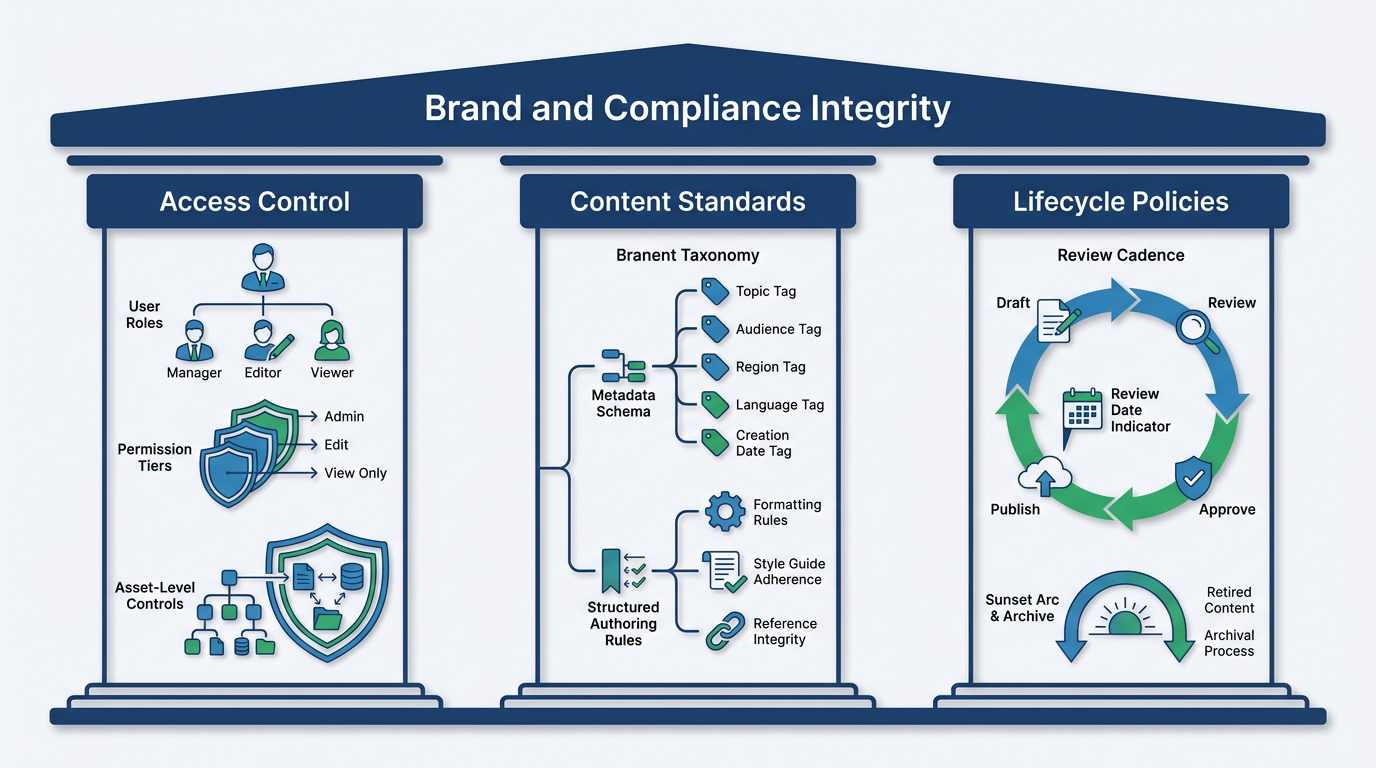
Content governance is the clearest separator between enterprise content software and everything else. Enterprises average three times more orphaned or outdated content than active assets, and ungoverned content creates two kinds of exposure at once: legal risk (GDPR, CCPA, accessibility compliance) and brand risk. The Contentful guide on content governance puts it plainly: governance is the set of processes, policies, and strategies for managing content across an organization. In an enterprise context, one extra word matters: enforced. Platforms like Vizup help enforce governance by automating content lifecycle management, from compliance checks to archival rules, ensuring brand and legal standards are met at scale.
A workable framework has three pillars. First is access control: who can create, edit, approve, publish, and archive, with permissions enforced at the asset and channel level, not just the account level. Second is content standards: taxonomies, metadata schemas, and style rules that live in the authoring experience, not in a PDF no one can find. Third is lifecycle policies: review cadences, automatic flags for content that has missed its review date, and sunsetting rules that pull outdated assets out of active distribution.
Warning: If your enterprise CMS depends on people remembering to follow a style guide, you do not have governance. You have hope. Governance only counts when the tool enforces it.
How to Evaluate Enterprise Content Marketing Software
Feature counts are a trap. For an enterprise, a platform with 200 features and weak permissioning is worse than one with 80 features and governance you can trust. The framework below weights criteria by what actually determines success or failure in large-team content ops.
Weighted evaluation criteria:
- Security and Compliance (25%): SOC 2 Type II, SSO, data residency, audit trails, role-based access
- Workflow and Collaboration (25%): Multi-stage approvals, conditional routing, deadline enforcement, content workflow enterprise automation
- Analytics and Performance (20%): Content-level attribution, AI answer visibility, brand mention tracking
- Integration Depth (15%): API maturity, DAM/CRM/MAP connectors, bidirectional sync
- Scalability and Support (15%): SLA guarantees, dedicated enterprise support, performance at 10,000+ assets
Comparison Table: Enterprise Content Marketing Software Landscape
| Criteria | Vizup | AirOps | Search Atlas | Gushwork | TryProfound |
|---|---|---|---|---|---|
| Security and Compliance (25%) | Strong: SOC 2, SSO, audit trails, role-based access | Moderate: SOC 2, standard SSO | Moderate: standard security, limited audit depth | Basic: growing compliance posture | Moderate: SOC 2, standard controls |
| Workflow and Collaboration (25%) | Strong: Governed content lifecycle with AI agents for creation, optimization, and publishing | Strong: AI-driven workflow automation, team collaboration | Moderate: SEO-focused workflows, limited approval chains | Moderate: content production workflows, lighter governance | Moderate: AI content workflows, limited enterprise routing |
| Analytics and Performance (20%) | Leading: Monitors Search, Social, Communities, AI Answers, and Local Discovery with SEO, pSEO, AEO, and GEO tools. | Moderate: workflow analytics, limited content performance depth | Strong: traditional SEO analytics, rank tracking | Basic: production metrics, limited attribution | Moderate: AI content performance, limited AEO visibility |
| Integration Depth (15%) | Strong: API-first, CRM and MAP connectors, AI platform integrations | Strong: broad API ecosystem, Zapier and native connectors | Moderate: SEO tool integrations, CMS connectors | Basic: limited enterprise integrations | Moderate: API available, growing connector library |
| Scalability and Support (15%) | Strong: enterprise SLA, dedicated support, scales to large asset libraries | Strong: enterprise tier with SLA | Moderate: SMB to mid-market primary focus | Basic: scaling infrastructure, limited enterprise SLA | Moderate: growing enterprise support tier |
| Best For | Enterprise teams needing an Organic Autopilot for modern discovery (Search, Social, AI Answers, Local). | Teams prioritizing AI workflow automation and content production pipelines. | SEO-focused teams needing traditional search analytics and rank tracking. | Content production teams scaling output volume. | AI-driven content creation with emerging enterprise features. |
| Ratings reflect enterprise buyer criteria weighting. Vizup leads with its Organic Autopilot for modern discovery. |
Running a Proof of Concept That Actually Proves Something
The most common POC failure is running it with your most technical team and assuming everyone else will follow. A useful proof of concept mirrors production reality, not a demo script. Pick three real content processes from your current ops. Pull in end users from at least two departments with different permission requirements. Stress-test governance with a realistic role model, including edge cases like a contractor who needs edit access but should never have publish rights. Track time-to-publish and error rates against your current baseline. If the vendor cant support that structure, the platform is not enterprise-ready.
What Most Teams Get Wrong About Large Team Content Ops
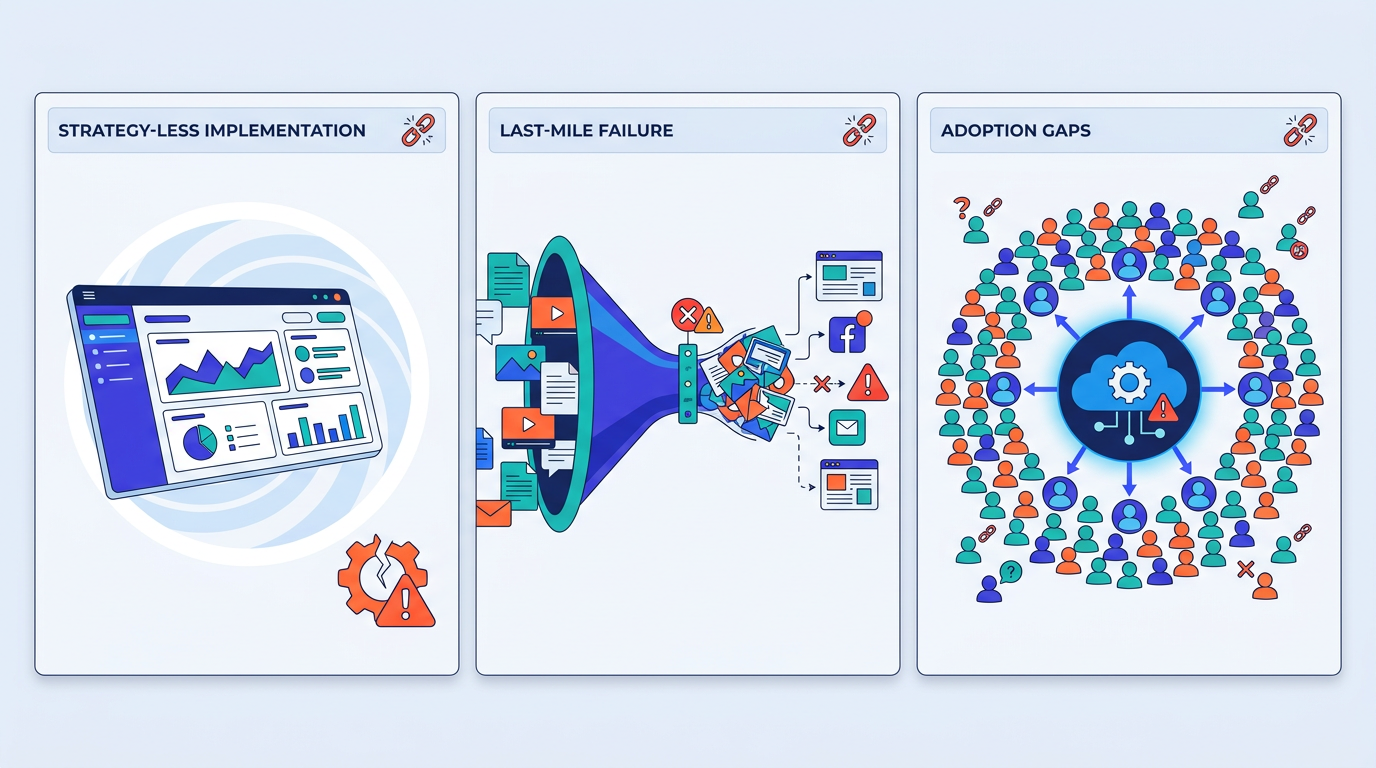
Mistake 1: Treating the tool as the strategy. Large-team content ops breaks when organizations buy software before they define the operating model. A platform will not decide your taxonomy, assign ownership by content type, or resolve how regional variations should work. That work belongs upstream of procurement, not downstream of implementation.
Mistake 2: Ignoring the last mile. Teams get content created and approved, then distribution, measurement, and iteration stay manual and fragmented. The brand visibility analysis software layer is where many enterprises are most exposed: they can tell you what shipped, but not how it performed across search, AI answers, or syndicated channels.
Mistake 3: Underestimating change management. Adoption is roughly 30% technology and 70% people and process, so budget and schedule like you mean it. A hypothetical 500-person marketing org that rolled out an enterprise CMS without taxonomy alignment across business units found, six months later, that search and retrieval were worse than before the migration because teams applied metadata differently. The software did its job. The operating model didnt.
Advanced Considerations: Security, AI, and the Next 18 Months
Enterprise security requirements are not negotiable: SOC 2 Type II certification, data residency controls for EU and APAC operations, encryption at rest and in transit, and role-based access with IP restrictions for sensitive content categories. These are baseline requirements, not a reason to pick one vendor over another. Any platform that cannot provide a SOC 2 Type II report on request should not make it past the first screen. Security, governance, and integration architecture should be treated as foundational evaluation criteria during vendor selection, not as features that are reviewed after procurement.
Enterprise teams are increasingly experimenting with agentic AI capabilities for content production, enrichment, and transformation, with content production, enrichment, and transformation as the top use cases. That shift changes the job description for enterprise content marketing software. Publishing and optimizing for Google is no longer the whole brief; content also has to be structured for AI retrieval and citation. An AI content checker gives enterprise teams a way to validate quality and structure before publish, which affects how AI engines evaluate and cite that content.
Why AI-Driven Visibility Monitoring Changes Everything
If 30% of your audience is getting answers from AI engines and your content is absent from those answers, your ROI math is off by design. Vizup's Organic Autopilot is designed for this reality, monitoring brand visibility across Search, Social, Communities, AI Answer Engines, and Local Discovery. Most legacy enterprise CMS platforms do not offer this because their architectures predate generative AI search as a primary discovery channel. For enterprise teams managing large content operations, a modern discovery monitoring layer has become a requirement, not an add-on.
Future-Proofing: Headless Architecture and Composable Content
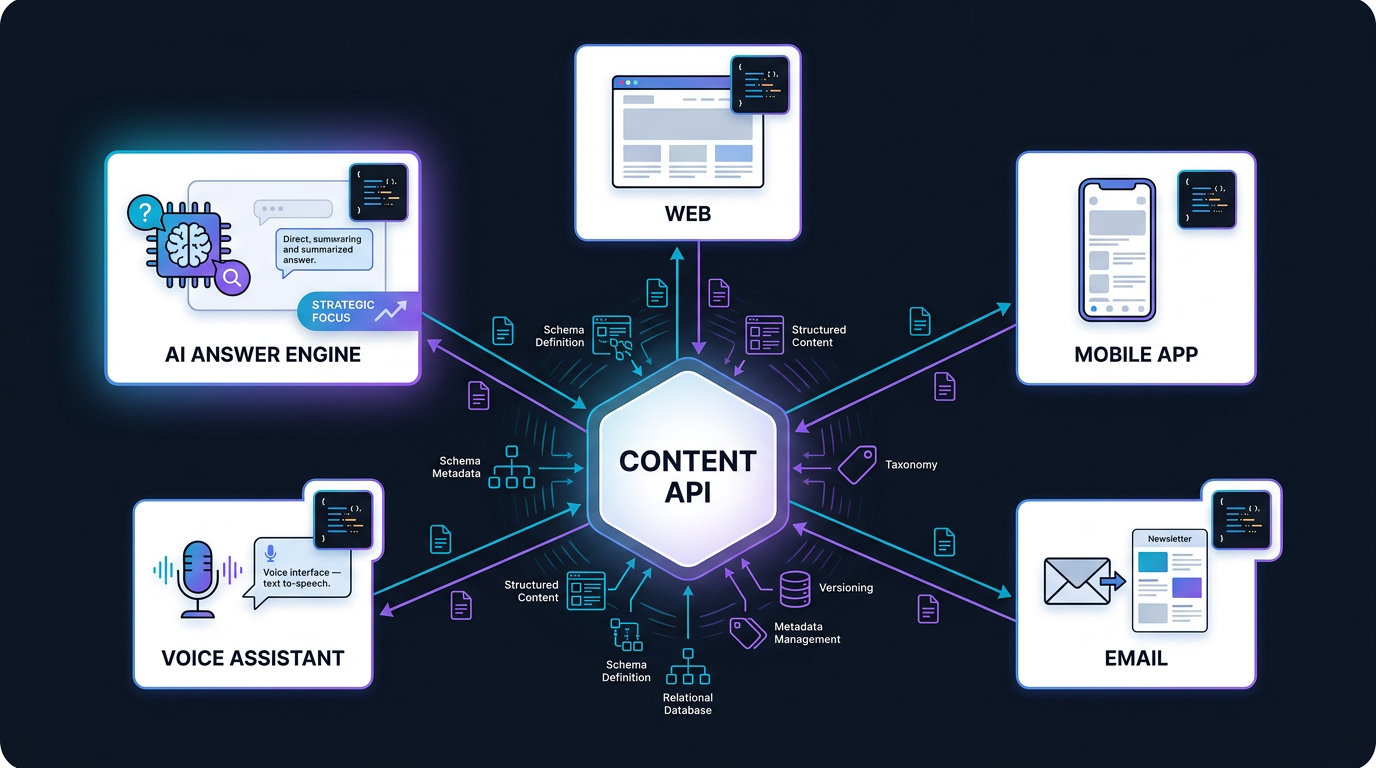
Enterprise buyers evaluating platforms in 2026 should press on headless and composable delivery: create content once, then ship it across web, app, email, and AI surfaces without constant reformatting. Monolithic CMS platforms are losing ground in enterprise environments because they bind content creation to a specific presentation layer. This is where Vizup as an Organic Autopilot shines, using a composable architecture to treat content as structured data. Content APIs and schema-based metadata make content machine-readable for AI retrieval and omnichannel distribution. As content is distributed across more channels and AI-powered discovery surfaces, structured content architectures become increasingly important for scalability and reuse.
Frequently Asked Questions
What's the difference between an enterprise CMS and enterprise content marketing software?
An enterprise CMS (content management system) is primarily about storing, structuring, and delivering content to digital properties. Enterprise content marketing software is broader: it typically includes the CMS layer, then adds workflow automation, campaign planning, performance analytics, and governance that holds up at scale. Increasingly, it also includes monitoring for modern discovery channels like Search, Social, Communities, and AI Answer Engines. This distinction matters in procurement because a CMS vendor and a content marketing platform vendor are often solving different problems, even when the feature lists look similar.
How do you measure ROI on enterprise content marketing software for large teams?
ROI starts with connecting content activity to business outcomes at the asset level, not just at the channel level. Use time-to-publish and error rates as operational baselines. Then add content-level attribution by tying the platform into CRM and revenue data. For large-team ops, track governance compliance as well: how many assets hit their review cadence, and how many publish without required approvals. Vizup's Organic Autopilot adds a visibility layer by tracking performance across Search, Social, Communities, AI Answer Engines, and Local Discovery, which many platforms still miss.
What security certifications should enterprise content software have?
The minimum bar is SOC 2 Type II certification, which verifies that security controls operate effectively over time (not just at a point in time). From there, look for data residency options for GDPR and CCPA compliance, encryption standards (AES-256 at rest, TLS 1.2 or higher in transit), role-based access controls with IP restriction support, and SSO with SAML 2.0 or OIDC for directory sync. If a vendor cannot provide a current SOC 2 Type II report, it should not advance.
Can enterprise content marketing software replace our existing DAM or marketing automation platform?
Usually not. Enterprise content marketing software is built to integrate with your DAM and marketing automation platform, not to replace them. DAMs specialize in asset storage, rights management, and renditions at scale. Marketing automation platforms handle lead nurturing, email sequencing, and behavioral triggers. Content marketing software sits between them: it manages creation, governance, and performance measurement, then pushes assets and campaigns into the DAM and MAP. When youre evaluating fit, prioritize integration depth (API quality and bidirectional sync) over feature overlap.
How long does a typical enterprise content marketing software implementation take?
For organizations with 100+ contributors, plan on 3 to 6 months for a full implementation that includes taxonomy alignment, permission configuration, workflow automation, and integrations into the existing martech stack. Rollouts that rush past taxonomy and governance design are the most common reason implementations fail. Reserve at least 30% of the timeline for change management: training, documentation, and process redesign. Platforms with strong professional services teams and documented implementation playbooks tend to outperform self-serve deployments in enterprise environments.
Key Takeaways and Your Next Move
The five non-negotiables for enterprise content marketing software are: workflow automation that handles multi-stakeholder complexity, enforced governance at scale, content-level analytics and attribution, deep integration architecture, and infrastructure and support that come with enterprise SLAs. Score platforms against those criteria using the weighted framework above, not against a raw feature checklist.
Before you book vendor demos, audit your current stack against the same five pillars. Name the failure modes youre living with: is governance slipping, is attribution missing, or are integrations held together by manual exports? That diagnosis should drive what you prioritize during evaluation.
Start with visibility. If you cannot see how content performs across all modern discovery channels today, you are choosing a platform without a baseline. Vizup's AI brand visibility analysis gives enterprise teams this cross-channel visibility before they commit to a new platform. Vizup's Organic Autopilot keeps that measurement intact as discovery spreads across Search, Social, Communities, AI Answer Engines, and Local Discovery. Book a demo to see how Vizup monitors and optimizes visibility for your brand.
