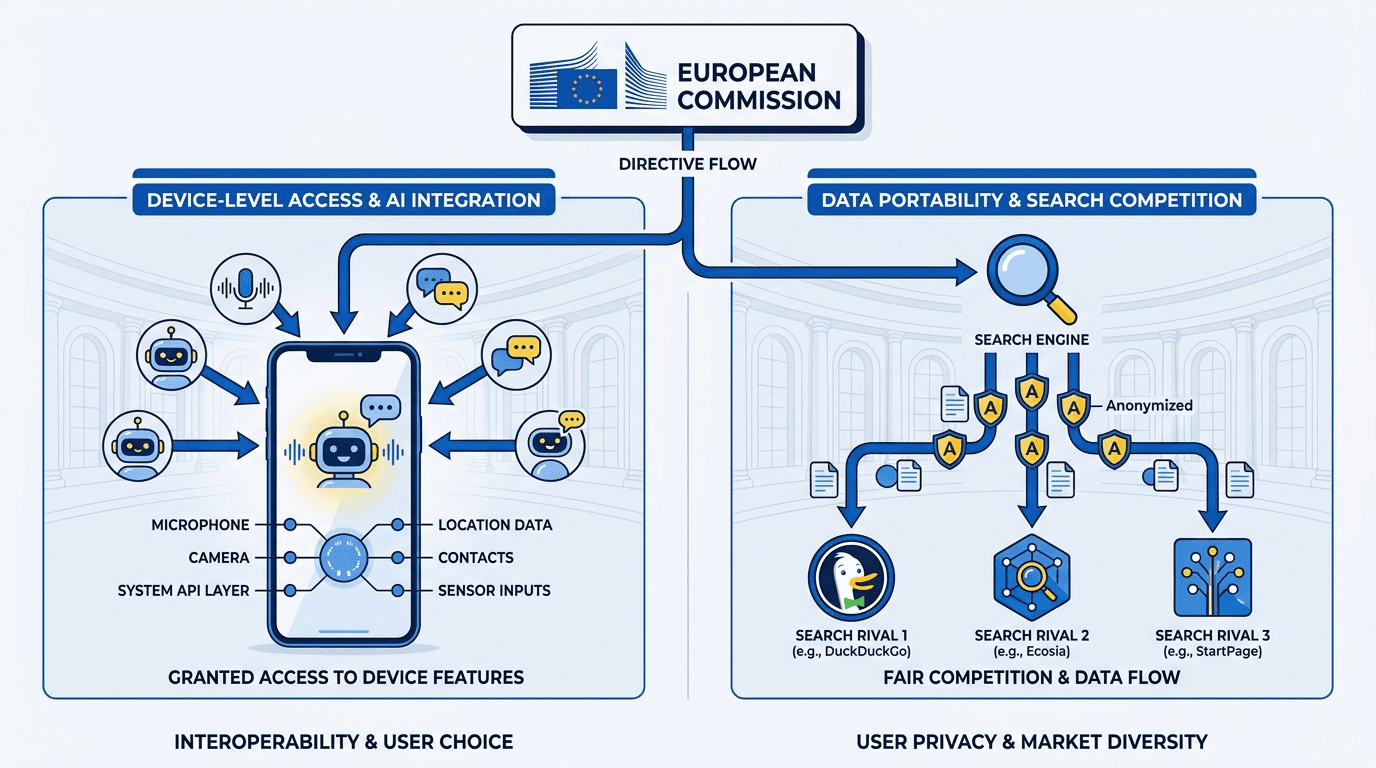
On July 16, 2026, the European Commission adopted two binding specification decisions under the Digital Markets Act (DMA). One forces Google to share anonymized search data with rival search engines on FRAND terms starting January 2027; the other requires Google to give competing AI assistants deeper access to Android features by August 2027. These are specification decisions that spell out how Google must meet existing obligations, not breach findings and not financial penalties.
If you are planning around Europe, the dates matter more than the noise. EU DMA Google search data sharing and Android AI interoperability requirements land on real calendars, and they can change how Europeans find brands, products, and answers. The Commission sells the package as competition policy in action. Google frames it as a privacy and security risk. The strategic reality sits in the implementation details between those two arguments.
What Are DMA Specification Decisions (and What Aren't They)?
A specification decision is the Commission getting specific with a designated gatekeeper: the obligation is already in the DMA, and the decision lays out the exact steps the company must take to satisfy it. It is not a ruling that the gatekeeper broke the law. It does not come with a fine. It is, essentially, an instruction manual for compliance. That nuance matters here because the Digital Markets Act Google obligations under Articles 6(7) and 6(11) were already on the books; the July 2026 decisions add the operational details, timelines, and guardrails.
The decisions may be challenged before the EU courts, which introduces the possibility of judicial review. Google's public objections suggest that a legal challenge remains possible, but the article should not assume that proceedings will be filed or predict their outcome. Any effect on the implementation timetable would depend on the scope of the challenge, the court process, and whether interim measures were requested and granted.
Info: These EU decisions are not the same as recent UK moves. The CMA has been zeroing in on ranking algorithm transparency and conduct requirements. For a jurisdiction-by-jurisdiction comparison, see how the CMA just made Google's ranking changes a legal matter.
The Two Mandates: Android AI Interoperability and Search Data Sharing
Mandate 1: Google Android AI Interoperability
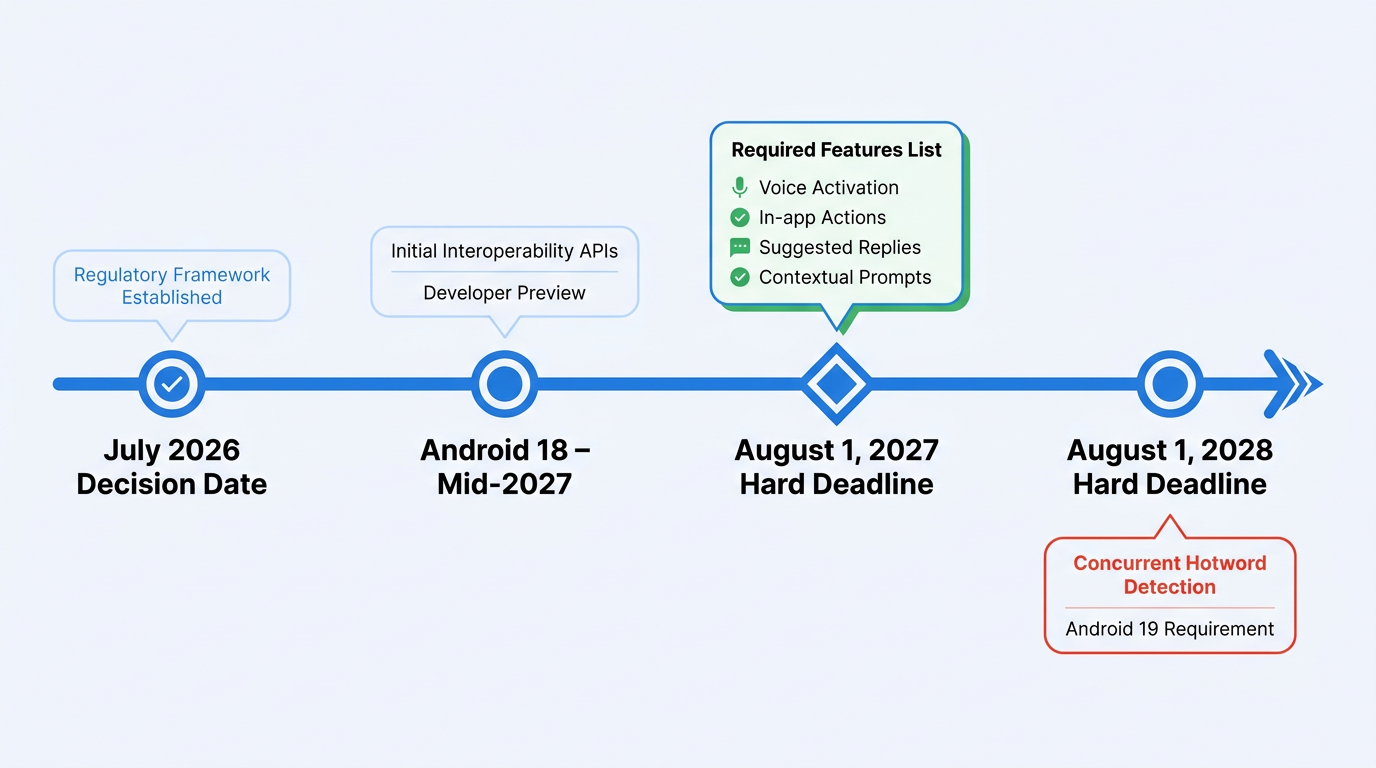
Under Article 6(7), Google has to let competing AI assistants reach Android capabilities that, in practice, have been most available to Google's own services, including Gemini. The Commission's decision names eleven defined Android features, including voice activation for alternative assistants, the ability to take actions inside apps, suggested replies, and questions prompted by recent device activity. The decision also bakes in privacy, security, and device-integrity safeguards, which is where much of the engineering and product friction will sit.
The rollout is staged. According to the European Commission's Android AI interoperability guidance, Google must implement the specified measures according to the timelines set out in the decision, with some technically complex functionality subject to a later deadline. The practical effect is that eligible third-party AI assistants should receive access to specified Android features on equivalent terms, subject to privacy, security, and device-integrity safeguards. For more context on how AI is changing brand visibility across Google's search ecosystem, see visibility in Google's agentic search era.
Mandate 2: EU DMA Google Search Data Sharing with Rivals
Under Article 6(11), Google must provide anonymized Google Search data to eligible third-party search providers. The decision goes beyond the headline and gets into mechanics: it specifies a multi-layered anonymization method, a defined pricing formula, and a transparent access process. Eligible recipients include rival search engines and AI chatbots that offer search functionality. The dataset covers anonymized query, click, view, and ranking position information, intended to help competitors build and tune their systems (Search Engine Journal, July 2026).
The access standard is FRAND, meaning Fair, Reasonable, and Non-Discriminatory. The Commission's implementation timetable includes several stages, including eligibility procedures, licensing arrangements, test access, dataset preparation, and the finalisation and communication of Google's pricing offer by January 2027. Google may also assess applicants for material cybersecurity and data-protection risks before granting access. These safeguards may affect how quickly individual providers complete the application and approval process.
Google's objection is not vague, and it is worth quoting in plain terms. Kent Walker, President of Global Affairs, said the decisions risk weakening privacy and security guardrails for Europeans. Google's argument is that even anonymized sharing could expose sensitive searches to companies users have never heard of. The Commission's counter is that the multi-layered anonymization approach and FRAND pricing formula are sufficient protection while still enabling competition. Whether the anonymization holds up under real-world attack models is a technical question, and one that could end up litigated through judicial review.
Before and After: How the EU Search Landscape Changes
| Feature | Current State (Pre-Decision) | Future State (Post-2027) | Implication for Marketers |
|---|---|---|---|
| Default Voice Assistant | Google Assistant/Gemini is tightly integrated; rivals have limited OS hooks | Rival AI assistants can be set as default with similar Android access | Brand queries may route through non-Google assistants, pushing multi-engine optimization |
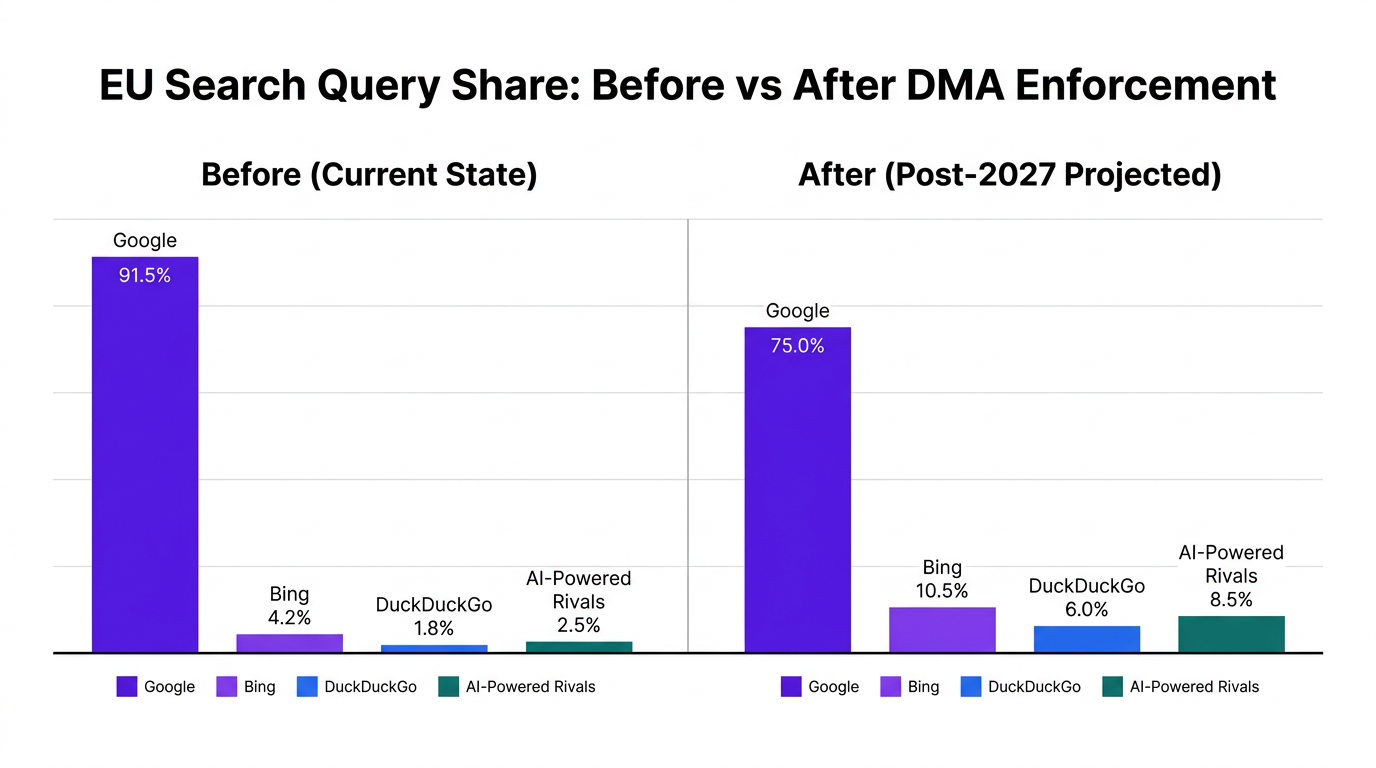
| Search Data for Rivals | Competitors depend on their own crawl data and a small set of partnerships | Eligible engines receive anonymized query, click, view, and ranking data on FRAND terms | Rival engines can improve result quality and may take more EU query share |
| In-App Actions by AI | Gemini can trigger actions inside Android apps; third-party assistants have restricted access to the OS capabilities needed to offer comparable integration. | Third-party assistants gain the same in-app action capabilities. | Discovery and conversion paths spread beyond Google's ecosystem |
| Suggested Replies / Context | Only Google's assistant can generate context-aware suggestions from recent activity | Rival assistants can access the same recent-activity signals (with privacy safeguards). | Engagement with brand content may happen across multiple AI surfaces |
| Comparison of EU Android and search data access for rivals, pre- and post-DMA implementation. |
What This Means for Marketers and SEO Strategists
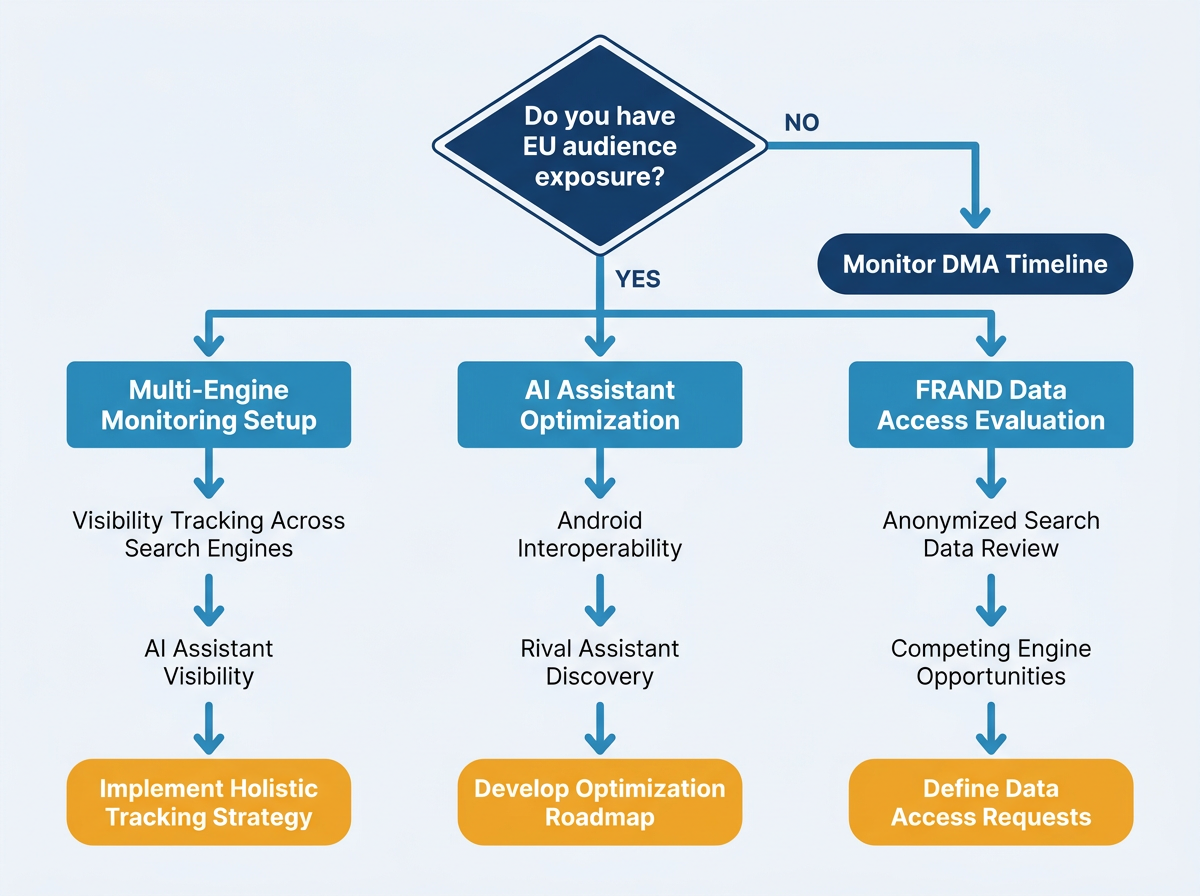
The strategic read is simple, even if the execution will not be: stronger alternative search services and deeper AI-assistant integration create more places where discovery can happen. A plan that assumes Google will remain the only meaningful discovery funnel in Europe becomes increasingly fragile as users move between conventional search, AI-generated answers, social platforms, communities, and local results. Vizup addresses this shift by acting as an Organic Autopilot for modern discovery, helping brands monitor and improve visibility across all of these surfaces rather than optimising for one channel in isolation.
Do not treat fragmentation as a theoretical future state. Work on why major answer engines cite different sources already shows real divergence in which URLs surface across AI-powered search experiences. As these systems gain access to richer ranking signals, some gaps will close while others open, and that is exactly why engine-by-engine visibility tracking shifts from nice-to-have to table stakes.
Europe is not one market with one set of search habits. The zero-click patterns across UK and German search show how intent and search-result behaviour already vary across borders. Add DMA-driven competition, and brands with European exposure need visibility monitoring that is granular by country and discovery surface rather than a single blended dashboard that hides meaningful differences. Vizup's Organic Autopilot helps brands monitor their presence across Search, Social, Communities, AI Answer Engines, and Local Discovery, so teams can identify where visibility is growing, weakening, or shifting.
This fragmentation is where Vizup's Organic Autopilot helps brands build and maintain a consistent presence across Search, Social, Communities, AI Answer Engines, and Local Discovery. Vizup combines AI agents, human experts, and live SEO, pSEO, AEO, and GEO tools to monitor visibility, create and optimise content, publish improvements, and learn from performance in one connected workflow. Organic discovery remains the core strategy, with paid advertising available as an optional amplification add-on when additional reach is needed.
Common Misconceptions About the DMA Specification Decisions
- "Google was fined." No. These are compliance instructions, not penalties. No financial sanction was imposed, and the decisions do not determine a breach.
- "This applies globally." The DMA applies to gatekeeper services as designated in the EU. Android users outside Europe and search providers not operating in the EU are not directly covered by these specific decisions.
- "Rivals will get raw user search histories." The decision requires multi-layered anonymization. What gets shared is aggregated, anonymized ranking signals, not identifiable user queries. Google's objection is about whether anonymization is strong enough, not about raw histories being handed over.
Key Takeaways for Strategists
- Two binding mandates, one goal: The EU is forcing Google to open Android to rival AI assistants (Article 6(7)) and to share anonymized search data with competing search engines on FRAND terms (Article 6(11)).
- Specification, not sanction: These DMA specification decisions spell out how Google must comply. They are not fines or breach findings, and they can be challenged through judicial review.
- Timelines are concrete: Search data sharing starts January 2027. Android AI interoperability rolls out through mid-2027, with a hard deadline of August 1, 2027 for most features and August 1, 2028 for concurrent hotword detection.
- Google objects on privacy grounds: Kent Walker said the decisions risk undermining privacy and security, arguing anonymization may not sufficiently protect sensitive European searches.
- Strategic implication: EU search and discovery are likely to spread across more engines and AI assistants, which raises the value of multi-engine visibility tracking versus a single-engine SEO posture.
Frequently Asked Questions
Does this EU DMA decision mean Google was fined?
No. These are specification decisions that tell Google how to comply with existing Digital Markets Act obligations. They do not determine a DMA breach and they do not impose a financial penalty. That is a separate enforcement track.
Will I see these changes on my Android phone outside the EU?
Not necessarily. The DMA applies to gatekeeper services designated within the EU, and these compliance instructions are aimed at the European market. If Google chooses to extend similar changes elsewhere, that would be a separate business and regulatory decision.
What does 'FRAND search data' actually mean?
FRAND means Fair, Reasonable, and Non-Discriminatory. Here, it requires Google to offer anonymized search data to eligible rival search providers using a defined pricing formula, without playing favorites. The access terms and pricing are meant to be transparent and applied consistently.
How will Google anonymize the search data it has to share?
The Commission's decision calls for a multi-layered anonymization method. The dataset covers anonymised ranking, query, click, and view data. The Commission's safeguards remove or alter identifiers and sensitive attributes; it should not be described simply as aggregated data that is processed to remove individually identifiable signals. Google can also assess cybersecurity and data-protection risks before sharing with a specific party, and it argues anonymization may still leave sensitive searches exposed.
Could these DMA specification decisions be overturned?
Yes. Both decisions can be reviewed by the General Court of the EU. Google can challenge them, and its public objections make that outcome plausible. A court case would not automatically stop the compliance deadlines, but a ruling could modify or annul particular requirements.
