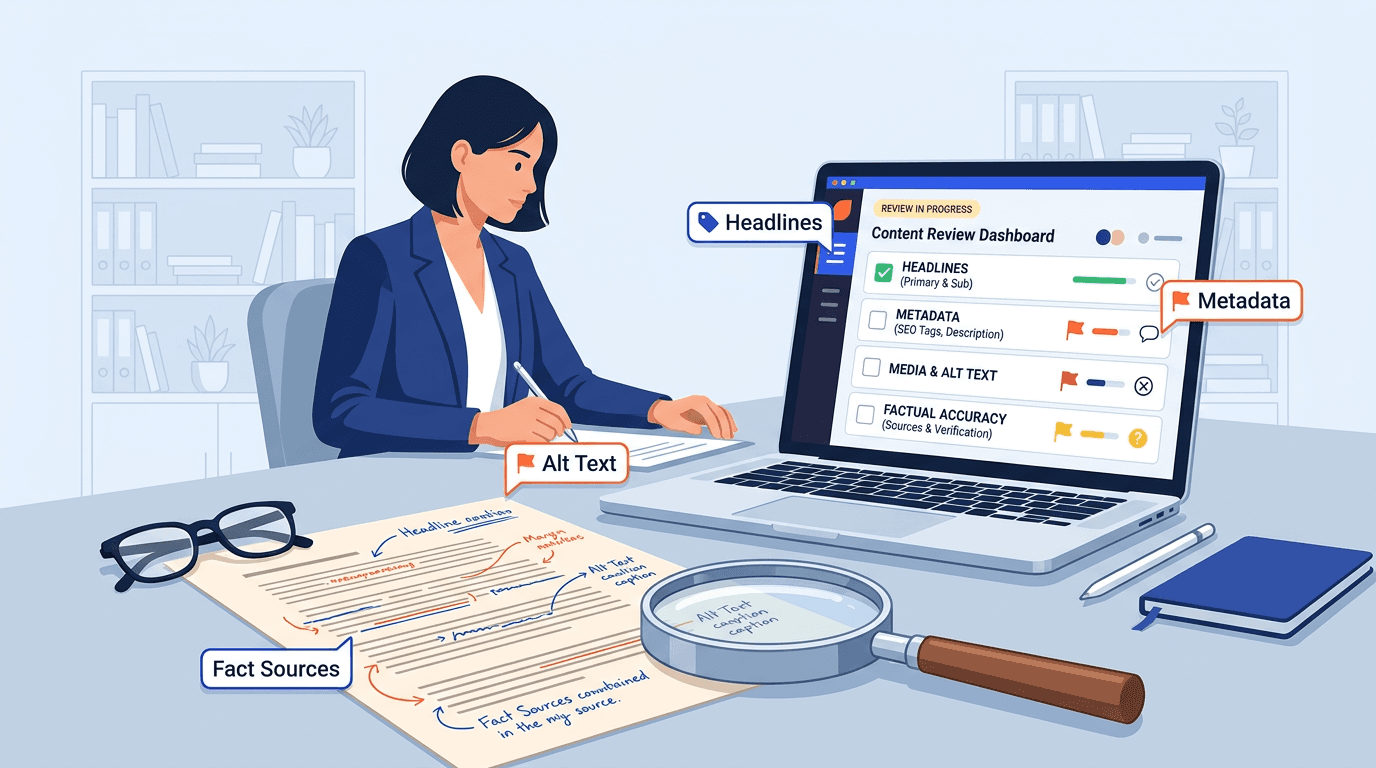
On October 1, 2026, Google updated its Search Central documentation: it is "critical to manually fact-check and review all AI-generated content for accuracy and trustworthiness before publishing," including titles and alt text. That line changes the operating model for teams publishing at scale. The issue is not whether to review AI output, but how to do it without turning review into the slowest part of production.
The workflow below turns that requirement into three practical phases. It covers familiar editorial checks as well as the page elements that frequently escape review, giving teams a process they can assign, document, and repeat.
What Google's AI Content Guidance Actually Says
Google's updated guidance is not a ban on AI writing. Its concern is accuracy and usefulness, not how a draft was produced. The tool is beside the point; a knowledgeable person must verify the finished work before readers see it.
Earlier E-E-A-T guidance left room for teams to treat quality as a broad editorial principle. The October 2026 update is more direct: it names manual review and extends it to metadata. Under Google's updated 2026 guidance on generative AI content, accuracy is a baseline expectation rather than a nice-to-have. Teams reading this as a coming crackdown on AI should first read Google's guidance on generative AI content. The data in Does AI content rank on Google? offers useful context: AI-assisted pages perform when they meet quality standards, and fail when they do not.
Info: The guidance does not punish AI assistance. It addresses publishing without verification - a different problem that needs a different workflow.
The Real Bottleneck: Fact-Checking Beyond the Body Copy
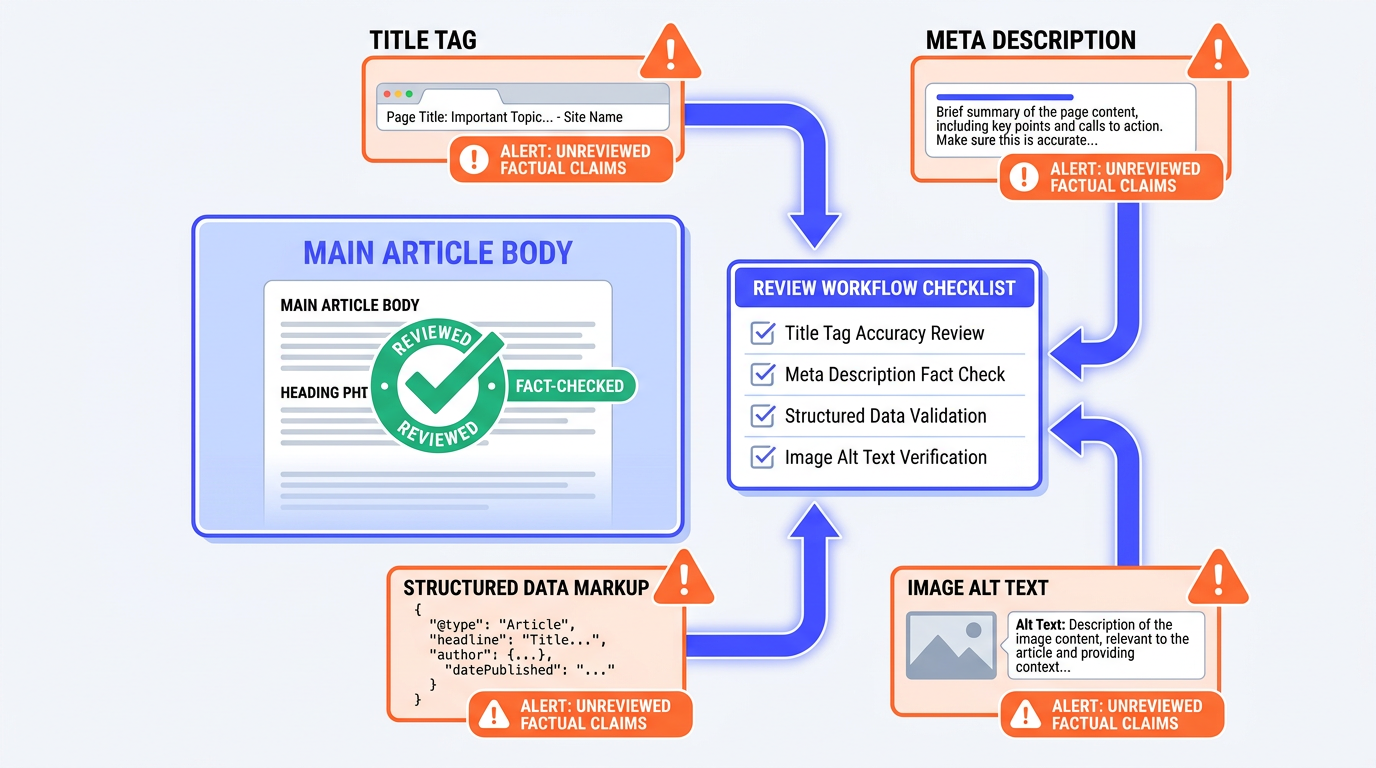
Editorial review often stops at the draft, even though Google assesses the full page. An unreviewed AI-generated FAQ schema is still a factual claim presented to users. Google notes that generative AI can produce inaccurate information, which makes manual verification necessary before AI-generated content is published. The risk is not confined to body copy.
The forgotten four are title tags, meta descriptions, structured data, and automatically generated image alt text. Each can make a claim. An incorrect HowTo duration, a meta description that conflicts with the article, or keyword-stuffed alt text that misrepresents an image all fail the accuracy test. Structured data brings an extra exposure: an error can appear in rich results before a user reaches the page, undermining AI content trustworthiness at first contact.
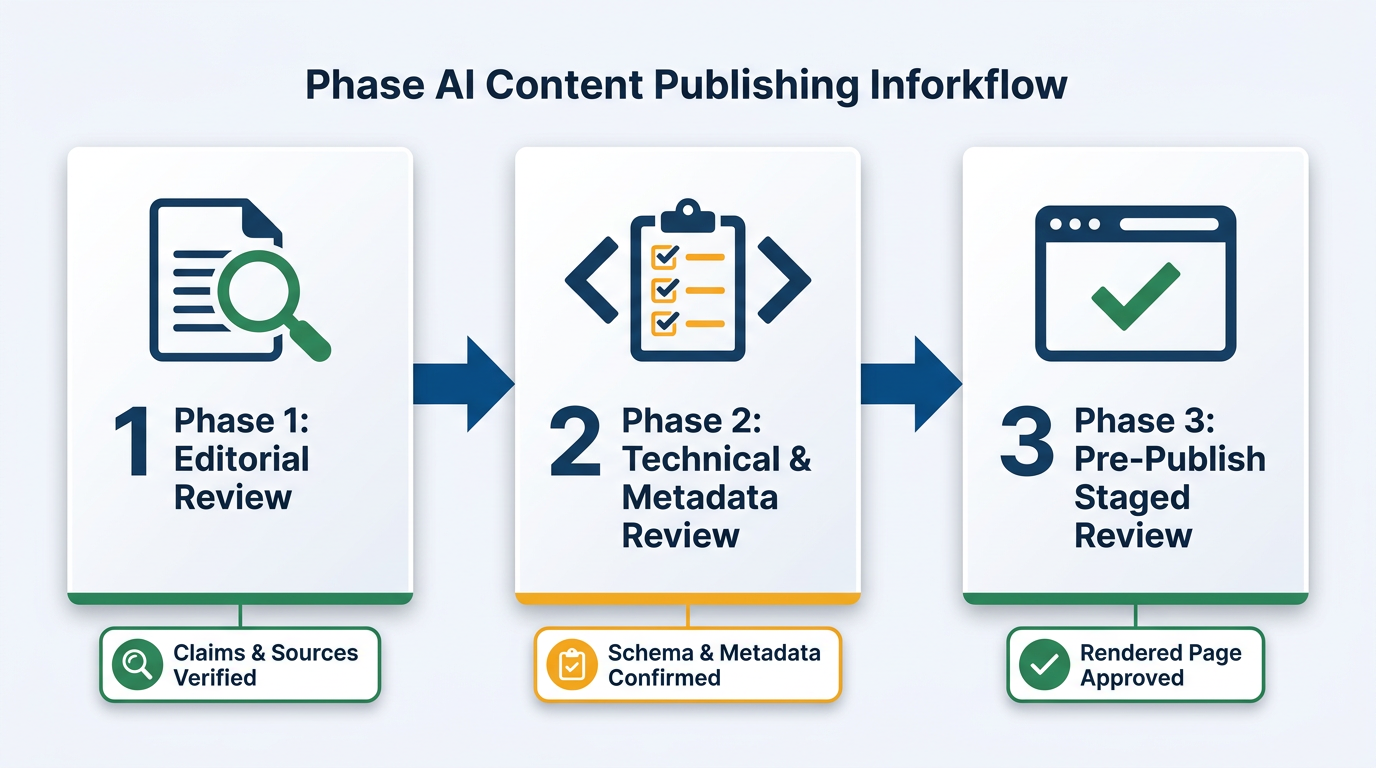
The 3-Phase AI Content Publishing Workflow
Phase 1: The Editorial Review
Begin with the body copy. The reviewer is there to verify claims, not merely smooth the language. Every statistic needs a source; every described process must reflect reality; every product statement must match the brand's current offering.
Hallucinations tend to follow recognizable patterns: credible-looking but untraceable statistics, stale information presented as current, and confident instructions missing a prerequisite. The Associated Press treats AI output as "unvetted source material" that requires ordinary sourcing checks. That is the useful standard: assess the draft as a source, not as finished copy.
Red-flag checklist for common AI body copy errors:
- Statistics without a named source or year
- Dates and version numbers that may have changed since the training cutoff
- Process steps missing a prerequisite or dependency
- Claims about competitors or third-party services
- Phrases such as "studies show" or "experts agree" without attribution
- Absolute claims such as "always," "never," or "the only way"
Phase 2: The Technical and Metadata Review
Most AI publishing workflows break down here. Review four metadata elements separately, because each fails in a different way. This table pairs the check with the error AI tools commonly introduce.
| Page Element | What to Check For | Common AI Error |
|---|---|---|
| Title Tag | Matches the body factually; includes the primary keyword; makes no clickbait claim | Promises a conclusion the article does not reach |
| Meta Description | Summarizes the page accurately; does not conflict with the H1 or introduction | Uses generic copy that could fit any article on the subject |
| FAQ / HowTo Schema | Answers match the body in wording or substance; durations and step counts are correct | Contradicts or drops a nuance in the body |
| Image Alt Text | Describes the actual image; avoids keyword stuffing; captions are accurate | Describes what AI assumed the image showed rather than what it shows |
| Run this check on every AI-assisted page before it moves to pre-publish review. |
For structured data, consistency is the decisive check. If the body describes three steps but HowTo schema lists four, Google can index the contradiction. Google's Rich Results Test can identify many technical structured-data issues, but it cannot verify every factual or content-level inconsistency. A reviewer should still compare the schema with the published content. Teams building AI content quality control into CMS workflows should attach this checklist to each article record.
Phase 3: The Pre-Publish Sanity Check
The last gate is a rendered-page review in staging. Accuracy should already be settled; now inspect the page as a reader and crawler encounter it. Look for broken internal links, formatting errors, and schema that failed to render. Run the Rich Results Test on the staged URL, confirm the approved title tag and meta description, and make sure every image has alt text.
On an organized page, this final review can be completed efficiently once the factual checks are already resolved. It catches failures visible only after rendering, including schema that contradicts an otherwise accurate page in rich results.
Documenting Your Process: Generative AI Content Documentation as a Defensible Record
Generative AI content documentation now belongs in the publishing process. A CMS checklist standardizes review across reviewers and leaves a record of how quality control was performed if an algorithm update prompts scrutiny. The NIST AI Risk Management Framework treats documentation as part of AI trustworthiness, not clerical overhead.
Record the reviewer, date, completed phases, verified sources, and any flagged or corrected claims. "Approved" alone says little about the quality of the review. "Flagged: hallucinated statistic in paragraph 4, replaced with Statista 2026 source" shows the process working. Documenting corrections creates a clearer internal record of how claims were reviewed and updated. Separately, understanding how AI search engines retrieve and cite content can help teams structure authoritative, well-supported content for modern discovery.
Tip: Review quality varies when "fact-checked" has no shared definition. A documented checklist makes the standard visible and consistent across the team.
From AI Assistance to AI Accountability
Google's guidance is a guardrail, not a roadblock. Trouble awaits teams that publish with AI but lack human quality control for the whole page. Media-reported AI content incidents rose tenfold between early 2020 and January 2026, according to Statista data from the OECD's AI Incidents Monitor. A structured review process could have prevented many of them.
Run the 3-Phase Workflow on the next article, add the Phase 2 table to the CMS template, and attach a checklist to every record. The AI content workflow established now becomes quality infrastructure as AI-assisted publishing grows. Vizup acts as an Organic Autopilot for modern discovery, helping brands monitor, create, optimise, publish, and learn across Search, Social, Communities, AI Answer Engines, and Local Discovery. It combines AI agents, human experts, and live SEO, pSEO, AEO, and GEO tools to support content quality and organic visibility across the publishing lifecycle. "Use Vizup's AI Content Checker as a first-pass content-quality diagnostic to identify AI-like patterns and editorial weaknesses. It should support, not replace, manual source verification and factual review.
Frequently Asked Questions
Do I need to disclose that AI assisted with my content?
Google's current guidance does not require a disclosure label for AI-assisted content. Its focus is accuracy and helpfulness, not the production method. Some industries, jurisdictions, and editorial settings, including journalism and sponsored content, have separate standards. Check the rules that apply to your field rather than relying on Google's documentation alone.
How does this AI content guidance affect programmatic SEO?
Programmatic SEO creates the sharpest operational challenge because it publishes at volume. Google's guidance applies to each page, so a generated URL carries the same accuracy expectation as a hand-written one. Build review into template logic: audit the template, validate data sources, and use structured sampling to identify recurring issues. Sampling can support quality control at scale, but AI-generated pages should still receive appropriate human review before publication.
What is the fastest reliable way to fact-check AI-generated content?
Verify claims against primary sources rather than relying on a secondary search. Trace statistics to the original study or dataset, and check official product documentation for process descriptions. FactCheck.org's editorial process follows this model: claims are traced to primary sources before verification. Require citations in AI prompts so reviewers can validate them faster.
Will Google penalize AI-written meta descriptions or alt text?
No - not simply because AI generated them. Google's guidance concerns accuracy and relevance, not AI-produced metadata itself. Metadata is acceptable when it accurately represents the page and helps the reader. Risk enters when it is generic, contradictory, or factually wrong. Phase 2 addresses the checks Google expects before publication.
How much old AI-assisted content should I review?
Prioritize traffic and risk. Start with high-traffic AI-assisted pages, then pages using FAQPage, HowTo, or Product schema, where errors can surface in rich results. Pages making claims about products, prices, processes, or third parties deserve more attention than evergreen conceptual material. A complete retrospective audit may not always be practical, so start with the highest-traffic and highest-risk pages, especially those using structured data or making claims about products, prices, processes, or third parties.
