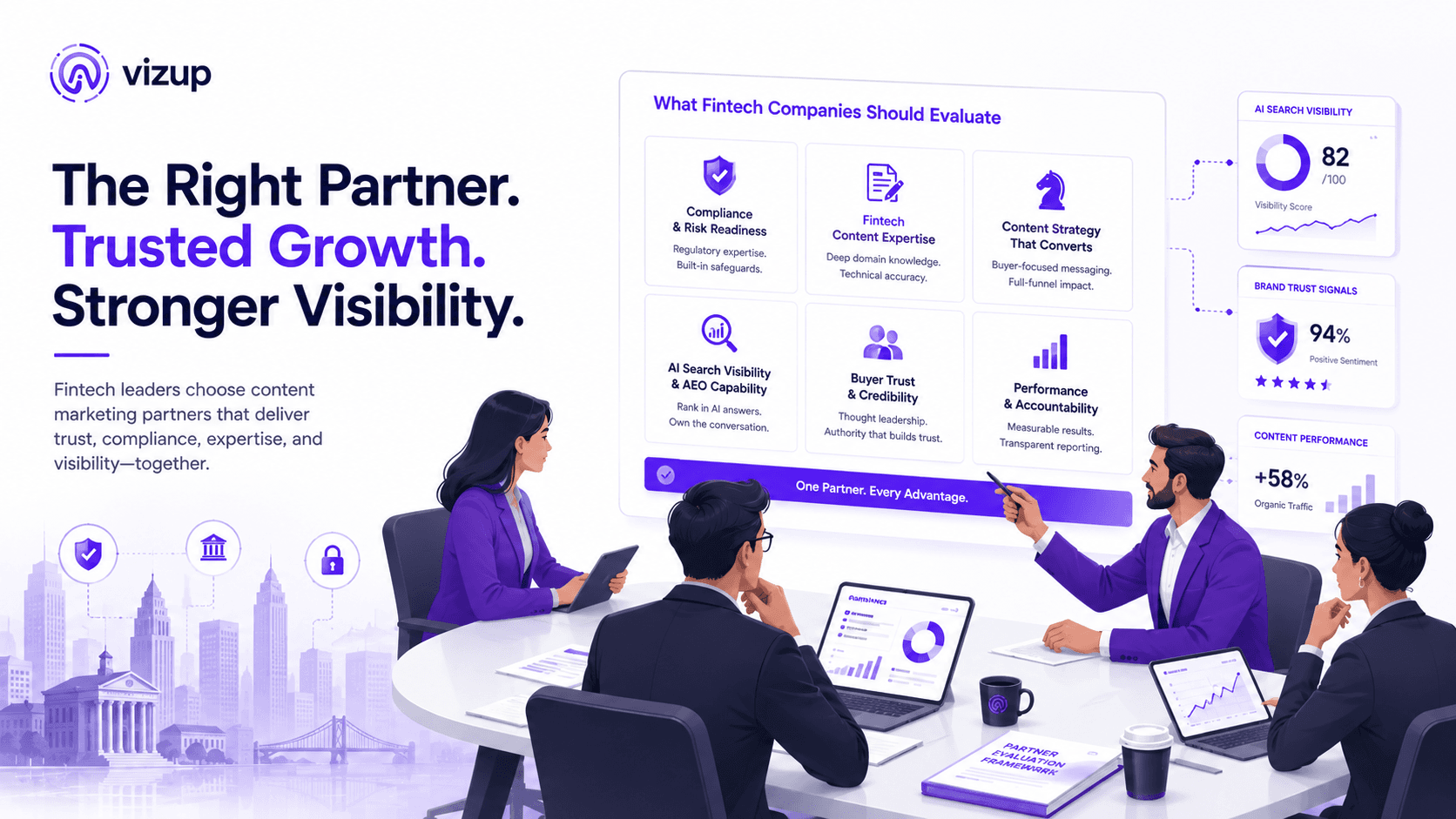
Fintech companies are pouring more money into content than ever. Yet many still struggle to turn content into measurable business results. That gap rarely comes down to effort; it usually comes down to picking the wrong partner.
In a regulated, trust-first category, a weak fintech content marketing agency does more than waste budget. It can ship copy your compliance team cannot sign off on, ignore the AI-driven surfaces where buyers now start their research, and leave you invisible when intent is highest. What follows is a practical way to vet agencies and to judge them on the visibility they can actually prove.
Why Fintech Content Marketing Is a Different Animal
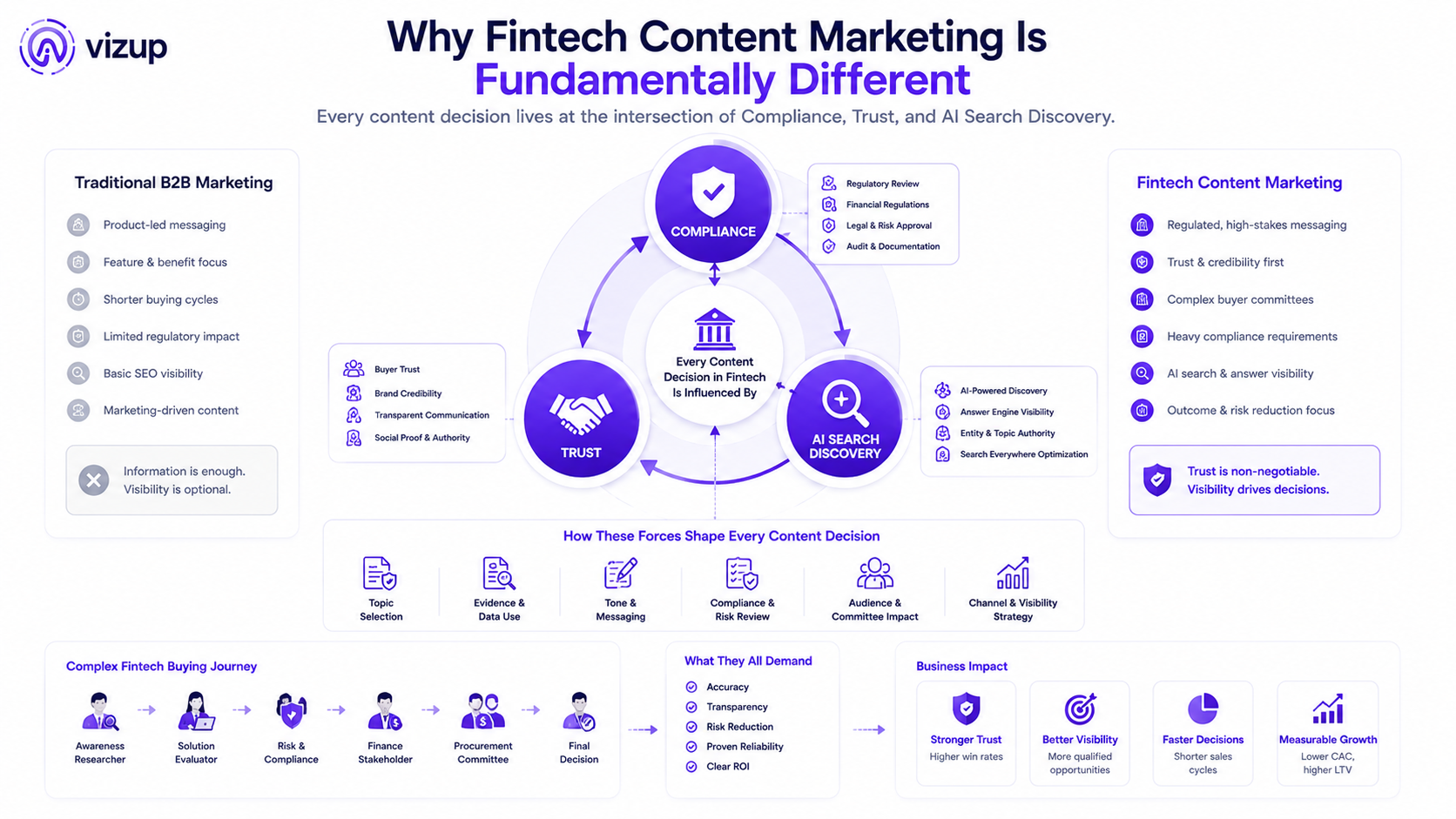
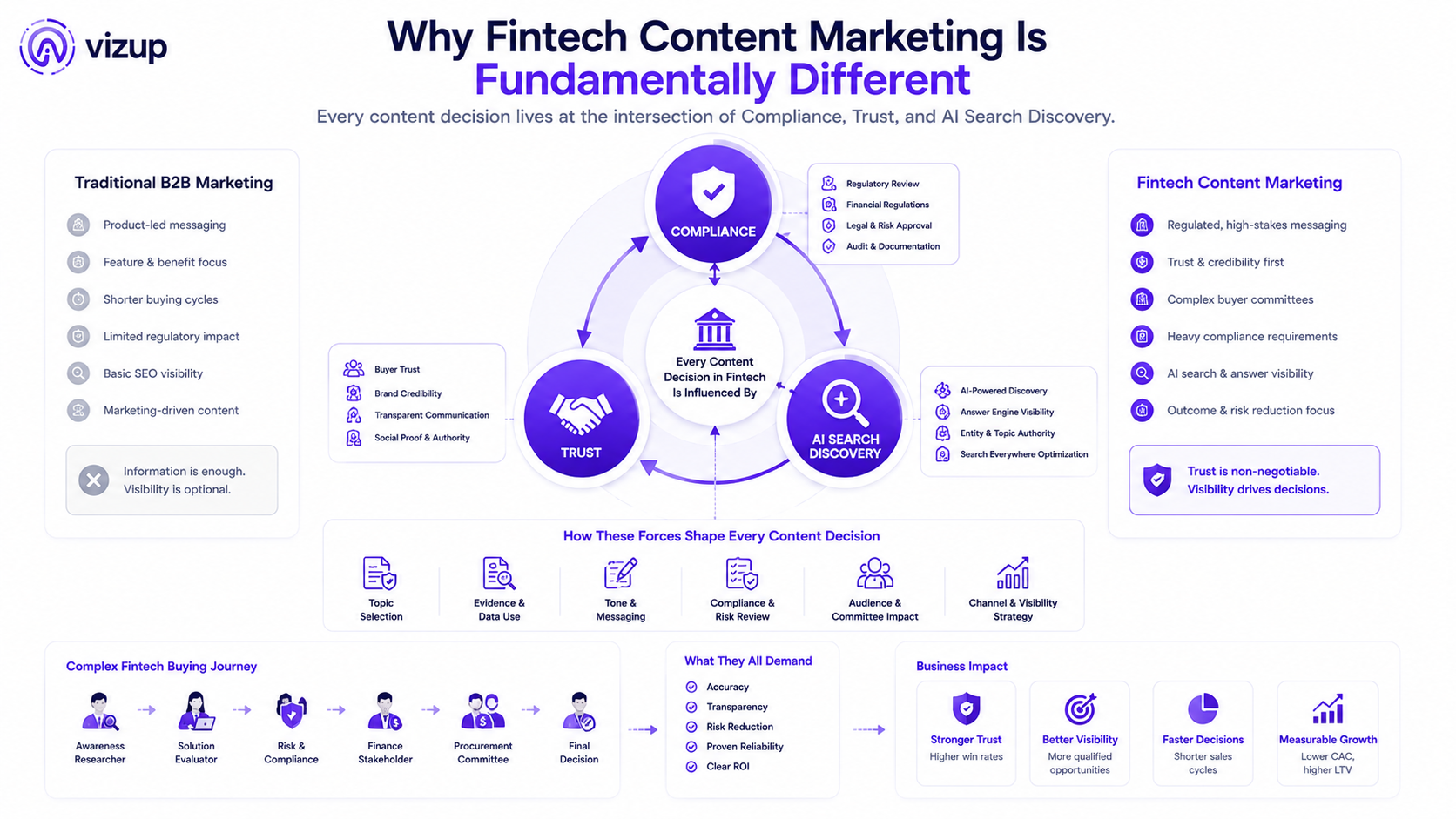
Plenty of agencies treat financial services like just another B2B vertical. That assumption gets expensive fast. In payments, lending, and insurtech, one sloppy claim about returns, risk, or guarantees can create compliance exposure. When writers do not speak the domain, legal will bounce drafts, and you end up paying for revision loops instead of momentum.
Fintech buying cycles are also longer, more risk-aware, and less forgiving. Procurement tends to be a committee sport: CFOs, compliance officers, and growth leads all show up with different questions and different thresholds for proof. Your content has to carry trust from first touch to shortlist, not just spike clicks at the top of the funnel.
The bigger shift, though, is discovery. As customers use generative AI tools to discover products, digital marketing is shifting from search engine optimization to generative engine optimization. If an agency is only optimizing for ten blue links, it is playing yesterday's game. Understanding content marketing in the AI search era is now table stakes for fintech teams.
What a Fintech Content Marketing Agency Should Actually Do for You
A monthly blog calendar is not a strategy; it is a production schedule. A partner worth keeping should own the full loop: strategy, production, distribution, and measurement. In practice, three capability areas separate agencies that move the needle from agencies that just keep shipping invoices.
Strategy That Speaks the Language of Finance
Start with translation. The agency needs to turn complex financial products into clear, compliant copy without sanding off the technical edges. Ask for samples across fintech categories such as payments infrastructure, embedded finance, lending origination, and insurtech underwriting. If the portfolio is mostly vague "digital transformation" thought leadership, treat that as a warning, not a credential.
Topic research should look like your market, not a keyword volume chart. Strong agencies map content to the questions CFOs, compliance managers, and product leads actually ask, and they filter out traffic that will never convert. Pulling in the wrong audience is not a rounding error; it is a measurable budget leak.
SEO and Answer Engine Optimization Under One Roof
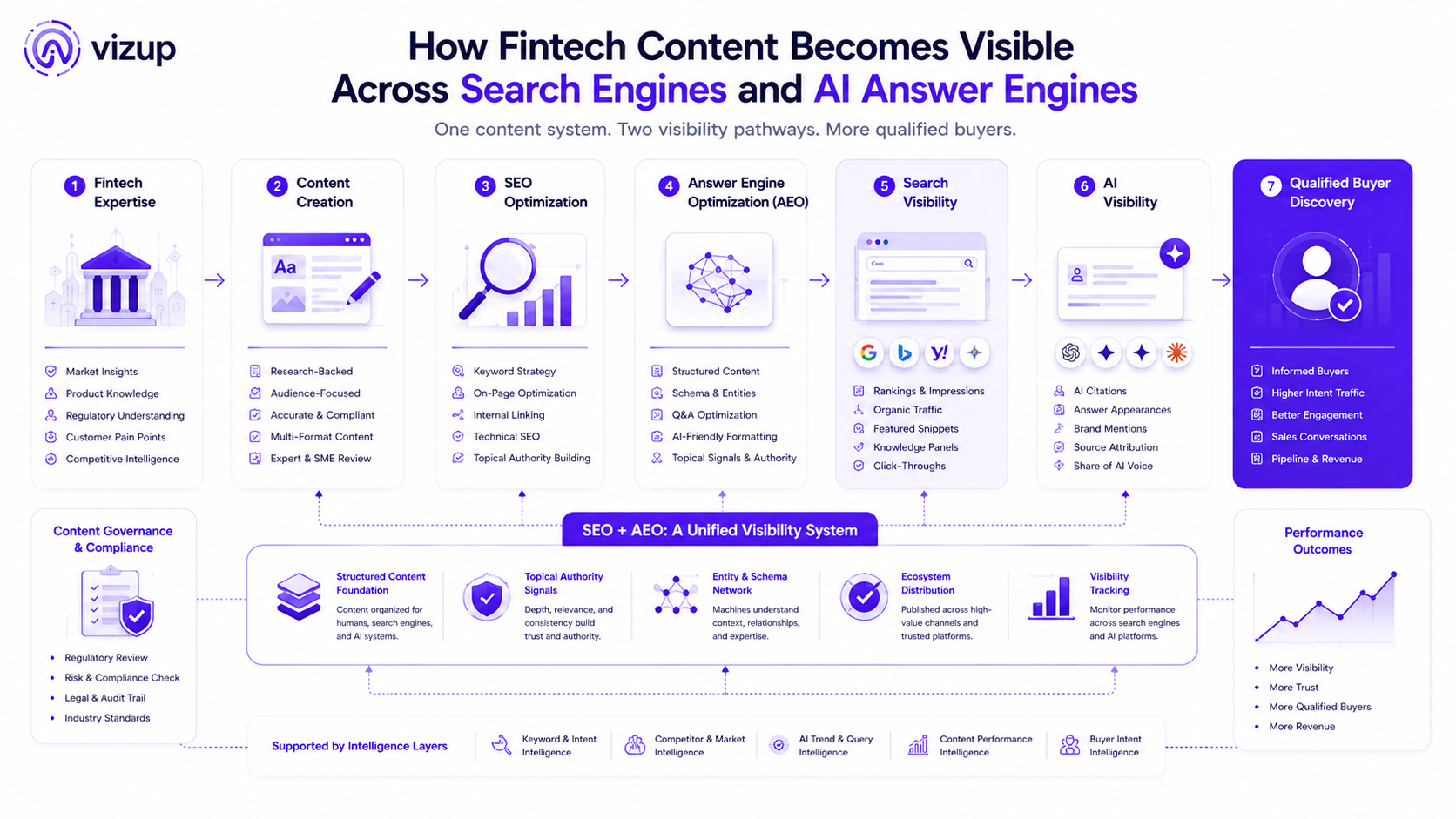
Classic SEO is still required, but it is no longer sufficient. Agencies also need to optimize content for AI-generated answers and LLM-driven search surfaces, commonly referred to as Answer Engine Optimization (AEO). That work includes structuring pages so systems can extract and cite them, building topical authority that LLMs consistently recognize, and tracking whether your brand shows up in AI responses over time.
That tracking is where most proposals get hand-wavy. Tools like Vizup's Answer Engine Monitoring give fintech teams a real-time read on visibility across both traditional and AI-driven search. A modern agency should either be using this category of tooling or have a clear equivalent in its stack. If they cannot explain how they measure AI presence, assume they are not managing it.
Distribution and Amplification, Not Just Production
Content that never leaves your CMS is just inventory. Push for agencies that bake distribution into the engagement from the start: syndication, email nurture, social amplification, and earned media. Production-only shops will happily fill your library while competitors win the channels where buyers actually pay attention. A strong B2B content marketing strategy for AI search treats distribution as a first-class discipline, not an afterthought.
The Red Flags That Should Kill a Deal
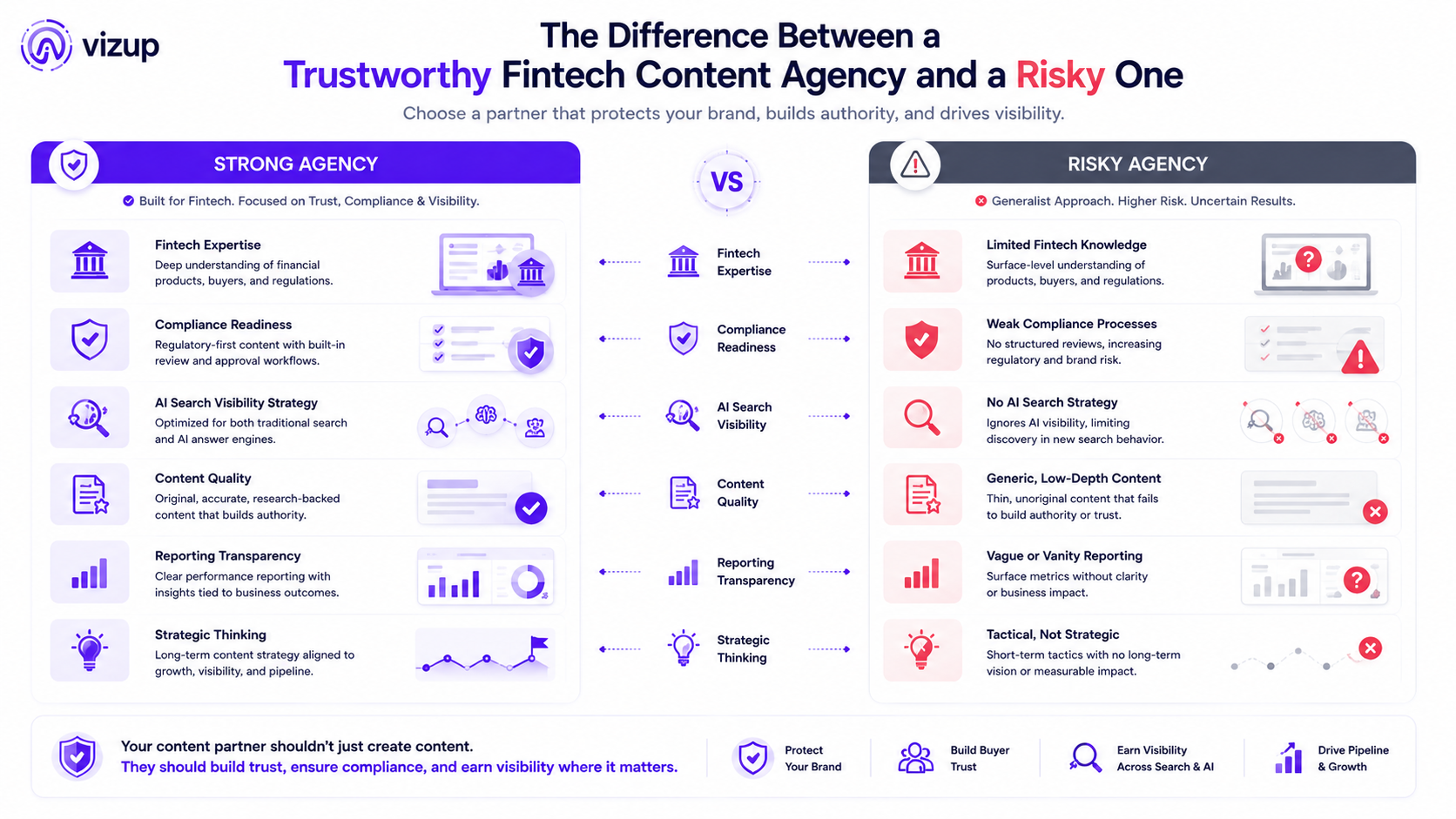
Watch for these signals during the evaluation process:
- No fintech-specific case studies or writing samples. A generalist portfolio usually means the agency will learn your category on your budget. Evaluating an agency's approach to compliant, data-driven content is a non-negotiable part of selection.
- Vanity metrics pitched as success. Page views without pipeline context are not a business result. If the proposal leads with traffic spikes and impressions, ask how they connect content work to revenue.
- No strategy for AI search visibility. This is the fastest-growing gap between legacy shops and modern ones. If they cannot describe an AEO approach, they are optimizing for a discovery model that is already shifting.
- Compliance review treated as your problem alone. Strong fintech agencies build compliance checkpoints into their own workflow. If they expect your legal team to catch everything at the end, plan for rework and delays.
How to Evaluate a Fintech Content Marketing Agency: A Practical Scorecard
Use the scorecard below to compare agencies across seven dimensions. Rate each dimension from 1 to 5 using the criteria, then multiply by the weight to calculate a weighted score. Tune the weights to your stage: early-stage fintechs should lean harder on domain expertise and compliance workflow, while growth-stage teams scaling output should put more weight on AEO readiness and reporting clarity.
| Dimension | Weight | Score (1-5) | What a 5 Looks Like | Notes |
|---|---|---|---|---|
| Fintech Domain Expertise | High | Credible work across payments, lending, or insurtech with clear technical accuracy | Ask for unedited writing samples | |
| SEO Capability | Medium | Keyword strategy tied to fintech buyer intent rather than generic search volume | Request sample keyword strategy | |
| AEO / AI Search Readiness | High | Documented approach to optimizing for LLM citation and AI Overviews | Ask how they track AI visibility | |
| Content Quality | High | Compliant, technically correct, and readable for non-specialist buyers | Have a subject-matter expert review samples | |
| Reporting Transparency | Medium | Proactive dashboards that pair SEO performance with AI visibility metrics | Ask to see a sample report | |
| Compliance Workflow Integration | High | A defined legal/compliance review step before anything ships | Confirm who owns each review step | |
| Pricing Model | Low | Clear retainer or project pricing with explicit deliverables and scope | Watch for vague scope language | |
| Score each dimension 1-5, multiply by weight (High=3, Medium=2, Low=1), and sum for a total. |
Measuring Visibility: The Part Most Companies Get Wrong
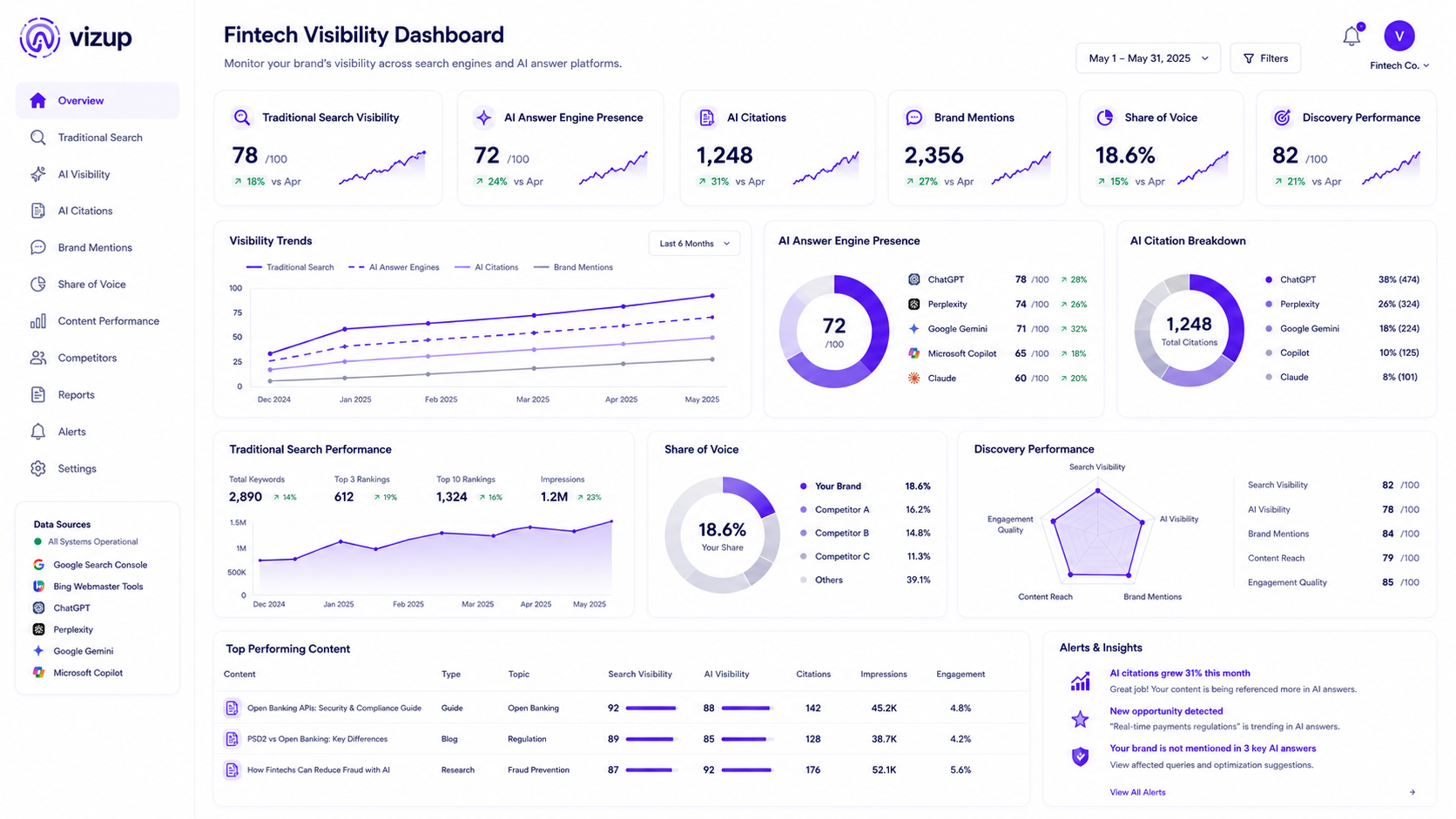
Visibility no longer maps cleanly to keyword rank. It now includes whether your brand shows up in AI-generated answers, featured snippets, and LLM-driven recommendations. Many agencies still report only organic traffic and keyword positions, which leaves a lot of discovery unmeasured. Read why visibility metrics matter more than traffic before you lock in a reporting model you will regret later.
Traditional SEO Metrics vs. AI-Era Visibility Metrics
Keyword rankings, organic sessions, backlinks, and domain authority still matter as baseline signals. They tell you how content performs in conventional search results. What they do not tell you is whether your brand gets cited when a buyer asks an AI assistant which payment infrastructure providers to shortlist or which lending platforms are considered most trusted.
That is what AI-era visibility metrics are for: answer engine presence rate, brand mention frequency in LLM outputs, and citation share in AI Overviews. Vizup's Digital Presence Monitoring and Answer Engine Monitoring are designed to surface those signals, giving fintech teams a live view of visibility across both classic search and AI-driven discovery. If you are comparing platforms, the AI search visibility management tools overview is a helpful benchmark for what your agency should be able to operate.
Tip: Before you sign, ask for a baseline: where does your brand appear in AI search right now? If the agency cannot pull that data, they are not set up to improve it. This provides a starting point so you can hold partners accountable from day one.
Building a Reporting Framework With Your Agency
Lock KPIs before kickoff, not after the first quarterly review. A common failure mode is letting agencies define success retroactively, which tends to favor whatever they already do well. Require dashboards that pair SEO performance with AI visibility. For SaaS-model fintechs, the AI search visibility reporting framework playbook is a useful template for structuring those reporting expectations.
A Quick Gut Check Before You Sign

The scorecard covers the rational part. Before you commit, run these five questions as an instinct check:
- Do they understand my buyer? Can they explain what a CFO needs to see versus what a compliance manager needs to read? If the language stays at generic persona level, that is a problem.
- Can they show me where my brand appears in AI search today? If they cannot answer with data, they cannot manage the outcome.
- Are they measuring what matters or what is easy? Traffic is easy to screenshot. Pipeline influence and AI citation share take better tooling and more candor.
- Do I trust their writers with a compliance-sensitive topic? Read samples like your legal team would. Would this pass without heavy edits?
- Would I read the content they have produced for other clients? If it feels generic, forgettable, or templated, your buyers will have the same reaction.
The Agency You Choose Shapes the Brand Your Market Sees
In fintech, content functions as trust infrastructure. Every article, whitepaper, and AI-cited answer either strengthens credibility or chips away at it, and credibility is what buyers need before they will share sensitive financial data or wire a payment API into core systems. The agency is not just a vendor; it is effectively a co-author of how the market understands your brand.
Hold partners to a visibility standard that matches how search works in 2026, not how it worked three years ago. The complete guide to improving brand visibility in AI search is a solid next step for teams building that measurement foundation. Vizup's Digital Presence Monitoring and Answer Engine Monitoring add the monitoring layer that keeps any fintech content marketing agency accountable to real visibility outcomes across both traditional rankings and the AI-generated answers where buyers increasingly start.
Frequently Asked Questions
What should a fintech content marketing agency include in its monthly reporting?
A credible monthly report covers both classic SEO metrics (keyword rankings, organic sessions, backlink growth) and AI-era visibility metrics (answer engine presence, brand citation frequency in LLM outputs, share of AI Overview appearances). It should also show content pipeline status, compliance review completion rates, and at least one attribution signal that connects content activity to pipeline or revenue. If you are only getting traffic and impressions, ask for reporting that reflects the full discovery picture.
How is answer engine optimization (AEO) different from traditional SEO for fintech companies?
Traditional SEO aims to rank in search results through keyword targeting, backlink building, and technical site health. AEO is about making content legible to AI systems such as ChatGPT, Perplexity, and Google's AI Overviews so they can extract, cite, and surface it when users ask questions. For fintech, that difference matters because buyers now often start their research in AI search. AEO typically demands tighter content structure, stronger topical authority signals, and monitoring that tracks LLM citation rather than only keyword position.
How much should a fintech company expect to pay a content marketing agency?
Pricing varies by agency size, specialization, and scope. As a current neutral benchmark, digital agency pricing varies by scope, with many agencies charging $175–$199 per hour as a current market benchmark, according to Promethean Research's Digital Agency Industry Report. Full-service fintech content engagements involving strategy, production, compliance review, distribution, and reporting are usually priced based on the volume and complexity of those deliverables.
Can a generalist content marketing agency handle fintech content effectively?
Most generalist agencies struggle with the compliance constraints, technical accuracy requirements, and a multi-stakeholder buyer journey that define fintech content. The ability to produce compliant, data-driven content is a core differentiator when selecting a partner. A generalist can sometimes handle light top-of-funnel material, but mid-funnel and bottom-funnel work that depends on regulatory nuance, product complexity, and risk framing typically requires real domain expertise.
How do I measure whether my fintech brand is visible in AI-generated search results?
You need tooling built for AI discovery, because traditional SEO platforms do not track LLM citations or answer engine presence. Answer Engine Monitoring platforms track whether your brand appears in AI-generated responses across major answer engines, with metrics such as citation frequency and share of AI Overviews. Start by capturing a baseline before an agency engagement so you can measure the delta their work creates. The AI search visibility management tools overview covers the broader set of platforms in this space.
