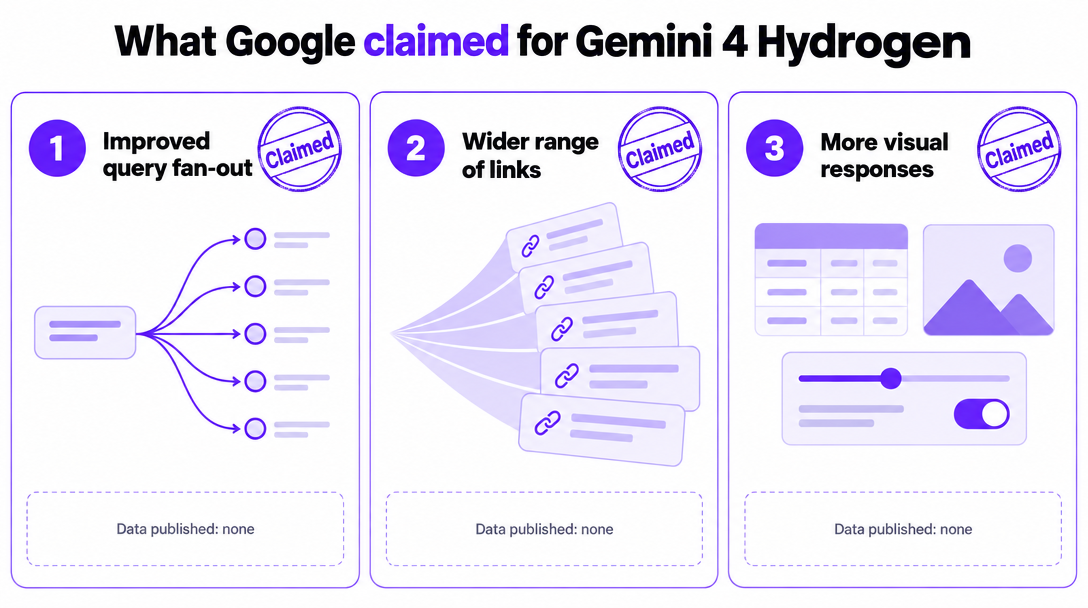
The Gemini 4 Hydrogen Google Search upgrade arrived on 12 November 2026. Google announced Gemini 4 Hydrogen's Search improvements, including better query fan-out and a broader range of helpful links. However, the announcement did not provide before-and-after measurements showing how these changes affect publisher citations, referral traffic, or organic visibility.
For SEO, AEO, and GEO teams, the challenge is understanding which changes actually caused a shift in AI citations. The launch overlaps a core update and a Search Console bug.
Contents:
- What changed: default model and rollout
- Query fan-out: four meanings of wider
- Claim vs. evidence: the ledger
- Tracking citations: prompt-level records
- Subtopic planning: missing answers
- Visual responses: competition for clicks
- Edge cases: measurement traps
- FAQ and this week's checklist
Note: Quote policy: quoted announcement wording is attributed to Google in the coverage. Google's announcement governs scope, markets and model roles; other descriptions are paraphrases.
Gemini 4 Hydrogen in Google Search: What Changed as the AI Mode Default Model
Tip: Already read the coverage? Skip to fan-out. The previous Gemini 3.8 Flash switch established the pattern: a new default, and citations reshuffled without notice.
Search Engine Land's launch report and Search Engine Roundtable's coverage confirm Hydrogen as AI Mode's default and report the AI Overviews upgrade. Google confirmed that Gemini 4 Hydrogen became available globally in Search on 12 November 2026. However, availability does not mean every user, language, query, or AI surface will produce identical results.
Google's three claims:
- Improved query fan-out: better prompt decomposition; mechanics undisclosed.
- Broader links: a "wider range of links".
- More visual responses: tables, images and custom tools.
Gemini 4 Hydrogen is the default model for AI Mode, while Gemini 4 Carbon is available as a separate model option for eligible subscribers. Hydrogen is also used for particularly difficult AI Overview questions. SEO teams should account for differences in model access and answer formats when comparing citations across users and queries.
How Query Fan-Out Works, and What 'Wider' Would Actually Have to Mean
Google has previously explained how query fan-out breaks complex questions into multiple retrieval paths before generating an answer. Separate Google Research work on R4T-Diffusion reported 12 to 20 times faster fan-out retrieval in research evaluations. However, that research does not establish that the same system powers Gemini 4 Hydrogen in Google Search.
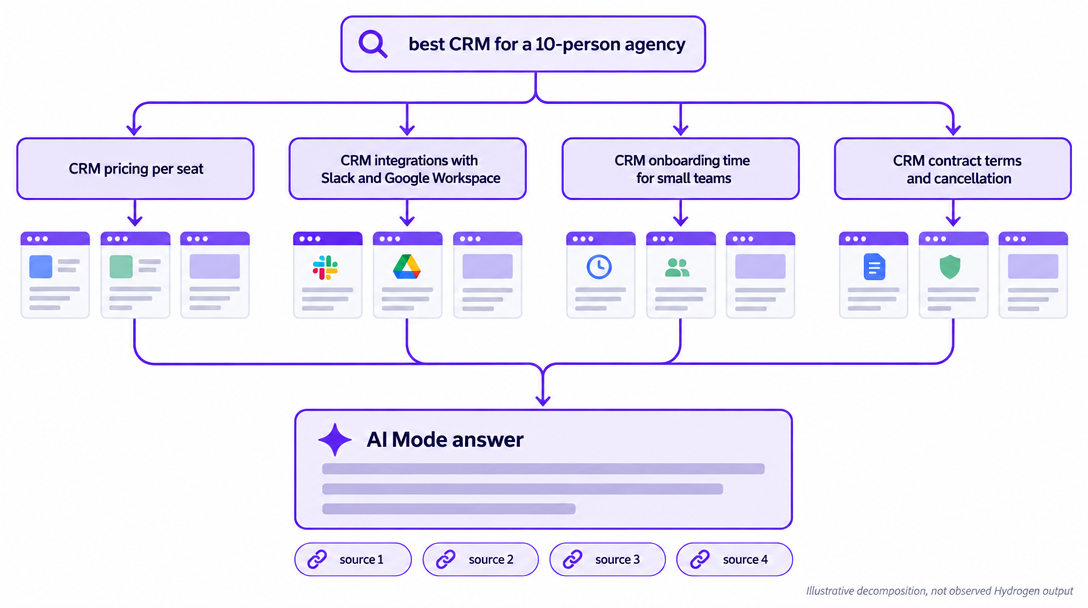
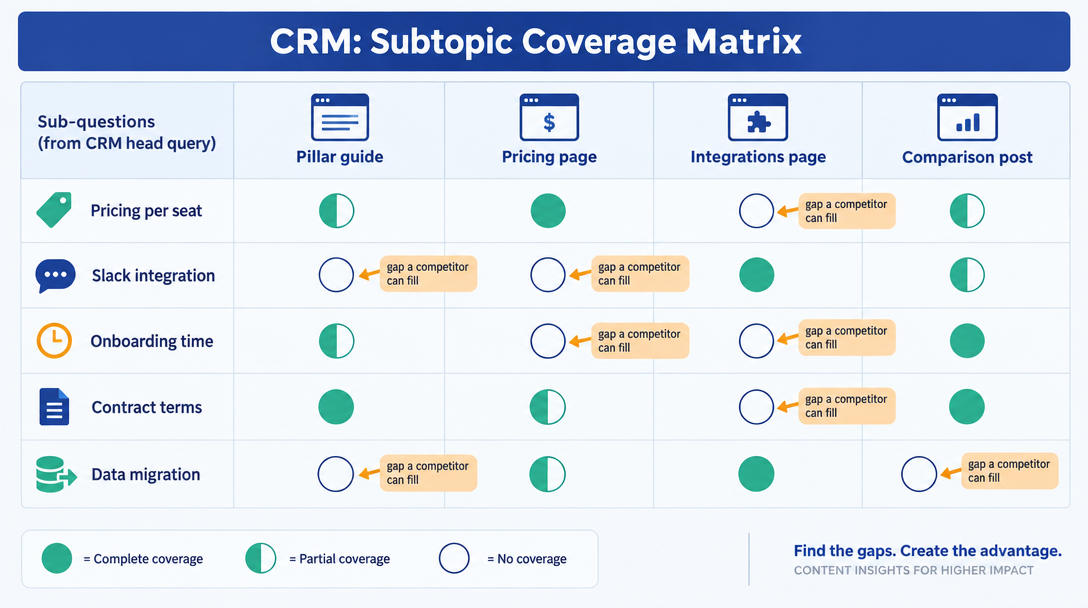
In this illustrative CRM search, a contract-terms page could earn a citation without ranking for the head term. Retrieval happens for each sub-query.
But what, exactly, gets wider?
- More sub-queries: rewards broad coverage.
- More domains retrieved: gives smaller sites an opening.
- Deeper sub-queries: favours precise niche pages.
- More displayed links: can dilute citation share.
These aren't mutually exclusive. Google hasn't specified or quantified any of them.
Google's Claim vs. the Evidence So Far
A "wider range of links" describes a product promise, not a measured result.
What Google has and hasn't published
| Claim | What Google stated | Quantified data published | What confounds measurement | How to test it yourself |
|---|---|---|---|---|
| AI Mode default | Default from 12 Nov 2026 | No citation-impact data | Carbon; core update | Weekly fixed prompts; cited domains |
| AI Overviews upgrade | Also applies here | None | Core update; reporting bug | Track citations separately |
| Improved fan-out | Better decomposition | None | Hidden sub-queries | Count cited subtopics per answer |
| Broader links | "wider range of links" | No breadth/click data | Update; bug; Carbon | Links, domains, citation share |
| More visual responses | Tables, images, custom tools | No frequency/click-cost data | Query/model variation | Log formats; watch CTR |
| Status as of 17 November 2026. Missing data isn't a negative finding. |
Our analysis of Google's earlier AI Mode traffic claim found the same gap: no click data, no denominator, no outside verification.
Warning: Don't mistake timing for cause. Citation gains aren't proof of Hydrogen; losses aren't proof of a penalty. The update, bug, Carbon and ordinary churn all complicate attribution.
Why Search Console can't isolate the change yet
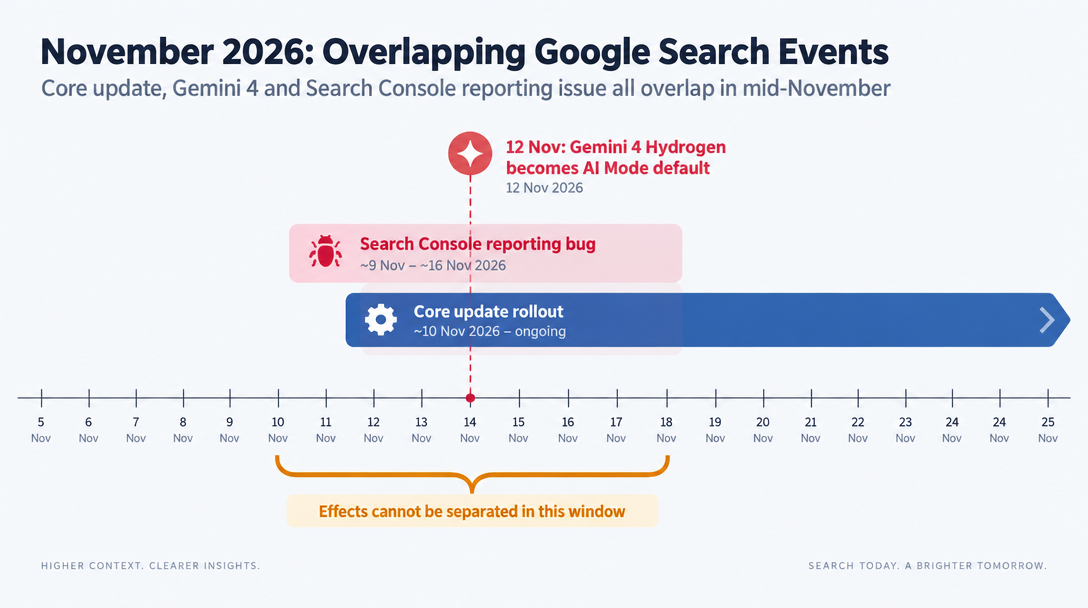
The core update started roughly two days earlier. Check affected dates and reports on Google's Search Status Dashboard. Generative AI performance reports show impressions and clicks, but cannot separate model selection from reranking.
Track AI Mode Citation Changes Without Waiting for a Changelog
Rather than waiting for a detailed changelog, teams can build their own citation tracking baseline. Keep your own prompt-level record.
Build a prompt-level citation baseline
Choose 30 to 50 multipart buyer questions. Log domains, URLs and link positions. Use pre-launch screenshots or exports; otherwise, this is week zero. Our notes on how AI Mode citations affect SEO and local search cover volatile prompts. Manual screenshots become difficult to manage as the number of tracked prompts grows. Vizup's Watcher agent helps teams monitor changes in AI answer visibility and identify citation shifts. As part of Vizup's Organic Autopilot, those findings can inform content improvements, optimisation priorities, and ongoing discovery strategies.
Turn Citation Insights Into Content Improvements With Vizup
Tracking citations is only the first step. Brands also need to understand which topics are missing, which pages need improvement, and how their content performs across different discovery channels.
Vizup works as an Organic Autopilot for modern discovery. It brings together AI agents, human experts, and live SEO, pSEO, AEO, and GEO tools to help brands monitor visibility, create relevant content, optimise existing pages, publish improvements, and learn from performance. This connects citation monitoring with ongoing organic growth across Search, Social, Communities, AI Answer Engines, and Local Discovery. Paid ads are available separately when brands want to amplify their organic efforts.
Measure share of citations, not just presence
More links can leave presence flat while diluting share. Record presence, citation share (your citations divided by all citations), and question level: head question or a sub-question farther down.
Annotate and segment before you conclude anything
Mark all three events. Compare AI-triggering queries with classic-only results: shared movement suggests the core update; AI-only movement isn't conclusive. Wait two clean weeks after rollout before interpreting trends.
Gemini 4 Hydrogen SEO: Rebuild Content Plans Around Subtopics, Not Head Terms
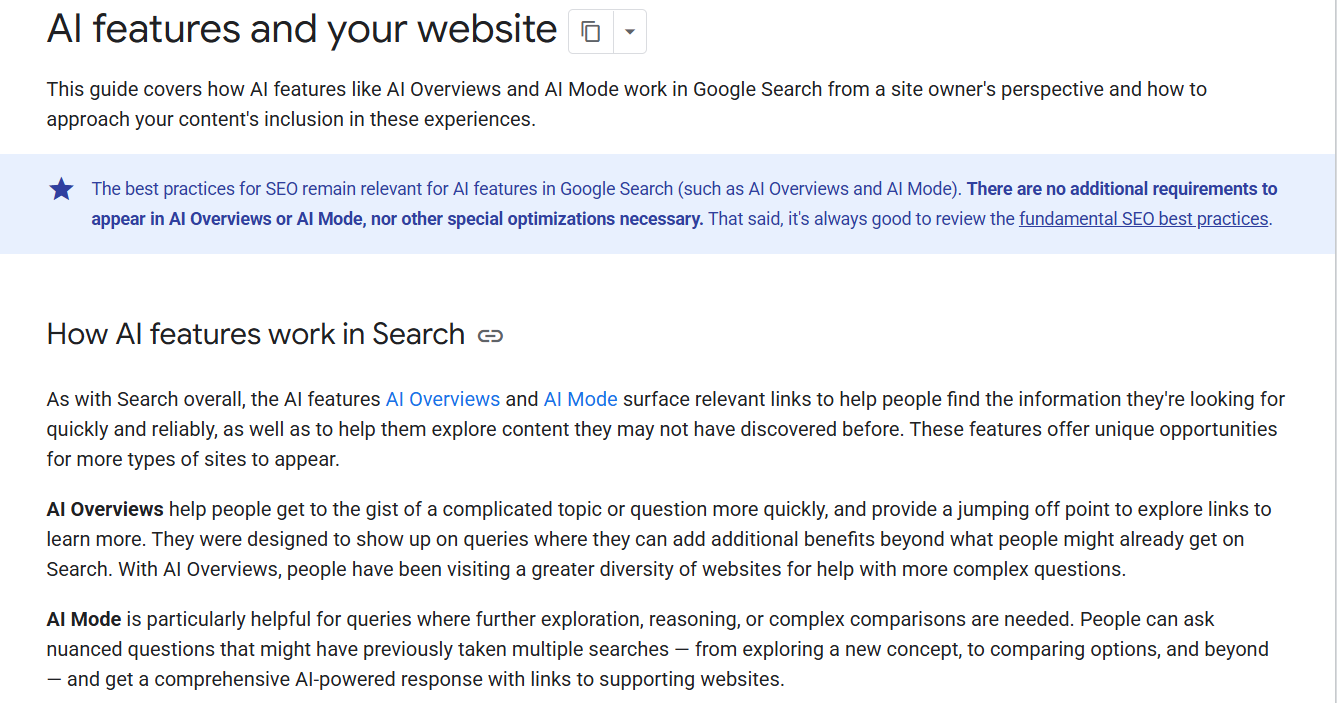
Google's Search Central guidance on AI features says: "There are no additional requirements to appear in AI Overviews or AI Mode, nor other special optimizations necessary." Still, volume-sorted keyword lists miss sub-questions. Coverage is something you control.
Map the fan-out before you write
Infer sub-questions from headings, comparison rows and citations. Mark your coverage full, partial or missing. Repeat: answers vary by run and model.
Optimise for query fan-out with extractable answer spans
- Give each sub-question a headed, self-contained answer of 40 to 80 words.
- Use numbers, units and named entities.
- Create a separate page when a sub-question branches further; otherwise, keep a section.
- Vizup's analysis of a SISTRIX study covering 96,418 URLs found associations between content structure and AI citations. These correlations do not establish ranking rules or prove that particular page elements cause citations.
Are AI Mode Visual Responses Now Competing With Your Links?
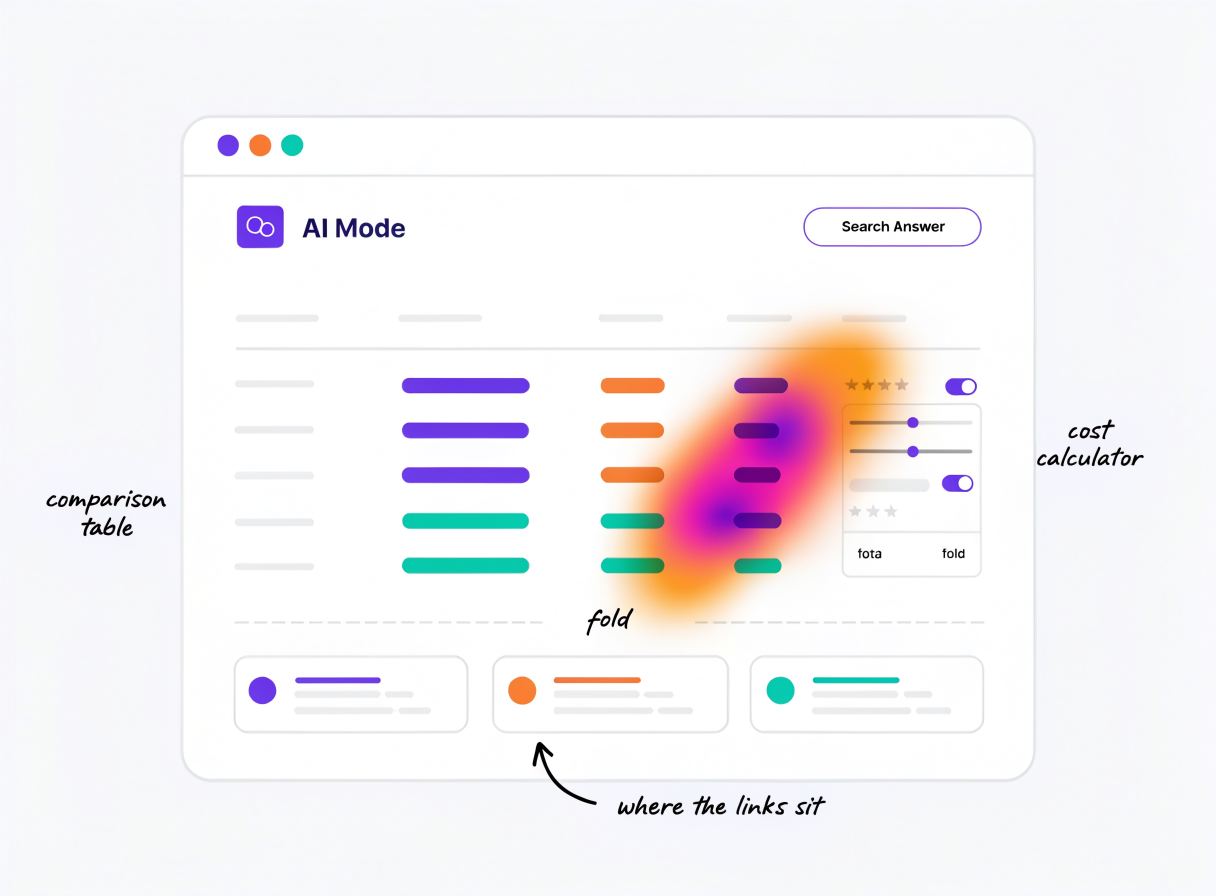
Your comparison table becomes source material. Give it original figures, clear units and an update date, not recycled vendor numbers. Our generative UI analysis traced its spread to AI Overviews; the click cost remains unmeasured.
Edge Cases That Will Skew Your Read
- Model: Carbon and Hydrogen can cite differently.
- Surface: track AI Mode and AI Overviews separately.
- Market: verify rollout by country and language, including outside English and the US.
- Volatility: measure ordinary weekly churn before declaring a model effect.
Frequently Asked Questions
Does Hydrogen also power AI Overviews?
Google says yes. Track the surfaces separately.
Where does Carbon fit?
Hydrogen is the default; Google's announcement defines Carbon's role. Both can affect citations.
Should my SEO strategy change?
No special optimisation is required, says Google. We favour auditing subtopic gaps.
Will wider fan-out bring more traffic?
Unknown. Neither link breadth nor click gains have been quantified.
Can Search Console isolate AI Mode traffic?
Partly. Generative AI reports and query patterns offer clues; see why 'yes' shows up in Search Console AI Mode queries. Neither isolates this model change.
Key Takeaways and What to Do This Week
The model changed. Whether citation breadth changed, and for whom, still needs measurement.
This week:
- Annotate the update, 12 November launch and bug.
- Log 30 to 50 prompts weekly.
- Measure presence and share.
- Map sub-questions for your top 10 head terms.
- Audit table originality, units and dates.
Stay Visible as AI Search Evolves With Vizup
Google's move to Gemini 4 Hydrogen is another reminder that AI search visibility can change even when your website stays the same.
Vizup helps brands move beyond simply tracking rankings and citations.
As an Organic Autopilot for modern discovery, Vizup combines AI agents, human experts, and live SEO, pSEO, AEO, and GEO tools to help brands monitor, create, optimise, publish, and learn across Search, Social, Communities, AI Answer Engines, and Local Discovery.
Instead of reacting to every model update manually, brands can build an ongoing process for identifying visibility gaps and improving their organic presence. Paid ads are also available as an amplification add-on.
Explore Vizup's Organic Autopilot and see how your brand can improve visibility across modern discovery channels.
