Content structure AI citation is the measurable relationship between a page's architecture, including headings, tables of contents, schema, and trust signals, and its likelihood of being selected as an AI answer source. SISTRIX's matched-pair study of 96,418 URLs puts numbers on the features associated with citation rates and the ones that amount to noise.
Much of the GEO advice circulating in 2025 and 2026 is assertion posing as measurement. Teams are shipping llms.txt files, Product schema, and readability rewrites without evidence of a return. The SISTRIX citation worthiness study is more useful because it examines nearly 100,000 URLs with a matched design. The study uses data from the German-speaking DACH region (Germany, Austria, and Switzerland), collected in Q2 2026. Researchers compared cited and non-cited pages from the same domains and used conditional logistic regression to assess associations across 43 features. The findings show correlations, not proven causes, and may differ across markets and content types.
Why Effect Sizes Matter More Than Best-Practice Lists
GEO checklists usually give every item equal billing: add schema, publish llms.txt, add an author box, improve readability. The dataset instead shows results ranging from no measurable difference to pages with high overall optimization scores being cited 2.1 times as often as barely optimized pages. Equal treatment turns engineering time into an expensive guessing game.
Correlation is the obvious objection. Pages with tables of contents are often better produced in other ways, too. SISTRIX compares cited and non-cited URLs within the same domain, helping reduce differences caused by domain-level authority. Its regression analysis identifies associations between page features and citations, but cannot establish that any individual feature directly causes more citations. That moves on-page AEO from "do everything" to "prioritize what survives the data." How AI search engines retrieve and cite content explains why structural landmarks matter for passage-level answers, even though observational data cannot prove the mechanism.
The Features Associated With Higher AI Citation Rates
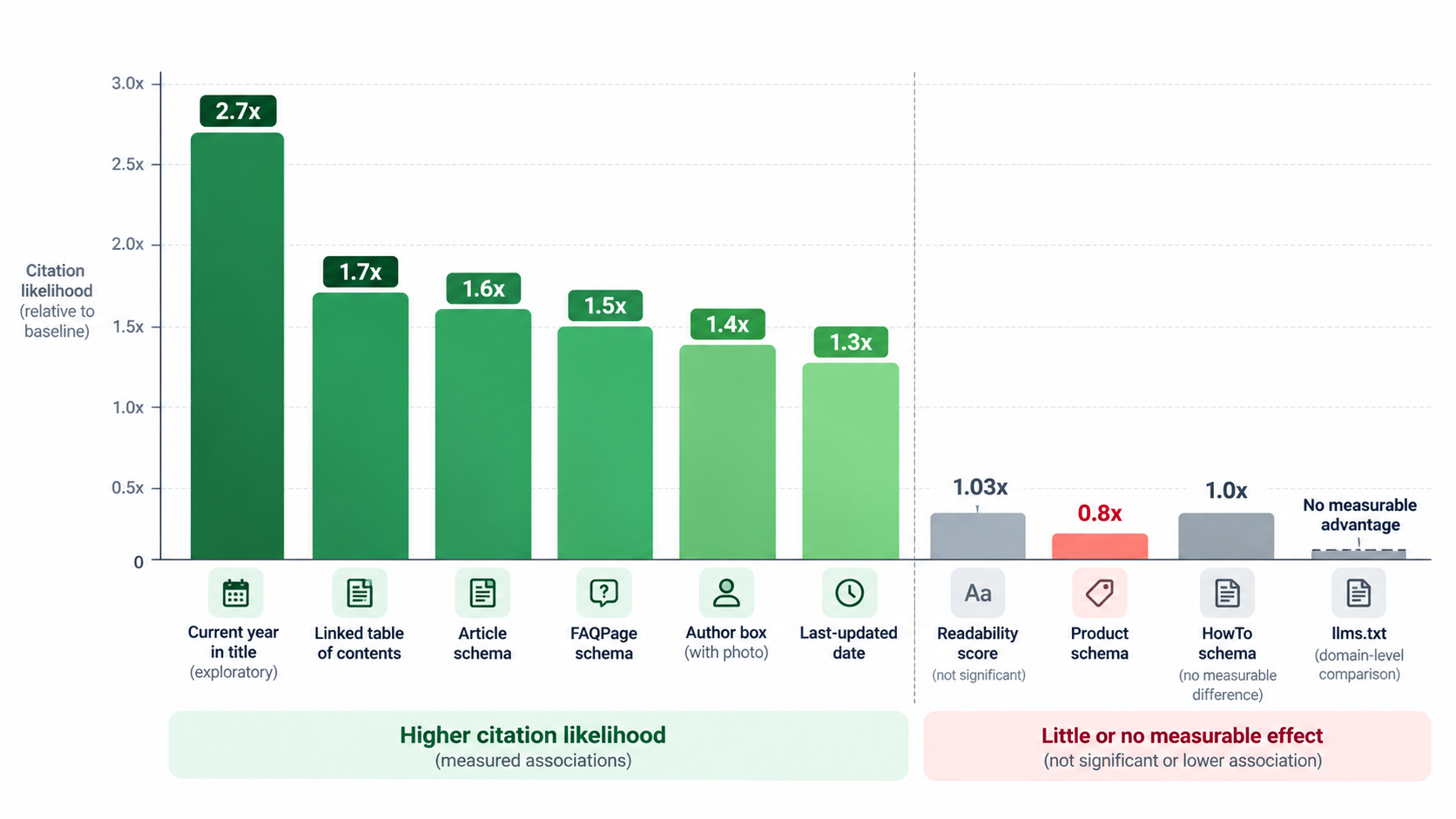
The positive cluster includes a table of contents, Article schema, FAQPage schema, an author box, a last-updated date, sourced claims, and a year in the title. SISTRIX combined eleven features into an overall optimization score. Pages meeting many of these criteria were cited 2.1 times as often as barely optimized pages, though the study does not establish that adding those features caused the difference.
Table of Contents and H2 Structure: Among the Strongest Signals
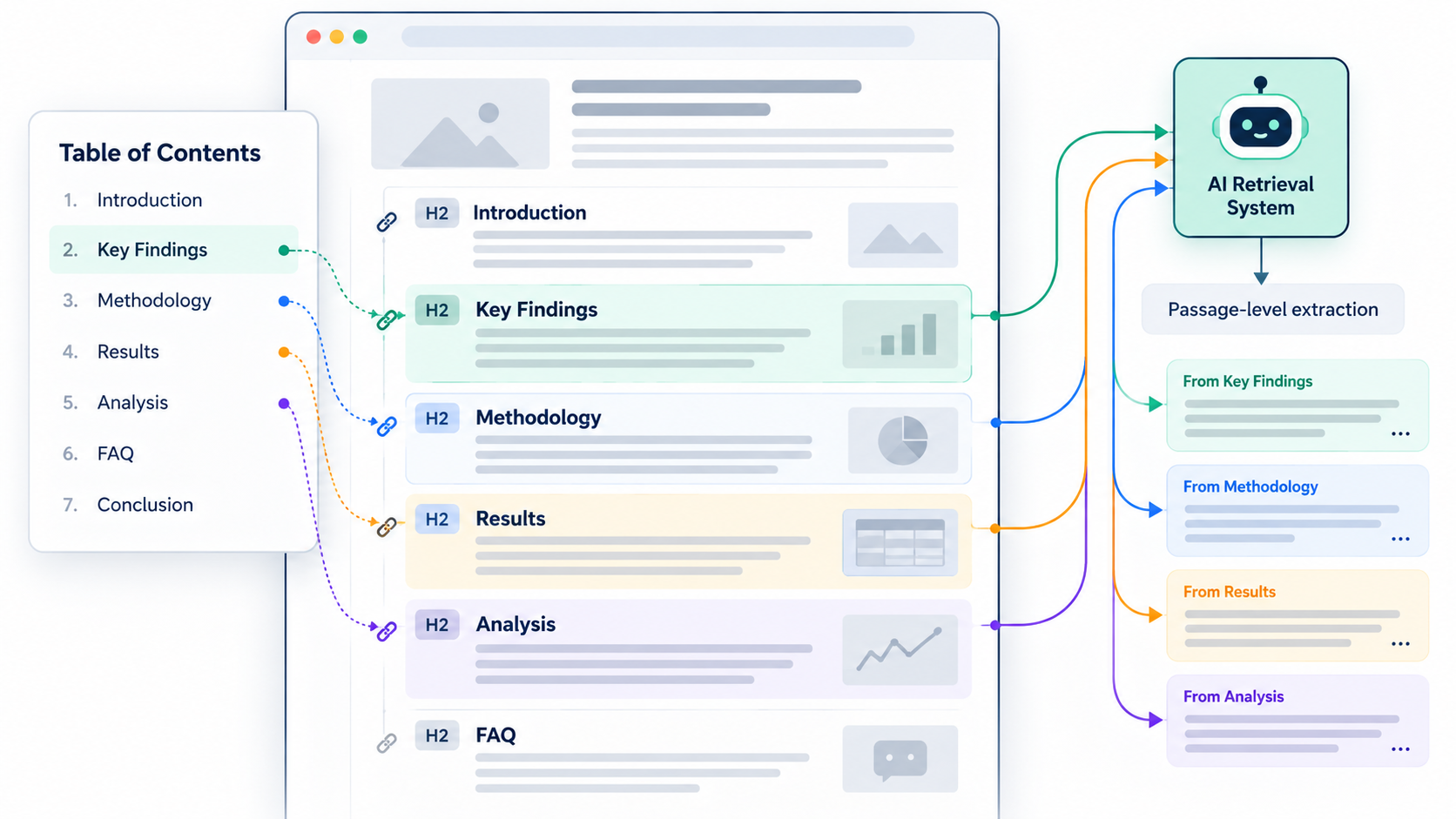
The table of contents AI search effect was among the dataset's strongest on-page associations. A linked TOC retained a significant relationship with citation probability in the regression analysis. Retrieval pipelines use heading anchors to find passage-level answers; a table of contents makes the page's argument explicit and provides a direct map to relevant passages.
H2 structure AI citation follows from the same logic. Descriptive H2s are retrieval landmarks; vague labels such as "The Big Picture" are not. A TOC is cheap, difficult to botch, and a sensible first change for a team asking what gets cited in AI search. SISTRIX found that pages with at least five H2 headings were cited 1.6 times as often, while pages with a question as an H2 were cited 1.4 times as often. These findings support descriptive headings without establishing an ideal passage length.
Schema That Earns Its Keep, and Schema That Does Not
Article schema AI citations showed a measurable positive association. Article and FAQPage markup tell engines what kind of content sits on a page, reducing ambiguity. In SISTRIX's study, pages with Article schema were cited 1.6 times as often, while those with FAQPage schema were cited 1.5 times as often. However, the strength of the association varied across schema types and website categories.
FAQPage schema was associated with more citations across ChatGPT, Google AI Mode, and AI Overviews. HowTo, Breadcrumb, and QAPage schema showed no measurable difference, while Product schema had an overall citation factor of 0.8. These findings do not mean Product schema should be removed, since it serves important purposes in traditional search and e-commerce visibility. Perplexity was not included in the study. Treating structured data AI search 2026 as one tactic is a mistake. Check current markup with Vizup's Schema Checker tool, then build the types supported by your use case with the Schema Builder.
Trust Signals: Author Box, Dates, and Sources
Linked author bios, visible update dates, and inline citations each had positive associations with AI citations. These signals track editorial rigor and provide specific, attributable claims that answer engines can cite. An Ahrefs study published in August 2025 found that approximately 12% of citations from AI assistants overlapped with Google's top 10 results for the original prompt. The analysis covered ChatGPT, Gemini, Copilot, and Perplexity, with substantial differences between platforms. This suggests that traditional rankings alone cannot reliably predict AI citation visibility.
What Delivers Less Than Expected
SISTRIX found no measurable AI citation advantage for domains publishing llms.txt. Separately, an Ahrefs study of approximately 137,000 domains found that 97% of valid llms.txt files received no requests during May 2026. Vizup has also covered these findings, supporting the case for prioritizing measurable AI visibility improvements over llms.txt implementation.
Word count is a symptom rather than a cause. Longer pages are cited more often, but padding a short one does not reproduce the effect; length stands in for depth. Flesch-Kincaid and similar readability scores were neutral. They serve human readers, not AI retrieval. Budgets assigned solely to readability rewrites or llms.txt implementation should move toward changes with measurable citation associations.
Effect Sizes at a Glance
| On-page factor | Reported citation factor |
|---|---|
| Current year in title (exploratory) | 2.7x |
| Linked table of contents | 1.7x |
| Article schema | 1.6x |
| At least five H2 headings | 1.6x |
| FAQPage schema | 1.5x |
| Table with a header row | 1.5x |
| Ten or more bullet lists | 1.5x |
| At least 1,000 words | 1.5x |
| Author box with photo | 1.4x |
| Question used as an H2 | 1.4x |
| Visible last-updated date | 1.3x |
| At least ten external links | 1.3x |
| Numbered lists | 1.2x |
| Product schema | 0.8x |
| HowTo schema | 1.0x |
| Readability (Flesch index) | 1.03x, not significant |
| llms.txt | No measurable advantage, domain-level comparison |
| Verified on-page citation factors reported by SISTRIX. These results describe associations, not proven causal effects. |
Warning: The budget problem is clear: llms.txt implementation and readability rewrites showed no measurable citation advantage, while a TOC, Article schema, and an author box had stronger associations and are inexpensive to implement. Keep Product schema where it supports traditional search and e-commerce, but do not treat it as an AI citation tactic.
Each Answer Engine Shows Different Structural Associations
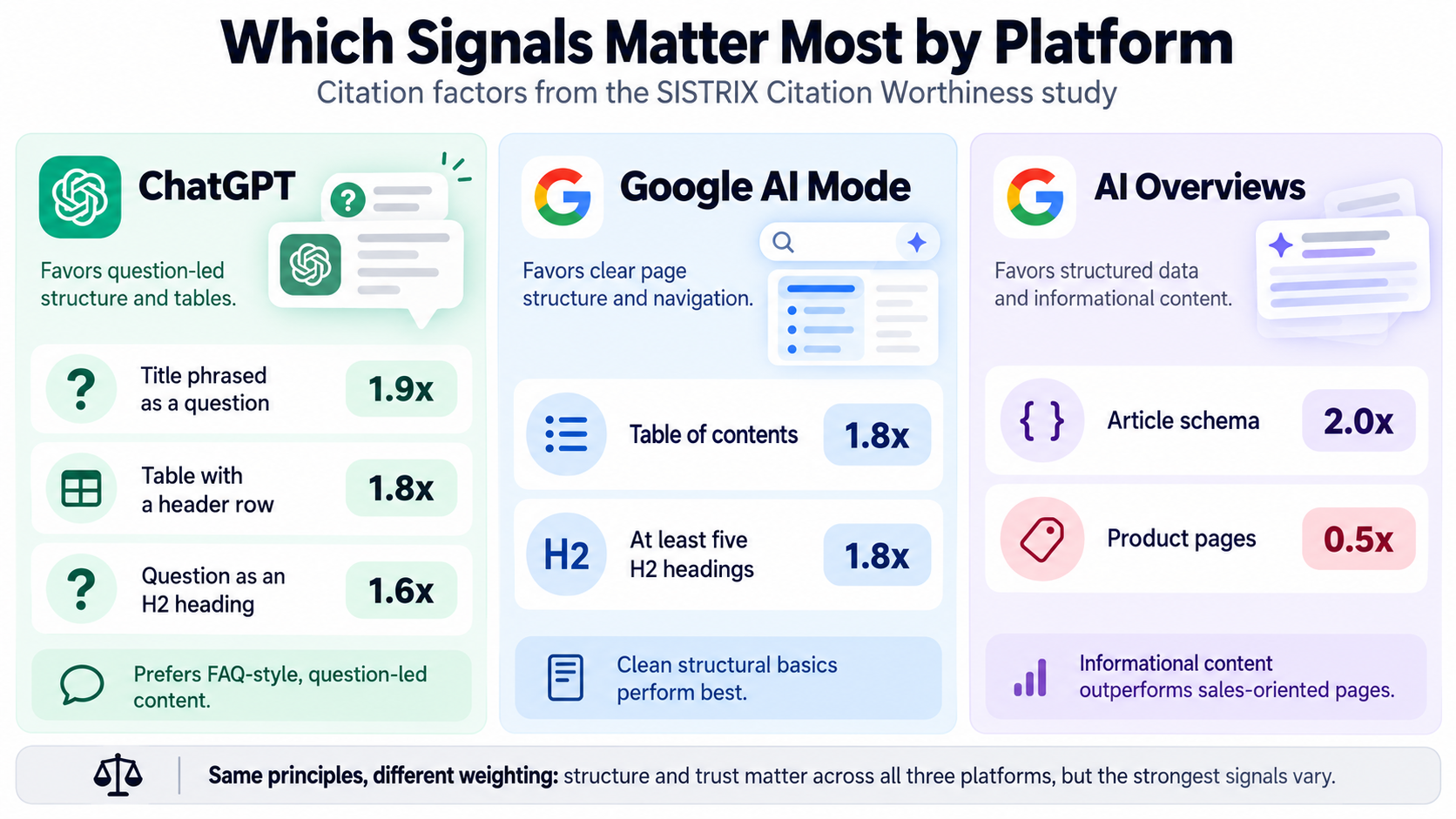
SISTRIX found different structural associations across ChatGPT, Google AI Mode, and AI Overviews. In ChatGPT, question-based titles and tables showed particularly strong associations with citations. In AI Mode, tables of contents and pages with at least five H2 headings each had a citation factor of 1.8. For AI Overviews, Article schema reached a factor of 2.0. Separately, Ahrefs reported in March 2026 that approximately 38% of AI Overview citations overlapped with Google's first ten search result blocks, down from roughly 76% in its earlier study. The Ahrefs studies used their own methodologies, so the figures should not be treated as directly equivalent to the SISTRIX platform comparison. Perplexity was not included in the SISTRIX analysis.
For teams asking how to get cited by ChatGPT, the SISTRIX results support testing clear question-based titles, descriptive H2s, and tables that genuinely clarify information. The dataset supports using well-structured tables and clear headings where they help readers understand the content. Pages containing a table with a header row had a citation factor of 1.5 overall, rising to 1.8 for ChatGPT. Because citation patterns vary across answer engines, teams should monitor individual platforms rather than assume one format performs equally everywhere. Answer engine optimization techniques therefore need per-engine monitoring, not a single playbook.
Common Misconceptions About Content Structure and AI Citation
"All structured data helps equally." SISTRIX shows wide variation by type. Article and FAQPage schema had positive citation associations, while HowTo, Breadcrumb, and QAPage showed no measurable difference. Product schema had an overall citation factor of 0.8, but it still serves traditional search and e-commerce functions. Implementing every eligible type solely for AI citation is busywork, not strategy. Use evidence to make content discoverable in AI engines selectively.
"If a page ranks well in traditional search, it will get cited by AI." The systems overlap without being identical. Ahrefs (2025) found that approximately 12% of citations across ChatGPT, Gemini, Copilot, and Perplexity overlapped with Google's top 10 results for the original prompt, with substantial platform differences. Traditional rankings alone do not reliably predict AI citation visibility.
"llms.txt is the new robots.txt." Current SISTRIX data shows no measurable AI citation advantage. Ahrefs (2026) also found that 97% of valid llms.txt files in its study received no requests during May 2026. Treating the file as urgent means spending against a signal that has not demonstrated measurable citation value.
What to Prioritize for Content Structure AI Citation
- A linked table of contents is a low-cost structural change with one of the study's strongest citation associations.
- Article and FAQPage schema had positive associations, but schema types did not perform equally.
- Product schema had an overall citation factor of 0.8, yet it remains useful for traditional search and e-commerce visibility.
- SISTRIX found no measurable citation advantage for llms.txt. Move AI visibility budget toward changes that can be monitored.
- Pages meeting many of the eleven optimization criteria were cited 2.1 times as often as barely optimized pages, though the study does not prove those features caused the difference.
- ChatGPT, Google AI Mode, and AI Overviews showed different structural associations. Perplexity was not included in the SISTRIX dataset.
- Vizup's Answer Engine Monitoring shows which pages receive citations, so structural changes can be measured before and after. Track your brand in AI search.
FAQ: Content Structure and AI Citation
Does a table of contents actually improve AI citation rates?
Yes, it was associated with higher citation rates in the 96,418-URL matched dataset. In Google AI Mode, tables of contents had a citation factor of 1.8. Heading anchors also give retrieval systems an explicit map to passage-level answers. The study is observational, so it does not prove that adding a TOC directly causes more citations.
Which schema types help pages get cited in AI search results?
Article schema had an overall citation factor of 1.6, while FAQPage schema had a factor of 1.5. HowTo, Breadcrumb, and QAPage showed no measurable difference. Product schema had an overall factor of 0.8, but it remains important for traditional search and e-commerce visibility.
Is llms.txt worth implementing for AI search visibility?
Not on current evidence. SISTRIX found no measurable AI citation advantage for domains publishing llms.txt. Separately, Ahrefs found that 97% of valid llms.txt files across approximately 137,000 domains received no requests during May 2026.
How do Google AI Mode and ChatGPT differ in what they cite?
SISTRIX found that question-based titles and tables had particularly strong associations in ChatGPT. In Google AI Mode, tables of contents and pages with at least five H2 headings each had a citation factor of 1.8. These are platform-specific associations, not proof that any format directly causes citations.
What is the fastest on-page change to improve AI citation chances?
Add a linked TOC with descriptive H2 anchors. It requires little development work and showed a strong association with citations, including a factor of 1.8 in Google AI Mode. Pair it with accurate Article schema, an author box, and a visible update date, then monitor whether citation visibility changes.
