When a potential customer asks an AI whether your product is worth buying, the response lands with real authority. According to Forrester, an overwhelming majority 89% of B2B buyers use generative AI in their purchasing process (Forrester, 2024). What those systems say about your brand is not a coin flip. It is a stitched-together narrative drawn from your digital footprint, and you can measure it. For marketers who care about controlling perception, understanding brand sentiment in AI answer engines has moved from a secondary concern to a core business requirement.
This piece lays out the discipline of AI brand sentiment: what it is (and what it is not), how answer engines form opinions, which sources push those opinions around, and a practical way to measure and improve perception across ChatGPT, Gemini, Claude, Perplexity, Copilot, and Google AI Overviews. If you are a brand strategist, reputation manager, or a CMO staring down a new category of risk, the sections below start with fundamentals and build toward operational workflows.
Sections covered:
- What AI brand sentiment actually means (and what it doesn't)
- Visibility vs. mentions vs. citations vs. sentiment: the hierarchy
- How AI engines form perceptions about brands
- Third-party sources that shape AI sentiment
- Measuring sentiment: KPIs, citation analysis, and competitive benchmarking
- A step-by-step framework for improving AI brand perception
- FAQ on AI search sentiment tracking
What AI Brand Sentiment Actually Means
Sentiment analysis is the practice of computationally detecting subjective opinion in text. AI brand sentiment is that idea applied to a specific output: the tone, framing, and evaluative language an answer engine uses when it talks about your company. If Perplexity calls your product "reliable but overpriced," thats a sentiment signal. If Gemini recommends a competitor and positions you as a fallback with caveats, thats a sentiment signal too.
The difference from traditional sentiment analysis (tweets, reviews, news coverage) is where you measure. AI sentiment is output-level: not what people say about you, but what AI systems say about you to millions of people at once. This shift is critical, as Gartner predicts traditional search engine volume will drop 25% by 2026 as AI chatbots and other virtual agents gain share. Read that as a budgeting memo: AI perception is no longer a curiosity, it is a strategic line item.
Visibility, Mentions, Citations, and Sentiment: The Hierarchy
When teams first start poking at AI visibility, they often mash four different metrics into one. These concepts overlap, but they are not interchangeable. Mix them up and your tracking will lie to you.
| Metric | What It Measures | Example |
|---|---|---|
| Visibility | Whether your brand shows up at all in AI-generated responses | Your brand is named in 12 out of 50 relevant queries on ChatGPT |
| Mentions | How often your brand is referenced within AI outputs | Your brand appears 3 times in a single Gemini response about CRM tools |
| Citations | Whether the AI links to or attributes a source when mentioning you | Perplexity cites a TechCrunch review when recommending your product |
| Sentiment | The evaluative tone and framing attached to those mentions | Claude describes your platform as 'intuitive but lacking enterprise features' |
| Understanding these four layers is essential for accurate AI answer engine monitoring. |
You can be everywhere and still be the warning label. High visibility with bad sentiment looks like showing up in every category query as the example of what to avoid. The reverse happens too: strong sentiment when you are mentioned, but low visibility overall, meaning the AI likes you but rarely brings you up. The target is obvious: high visibility paired with consistently positive sentiment. If you want to measure your AI brand presence with any rigor, start by tracking these four layers separately.
How AI Engines Form Perceptions About Brands
AI answer engines do not hold opinions the way humans do. They generate text by learning patterns from training data and, for retrieval-augmented systems like Perplexity and Google AI Overviews, by pulling in live web content at query time. In ChatGPT, brand perception is shaped by whatever text OpenAI trained on: product reviews, news coverage, Reddit threads, documentation, and editorial content. If that corpus leans hard on a story like "their customer support is bad," ChatGPT will tend to reproduce it.
Gemini and Google AI Overviews lean heavily on Googles index, so your traditional SEO footprint bleeds straight into AI sentiment. Claude is typically more cautious in tone because of its safety and accuracy posture, but the source material still determines whether that caution tilts positive or negative. Copilot sits in the middle, blending Bings index with OpenAI models, which creates its own hybrid layer of perception.
Warning: What most people get wrong: they assume AI sentiment is static because it comes from training data. In reality, retrieval-augmented engines (Perplexity, Google AI Overviews, Copilot) update their source material continuously. Your sentiment can shift week to week based on new reviews, articles, or forum discussions.
Third-Party Sources That Shape AI Sentiment
Your website still matters, but third-party sources often do more to set the default narrative. Models are trained to look for consensus; when independent sources repeat the same characterization, answer engines treat it as the safe summary. In practice, influence clusters in a few places:
Reddit and forums. These punch above their weight. Reddit shows up in the training data for nearly every major model, and Perplexity will cite Reddit outright. One highly upvoted thread dragging your onboarding experience can echo through AI responses for months. The raw, conversational tone of forum content also reads as "authentic" to synthesis systems, which makes it sticky.
Review platforms. G2, Capterra, Trustpilot, and similar sites are heavily indexed and frequently cited. A Harvard Business Review study found that businesses responding to reviews see measurable increases in overall ratings over time (Harvard Business Review study on responding to customer reviews). For AI sentiment, that matters twice: higher scores improve the underlying data, and they improve the story the model extracts from it.
Editorial and news content. TechCrunch reviews, analyst reports, and authoritative blog posts carry disproportionate citation weight, especially in Perplexity and Google AI Overviews. YouTube is easy to underestimate: transcripts from reviews and tutorials flow into training corpora, and Gemini, as a Google product, has deep access to YouTube content. If a popular tech YouTuber posts a negative review, you can feel the shift in AI sentiment faster than you can publish a dozen blog posts.
The takeaway for AI reputation management is blunt: you cannot fix AI sentiment by polishing your homepage. You need an ecosystem strategy that accounts for the third-party pages answer engines treat as evidence. For a broader view of that work, see this guide on AI for brand reputation management.
Measuring AI Sentiment: KPIs, Citation Analysis, and Competitive Benchmarking
Tracking brand sentiment in AI search calls for a different measurement stack than classic brand monitoring. You are not scraping social feeds; you are running controlled queries across answer engines, capturing the outputs, and analyzing how they talk about you. Done consistently, answer engine sentiment analysis becomes a real practice, not a one-off experiment.
Core KPIs for AI Brand Monitoring
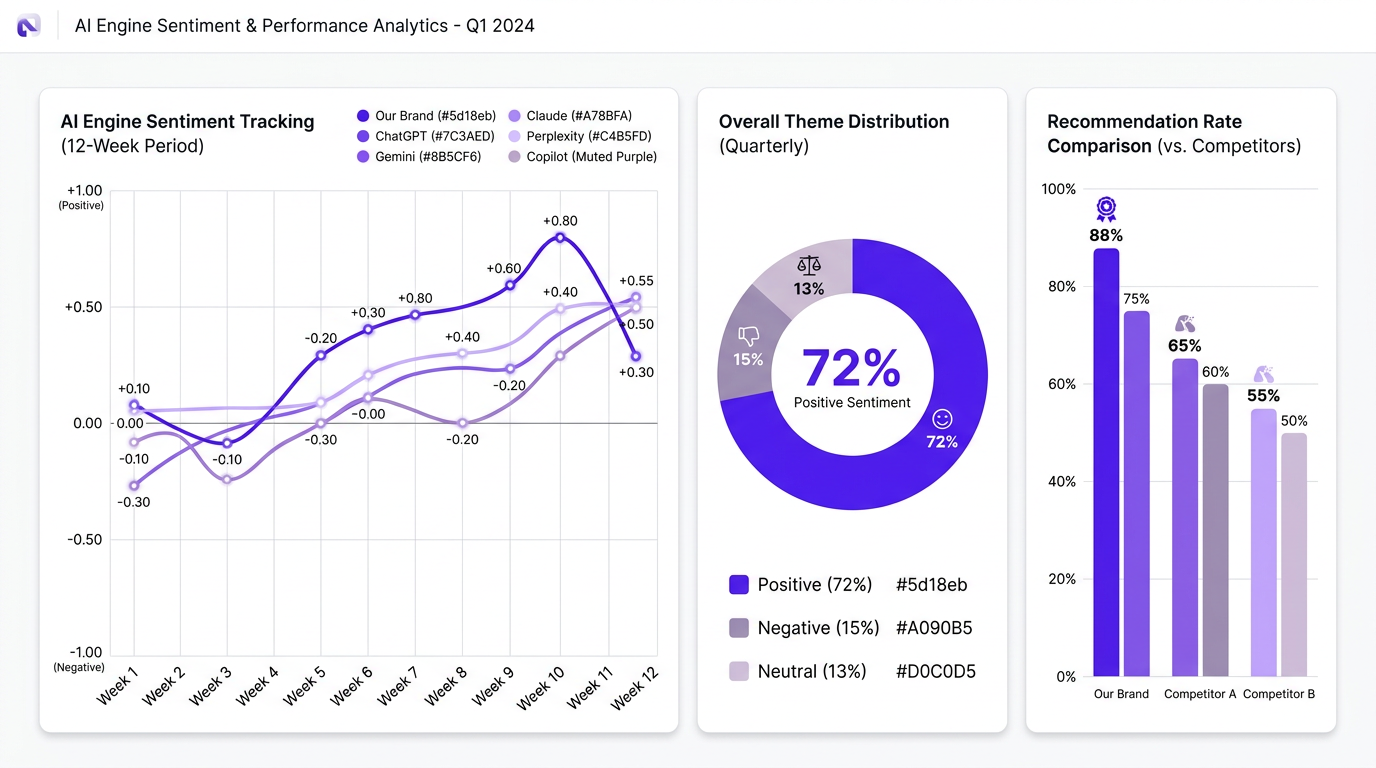
- Sentiment score per engine: A normalized positive/negative/neutral score for each AI platform (ChatGPT, Gemini, Claude, Perplexity, Copilot, Google AI Overviews) based on response language analysis.
- Sentiment trend over time: Weekly or monthly movement. A snapshot without a trendline is trivia.
- Positive-to-negative theme ratio: The count of distinct positive themes (e.g., "easy to use," "great support") versus negative themes (e.g., "expensive," "limited integrations") across all AI responses.
- Citation sentiment alignment: Whether the sources AI engines cite about you are positive, negative, or neutral. This is citation sentiment analysis in practice.
- Competitive sentiment gap: The difference between your sentiment scores and those of direct competitors for the same query set.
- Recommendation rate: The percentage of relevant queries where an AI engine actively recommends your brand versus merely mentioning it.
Citation-Level Sentiment Analysis
Perplexity and Google AI Overviews are built around citations. They do not just generate an answer; they show their receipts. That creates a measurement advantage: when your brand is mentioned, you can log the sources that appear alongside it and see which pages are effectively "speaking" for you. If Perplexity keeps pulling in a two-year-old negative review from a niche blog, that one URL becomes a high-leverage target for your reputation work.
The workflow is simple, if not glamorous: run your prompt set, pull citations from any response that mentions your brand, label each cited source by sentiment, then track frequency over time. Tools built for AI search monitoring take a lot of the manual work out of querying and capture.
Competitive Sentiment Benchmarking
A sentiment score by itself is hard to interpret. If you are at 0.6 out of 1.0, is that healthy or quietly disastrous? The only honest answer is: compared to what. Competitive benchmarking means running the same query set for you and your competitors, then comparing how each brand gets framed. You might find Claude routinely describes a competitor as "enterprise-ready" while placing you in the "best for small teams" bucket, even if you serve enterprises just fine. That is not an abstract problem; its positioning, decided upstream of your funnel.
While buyers use AI for initial research, trust remains a crucial factor. A May 2026 Gartner survey found that 69% of B2B buyers prefer to validate AI-generated insights with sales reps before making a final decision. If the AI recommends your competitor with warmer language, you are losing deals before sales gets a meeting. At a minimum, run competitive AI search sentiment tracking monthly.
Positive and Negative Sentiment Themes in AI Responses
Scores (positive, negative, neutral) get you a dashboard. Themes get you a plan. Once you analyze enough AI responses about your brand, the same phrases and critiques start showing up like clockwork.
On the positive side, answer engines often latch onto ease of use, strong support, competitive pricing, reliability, and innovative features. On the negative side, they tend to repeat complaints about documentation, performance, hidden costs, limited integrations, and unresponsive support. Those themes frequently mirror your review profiles, but not always. Models can amplify minority opinions if they appear in high-authority sources. One Wired article calling your UX "clunky" can outweigh fifty G2 reviews praising it, depending on how the engine weights authority.
Tip: Track themes, not just scores. A 0.7 sentiment score is not a product requirement. "AI engines repeatedly cite a 'steep learning curve'" is something a team can actually fix.
A Step-by-Step Framework for Improving AI Brand Perception
Measurement without follow-through is just an expensive hobby. Once you have a clear read on your AI sentiment baseline, you need a repeatable way to change what the engines have to work with. This is where answer engine optimization starts to look a lot like reputation management, because it is.
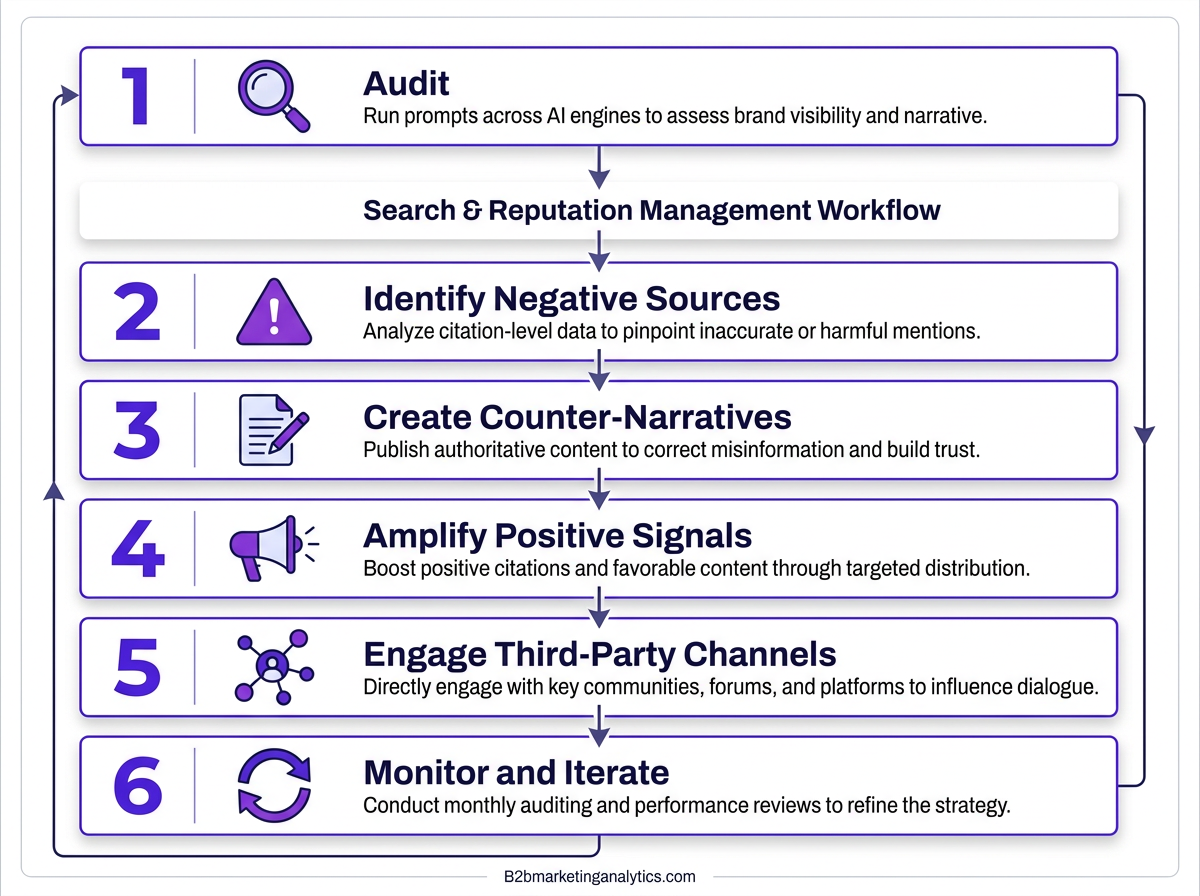
Step 1: Audit your current AI sentiment. Run 30 to 50 prompts across ChatGPT, Gemini, Claude, Perplexity, Copilot, and Google AI Overviews using the wording a real buyer would use. Save every response. Label sentiment and pull out themes. That becomes your baseline.
Step 2: Identify the sources driving negative sentiment. Use citation-level analysis (especially in Perplexity and AI Overviews) to find the third-party pages feeding the negative narrative. Rank them by how often they show up.
Step 3: Create counter-narratives. For each negative theme, publish authoritative material that addresses it head-on. If engines keep saying your product is "hard to set up," ship a detailed setup guide, a video walkthrough, and encourage satisfied customers to mention ease of setup in reviews. The point is to change the balance of available evidence. Applying Answer Engine Optimization (AEO) techniques improves the odds that engines will retrieve and reuse that material.
Step 4: Amplify positive signals. Find your strongest positive citations and give them more surface area. Share favorable editorial coverage, encourage customers to post on Reddit and review sites, and make sure your best content is cleanly indexed and structured for retrieval.
Step 5: Engage third-party channels directly. Reply to negative Reddit threads with real, helpful answers (not brand voice). Correct outdated details on review platforms. Bring updated product narratives to journalists and bloggers who have covered you before. This is where improving brand visibility in AI search meets reputation work in the real world.
Step 6: Monitor and iterate. Repeat the audit monthly and watch for movement in scores and theme ratios. Retrieval sources update on their own schedules, so changes tend to show up over weeks, not days. Consistency beats cleverness here.
AI Reputation Management Workflows for Marketing Teams
You do not need to spin up a new department to operationalize AI sentiment tracking. You need to add a few checkpoints to work you already do. Content teams should pull AI sentiment themes into the editorial calendar. PR should treat citation patterns as a signal for where coverage matters most. Customer success should assume that every review response and forum reply is now part of the evidence layer models learn from.
A workable monthly cadence looks like this: Week 1, run the audit across engines. Week 2, analyze citations and flag new negative or positive signals. Week 3, brief content, PR, and product on what changed and assign owners. Week 4, publish counter-narrative content and do outreach. Platforms like Vizup's features for AI monitoring can streamline the audit and analysis steps, but deciding what to do about the results is still a human job.
53% of consumers say they do not trust AI-powered search results for product research (Gartner, 2025). That skepticism raises the stakes in a specific way: when an engine does speak confidently about your brand, the people who accept that guidance are often the highest-intent buyers. Losing trust at the AI layer gets expensive quickly.
Why AI Sentiment Is Becoming a Key Marketing KPI
Traditional brand health metrics (NPS, share of voice, social sentiment) tell you how humans feel about you. AI sentiment tells you how the machines mediating those humans decisions describe you. Those are not the same thing. A brand can post an excellent NPS and still show up with negative AI sentiment if happy customers stay quiet while a vocal minority dominates Reddit and review sites.
The business case is not subtle. As answer engines become a default research channel, the sentiment they attach to your brand shapes consideration and conversion. If you want to learn how to track brand mentions in AI search, mentions are a solid starting point. Sentiment is where the revenue shows up. A mention without positive framing is just awareness. Positive sentiment plus a recommendation is pipeline.
Summary and Next Steps
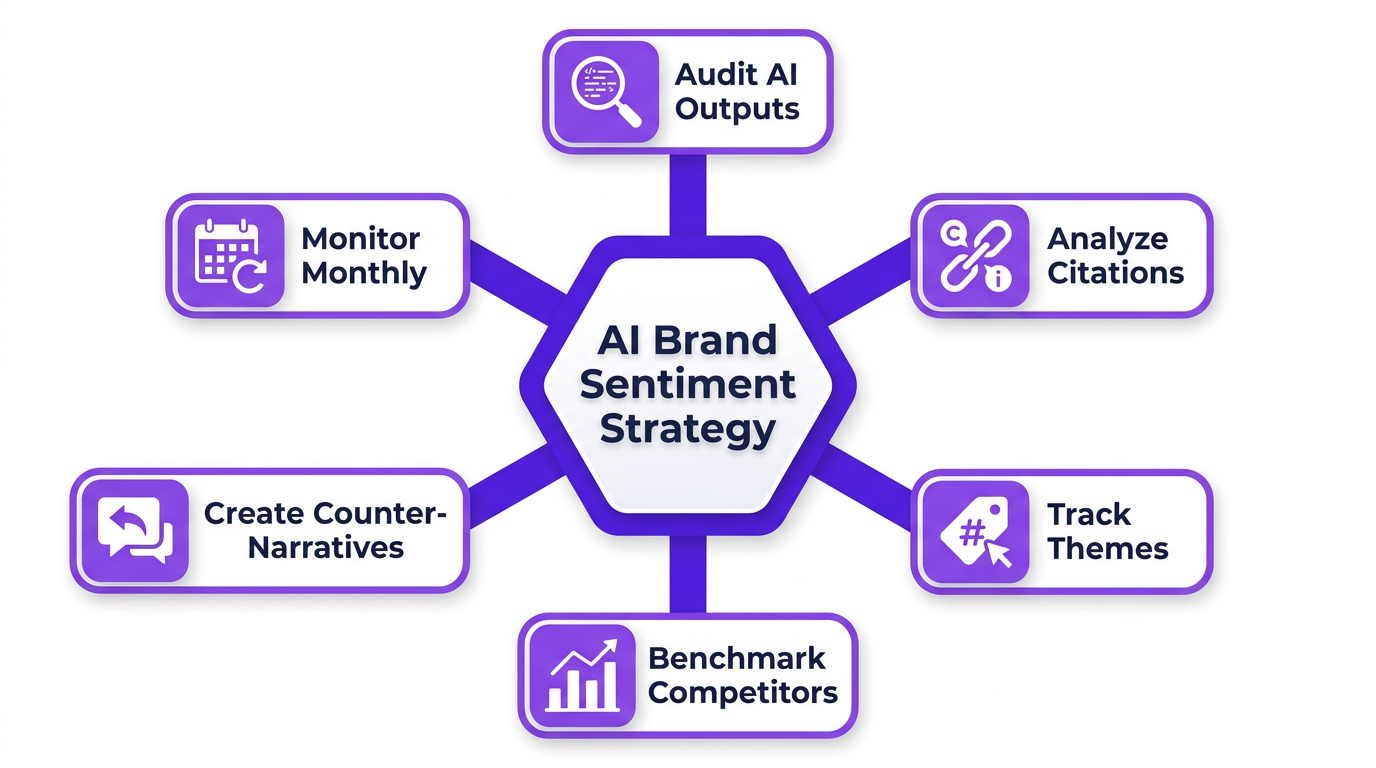
Brand sentiment in AI answer engines can be measured, tracked, and improved, but only if you treat it like a KPI instead of a vanity chart. Start by running a baseline audit across ChatGPT, Gemini, Claude, Perplexity, Copilot, and Google AI Overviews. Keep visibility and sentiment separate. Map the third-party sources shaping your narrative. Publish counter-narratives for the negative themes, and amplify the positive signals. Then rerun the process monthly.
AI visibility is bigger than SEO. It pulls in reputation management, content strategy, community engagement, and competitive intelligence. Organizations that build cross-functional workflows around AI brand sentiment get to shape what answer engines say about them, instead of inheriting whatever the internet happened to write.
Frequently Asked Questions
How often should I audit brand sentiment across AI answer engines?
Monthly is the floor for active brands. If you are in a fast-moving category or you just launched, add bi-weekly checks on a smaller set of high-priority queries so you catch shifts early. Retrieval-augmented engines like Perplexity and Google AI Overviews can reflect new source material within days.
Can I influence what ChatGPT says about my brand?
Not by tweaking anything inside ChatGPT itself. What it says is shaped by training data and any retrieval-augmented sources it has access to. The lever you control is the web content that feeds those systems: reviews, editorial coverage, documentation, and community discussions.
What is the difference between AI brand monitoring and traditional social listening?
Social listening measures what people say about you on social platforms. AI brand monitoring measures what answer engines say about you to their users. The inputs overlap because both draw from online content, but the outputs are different: AI engines synthesize and editorialize, so one negative source can outweigh its actual social reach.
Which AI answer engine is hardest to influence in terms of sentiment?
ChatGPT and Claude, when they are not using real-time retrieval, are typically the slowest to move because their sentiment is largely set by training data that refreshes on longer cycles. Perplexity and Google AI Overviews tend to respond faster because they pull from live web content, which means improvements can show up sooner.
Do I need a dedicated tool for AI search sentiment tracking?
You can do a baseline manually, but it stops scaling fast. Running 50 prompts across five or six engines, saving outputs, classifying sentiment, and extracting citations turns into a lot of labor. Dedicated AI search monitoring tools automate the query, capture, and analysis layers so your team can spend its time on strategy and execution.
