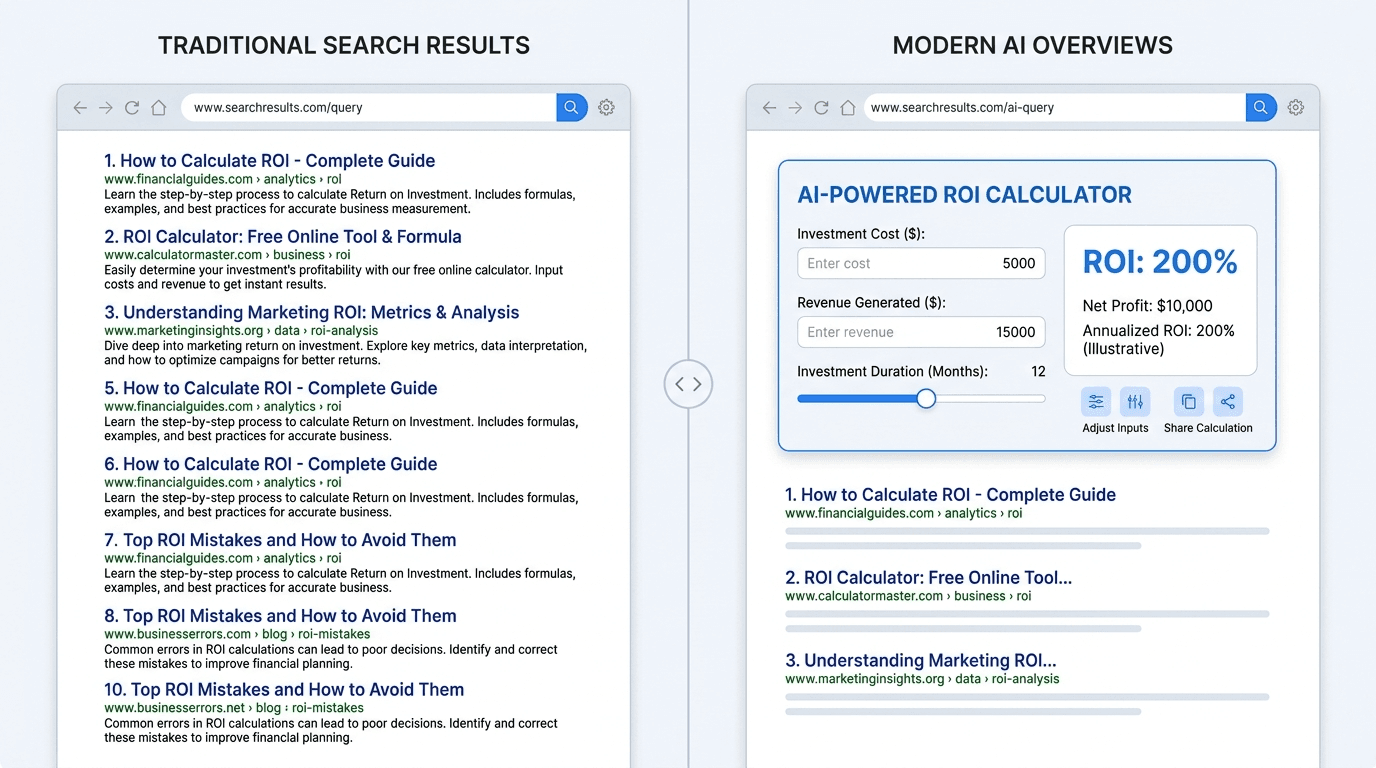
Generative UI lets Google assemble query-specific widgets - calculators, converters, and simulations - inside AI Overviews, using models such as Gemini 3. A searcher who once clicked through to a mortgage calculator can now use one in the results. For sites whose product is the tool itself, that reroutes the customer journey before a visit occurs.
Search has been encroaching on destination sites for years. The August 2026 AI Overviews rollout changes the stakes: Google is not merely summarizing content; it can reproduce the product experience. Brands dependent on calculators, converters, or narrow data tools need to reassess where their traffic and conversion risk sits.
What Exactly Is Happening with Generative UI in Search?
Until recently, an AI Overview was largely a synthesized text answer above organic results. In August 2026, Google started bringing generative UI from AI Mode into standard AI Overviews (Search Engine Journal, 2026). The result can be a working interface shaped around the query, rather than a link to one.
Gemini 3 AI Mode supplies the underlying capability: a multimodal model that can generate text and executable UI code. In Google's own research, published in November 2025, users "overwhelmingly preferred" these generated interfaces to standard markdown. The SERP can now contain sliders, fields, dropdowns, and live outputs.
This is a move from answering a question to carrying out the task that used to happen on a publisher's page. The Nielsen Norman Group defines generative UI as a "dynamically generated, real-time interface customized by AI," replacing one-size-fits-many design with tailored-for-one. AI Mode first tested the pattern in trip planning and recipe scaling; it now reaches the broader search product used by billions daily.
The Anatomy of a Generative UI Tool
The exposure becomes clearer when you look at the widgets Google can produce. Two tool-page categories are immediately vulnerable.
Mortgage and Loan Calculators
Google has already demonstrated mortgage-calculator experiences in AI Mode, illustrating what could happen as generative UI expands through AI Overviews. Instead of visiting a standalone calculator page, a searcher may increasingly be able to enter loan parameters, compare terms, and inspect estimated payments directly within Google's generated interface. The user enters a loan amount, moves interest-rate sliders, switches fixed and variable terms, and sees a monthly-payment breakdown without leaving Google. Because fields can reflect the query, the widget can match - and sometimes surpass - a dedicated calculator's basic experience.
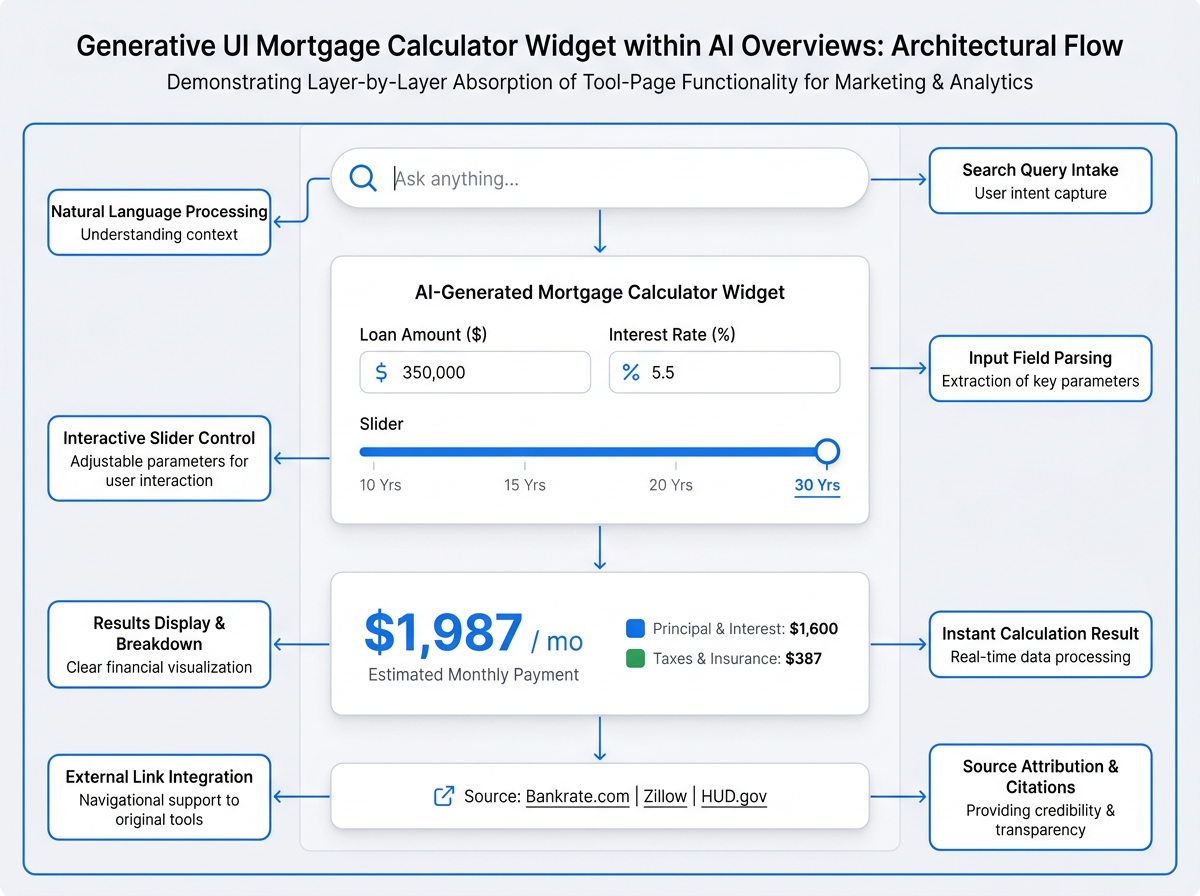
Unit Converters and Simple Data Tools
Queries such as "convert 10 miles to km" and "BMI calculator" can trigger conversion tools inside the AI Overview. These are the easiest tool pages for AI search to reproduce end to end. Sites built around a single commodity conversion face a blunt form of cannibalization: once Google is the tool, a click has little purpose.
The Impact: Why Tool and Calculator Page Owners Should Be Worried
Generative UI competes with a page's utility, not only its copy (Relevant Audience, 2026). Earlier SEO threats involved Google quoting the page. This one involves Google rebuilding the product. Citations - a lifeline for publishers in text AI Overviews - may be sparse or missing when the Overview is the functional destination.
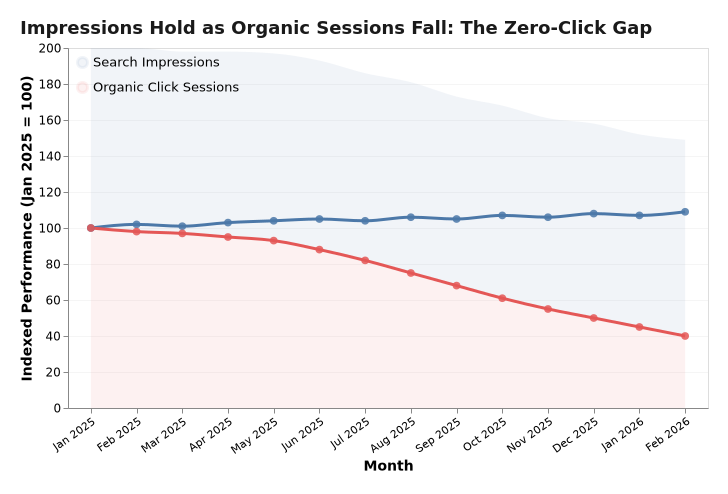
The data points in the same direction. A 2026 study found 64.82% of Google searches already end without a click (Digital Applied, 2026). As calculator queries move into generative UI, that share is likely to increase. For what a 40% trigger rate for AI Overviews really means for traffic, remember that tool queries often bring users closest to a decision. Losing them costs more than sessions; it removes people already moving through a conversion funnel.
Warning: Impressions can remain steady as sessions fall. That is the zero-click pattern in 2026: the page still appears, but the need is resolved before the user reaches it. CTR alone will mislead you here.
Common Misconceptions About Generative UI and Search
"This is just a test that will go away." Google's investment includes published research, a staged move from AI Mode to AI Overviews, and Gemini 3 integration. That resembles the path of featured snippets, knowledge panels, and People Also Ask: each began as an experiment and became standard SERP infrastructure. The August 2026 rollout is a waypoint, not a trial balloon.
"My tool is too complex for Google to replicate." Complexity is not fixed. Google currently handles simple calculators and converters, but the architecture can extend to multi-variable financial planners or diagnostic tools with more context and training data. Treating today's limits as permanent protection is risky.
"I can optimize for the AI Overview citation and still get traffic." Citation work remains useful for text answers. Generative UI changes the structure: when the Overview is the tool, there may be no attributable paragraph, and any source link sits beneath a completed task. Those clicks are negligible beside traditional organic traffic. How search visibility tools have changed in the AI era should inform revised expectations.
Adapting Your Strategy: How to Survive the Generative UI Wave
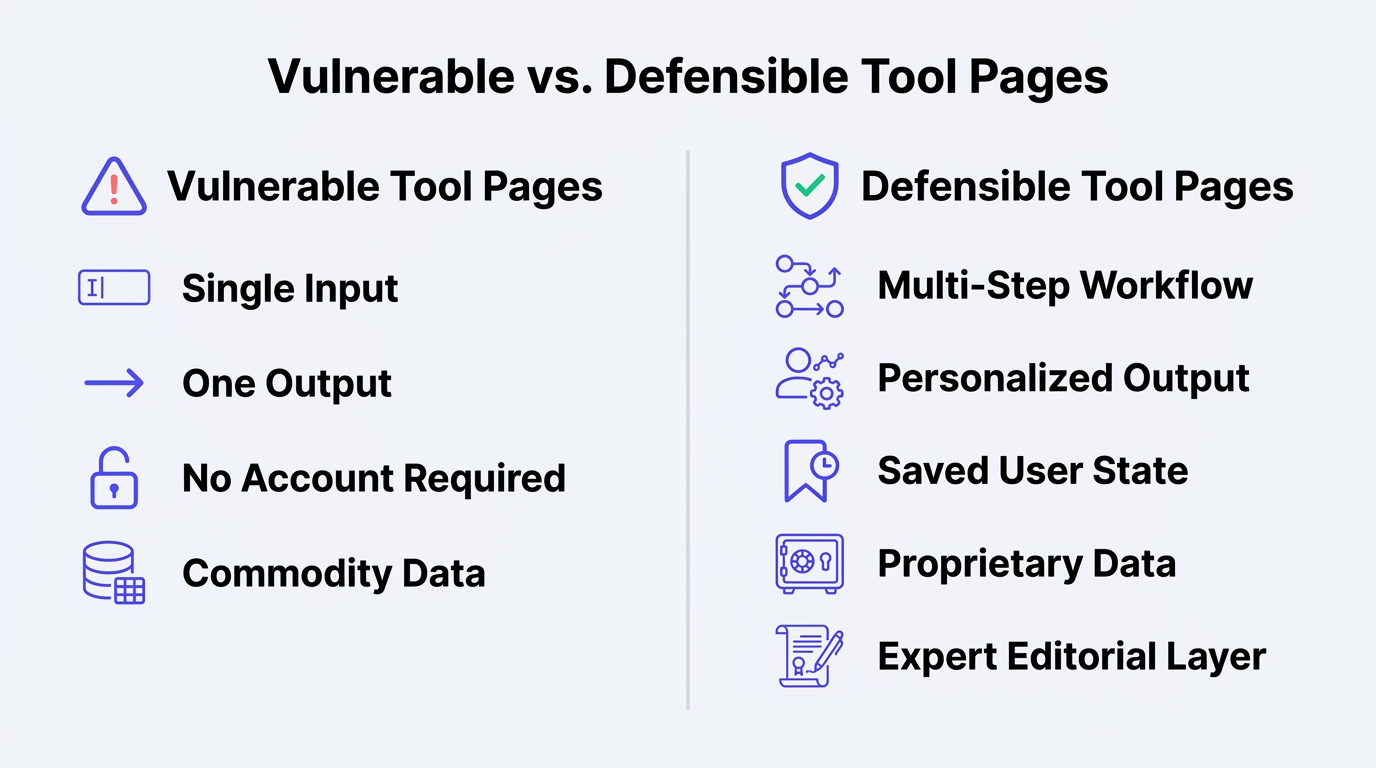
Do not try to beat Google at single-step utility. Build the page around value a SERP widget cannot reproduce.
Four strategic pivots for tool and calculator page owners:
- Go deeper than a single calculation. Put a mortgage calculator within a first-time homebuyer's resource that includes expert commentary, local market data, and downloadable checklists. Google can produce a calculation, but not your proprietary dataset or editorial authority.
- Build a brand, not just a tool. A branded search such as "[YourBrand] mortgage calculator" bypasses the AI Overview. Newsletters, community forums, and proprietary benchmarks create demand that does not begin with a generic query.
- Shift to complex, multi-step workflows. Replace a calorie calculator with a personalized weekly meal planner that needs an account, stored preferences, and ongoing refinement. Saved-state wizards exceed what a SERP widget delivers today.
- Monitor and measure what actually matters. Clicks no longer tell the full story. Use AI Overviews trackers and an AI rank tracking tool like Vizup to follow brand presence and mentions within AI Overviews, including results that generate no click. Track SERP-feature presence and brand impression share as leading indicators.
Compliance belongs in the response, too. As Google generates more of the SERP, Google's spam policies for generative AI can help keep your own AI-assisted content within guidelines.
Key Takeaways
- Generative UI in AI Overviews lets Google build interactive calculators, converters, and simulations in search results with Gemini 3.
- Live since August 2026, the expansion reproduces tool-page utility, not merely page content.
- Single-input tools face the greatest calculator-page traffic risk: impressions can hold while clicks drop.
- Defensibility comes from deeper content, multi-step workflows, proprietary data, and direct brand demand.
- Click metrics are incomplete. Track AI Overview presence, brand mentions, and SERP-feature share with tools such as Vizup.
Frequently Asked Questions
What is generative UI in Google Search?
Generative UI is Google's ability to create interactive interfaces - calculators, converters, and planning tools - directly in results. Rather than hand-coding every widget, Google's model generates an interface in real time from the query. It began in AI Mode and expanded to AI Overviews in August 2026.
Will AI Overviews replace all tool and calculator websites?
No. Simple, single-input tools such as unit converters and basic calculators face the greatest exposure because generative UI can reproduce their full function. Tools requiring accounts, saved preferences, proprietary datasets, or multi-step work remain more defensible for now. That threshold will move, so depth and brand loyalty matter.
How does the Gemini 3 model create interactive tools in search results?
Gemini 3 is a multimodal model that can generate executable code alongside text. For a query such as 'calculate monthly payment on a 250k mortgage,' it generates the HTML, CSS, and JavaScript for a functional AI Overview widget. Google's 2025 research found users overwhelmingly preferred these interfaces to plain-text responses.
What is the best way to measure the SEO impact of generative UI?
CTR is no longer enough. Track AI Overview trigger rates for target queries, check whether your brand appears in generative UI results, and measure branded-search volume as a signal of direct demand. Platforms like Vizup offer AI-specific rank tracking and visibility monitoring for this search environment.
Can I prevent Google from creating a generative UI for my tool's query?
No. Generative UI is query-triggered, not content-triggered. Google can build a tool from its model capabilities whether or not your page is crawled or indexed. Opting out of AI training data or blocking AI crawlers will not stop a competing widget. Offer value a SERP widget cannot match.
