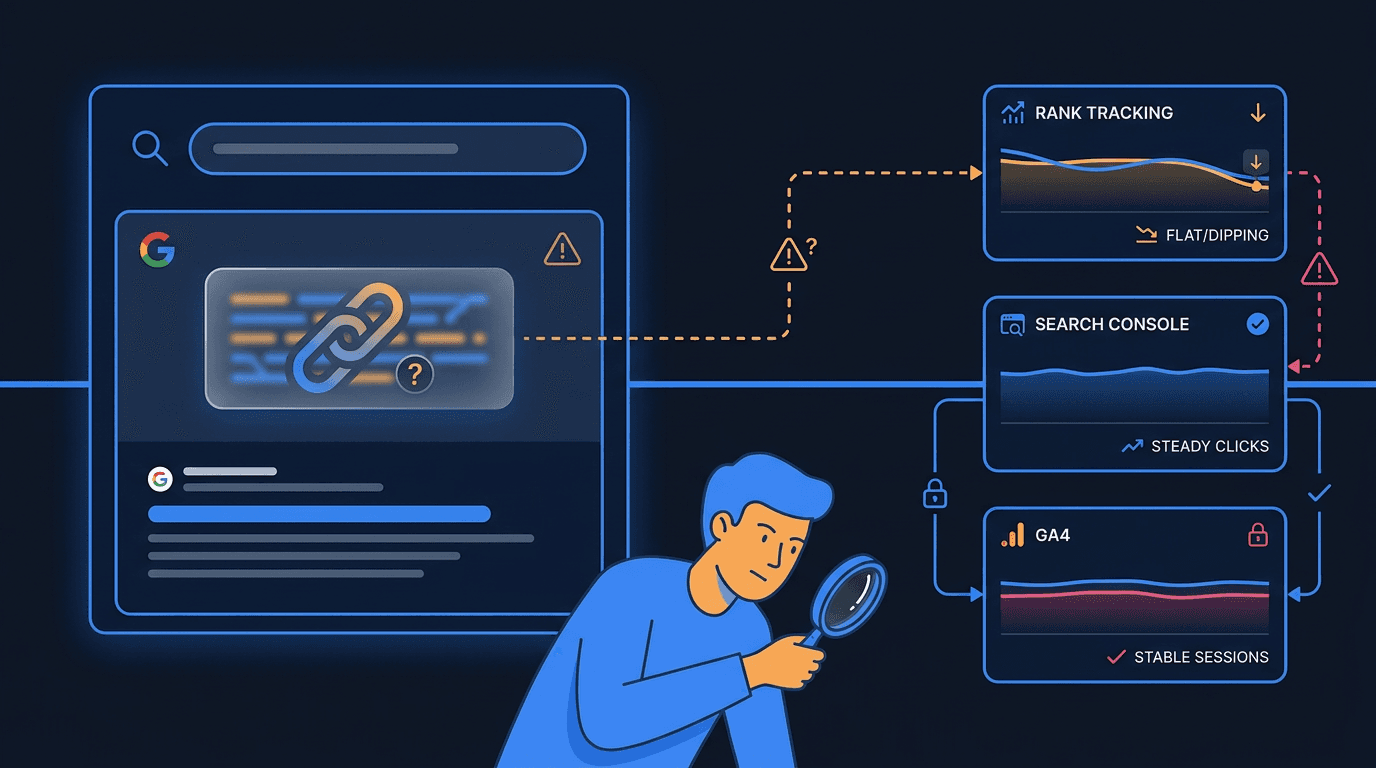
Google's google.com/goto redirect URLs are server-side passthrough links being deployed in search results. Instead of exposing a publisher's direct URL in the result markup, Google routes a click through its own endpoint before redirecting the user to the destination. Google has described the rollout as part of its broader technical measures against evolving forms of abuse, while the specific impact on automated SERP extraction remains an industry interpretation.
For users, the handoff is nearly invisible. For tools that extract destination URLs from HTML, it creates a serious resolution problem. That difference explains why google.com/goto redirect URLs can produce missing rankings without any corresponding loss in Search Console clicks, organic sessions, or conversions.
What exactly are google.com/goto redirect URLs, and why is Google using them?
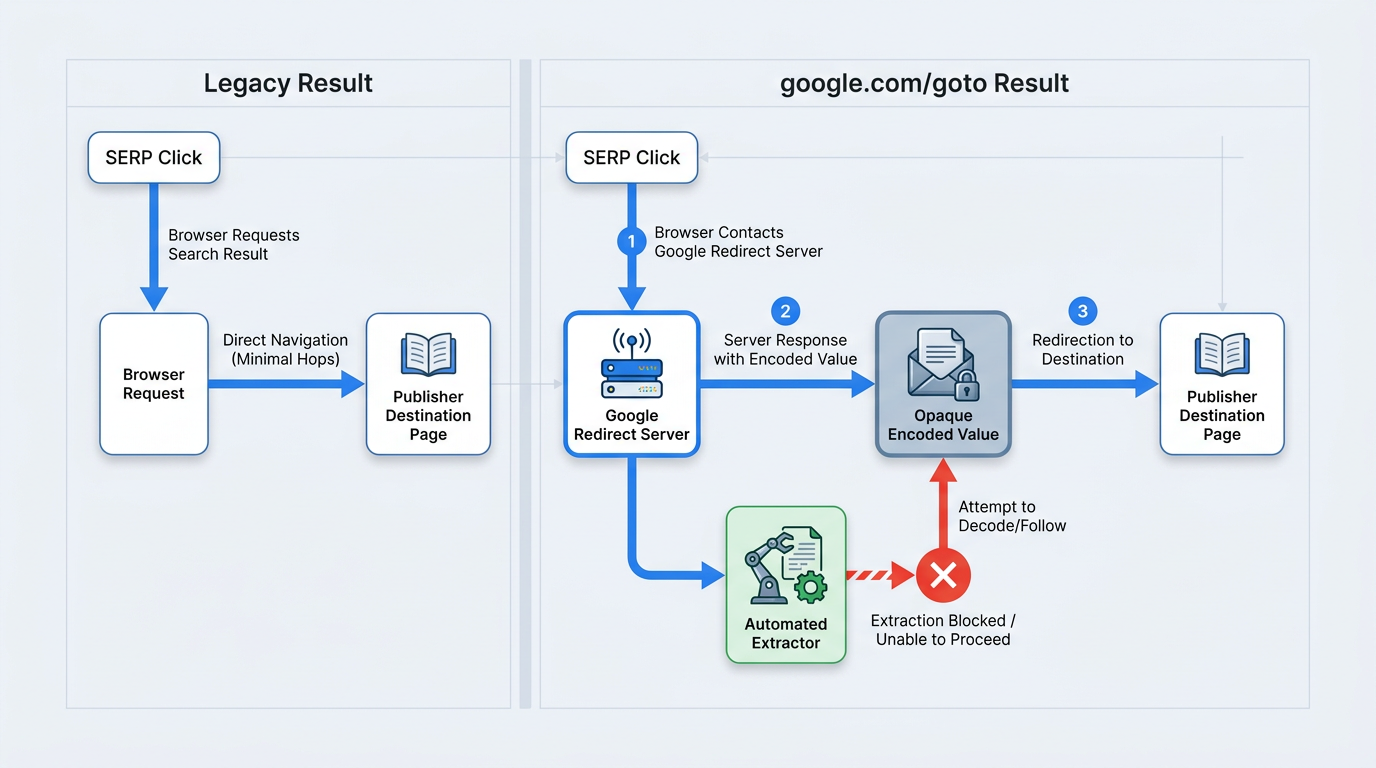
How does the passthrough work?
Previously, a collector could often read the destination from a result's anchor or an interpretable redirect parameter. With a Google goto passthrough URL, the markup points to a Google-controlled endpoint containing an opaque value. The server resolves that value and returns a redirect to the publisher.
Some third-party technical analyses have attempted to characterize the opaque value used in the /goto implementation, but Google has not publicly documented its encoding format. Treat claims about the underlying serialization method as unconfirmed implementation analysis. The intermediary /goto URL can create additional resolution work for automated collection systems that previously expected the final publisher URL to be directly readable from search-result markup.
Info: Confirmed: Google acknowledged the rollout and characterized it as protection against abuse. Industry interpretation: the redirect design may make automated SERP extraction more difficult or costly. Not established: that the change modifies ranking, crawling, indexing, or page quality evaluation.
Is this part of Google's campaign against SERP scraping?
The timing and design align with broader Google measures against abuse. Search Engine Land's August 2026 report recorded Google's confirmation that the rollout was part of its technical measures against evolving forms of abuse. Search Engine Roundtable's rollout coverage provides secondary industry coverage of the rollout and abuse-prevention context.
Large-scale automated SERP collection can become more complex when destination URLs require an additional redirect-resolution step instead of being directly readable from the result markup. Calling it a universal Google SERP scraping block overstates the evidence, though. It raises collection costs and failure rates rather than proving that every scraper is blocked.
The SerpApi Google lawsuit and related DMCA arguments provide legal context, but Google has not said the litigation caused this rollout. Vizup's analysis of the Google vs. SerpApi DMCA ruling separates the court record from assumptions about Google's engineering motives.
How can the rollout affect SEO tools, rank reports, and analytics?
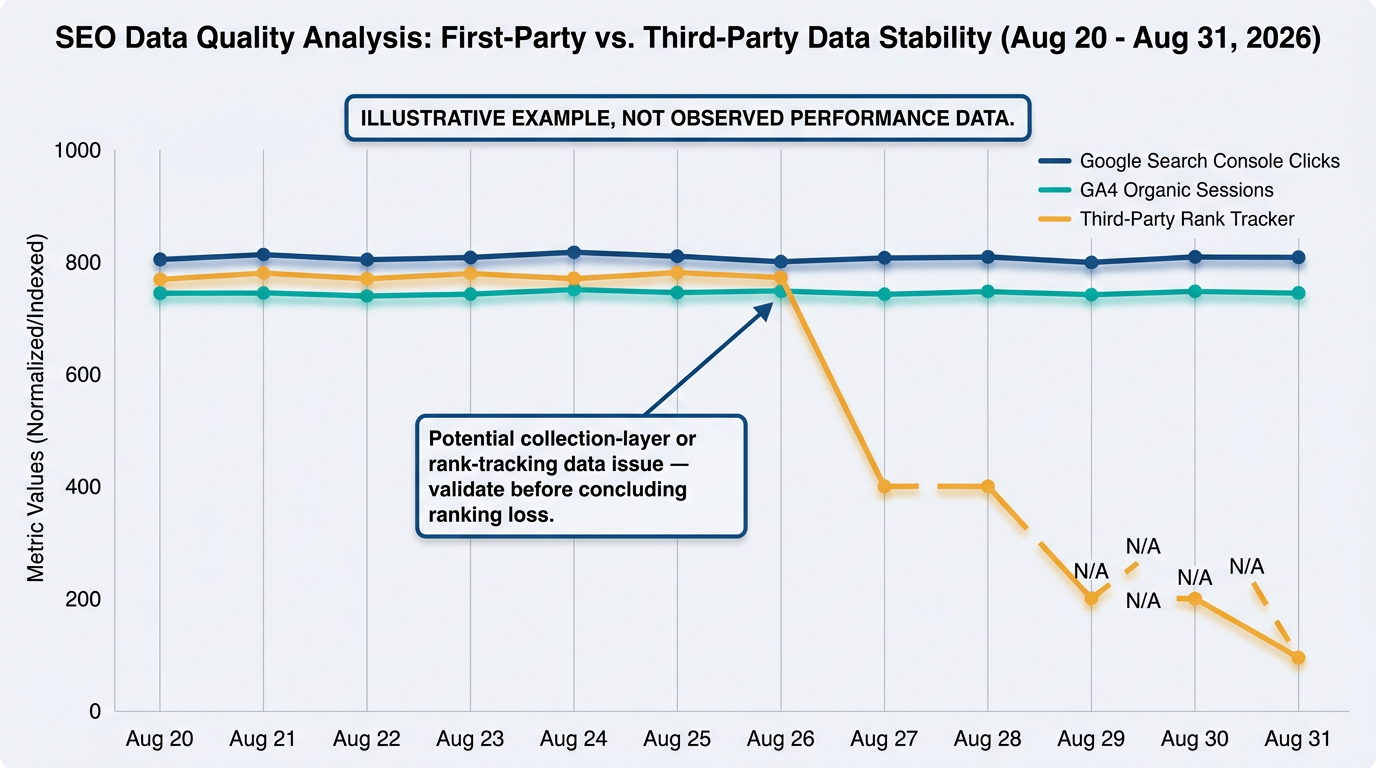
Why are rank trackers showing volatility or missing results?
A provider that expected a readable destination URL may record the Google endpoint instead, fail domain matching, or stall before resolving the redirect. That SERP API disruption surfaces as 'Not Found', 'N/A', a changed landing page, lower visibility scores, or a sharp drop across otherwise stable keywords.
Signals that rank tracker volatility in August 2026 is probably a collection artefact:
- Many unrelated domains or keyword groups change at the same collection timestamp.
- Desktop, mobile, country, or engine segments fail unevenly without an SEO deployment.
- Historical positions are stable, then large batches become missing rather than moving gradually.
- GSC clicks, impressions, average position, GA4 organic sessions, and conversions remain directionally consistent.
- The vendor acknowledges redirect resolution, parsing, or delayed-processing problems.
Do not silently backfill bad third-party SEO tool data or present it as a ranking loss. Preserve the raw export, provider, location, device, timestamp, collector status, and affected keyword count. Agencies can apply the same controls to an agency rank tracking process.
Will real clicks lose their Google attribution?
Because the redirect ultimately sends the browser from a Google-controlled URL to the publisher's destination, there is currently no evidence of widespread loss of Google attribution for ordinary human clicks. Teams should still validate their own GA4 source/medium and landing-page data rather than assuming attribution is unaffected.
Validate it rather than assuming. Compare GSC clicks with GA4 organic sessions by landing page, inspect source and medium, and test representative results in a clean browser. A sudden rise in direct traffic alongside stable GSC clicks deserves investigation, as bot traffic and collectors that strip referrers behave differently from real users. Run through a documented Google Analytics data cleanup checklist before changing any channel rules.
What should SEO and analytics teams actually watch?
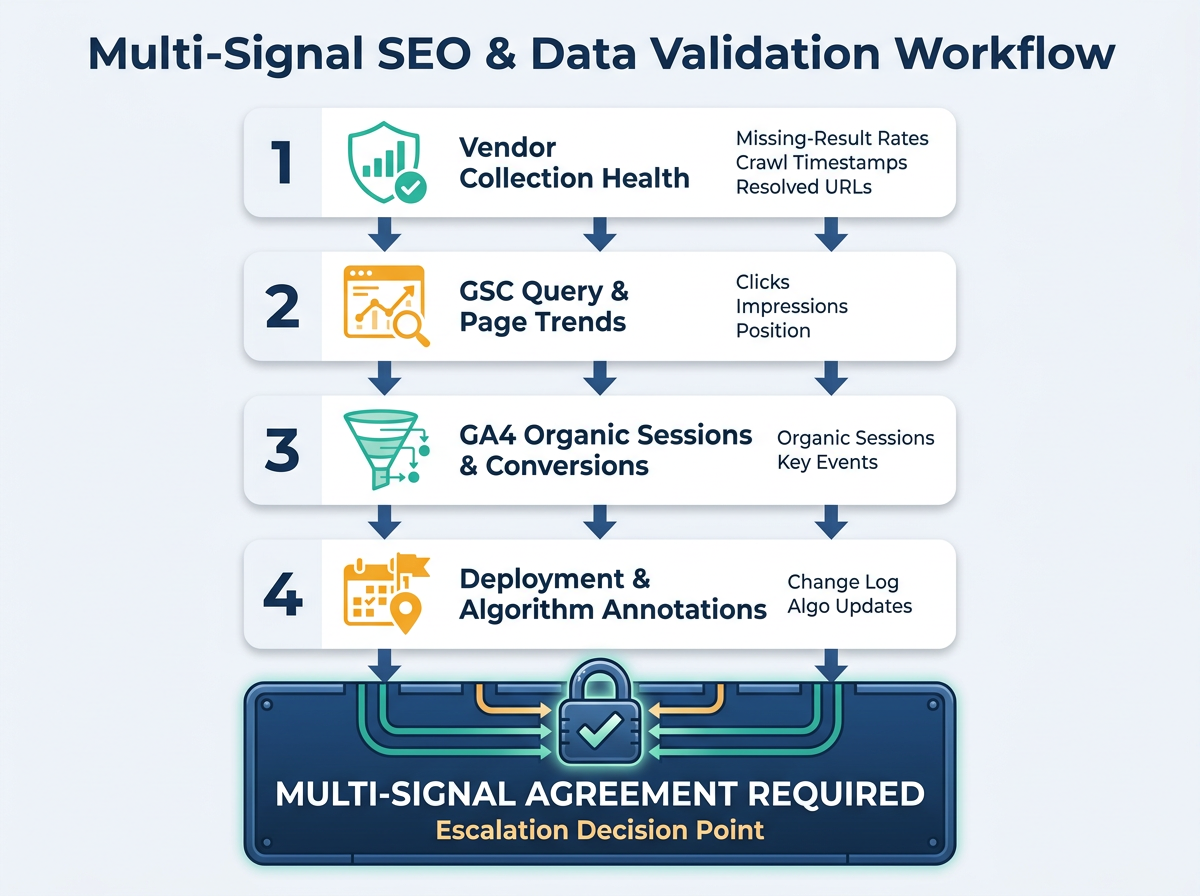
Start with source agreement. GSC measures Google-reported search performance, GA4 measures site visits and outcomes, and rank tools provide sampled observations of result pages. None is a perfect substitute for another, but a meaningful visibility loss is more credible when multiple independent signals begin moving in the same direction over time.
Use this reporting sequence:
- Check collection health: Review missing-result rates, resolved URLs, crawl timestamps, affected markets, and vendor notices.
- Segment the change: Separate branded from non-branded queries, device, country, search type, directory, and landing-page template.
- Verify first-party trends: Compare GSC clicks, impressions, position distributions, GA4 sessions, leads, revenue, and server logs.
- Annotate other causes: Record releases, migrations, outages, manual actions, seasonality, and confirmed Google updates.
- Delay strong claims: Require several consistent data points before telling leadership that rankings fell.
GSC is the strongest first-party reference for this specific collection dispute, but it is not infallible or a literal rank tracker. Google's separate reporting changes can shift impression patterns in ways that compound the confusion, as examined in Vizup's 2026 GSC impressions analysis. Retain exports and annotate reporting changes as they happen.
Tip: Set a temporary dashboard flag: 'Rank tracking data accuracy 2026 under validation due to goto redirect rollout.' Vizup acts as an Organic Autopilot for modern discovery, helping brands monitor, create, optimise, publish, and learn across Search, Social, Communities, AI Answer Engines, and Local Discovery. It combines AI agents, human experts, and live SEO, pSEO, AEO, and GEO tools, with paid ads available as an optional amplification layer.
Key takeaways: the action plan
For google.com/goto redirect URLs, remember:
- The confirmed change is a redirect-layer deployment, not a confirmed ranking-system update.
- Treat abrupt missing ranks as a possible provider artefact until GSC, GA4, and technical checks agree.
- Ask vendors whether they resolve redirects, preserve final URLs, and reprocess failed observations.
- Monitor organic traffic and conversions, not rank positions alone.
- Explain uncertainty explicitly, including the affected dates, sources, segments, and confidence level.
Frequently Asked Questions
Will google.com/goto redirects hurt my site's SEO or rankings?
No evidence has been established that they function as a ranking factor or alter crawling and indexing. The confirmed change sits in the search-result click layer. Any reported drop should be corroborated with GSC data, traffic trends, conversions, and technical checks before drawing conclusions.
How can I tell if my SEO tool has adapted to the google.com/goto redirect URLs?
Check whether it returns final publisher URLs rather than the goto endpoint, keeps missing-result rates near baseline, covers affected countries and devices, and has published a remediation notice. Run several manual SERP comparisons across different keywords rather than relying on a single data point.
Does the Google goto passthrough URL affect my Core Web Vitals scores?
No direct effect has been documented. Core Web Vitals evaluate the destination page's user experience. A fast Google-side handoff before navigation is not part of your page's rendered experience, though your own redirect chain still deserves routine monitoring.
Is this related to the link spam update or other Google algorithm updates?
Google has not publicly connected the rollout to a link spam update or any ranking change. Shared timing does not prove a relationship. Diagnose algorithmic movement separately using query patterns, affected page types, confirmed update dates, and first-party performance data.
What is the difference between this and the old '/url?q=' redirect Google used to use?
Older formats typically exposed an interpretable destination parameter that collectors could parse directly. The goto implementation presents an opaque identifier that requires following Google's server response to resolve, adding extra requests and creating more points of failure for automated collection.
