Google's Preferred Sources lets users choose publishers they want to see more often in Top Stories. Selected sources can also receive preferred labels in AI Overviews and AI Mode. The feature gives publishers another way to strengthen visibility among readers who already value their content. A preferred sources subscriber count is the cumulative number of selections for a site. In October 2026, Google began emailing that number to some verified site owners for the first time (Search Engine Roundtable, 2026).
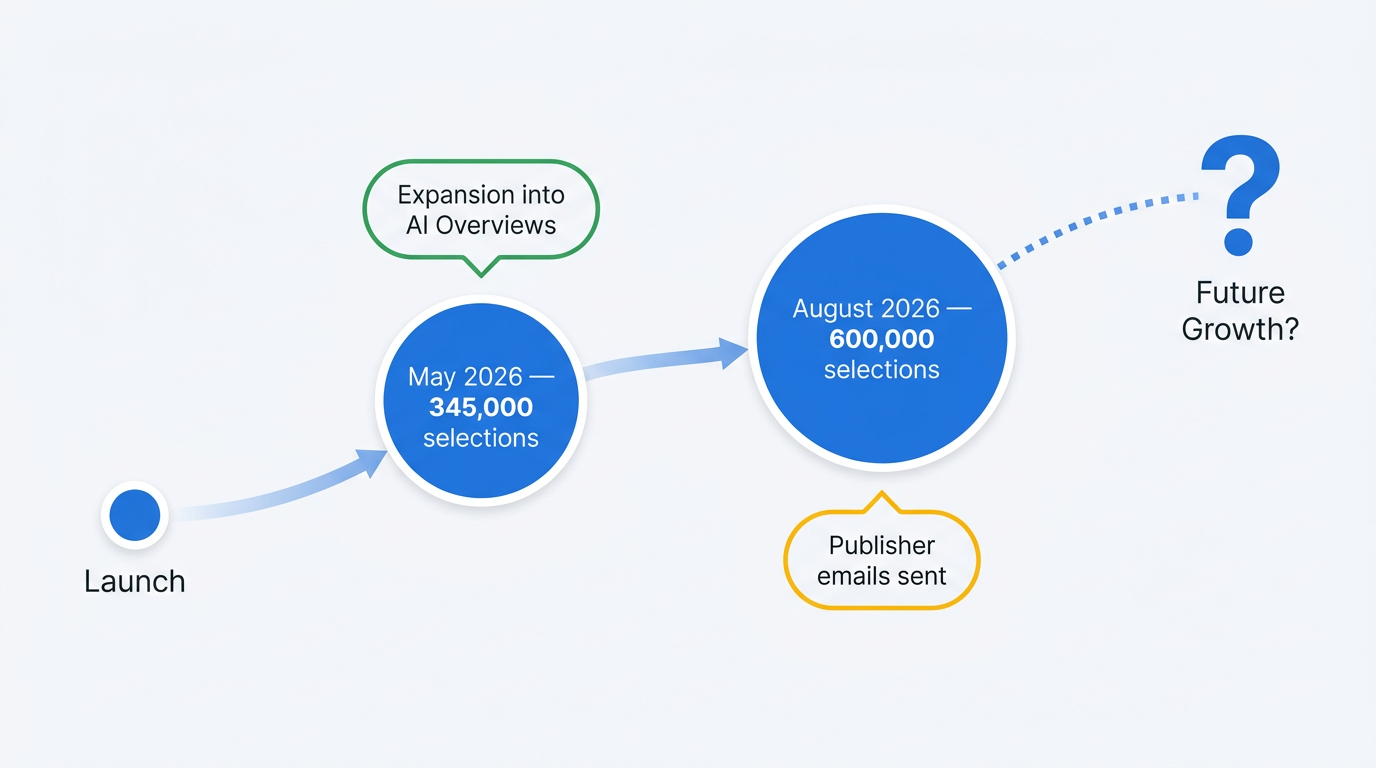
In August 2026, Google reported that users had selected more than 600,000 unique sources through Preferred Sources. This figure represents distinct sources selected across the feature, not the total number of users or selection actions.
Six hundred thousand sounds promising until the only number in your inbox is your own. For an audience lead who enabled the feature months ago and promoted it in newsletters, banners, and social posts, 1,200 selections has no obvious meaning. There is no dashboard, trend line, or percentile ranking. Is it a win or a rounding error? Google's attached survey is more revealing than the count: its questions point toward what the company may build next, and what it needs publishers to tell it first.
What Preferred Sources Actually Is, and Why 600K Matters Less Than You Think
A signed-in user who finds a publisher in Search, Discover, or Google News can tap "Follow" or "Prefer" to ask Google to show that source more often. The choice applies to the domain, rather than an individual page, and persists across sessions. Vizup has a fuller explainer on Google Preferred Sources.
Google reported that users had selected more than 600,000 unique sources by August 2026, compared with more than 345,000 reported in May. This suggests that Preferred Sources is reaching a wider range of publications. However, the figures do not reveal how many individual users have adopted the feature or how selections are distributed among publishers. Without those details, it is too early to measure overall user adoption or establish a meaningful publisher benchmark.
Inside the Google Preferred Sources Email
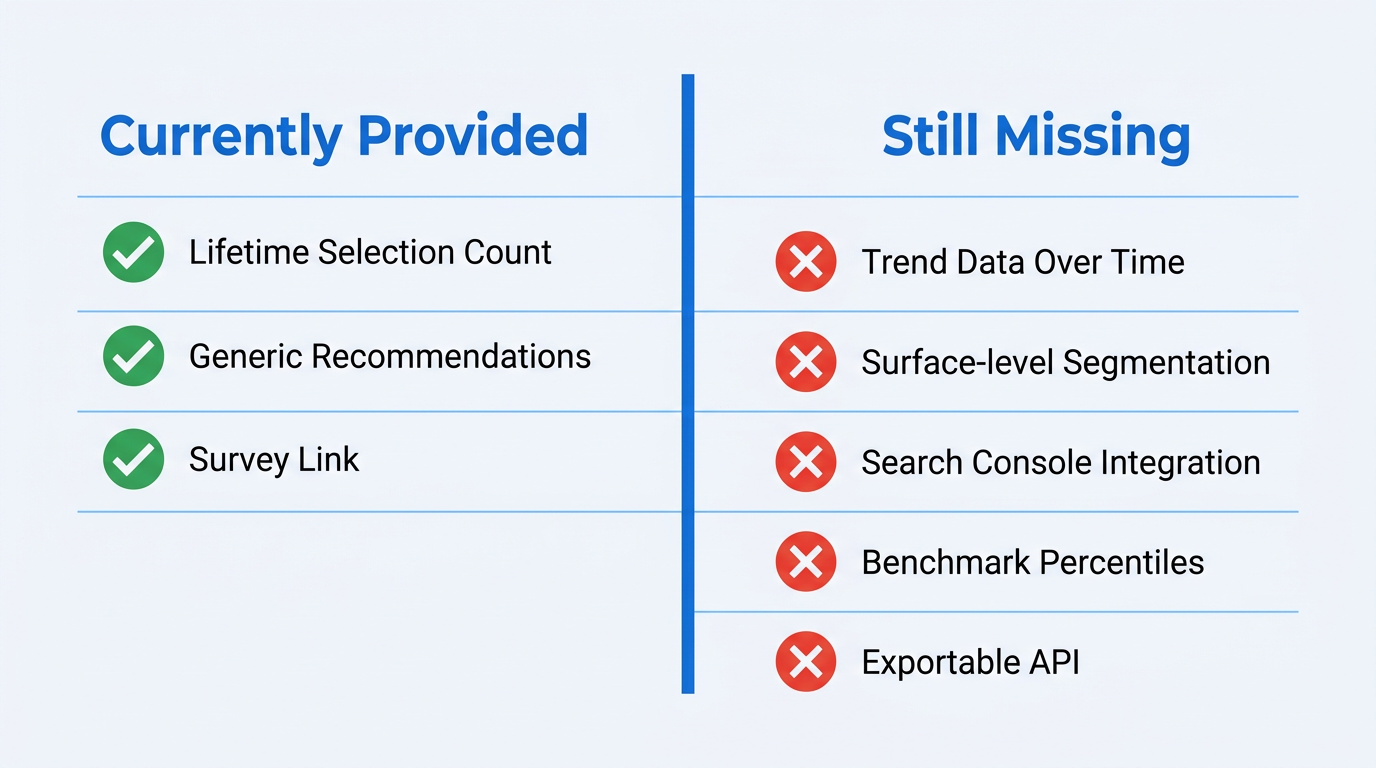
In early October 2026, Google Search Console emailed some owners a single figure: the Preferred Source selections their domain had accumulated (Search Engine Land, 2026). The google preferred sources email gives a lifetime count, generic advice to keep publishing quality content, and a survey link. That is all.
The emails did not reach every verified owner, including sites that had enabled the feature months earlier. Portfolio operators therefore have numbers for some properties and silence for others. No email does not mean no selections; it means the rollout was partial. There is no self-service lookup for the count.
What the Email Tells You (and What It Doesn't)
The number is a lifetime total, not a time series. One snapshot cannot yield a growth rate, weekly trend, or before-and-after comparison. Google's recommendations are editorial platitudes, not diagnostics. They cannot tell you which pages prompted a selection, which Google surface delivered it, or whether your promotion worked.
The Survey Google Attached, and What It Is Fishing For
Google's Preferred Sources survey asks whether publishers were already familiar with the feature, how clearly the email explained the selection count, and how useful they find that information. It also asks how frequently publishers would like updates and which Preferred Sources metrics would be most valuable inside Search Console. These questions suggest Google is gathering feedback about future reporting options, although no dashboard or release timeline has been confirmed.
Google appears to be assessing publisher demand for more detailed Preferred Sources reporting. Its interest in desired google preferred sources metrics suggests a Search Console integration is being considered, not promised. Publishers can use the survey to explain which metrics would make Preferred Sources reporting more useful for editorial and audience decisions.
The Search Console Gap: Why There Is No Dashboard Yet
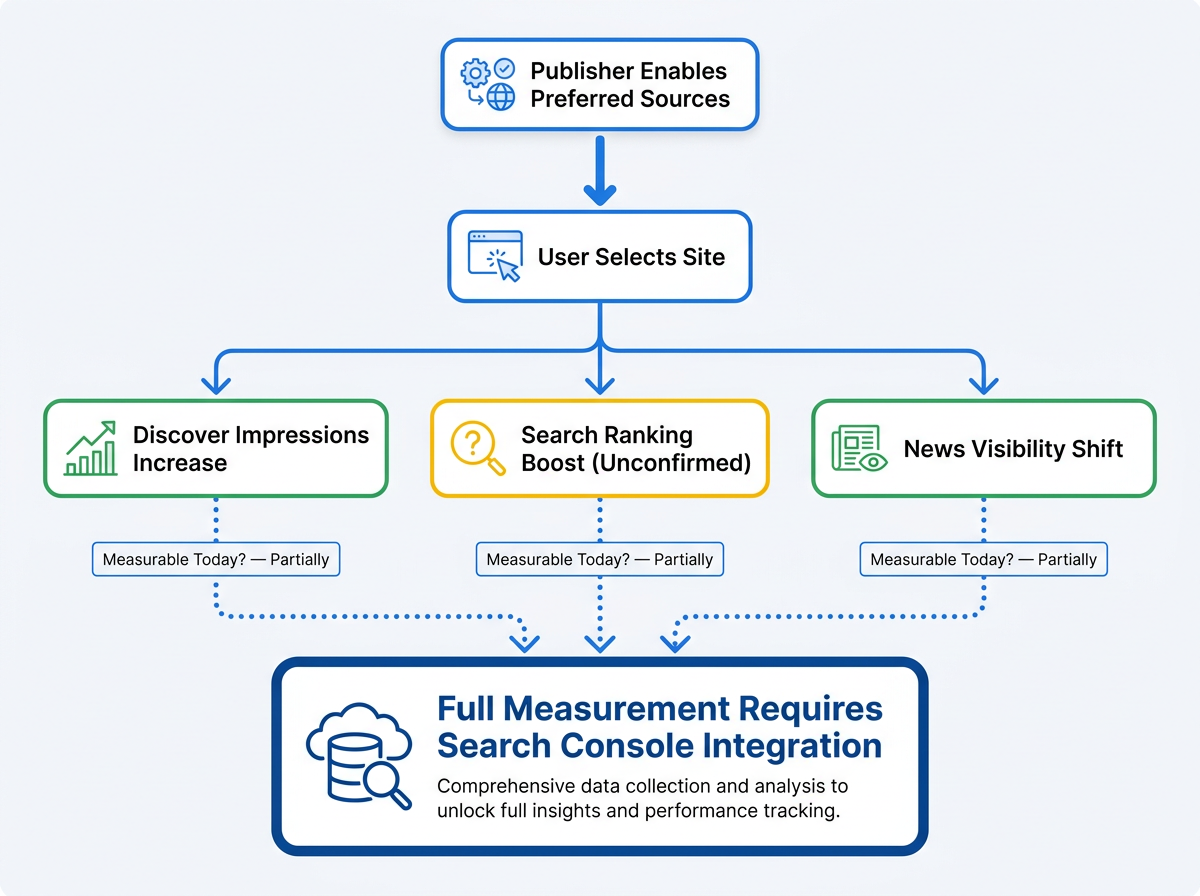
As of mid-2026, preferred sources data search console integration does not exist: no report, filter, or API endpoint. The initial Preferred Sources figures were delivered by email, and Google has not confirmed a recurring reporting schedule. You cannot pull the data into a dashboard, export it beside clicks and impressions, or compare it with google news publisher metrics 2026 such as Discover performance and Top Stories appearances.
For teams used to reporting in Google Search Console, this is an awkward hole. There are no milestone alerts, monthly automation, or splits by Search, Discover, and News. The survey asks publishers what reporting they would value, but Google has not announced which capabilities, if any, will be introduced.
How to Track Preferred Sources Performance Right Now
There is no native measurement tool, so preferred sources impact has to be approximated with a manual log and proxy signals.
Record every emailed count with a date. If you run several properties, keep them in one shared spreadsheet; future emails will at least create a rough trend line. Add dates for banner launches, newsletter CTAs, and social pushes. It is crude, but it establishes a baseline Google has not supplied.
Then watch Discover and Search impressions in Google Search Console around promotion dates. A Discover increase after a push is correlation, not proof, but it is useful evidence.
Vizup's Watcher agent helps brands monitor visibility across Search Engines, AI Answer Engines, and Social and Community platforms. Publishers can use these broader visibility signals alongside Google Search Console, analytics data, and manually recorded Preferred Sources counts to investigate changes without assuming that selection growth directly caused them.
What Publishers Get Wrong About the Numbers
"My subscriber count is my audience size." No. A selection is a preference signal, not reach. It does not guarantee appearance on every relevant query; impressions still depend on relevance, freshness, and ranking signals. The count shows how many users asked Google to prioritize you, not how often Google did.
"A low number means the feature isn't working." Without a preferred sources benchmark, a raw count has little meaning. A niche B2B publisher with 400 selections could outperform a general-interest site with 4,000 relative to its eligible audience. Google has not supplied the denominator. Before judging one number, smaller publishers should read Vizup's how small publishers can benefit.
"If I didn't get the email, I have zero subscribers." The delivery was inconsistent. Google's partial rollout left verified properties out, so a missing email is a distribution gap, not a data point.
When Preferred Sources Data Becomes Strategically Useful
The number becomes useful with three additions: trend data, so publishers can measure growth; surface-level segmentation, so they can connect selections to Discover impressions, Search clicks, or News appearances; and Search Console integration beside clicks and impressions. Until then, it is interesting evidence, not a KPI.
Its strategic value will come when teams can test on-site promotion and match it to selection growth. That takes Google's reporting buildout or third-party monitoring. Vizup's digital presence tools track visibility across Search, Discover, AI Answer Engines, and social surfaces, offering a way to infer impact before native reporting arrives. The relationship between publishers and Google matters here: Preferred Sources is one of several direct-audience signals Google is testing in 2026. Publishers that start instrumenting now will have history when the reporting catches up.
Key Takeaways
- The Google Preferred Sources email offers one lifetime selection count, generic recommendations, and a survey link - not trends, segments, or benchmarks.
- Preferred sources data is absent from Search Console as of October 2026. There is no report, filter, or API.
- A raw subscriber count needs context: niche, audience size, and promotion effort all affect it.
- Log each emailed count and promotion date now to build a baseline.
- The survey indicates Google is gathering feedback about Search Console reporting, but neither a release timeline nor early-access programme has been announced.
Frequently Asked Questions
How many preferred source subscribers does the average publisher have?
Google has not published an average or median Preferred Source selection count per publisher. Its August 2026 figure of more than 600,000 unique selected sources does not reveal how many users selected each site. Publishers should therefore avoid treating any particular selection count as an industry benchmark.
Will preferred sources data appear in Search Console?
Google has not announced a dedicated Preferred Sources report in Search Console. Its October 2026 publisher survey asks which reporting formats and metrics would be most useful, suggesting that Google is evaluating demand for additional reporting. No implementation or release date has been confirmed.
Does a higher preferred sources subscriber count directly increase rankings?
Not directly. A selection asks Google to show a publisher more often to that user, affecting personalized results. Google says marked sources are twice as likely to receive a click-through, but that is an engagement signal, not a universal ranking factor.
Why didn't I receive the Google preferred sources email?
The rollout was inconsistent. Some verified owners of enabled properties did not receive an email, and Google offers no self-service way to check a selection count. A missing message does not establish that the site has zero selections.
How can I track preferred sources performance if Google doesn't offer a dashboard?
Log each emailed count with its date, then compare it with promotion activity. Watch Discover and Search impressions in Google Search Console for correlations. Vizup's Watcher agent can flag related visibility shifts across Search, Discover, and AI surfaces.
