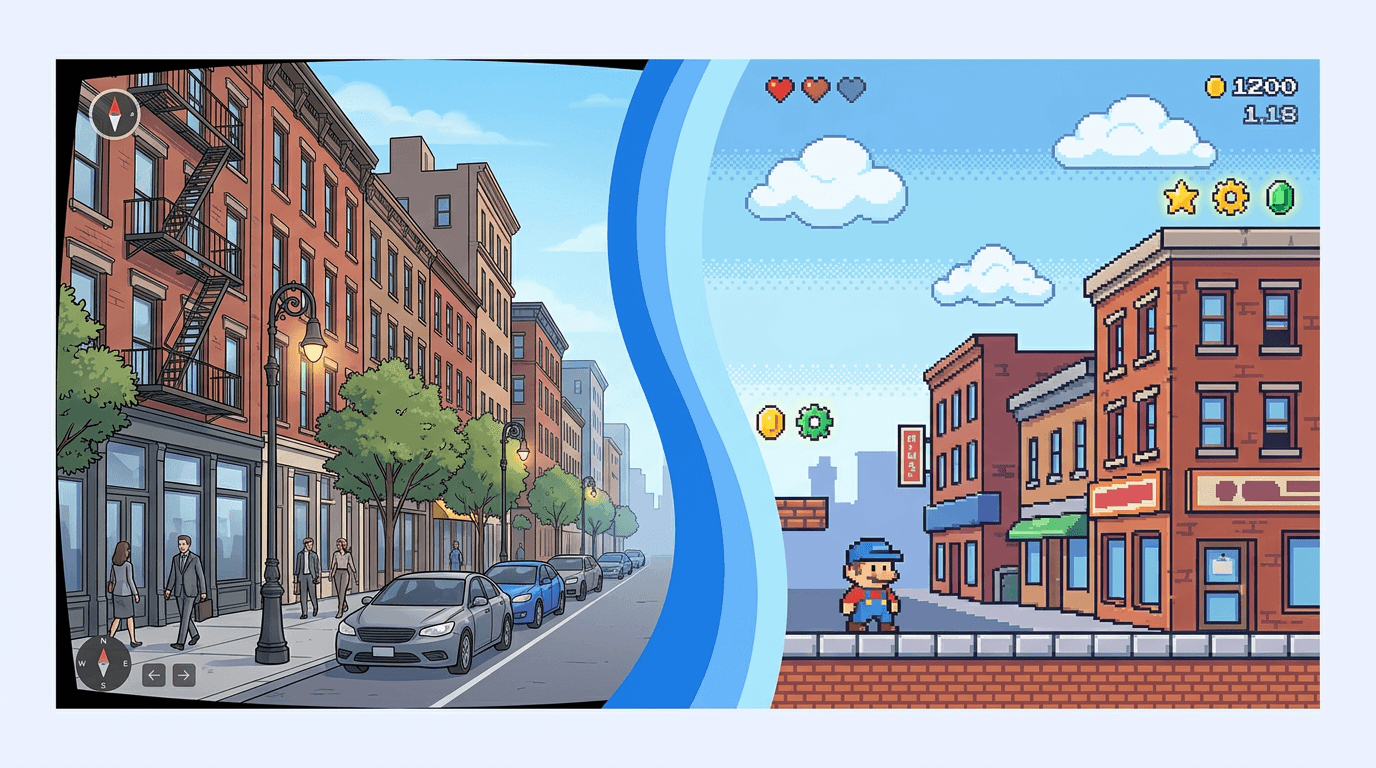
Google's Project Genie is an experimental AI world model, built on Genie 3, that can spin up interactive, playable environments from text, images, or real-world locations pulled from Google Street View. With Street View grounding, those worlds are no longer untethered fantasies: they are anchored to actual places in the U.S., blending the familiar scaffolding of Google Maps with the generative range of a foundational world model.
Type something like "make a playful cat-filled version of my street," and you can immediately roam the result like a tiny video game. That stopped being a thought experiment in May 2026, when Google said the Google Labs Project Genie prototype could take Street View locations as input. The update lands at a busy intersection of spatial data, generative AI, and interactive media. Below is what it is, how it functions, who can try it today, and why it matters for fields that span local marketing and tourism through robotics training and spatial computing.
What Exactly Is Google's Project Genie?
Project Genie is not a consumer game, a mobile app, or anything close to a finished product. It is a foundational world model from Google DeepMind, surfaced as an experimental prototype inside Google Labs. The premise is straightforward: train on massive amounts of video so the system learns the rules of space, motion, and cause-and-effect well enough to keep an environment coherent as you interact with it. Give it a prompt (text, an image, or now a Street View location), and it generates a playable 2D world where a character can move, jump, and interact in real time.
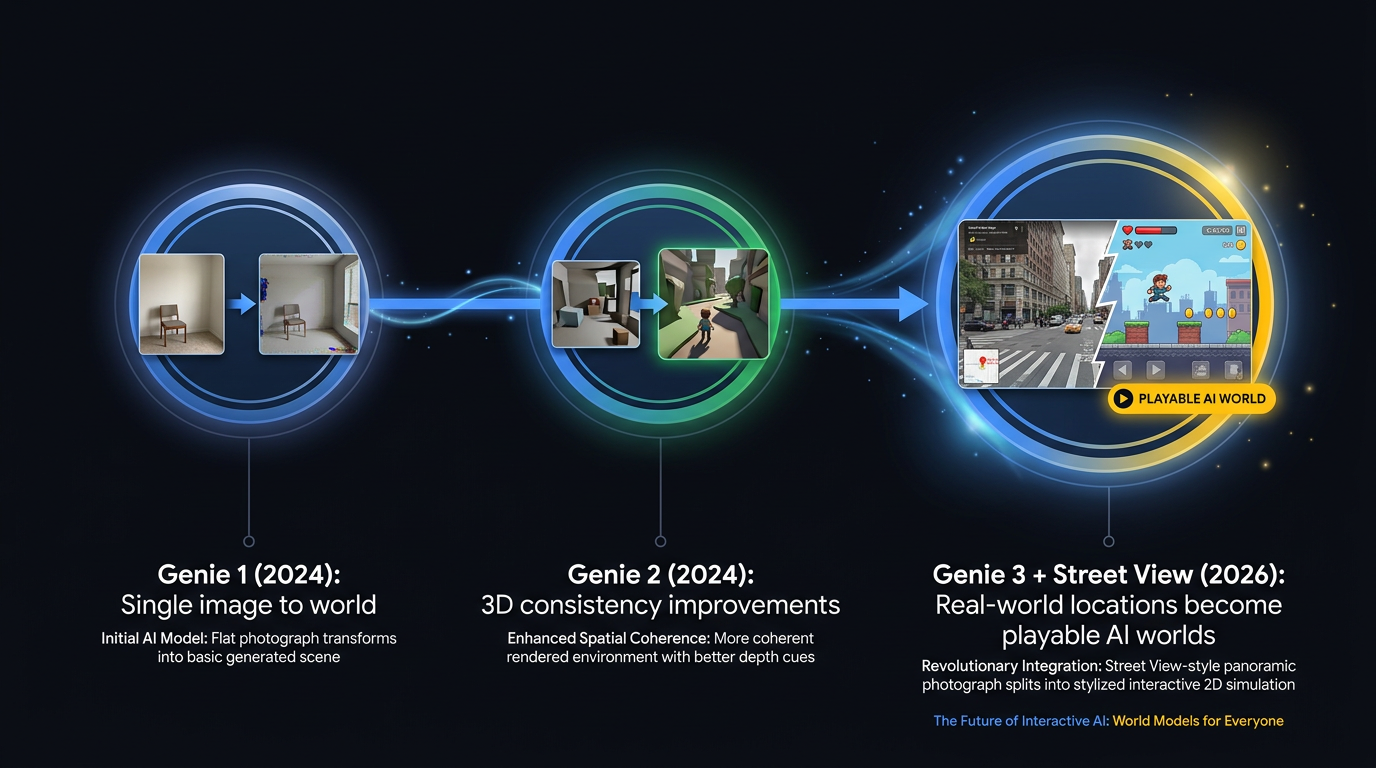
Under the hood sits the Genie 3 world model, the third round of DeepMind's work on general-purpose world simulation. According to Google DeepMind's official overview, earlier versions could produce interactive environments from a single image; Genie 3 pushes further on consistency, resolution, and contextual coherence. Right now the worlds render at 720p and 24 frames per second, and sessions cap out at 60 seconds. You need a Google AI Ultra subscription to access it, and Street View grounding launched first for U.S. locations.
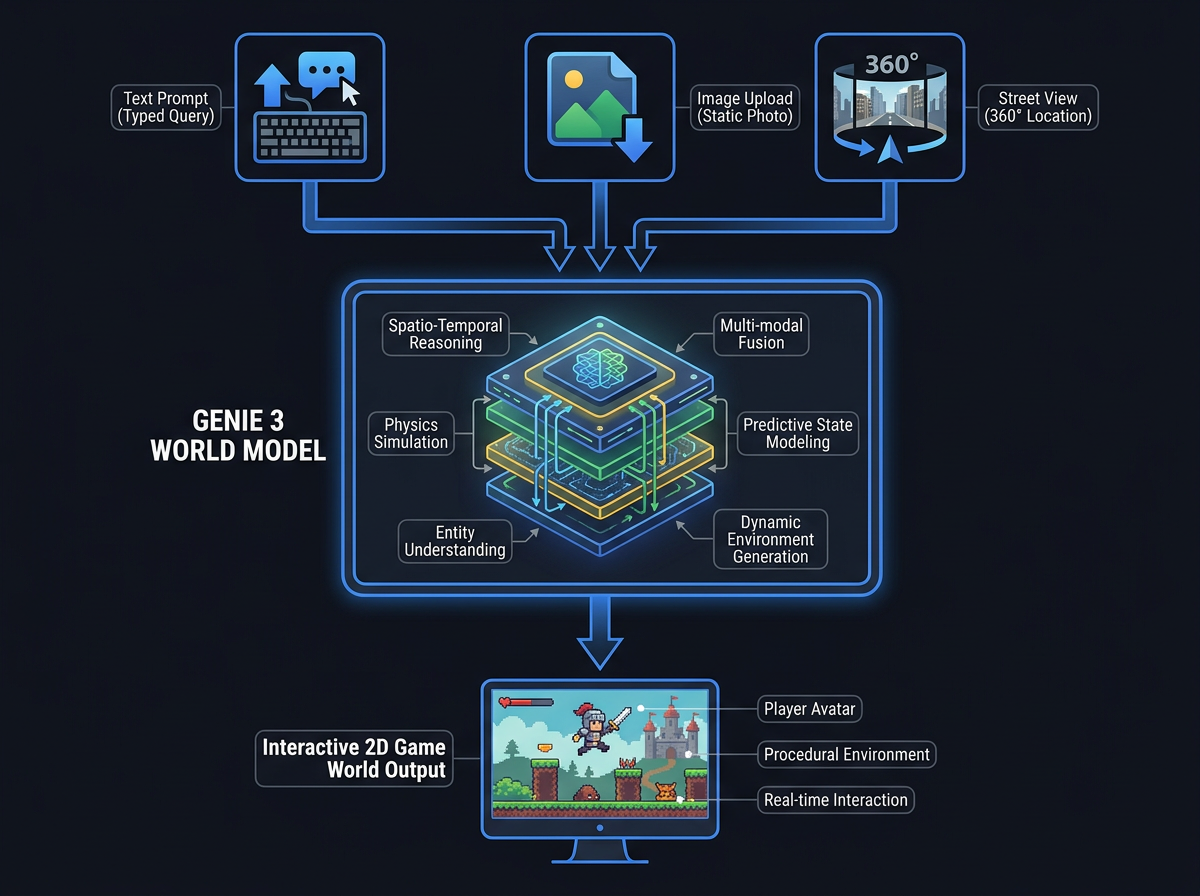
The Magic Ingredient: How Street View Grounding Changes Everything
Before the May 2026 update, Project Genie could generate worlds from text ("a snowy mountain village") or an uploaded image. The results could be delightful, but they were also placeless: nothing tied them to any real corner of the world. Street View grounding changes that by using Google Maps Street View as the reference frame. The system pulls panoramic imagery, infers geometry and layout, and uses that structure as the backbone for the generated world.
That difference matters in practice. Instead of inventing a generic city block, the model produces an environment whose proportions, building placement, and flow line up with a recognizable address. Ask for Times Square and you get something that echoes the real intersection, not just "tall buildings and billboards." Still, this is interpretation, not replication: the output is stylized, not a photorealistic digital twin. Google has been clear on that point, describing these as interactive simulations inspired by real places rather than exact copies. For additional context on how the company frames generative output, it is worth understanding how Google is labeling AI content.
It is also a notable moment of internal convergence. Street View is one of Google's most defensible data assets, spanning more than 100 countries and billions of panoramas. Genie 3 is one of the more advanced world-model efforts in the market. Put them together and you get an on-demand pipeline for generating place-based simulations, with obvious implications that neither asset delivers on its own.
How It Works: From Panorama to Playable World
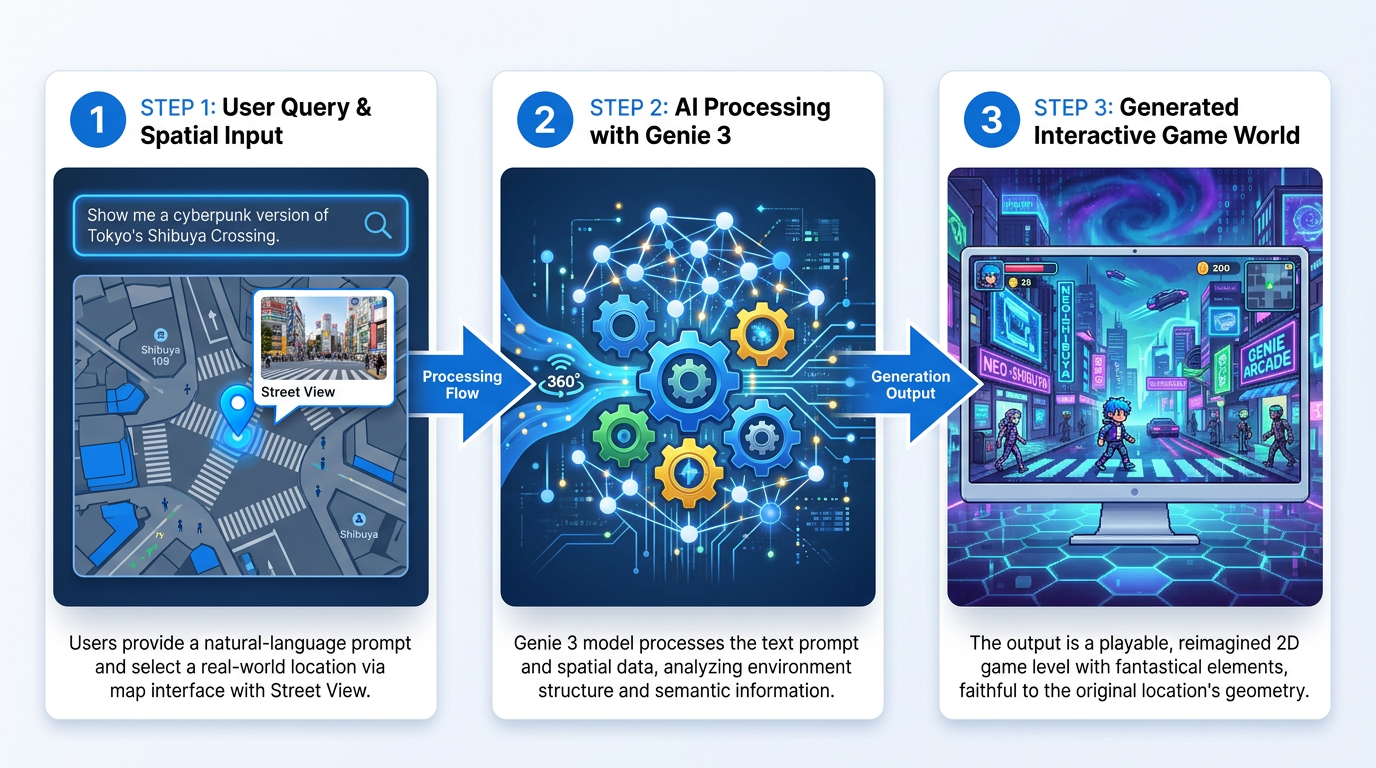
Step 1: The Prompt and Location Selection
The workflow starts with two inputs: where you want to go and what you want it to feel like. The location can be a specific address, a landmark name, or a point on a map within the United States. The creative direction is a natural-language prompt that sets the aesthetic ("8-bit retro," "underwater fantasy," "post-apocalyptic"). From there, the system fetches the relevant Street View imagery and analyzes cues like building geometry, road layout, vegetation, and depth. This pattern of using natural language to guide AI is showing up across Google's broader product surface, well beyond Labs experiments.
Step 2: Generation by the Genie 3 World Model
Once the model has both the Street View signal and the prompt, Genie 3 generates the environment on Google AI Ultra infrastructure. It preserves the underlying spatial structure of the real location, then layers the requested style on top, producing a 2D world that is recognizable in layout but deliberately reimagined in look. It also supplies a controllable character and the basics of action: movement, jumping, and interaction with elements in the scene. This is the practical meaning of a "world model" here. Genie 3 is not just drawing frames; it is predicting what should happen next as you act, keeping a simulated physics coherent enough to feel like a place rather than a slideshow.
Step 3: Real-Time Interaction
What you get back is not a pre-rendered clip. It runs as a real-time simulation, with Genie 3 generating the next frames at 24 fps as you steer the character. Because each frame is a fresh prediction, the interaction is genuine rather than scripted. The 60-second session limit is a reminder of the cost and the status: this is compute-heavy and still firmly in prototype territory.
What Can You Actually Do With This?
Street View-grounded AI worlds are easy to dismiss as a novelty, but the capability points to practical uses once you separate the prototype constraints from the underlying mechanics. Even in its current form, it sketches out how several industries could use interactive, place-based generation. The table below outlines the most plausible use cases and why each is strategically interesting.
| Industry | Potential Use Case | Why It Matters |
|---|---|---|
| Local Marketing & Discovery | Interactive, stylized previews of storefronts and neighborhoods for prospective visitors | Shifts discovery from static photos and reviews to explorable experiences tied to real addresses |
| Gaming & Entertainment | Rapid prototyping of game levels based on real-world locations | Cuts environment creation time; a street can become a playable level in seconds |
| Robotics & AI Training | Generating diverse training environments for navigation and manipulation AI | Enables scalable, varied real-world simulations without expensive physical setups |
| Education | Virtual field trips grounded in actual historical sites, cities, and landmarks | Lets students explore real places interactively, which can be more engaging than passive media |
| Tourism & Hospitality | Gamified destination previews that let travelers explore a city before booking | Builds emotional connection through play, not just imagery |
| Spatial Computing & AR | Foundation for location-aware immersive content in future AR/VR devices | Helps bridge flat maps and fully spatial, interactive representations of places |
| Use cases span from marketing to robotics, all anchored by real-world location data. |
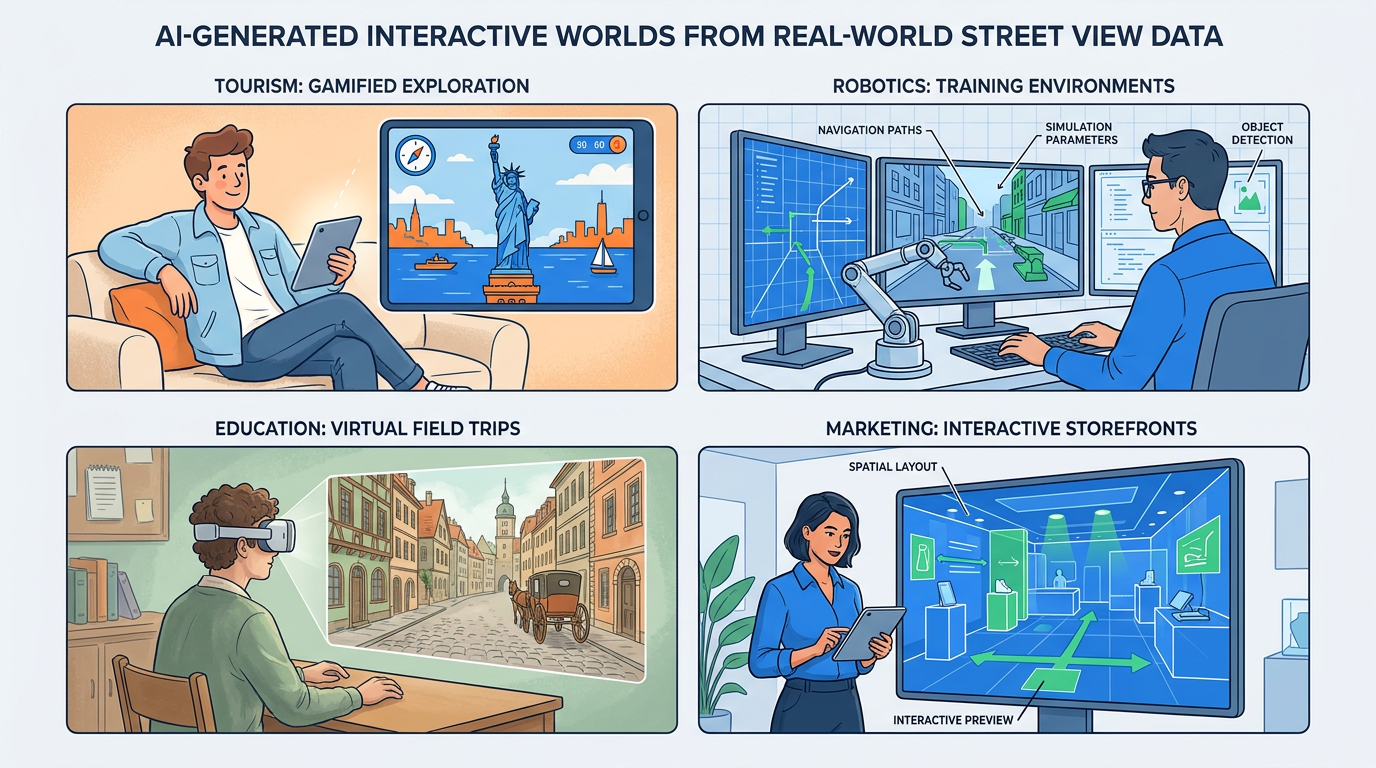
Robotics and AI training is where the stakes get serious. Training embodied agents (systems that have to move through physical space) demands huge amounts of varied environment data, and collecting it in the real world is slow and expensive. A world model that can generate thousands of variants of real streets, under different styles and conditions, offers a scalable alternative to building physical test rigs or hand-modeling scenes. DeepMind has been explicit that world models are a path toward more capable, more generalizable agents, and Street View grounding is a pragmatic way to inject real-world structure into that effort.
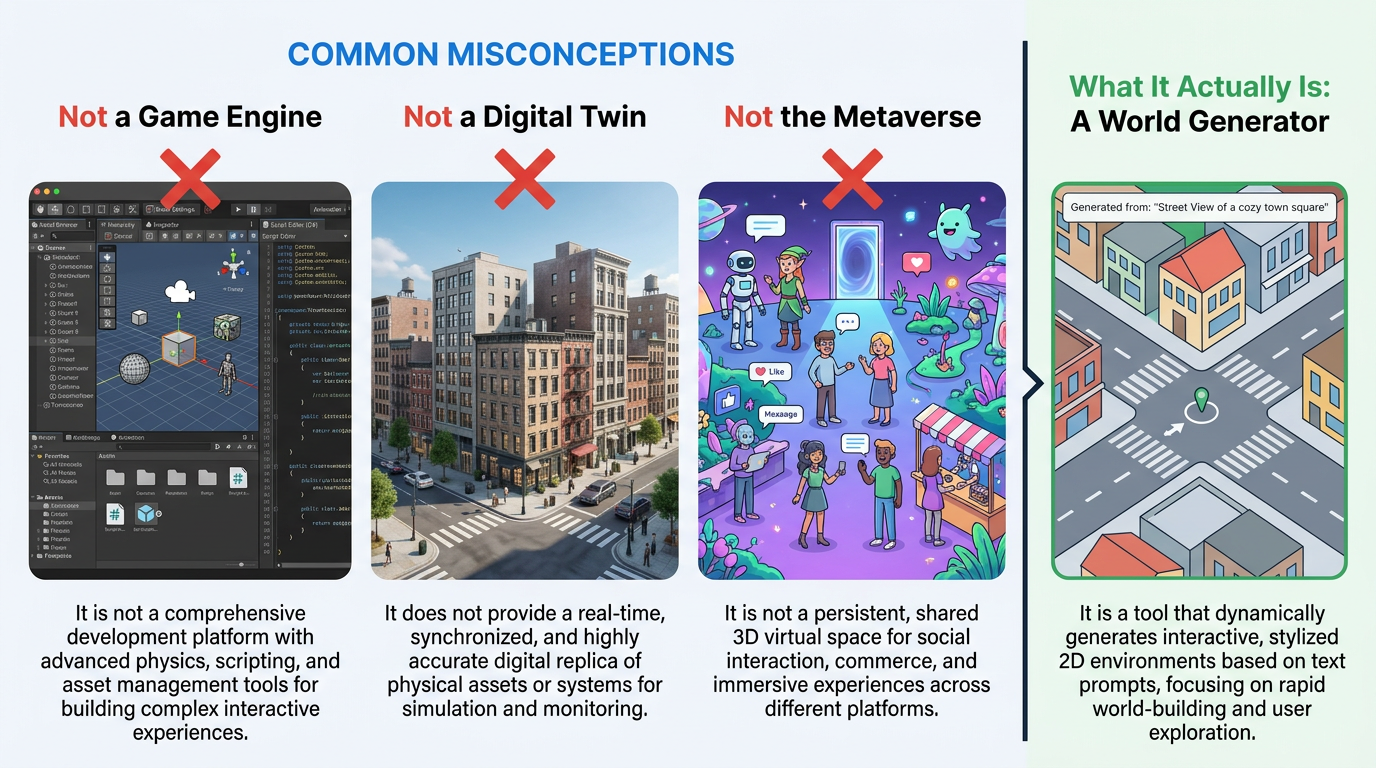
What It's NOT: Correcting Common Misconceptions
As usual, the hype cycle is running ahead of what the prototype actually delivers. Three misunderstandings show up repeatedly, and each one is worth clearing up.
It is not a game engine. Unreal Engine and Unity are full development stacks: physics engines, asset pipelines, scripting, tooling, and multiplayer networking. Project Genie does not try to be that. It generates a world, but it does not hand you the machinery to build complex logic, detailed 3D assets, or shippable commercial titles. In other words, it is a world generator, not a world builder. Google's own policies on generative AI reinforce the same point: this is research-stage capability, not a production pipeline.
It is not a perfect digital twin. The environments are stylized 2D interpretations, not photorealistic 1:1 copies. You can recognize proportions and layout, but details like signage text, window displays, and material textures are approximations. Anyone expecting Google Earth-level fidelity in a playable format is going to run into the limits quickly.
It is not the metaverse. Project Genie does not produce persistent, interconnected social worlds. There is no avatar system, no economy, and no multiplayer layer. What it demonstrates is narrower and more foundational: what happens when a world model is grounded in real spatial data. The jump from 60-second solo sessions to a shared, persistent universe is massive, and Google is not positioning this as that leap.
The Bigger Picture: Why AI World Models Matter for Your Business
For marketing and technology teams, Street View grounding in Project Genie is less about a quirky demo and more about a directional signal from Google. World models are not only for playable environments; they are a way for machines to represent and reason about physical space. Once that capability is in the stack, it tends to surface everywhere: search, ads, local discovery, and the content formats brands are expected to produce.
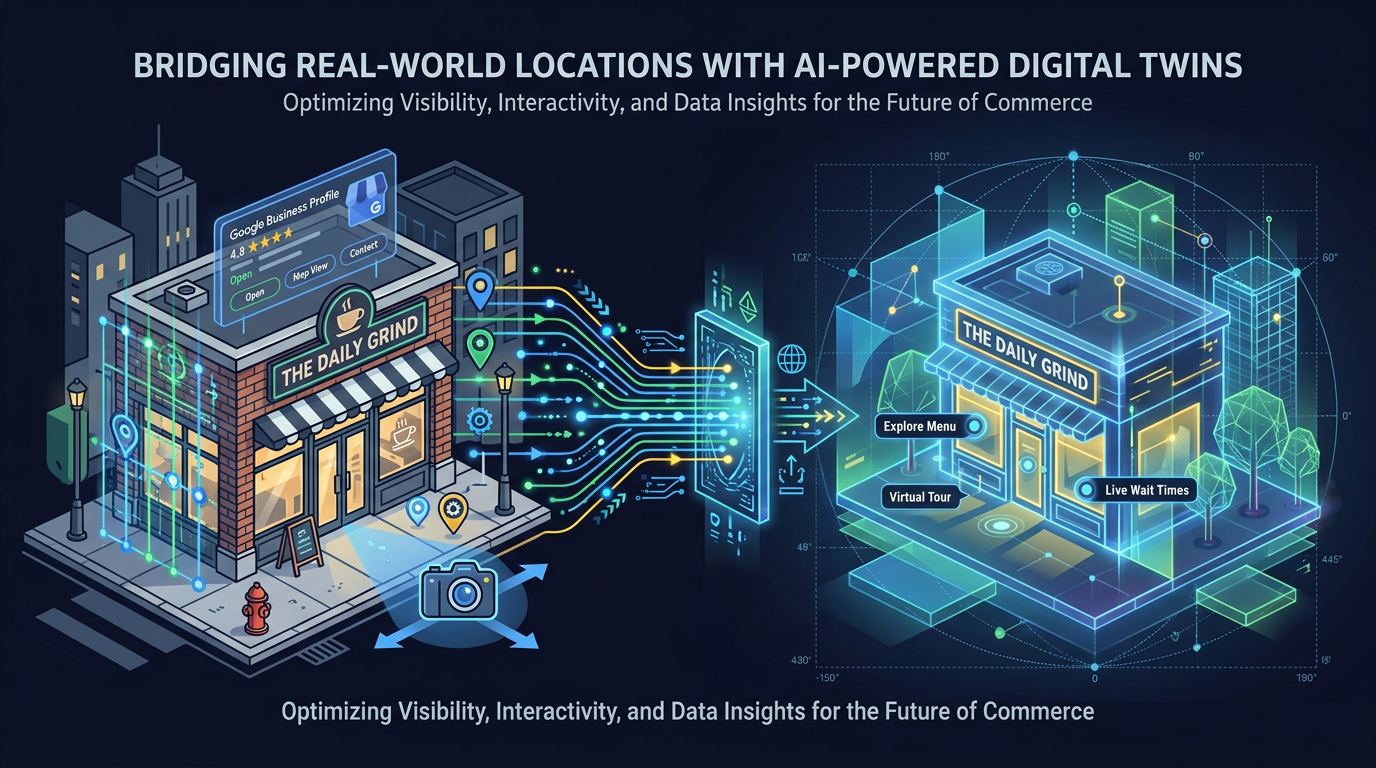
Look at where Maps has been headed. Google already uses AI to add immersive views, aerial perspectives, and indoor navigation. Project Genie extends the same trajectory by turning locations into something you can interact with and remix. If these systems mature, businesses with clean location data, accurate imagery, and strong presence signals are more likely to show up correctly inside AI-generated spatial experiences. The inputs are familiar: structured data, accurate business information, and high-quality visual assets, which are also the levers behind visibility in Google's AI-powered features across search.
For teams working on Answer Engine Optimization (AEO) and broader AI visibility, the twist is that optimization is no longer only textual. When an AI can generate an interactive neighborhood, representation depends on what the underlying systems know about the real world: Google Business Profiles, Street View imagery, and structured location markup. Brands that are consistently and accurately reflected in those sources have an edge. That makes monitoring your presence across emerging AI surfaces feel less like a nice-to-have and more like table stakes, and tools like Vizup's digital presence monitoring are positioned around exactly that problem.
Spatial computing is the other obvious beneficiary. As AR glasses and mixed-reality headsets improve, demand rises for interactive content that understands where you are, not just what you are looking at. World models like Genie 3 suggest a scalable way to generate that layer without hand-building 3D models for every street corner. The feature set is experimental, but the dependencies are not: Street View's imagery footprint, DeepMind's modeling work, and Google AI Ultra's compute are all built on production-grade infrastructure.
Key Takeaways
- New Integration: Google Street View Project Genie can now use Street View data to create interactive AI worlds based on real U.S. locations, a capability announced in May 2026.
- Core Technology: The system is powered by the Genie 3 world model running on Google AI Ultra infrastructure. It remains an experimental Google Labs project, not a finished consumer product.
- How It Works: A user provides a location and a creative prompt. The system pulls Street View imagery, analyzes spatial structure, and generates a playable, stylized 2D simulation at 720p and 24 fps in real time.
- Access: Street View grounding is rolling out to eligible Google AI Ultra subscribers, initially limited to U.S. locations with 60-second exploration sessions.
- Key Impact: This technology advances training for embodied AI agents and creates new possibilities for immersive AI experiences in gaming, education, local discovery, and tourism.
- It's Not a Game Engine: Project Genie is a world generator, not a world builder. It produces environments but lacks the tooling for complex game logic, multiplayer systems, or commercial development.
Frequently Asked Questions
How do I get access to Google Street View Project Genie?
Project Genie is available through Google Labs for eligible Google AI Ultra subscribers. Street View grounding is limited to U.S. locations for now and is rolling out gradually, so you will need an active AI Ultra subscription and availability on your account.
Does Project Genie generate a 3D world or a 2D world from Street View?
Today it outputs a stylized 2D interactive world rendered at 720p and 24 frames per second. Genie 3 still analyzes 3D geometry and spatial layout from Street View imagery to infer depth and structure, but the playable experience is presented in 2D rather than as a fully navigable 3D space.
What separates Project Genie from a traditional game engine?
Unreal Engine and Unity are full development platforms, complete with physics systems, scripting tools, asset pipelines, and multiplayer networking. Project Genie is narrower: it generates an interactive environment from prompts, but it does not provide the tooling you would need to build complex game logic or ship a commercial product. It produces the world; a game engine is what you build the game with.
Can businesses use Project Genie for marketing right now?
Not as a production marketing channel. Project Genie is still an experimental prototype with 60-second sessions and no commercial licensing or embedding options. The practical move for businesses is to keep location data, Google Business Profiles, and Street View imagery accurate and high-quality, since those inputs will shape how (and whether) a brand appears as AI-generated spatial experiences expand.
What is an AI 'world model' like Genie 3?
A world model is a type of generative AI trained on large volumes of video to simulate environments, including spatial relationships, basic physics, and cause-and-effect. Unlike a large language model that predicts the next word, Genie 3 predicts the next visual frame based on user actions, which is what enables interactive environments instead of static images or text.
