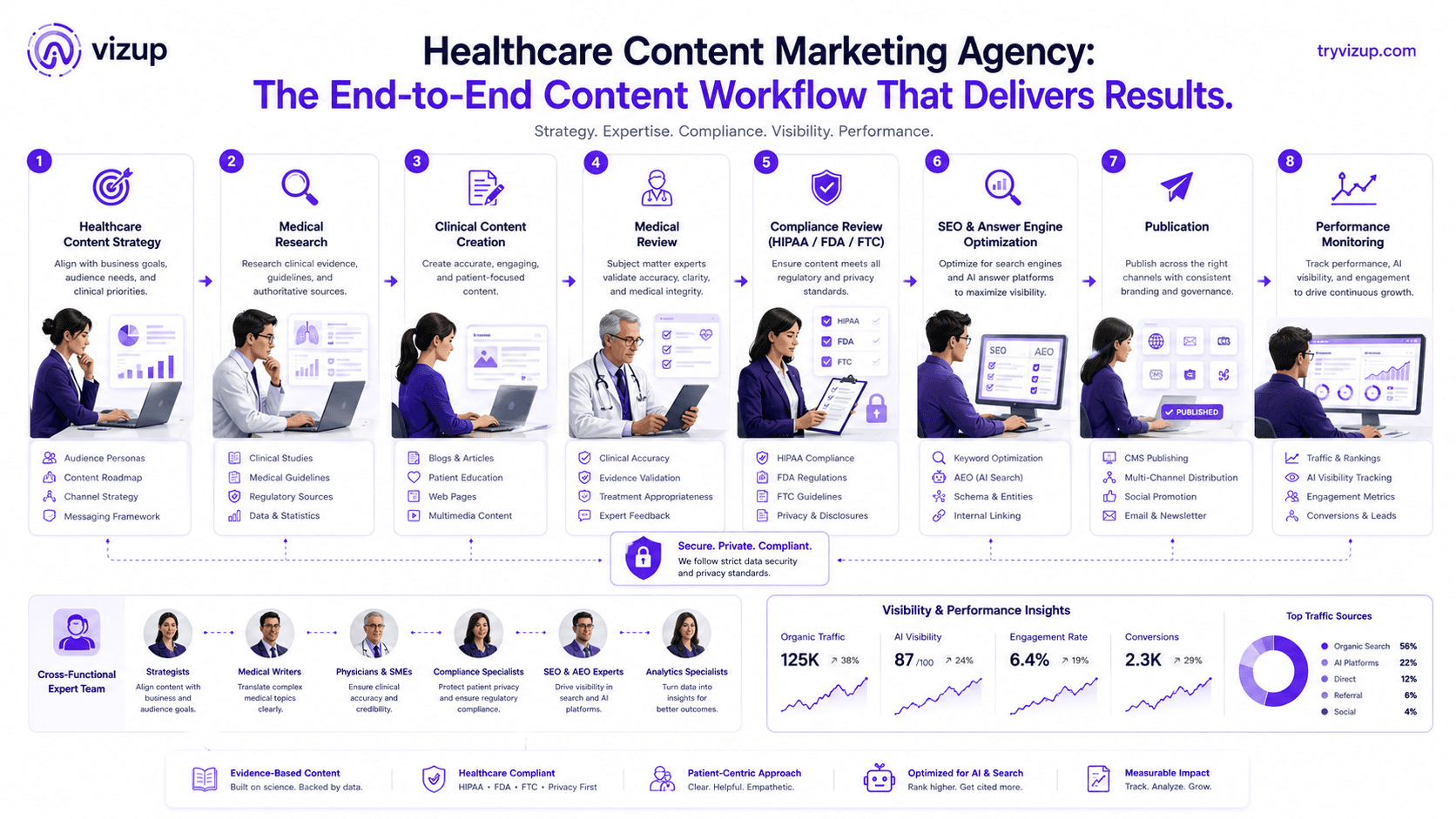
Healthcare brands operate under a pressure most industries never feel. You need content that reaches patients, providers, and payers, knowing one sloppy line can invite regulatory scrutiny, damage trust, or amplify misinformation. For marketing and analytics platforms like Vizup, this means connecting visibility to outcomes. The scale of health-related online activity is a massive opening for brands that get it right, and a very public failure mode for those that do not.
Hiring a healthcare content marketing agency is not the same exercise as bringing in a generalist shop for a product launch. Clinical accuracy, compliance requirements, and the realities of sensitive audiences change what "good" looks like. This piece lays out how to vet partners, starting with non-negotiable compliance fundamentals and moving to the quieter signals that separate real healthcare operators from agencies that simply say they have done it. Before you start comparing vendors, it helps to ground your team in what content marketing means in the AI search era.
Compliance Isn't a Feature. It's the Floor.
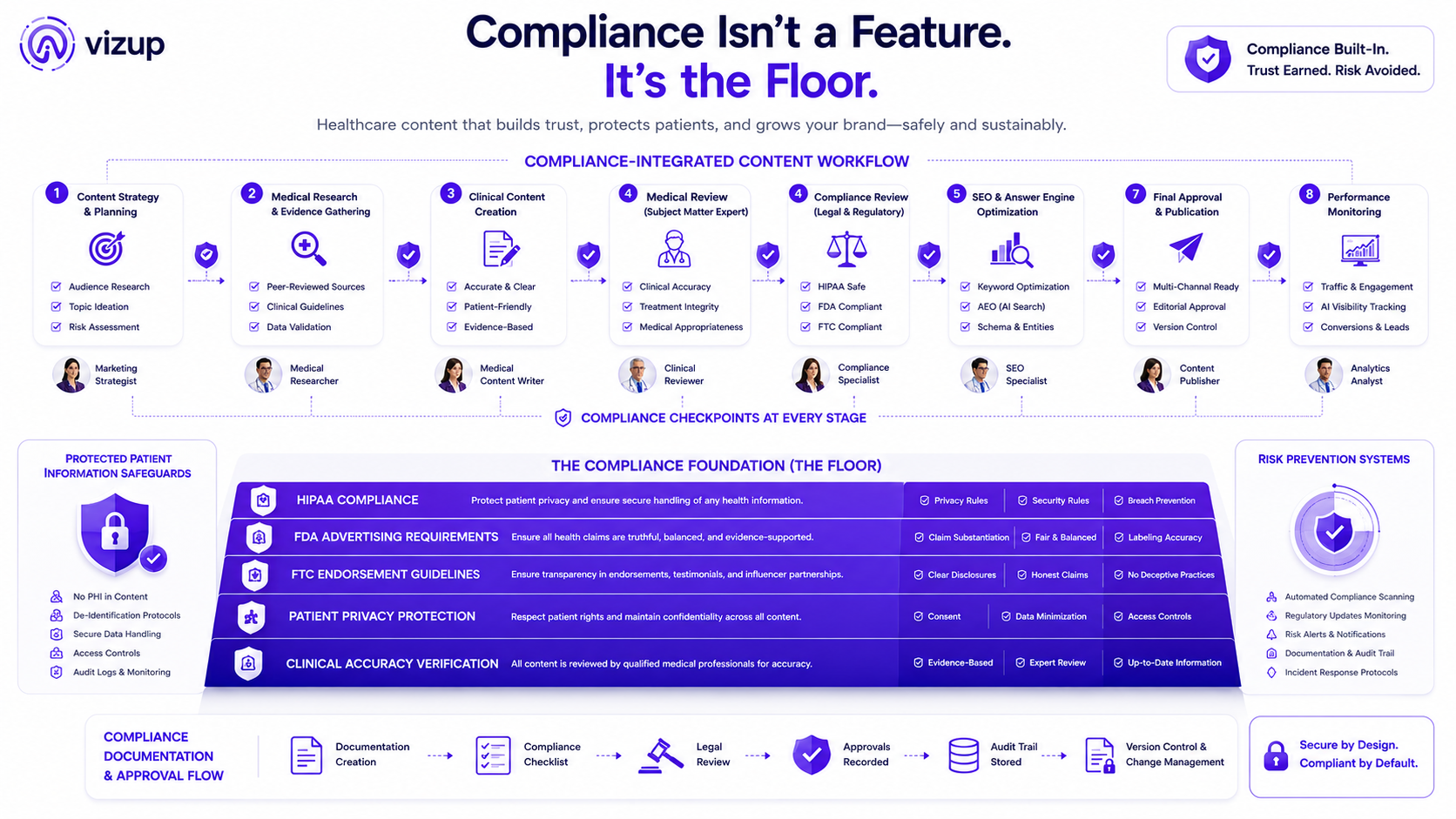
Healthcare marketers must navigate at least four overlapping regulatory frameworks before publishing a single piece of content.
HIPAA, FDA advertising rules, FTC endorsement guidelines, and a patchwork of state regulations turn everyday marketing tasks into a compliance exercise. Many generalist agencies have never had to work inside that reality. HIPAA penalties are adjusted periodically for inflation and can reach into the millions of dollars annually for serious violations, depending on the violation category and level of negligence. The HIPAA Privacy Rule requires written patient authorization before protected health information (PHI) can be used for most marketing purposes, including testimonials and case studies (HHS.gov, 2013).
A serious healthcare content marketing agency will volunteer its compliance workflow early, not wait for you to drag it out in procurement. Look for documented review chains, explicit PHI handling protocols, and a clear process for substantiating claims. If compliance shows up as a last-step checklist right before publishing, rather than a constraint that shapes the entire production system, treat that as a hard stop.
HIPAA and PHI in Content Workflows
Patient stories, testimonials, and case studies can be some of the most persuasive formats in healthcare. They are also some of the easiest places to create legal exposure. Any agency working on this kind of content needs a consent framework, de-identification protocols, and a way to show that patient-facing materials were reviewed against HIPAA standards. If the agency will touch patient data in any form, including through analytics integrations or CRM connections, your organization must have a Business Associate Agreement (BAA) in place. That is not a nice-to-have. If an agency cannot explain what a BAA is, or pushes back on signing one, take them off the list.
FDA and FTC Advertising Guardrails
When content makes claims about treatments, devices, or supplements, the bar is substantiation, not creativity. Your agency should know the difference between structure/function claims and disease claims, and when FDA, legal, or MLR review may be required. The AMA Code of Medical Ethics sets an expectation that communications are not misleading or deceptive and are readily understandable to the public. FTC endorsement guidelines matter just as much for influencer programs and patient testimonials. If an agency is running those efforts without a documented review path, it is asking your brand to absorb the enforcement risk.
What Actually Makes a Healthcare Content Marketing Agency Different
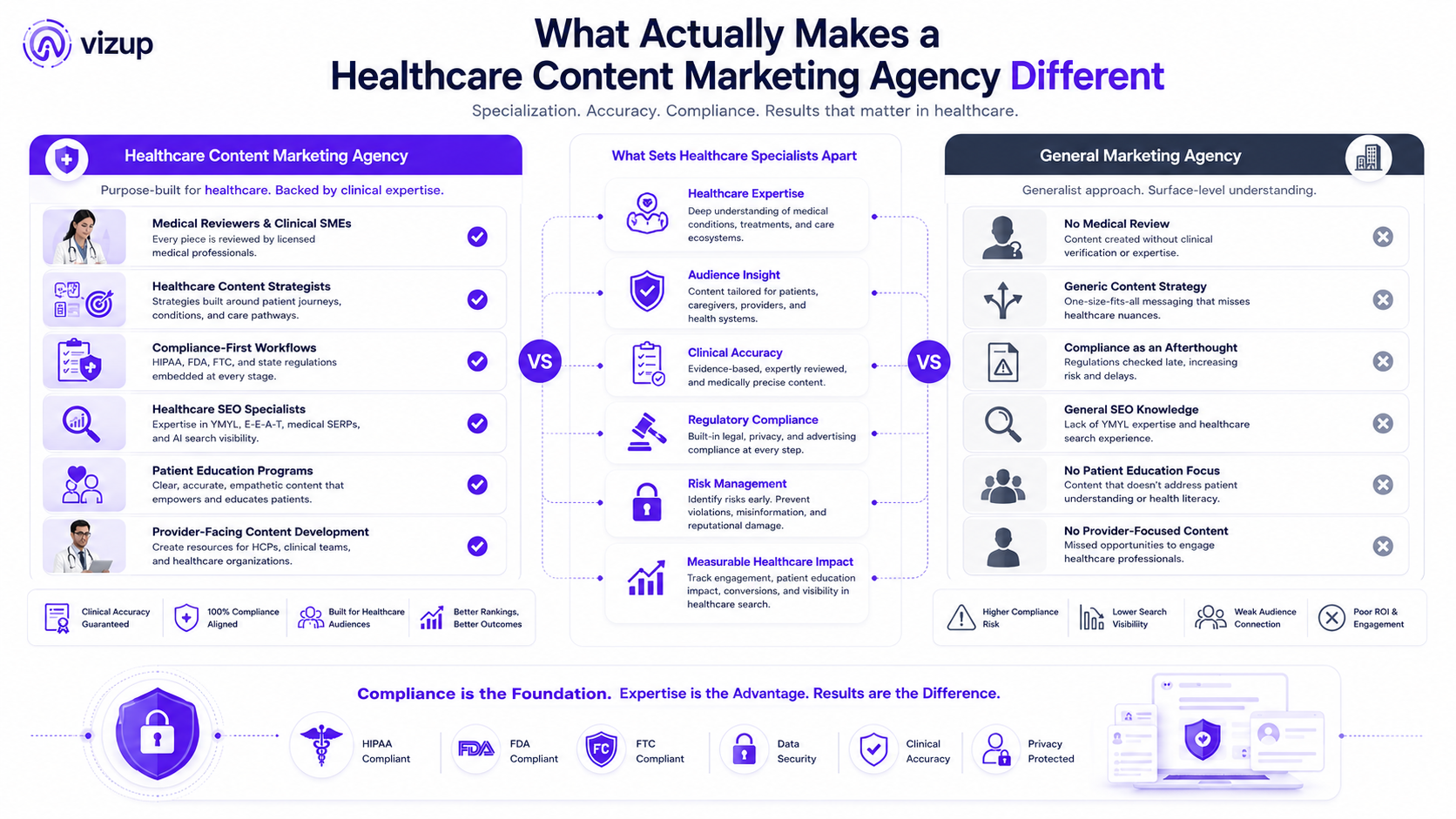
Subject-matter depth and structured review processes separate specialized healthcare agencies from generalist shops.
The obvious difference is subject-matter depth. A healthcare-specialized agency staffs writers with clinical, pharmaceutical, or health-system backgrounds, rather than relying on generalist freelancers who skim a few PubMed abstracts and call it expertise. That distinction is not academic: clinical inaccuracies can trigger regulatory exposure and, in the worst case, contribute to patient harm.
The less visible differentiator is segmentation discipline. Healthcare content routinely has to speak to patients, providers, payers, and administrators, sometimes within the same initiative. Each group needs a different level of clinical detail, a different tone, and a different call to action. If an agency cannot show how it changes voice and depth by audience, it is not equipped for healthcare work.
Content formats that matter in healthcare (and that generalist agencies rarely produce well):
- Peer-reviewed-style white papers for provider audiences
- Patient education materials calibrated to appropriate health literacy levels
- Educational content developed for healthcare professionals and continuing education initiatives
- Formulary support documents and payer-facing clinical summaries
- Disease awareness campaigns that comply with FDA off-label promotion rules
Strong healthcare agencies also avoid forcing the patient journey into a generic marketing funnel. Patients move through an emotional and informational arc: diagnosis anxiety, decision-making under uncertainty, and long-term condition management. Content that treats people as conversion events tends to underperform, and it can leave a reputational mark that is hard to erase. Because so many patients use online reviews to evaluate providers, tone and trust are not soft concerns; they show up in measurable outcomes.
The Vetting Checklist You Should Actually Use
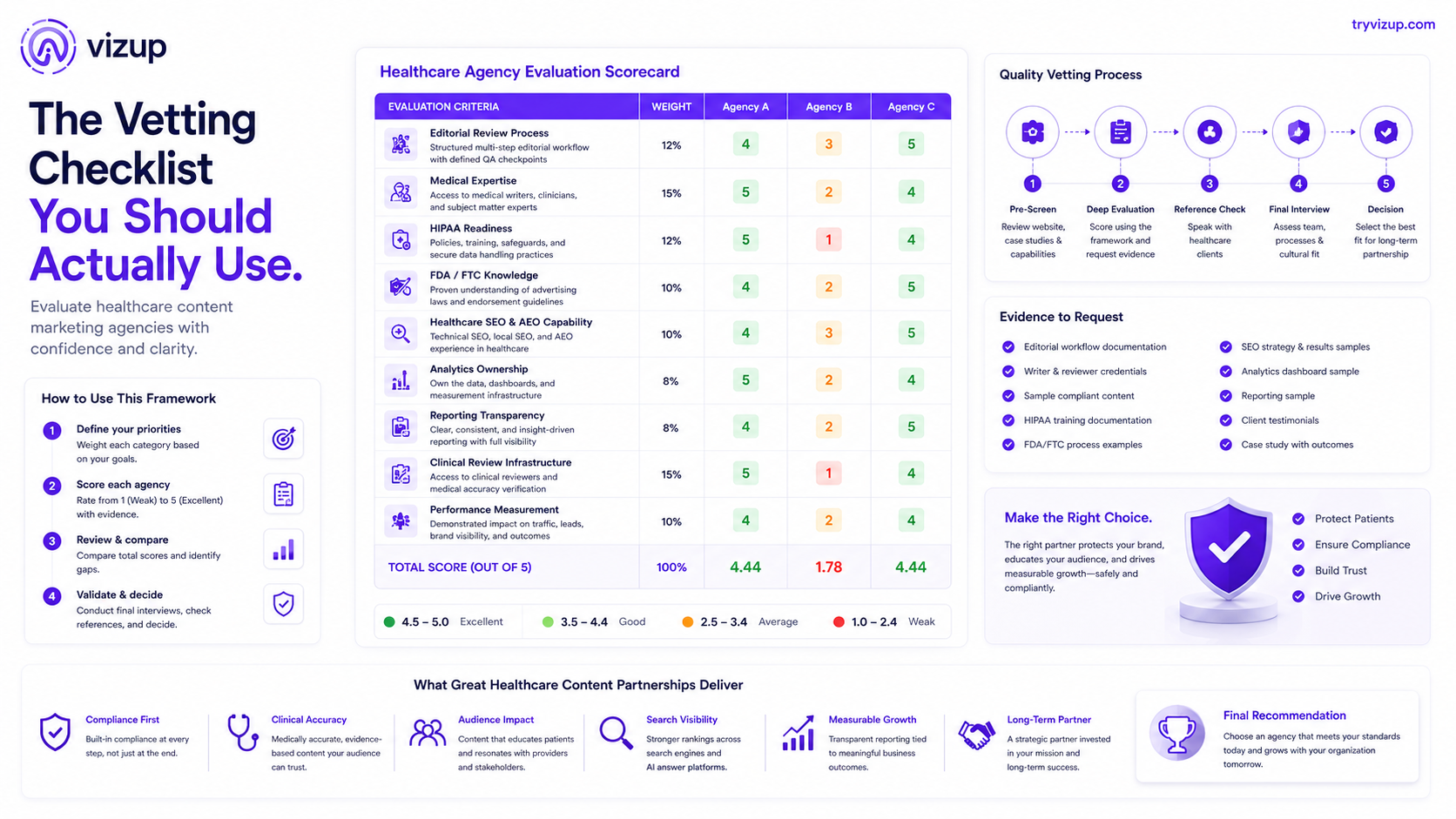
A structured vetting framework helps healthcare brands move beyond portfolio reviews to evaluate process rigor.
Most healthcare brands end up grading agencies on portfolio shine and pitch-deck confidence. That is how you end up with a partner that looks great in a meeting and struggles in production. The questions below focus on proof: can the agency run a compliant, repeatable content operation under real healthcare constraints?
Ask About Their Editorial Review Process
A credible healthcare content marketing agency should be able to walk you through its review chain in concrete terms: how many steps, who signs off, and what criteria each reviewer uses. Clinical accuracy review, regulatory compliance review, and brand voice review are separate jobs; collapsing them into one pass is how mistakes slip through. Ask whether they use medical reviewers or advisory boards, or whether accuracy is treated as the writer's responsibility alone. If the model is "the writer will be careful," you are buying content without a safety net.
Demand Proof of SEO and Distribution Expertise
Content without distribution is expensive journaling. Push for specifics on how the agency approaches organic search, answer engine optimization (AEO), and AI-driven discovery. Healthcare SEO has constraints that generalist teams often underestimate: Google's Your Money or Your Life (YMYL) scrutiny, E-E-A-T requirements that demand demonstrable expertise and authoritativeness, and medical schema markup that many SEOs have never implemented. A playbook built for e-commerce or SaaS rarely survives contact with regulated health topics.
The framing matters, too. why organic marketing is more than just SEO is useful context for setting expectations across channels. Tools for digital presence monitoring and answer engine monitoring give healthcare teams an outside view of where content is actually showing up, across traditional search and AI answer engines, so performance conversations are not limited to whatever the agency chooses to report.
Evaluate Their Measurement Philosophy
Pageviews and social shares are easy to report and easy to misread. In healthcare, the KPIs that matter tie content to outcomes: qualified lead attribution, patient acquisition cost, content-influenced appointment volume, and provider engagement rates on clinical content. Ask what dashboards and reporting tools the agency uses, and make sure your team owns the underlying data. If the agency controls your analytics access, it also controls your ability to evaluate its work.
Generalist Agency vs. Healthcare Content Marketing Agency: Where the Gaps Show Up
| Dimension | Generalist Agency | Healthcare Content Marketing Agency |
|---|---|---|
| Compliance infrastructure | Inconsistent or missing; leans on the client legal team | Built in: documented HIPAA, FDA, FTC review workflows |
| Editorial review process | Writer + editor; no clinical review layer | Multi-layer: writer, medical reviewer, compliance officer |
| Writer qualifications | General content writers, occasional subject-matter freelancers | Writers with clinical, pharma, or health-system backgrounds |
| SEO/AEO for YMYL topics | Standard SEO playbook; limited E-E-A-T strategy | Healthcare-specific E-E-A-T, medical schema, AEO for AI search |
| Content turnaround time | Fast (days to a week) | Longer (accounts for medical review cycles, often 2-4 weeks) |
| Risk exposure level | High; compliance gaps create regulatory liability | Lower; structured review reduces enforcement risk |
| Reporting depth | Traffic, engagement, social metrics | Clinical KPIs, patient acquisition attribution, provider engagement |
| Gaps in compliance and clinical expertise represent risk exposure, not just knowledge deficits. |
Note: Warning: Some brands try to patch the gap by pairing a generalist agency with internal compliance consultants. In practice, that setup creates friction, slows production, and often yields content that satisfies neither the creative brief nor the legal standard. A specialized agency is built to run those functions as one system from day one.
The Mistake Most Healthcare Brands Make When Hiring
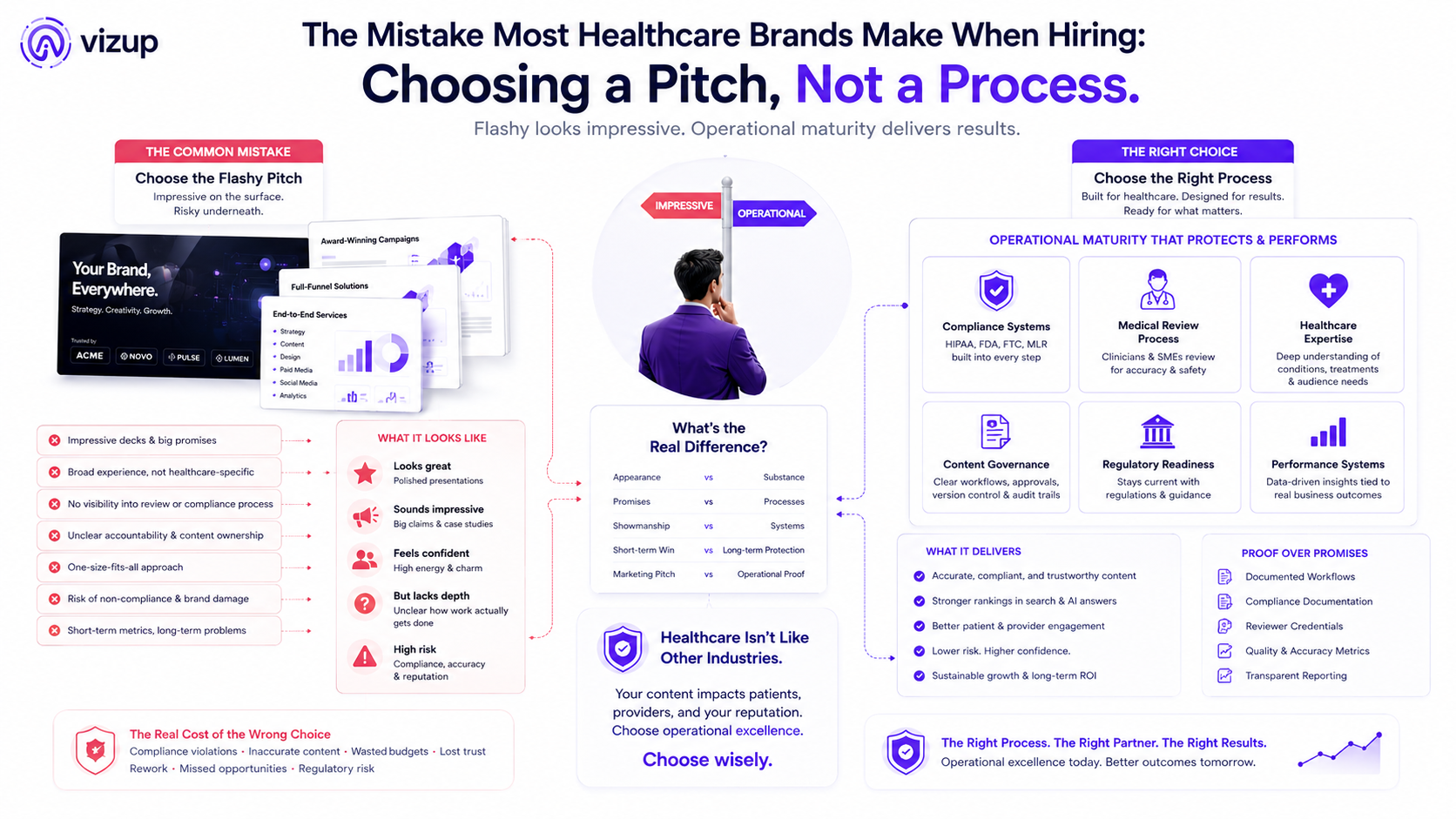
A compelling pitch is not a substitute for a documented compliance and clinical review process.
The most common hiring error is mistaking a good-looking portfolio for a safe, repeatable process. A polished case study from a direct-to-consumer wellness brand does not tell you whether the agency can work inside a hospital system's legal review requirements or a pharmaceutical company's Medical, Legal, and Regulatory (MLR) cycle.
A familiar scenario: a health system hires an agency on the strength of the pitch and the client logo slide, then spends the next four months stuck in legal review because every asset needs major rework to clear internal compliance. The agency did not understand MLR timelines, did not grasp off-label promotion rules, and had no medical reviewer in the workflow. The drafts read well and still could not ship. The loss is not limited to fees; it is four months without a functioning content program.
How to Monitor Whether Your Agency Is Actually Performing
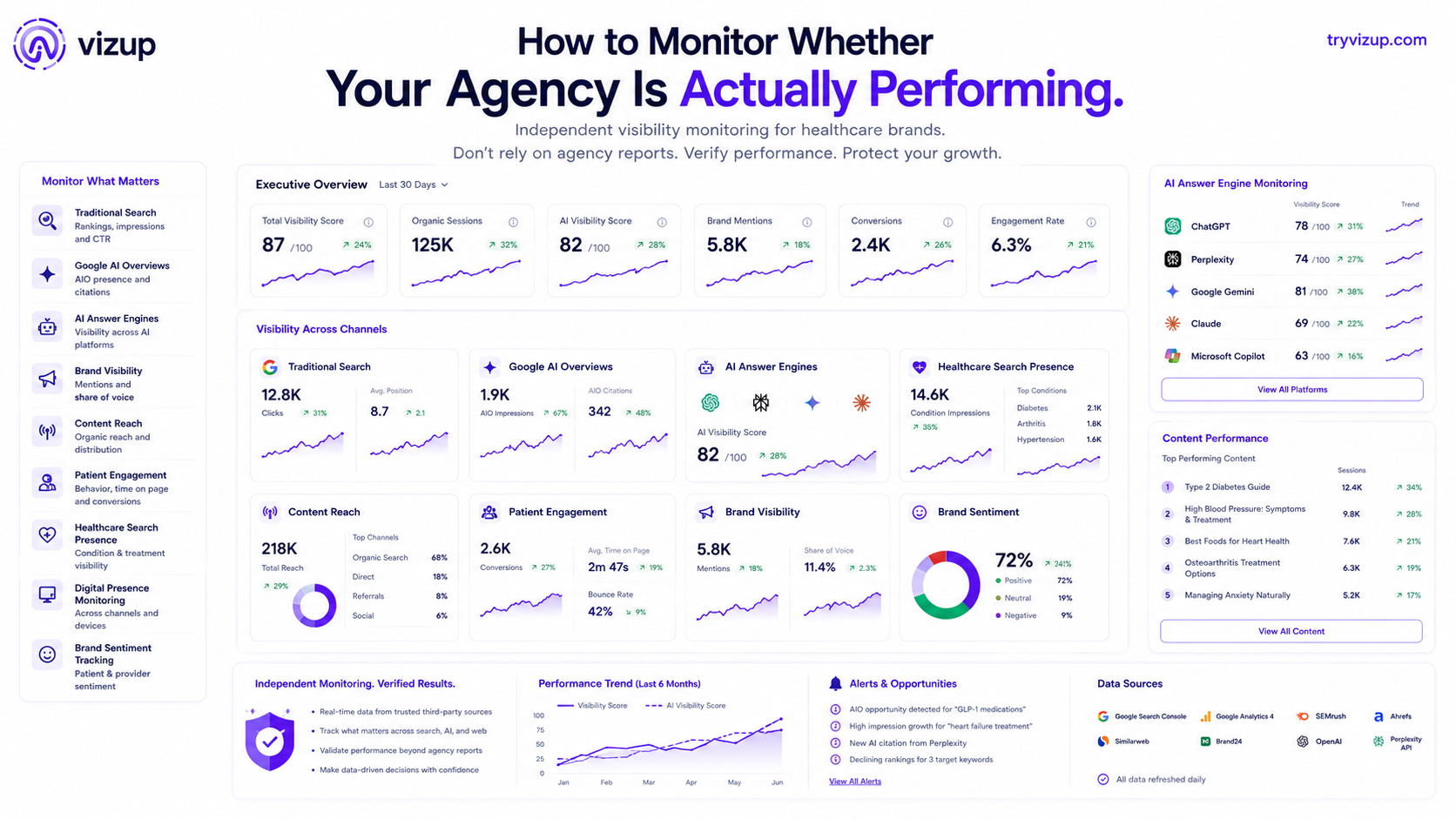
Independent monitoring tools give healthcare brands visibility into content performance that goes beyond agency-reported metrics.
Hiring the right agency is the starting line, not the finish. Healthcare teams need independent visibility into how content performs across search, AI answer engines, and broader digital presence channels. Spend at this level warrants measurement that is rigorous and not solely vendor-reported.
Vizup's platform gives healthcare brands a way to monitor digital presence and see how content surfaces in traditional search results and emerging AI-powered answer engines, without treating an agency dashboard as the only source of truth. That independence matters as AI search tools, including Google AI Overviews, Bing Chat, and Perplexity, change how patients encounter health information. Developing a content marketing strategy that includes answer engine optimization is no longer optional for brands that want to stay visible where people are actually looking.
Independent monitoring does not have to be adversarial. Strong agencies tend to prefer it, because it replaces subjective debates with shared evidence. The ability to track brand sentiment across AI search channels and confirm that your content is being cited accurately in AI-generated answers helps both sides work from the same facts, especially when performance questions get uncomfortable.
What the Best Healthcare Content Marketing Agencies Will Tell You Upfront
Signals that indicate a genuinely capable healthcare content marketing agency:
- They will tell you what they cannot do and name the partners or specialists they bring in to fill those gaps
- They will push back on content ideas that carry regulatory risk, and explain the specific rule or guideline at issue
- They will set realistic timelines that account for medical review cycles, not just creative production schedules
- They will ask about your MLR process, your legal review cadence, and your internal approval chain before scoping a project
- They will have a documented process for handling corrections or retractions if published content contains a clinical error
Hire for Trust, Not Just Talent
The right healthcare content marketing agency protects your brand as much as it grows it. When you evaluate partners, keep coming back to three things: compliance infrastructure, clinical accuracy, and performance you can measure. A beautiful portfolio built on non-healthcare work, a "fast" turnaround that skips medical review, or reporting that never gets past vanity metrics are all signals the agency is not built for regulated healthcare.
The best healthcare agencies don't just reduce compliance risk. They help healthcare organizations build trust, improve patient education, shorten decision cycles, and increase visibility in both traditional and AI-powered search experiences.
AI is already changing search and content discovery, and healthcare brands need partners who are prepared for where distribution is going. Patients are increasingly encountering health information through AI-generated answers, not just ten blue links, and agencies that know how to optimize for that shift will compound value over time. Independent monitoring tools help healthcare teams stay oriented throughout that change, from planning through ongoing measurement. Pairing a rigorous agency with independent monitoring is the standard healthcare brands should expect and enforce.
Frequently Asked Questions
What is a healthcare content marketing agency, and how is it different from a general marketing agency?
A healthcare content marketing agency is built to produce and distribute content under healthcare's regulatory, clinical, and audience constraints. Compared with a generalist agency, a healthcare-focused partner typically staffs writers with clinical or pharmaceutical backgrounds, embeds HIPAA and FDA review into the editorial workflow, and understands the E-E-A-T signals that shape how Google evaluates health content. Generalist agencies can write compelling copy, but they often lack the compliance infrastructure and clinical review layers healthcare brands need to publish safely and consistently.
Why is HIPAA compliance important when choosing a content marketing partner for healthcare?
HIPAA is not a back-office concern when your marketing touches patient information. The HIPAA Privacy Rule requires written patient authorization before protected health information can be used for most marketing purposes. If your agency works on testimonials, case studies, or analytics data that touches PHI, it is operating as a business associate and must sign a Business Associate Agreement (BAA). Without a documented PHI handling protocol, your organization takes on enforcement risk, including significant financial penalties that are periodically adjusted for inflation.
How do I evaluate whether a healthcare content marketing agency understands SEO and AI search optimization?
Ask for a clear explanation of how they handle YMYL (Your Money or Your Life) content, E-E-A-T signals, medical schema markup, and answer engine optimization for AI search platforms. A capable agency should be able to talk about visibility in Google AI Overviews, Bing Chat, and Perplexity, not only traditional organic rankings. Then validate their story with independent tooling, such as Vizup's digital presence monitoring and answer engine monitoring, to see where your content is actually surfacing across traditional and AI-powered search.
What KPIs should I track to measure the success of healthcare content marketing?
Treat pageviews and social shares as context, not outcomes. In healthcare, the more useful KPIs include qualified lead attribution, patient acquisition cost influenced by content, content-influenced appointment volume, provider engagement rates on clinical materials, and brand citation frequency in AI-generated health answers. As discovery shifts toward AI, brand sentiment across AI search channels also matters. Make sure your team owns the underlying data from any reporting tools so measurement does not disappear if the agency relationship changes.
Can a healthcare brand use a generalist agency if they add compliance review internally?
It can work, but it usually adds friction. When compliance review sits outside the production workflow, each asset turns into a back-and-forth loop between the agency and your internal legal or compliance team. That slows timelines, increases cost, and often produces content that no one loves. A specialized healthcare content marketing agency integrates these functions, which supports more consistent output with lower regulatory risk. If budget forces a generalist approach, confirm your internal compliance team has the capacity to absorb the extra review workload before you commit.
