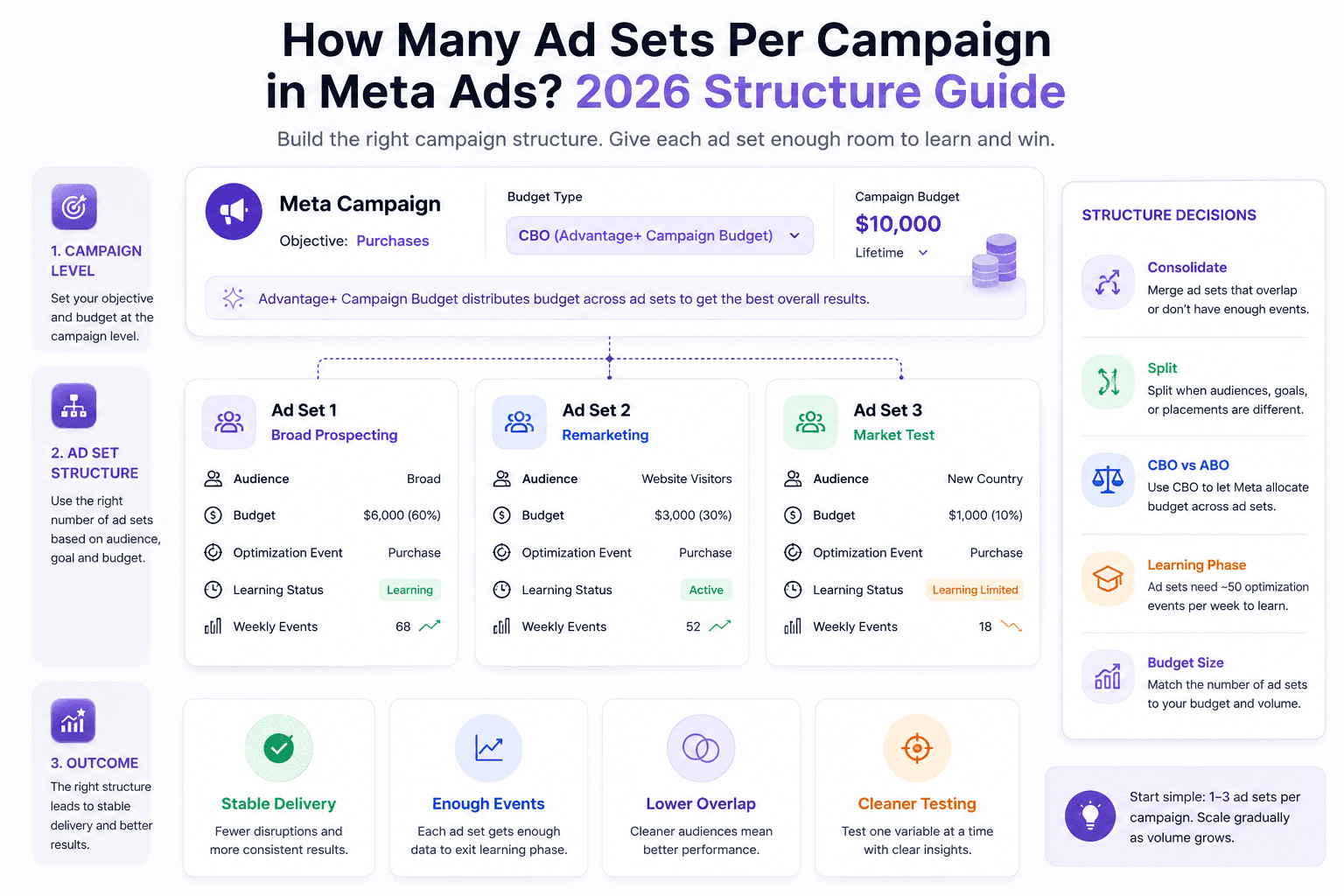
Few things burn budget faster than an overengineered Meta account. For a long time, the “smart” play was to carve audiences into dozens of ad sets, each fed a tiny slice of spend, all neatly tracked in a color-coded spreadsheet that didn’t actually move results. That approach made sense in an older version of the platform. In 2026, it mostly just drags performance down.
So the real question isn’t simply how many ad sets belong in a campaign. It’s why you’re creating each one in the first place. Meta’s system needs concentrated signals to learn; spread those signals across too many buckets and you pay for noise: swingy CPAs, inconsistent delivery, and a dashboard littered with “Learning Limited.” Keep things tight and you end up with something rarer: a structure that’s simpler, easier to scale, and more reliably profitable.
Quick Answer: How Many Ad Sets Should You Use?
Here’s the practical baseline: for most accounts, start with 1–3 ad sets per campaign. Full stop.
Run a single ad set when you’re working with a broad audience and a constrained budget. Move to 2–3 only when you can point to a specific reason to separate them: prospecting versus remarketing, different countries that need different spend, or a controlled test you actually plan to read. Consolidation should be the default. If an extra ad set can’t justify itself in plain business terms, it’s probably just clutter.
Why Too Many Ad Sets Can Hurt Performance
This isn’t a taste or a style preference; it’s how Meta’s delivery system works. Each ad set is its own optimization environment. To get stable, efficient delivery, the algorithm needs enough signal inside that environment. Meta’s rule of thumb is roughly 50 optimization events (purchases, leads, and the like) per week to get out of the learning phase and settle into steadier performance.
Build ten ad sets on a $100/day budget and you haven’t created ten shots on goal; you’ve created ten underfunded experiments. Each one effectively runs on $10/day, and your conversion data gets chopped into ten small pools that don’t teach the system much of anything. The result is predictable: fragmented spend, slower learning, and campaigns that never really stabilize. If your results feel volatile, this is often the culprit.
When to Use One Ad Set
If you’re operating with smaller budgets, consolidation isn’t just “nice to have” - it’s usually the whole strategy. The one-ad-set-per-campaign setup has become genuinely effective on modern Meta, and it fits a bunch of common situations.
Stick with a single ad set when:
- Your budget is small (under $5,000/month). Don’t starve the algorithm.
- Your audience is broad. If you’re targeting a large, general population, micro-segments usually just create overlap and inefficiency.
- You’re using Advantage+ audience or broad targeting. These tools work best when you feed them one consolidated stream of data.
- Your campaign objective is straightforward, like driving traffic or video views.
- You don’t have enough conversion volume. If you can’t reach 50 conversions a week in one ad set, splitting into two or three won’t magically fix it.
When to Use 2–3 Ad Sets
More ad sets shouldn’t be your way of “doing more.” They’re for clarity: tighter control over delivery, cleaner reporting, or both. Each ad set should have a job you can describe in one sentence. If you can’t name that job, the ad set probably shouldn’t exist.
Good reasons to use 2–3 ad sets include:
- Prospecting vs. Remarketing: The most common (and most defensible) split. Cold audiences need different messaging than people who already know you.
- Different Geographies: If the business needs separate budgets by country or region (e.g., USA vs. Canada), you need separate ad sets.
- Different Funnel Stages: A top-of-funnel awareness push and a bottom-of-funnel conversion push can be worth separating if you have the budget and volume to support both.
- Different Conversion Events: Optimizing for “Add to Cart” is not the same as optimizing for “Purchase.” If you’re running both, separate ad sets can make sense, especially when the values are materially different.
- Controlled Audience Tests: If you want a clean comparison (Lookalike 1% vs. Interest Stack, for example), you’ll need distinct ad sets.
When to Split Ad Sets
Use this rule and you’ll avoid most structural messes: split ad sets only when the split changes budget allocation, delivery constraints, or the way you need to report results. This is a technical call, not a creative one.
Split ad sets for:
- Separate Budgets: You have a fixed budget for Market A and a different fixed budget for Market B.
- Different Audience Exclusions: Prospecting needs to exclude past purchasers, while remarketing needs to include them.
- Different Constraints: One ad set targets ages 18-35 in English; another targets 35-55 in Spanish.
- Different Placements or Optimization Goals: Less common now, but sometimes you still need to force delivery to Instagram Stories only, or optimize one ad set for landing page views and another for leads.
- Clean A/B Test Setup: Meta’s A/B testing tools typically compare distinct campaigns or ad sets where you change one variable, like audience or placement.
When to Consolidate Ad Sets
If you open a campaign and see five, ten, or more ad sets, consolidation is usually the right reflex. Meta’s own best practices keep nudging advertisers toward fewer, fatter ad sets so the system has enough data to optimize.
It’s time to merge your ad sets when:
- Multiple ad sets are stuck in “Learning Limited.”
- Your audience reports show heavy overlap between ad sets.
- Your budget is spread so thin that no single ad set can reach 50 conversions per week.
- Results are unstable and CPAs fluctuate wildly day to day.
- You have multiple ad sets targeting very similar people (e.g., three different lookalikes of the same source).
- Your Facebook ad set structure is overly complex and difficult to manage.
CBO vs. ABO: How Budget Type Changes Ad Set Count
Where you set budget - at the campaign level or the ad set level - changes how many ad sets you can realistically support. The Meta ad set budget vs campaign budget question is basically a trade: manual control versus automated allocation.
- Advantage+ Campaign Budget (CBO): You set one budget at the campaign level. Meta distributes it in real time across ad sets based on where it expects the best results. This is the modern Facebook ads CBO vs ABO approach for scaling.
- Ad Set Budget (ABO): You assign a specific budget to each ad set. That buys you precise spend control per audience.
Meta’s guidance - and plenty of account history - points to Advantage+ campaign budget working best when you have a small set of strong ad sets and you’re comfortable letting the system chase efficiency. It’s particularly good at scaling what’s already working. ABO earns its keep in testing: it guarantees each ad set enough spend to show what it can do, instead of getting outcompeted by a larger ad set that the algorithm prefers inside a CBO campaign.
Learning Phase and Learning Limited: The Rule That Matters Most
Most debates about ad set count are really debates about the Meta ads learning phase. That’s the period when delivery is still probing, collecting signal, and figuring out who to show your ads to. Performance tends to wobble here. The system generally needs about 50 optimization events in a seven-day window to exit the phase and become more consistent.
When an ad set isn’t on track to hit that threshold, Meta tags it as “Learning Limited.” That’s the platform telling you it doesn’t have enough signal to optimize, so results are likely to stay messy. Treat the warning as a prompt to simplify: raise budget, narrow the number of ad sets, or consolidate. This is why “too many ad sets” is more than a cleanliness issue - it’s one of the main drivers of learning limited Meta ads.
Recommended Ad Set Structure by Budget Size
These are solid starting points, not commandments. The number that really matters is your conversion volume; structure should follow signal, not the other way around.
| Monthly Budget | Suggested Ad Sets | Structure |
|---|---|---|
| Under $1,000 | 1 | One broad prospecting campaign or a single core audience. |
| $1,000, $5,000 | 1–2 | Prospecting + Remarketing, but only if your remarketing audience is large enough to justify its own ad set. |
| $5,000, $20,000 | 2–4 | Clear funnel/audience splits (e.g., Broad Prospecting, Lookalike, Remarketing) with enough conversion volume behind each. |
| $20,000+ | 3–6+ | A more complex Meta campaign structure 2026 built around markets, funnel stages, or dedicated testing campaigns. |
Testing Structure: Don’t Test Everything With Separate Ad Sets
One of the quickest ways to torpedo an account is to spin up a fresh ad set for every experiment. New headline? New ad set. New image? New ad set. That path leads straight to an account that never leaves learning. A smarter Meta ads testing structure isolates the right variable without exploding your structure.
A better approach:
- Use Meta's built-in A/B Test feature for controlled strategy tests (e.g., Audience A vs. Audience B).
- Test creatives at the ad level within a single ad set. Let the algorithm sort the winners. If you’re looking for guidance, check out the latest Meta ad specs to ensure your assets are optimized.
- Only change one variable per test. Don’t swap audience and creative in the same move.
- Avoid frequent, significant edits that keep resetting the learning phase.
Common Ad Set Structure Mistakes
The same problems show up again and again. If you recognize any of these, you’ll usually get more mileage by simplifying than by “optimizing” around the edges.
- Micro-Budgets: Running 10+ ad sets with tiny daily budgets.
- Lookalike Overload: Creating separate ad sets for 1%, 1-2%, 2-3% lookalikes when a single 5% lookalike would perform better.
- Pointless Placement Splits: Separating Instagram and Facebook placements without a strong data-driven reason.
- Daily Edits: Constantly tweaking ad sets, which resets the learning phase over and over.
- Audience Overlap: Running multiple ad sets that target essentially the same people, so you end up bidding against yourself.
- Using ABO for Scaling: Manually juggling budgets across 5+ ad sets when a CBO campaign would simplify delivery and improve performance.
- Testing Too Much at Once: Trying to test new audiences, creatives, and offers inside the same chaotic campaign.
Final Recommendation
Most Meta campaigns in 2026 work better with fewer ad sets, not more. Give each ad set enough budget - and enough uninterrupted time - to generate signal. Start with 1–3 ad sets per campaign, then split only when there’s a concrete business reason tied to budget, targeting, or reporting. If performance starts swinging or “Learning Limited” shows up, consolidation should be your first move. Clean structure beats fragmented complexity, and once that foundation is in place, the next lever is designing high-converting ad creatives that can actually take advantage of it.
FAQs
How many ad sets should I use in one Meta campaign?
For most advertisers in 2026, start with 1–3 ad sets per campaign. Use one ad set for broad targeting on limited budgets, and add a second or third only when there’s a clear split, like prospecting vs. remarketing or separate countries that need separate spend.
Is one ad set enough for Facebook ads?
Often, yes. One ad set is frequently the most effective setup, particularly with broad targeting or Advantage+ audiences. It keeps budget and data concentrated, which helps the system move through learning faster and produce steadier delivery.
Is CBO better than ABO in 2026?
They’re built for different jobs. Advantage+ Campaign Budget (CBO) tends to be the better choice for scaling campaigns with proven audiences and creatives because it automates budget allocation. Ad Set Budget (ABO) is usually stronger for testing because it guarantees each ad set a fixed amount of spend to demonstrate performance.
When should I split ad sets?
Split ad sets only when you have a specific technical reason: separate budgets by market, different inclusion/exclusion rules (like excluding purchasers from prospecting), distinct constraints (language/age), or a clean Clean A/B Test Setup where you’re changing one variable.
How many conversions does a Meta ad set need per week?
A Meta ad set generally needs about 50 optimization events (such as purchases or leads) in a seven-day period to exit the learning phase and stabilize. If it’s unlikely to reach that, it can get labeled “Learning Limited.” That’s also a good moment to double-check robust setting up conversion tracking.
Can too many ad sets hurt Meta ads performance?
Yes, absolutely. Too many ad sets hurt performance by splitting your budget and data too thinly. This prevents individual ad sets from getting enough conversions (around 50 per week) to exit the learning phase. The result is unstable performance, volatile costs, and campaigns that get stuck in “Learning Limited” status.
