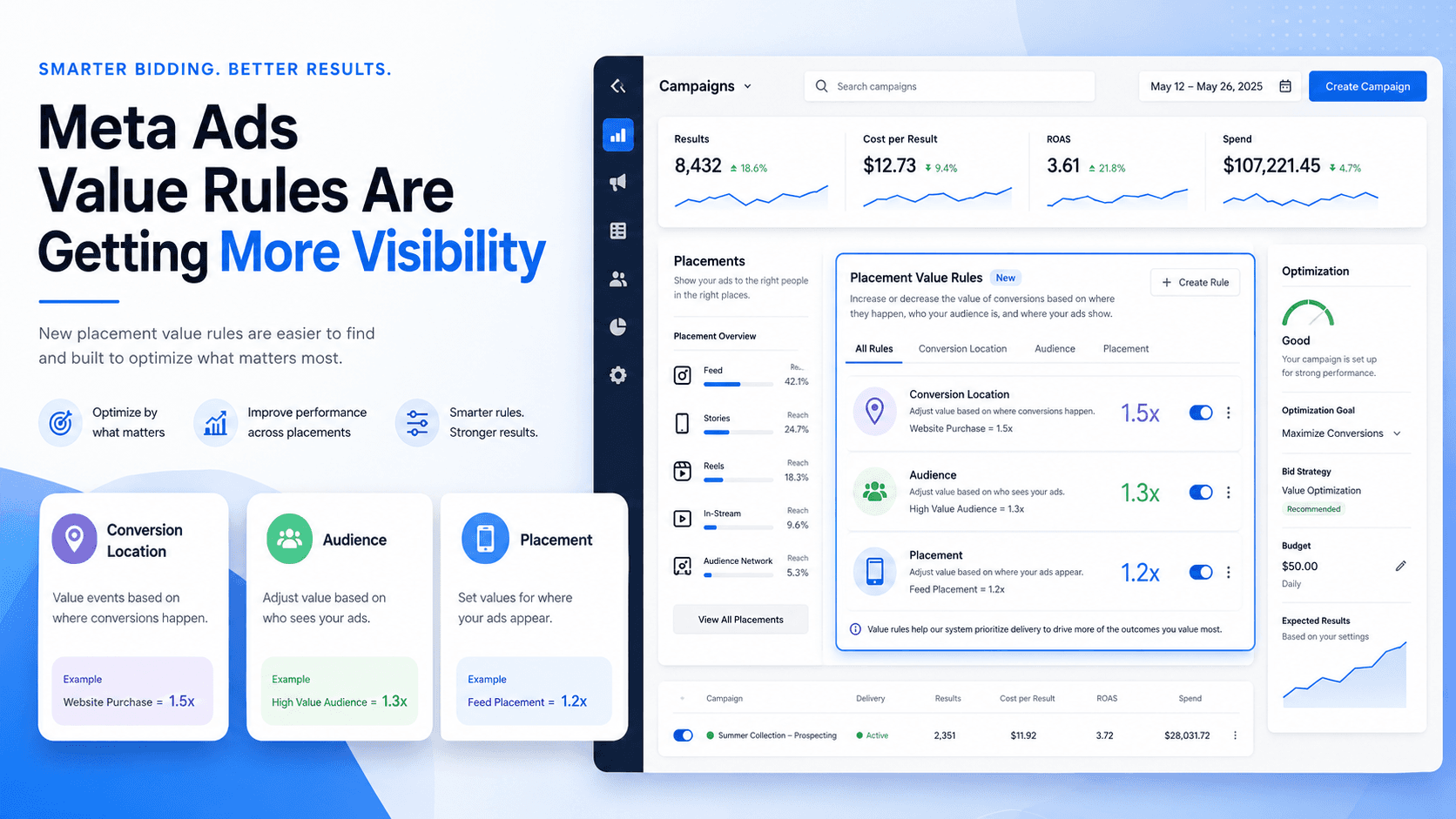
If you have ever run a Meta Ads campaign that racked up leads or sales and then realized most of them were duds, welcome to the club. It is the familiar trade: the algorithm delivers volume, not value. You end up with leads who never pick up the phone, or customers who buy the cheapest item once and vanish. That is what happens when you optimize for raw conversion count and hope quality shows up on its own.
What if you could steer the system, just a bit? A way to tell it, “Sure, conversions are good, but these conversions are the ones that matter.” That is what Meta Ads value rules are for. They let advertisers add extra signals to Meta’s ad delivery system so bidding leans toward users who are likely to be more valuable to the business, shifting the goal from sheer quantity to higher-quality outcomes.
What Are Meta Ads Value Rules, Really?
Handing Meta a budget and a “leads” objective is like telling a personal shopper, “Here’s $500, buy me an outfit.” You will get an outfit. It just might be the wrong cut, the wrong fabric, and the kind of thing you never actually wear.
Value rules are the version where you add constraints and preferences: “Here’s $500. I’ll pay extra for sustainably made denim, and I’m not wearing polyester.” Now you are not only setting the budget; you are defining what “better” means. The shopper can make smarter tradeoffs, spending more where it counts because you have told them what counts.
In Meta Ads, value rules do the same thing. You tell Meta’s algorithm to adjust its bid for specific audience segments. That can mean bidding up for a certain age range, location, or device type. It does not block everyone else; it just signals that Meta should push harder, and bid higher, when it sees someone you consider a VIP. You can raise bids by up to 1,000% or cut them by as much as 90% for defined segments.
How It Works: The Nuts and Bolts
Value rules are not a new campaign type; they are conditions you attach to campaigns you are already running. The feature started out limited to Sales and App Promotion objectives, but it has expanded to all campaign types, including Leads and Engagement. For B2B and service businesses that live or die on lead quality, that expansion changes what is possible.
The point is to encode what you know that Meta cannot infer on its own. The system is sophisticated, but it does not know that customers in California are worth 50% more over their lifetime for your business, or that leads from Instant Forms convert at a lower rate than leads from your site. That context sits in your CRM and internal reporting, not in Meta’s auction.
Value rules are how you hand that context to the machine. You can build rules around:
- Location: Prioritize users from specific countries, regions, or cities.
- Demographics: Adjust bids based on age and gender.
- Device: Differentiate between mobile operating systems (iOS vs. Android) or device types.
- Placements: Bid more or less for users on Facebook Feed vs. Instagram Stories vs. Audience Network.
One detail people miss: when you have multiple rules, order is everything. Meta applies only the first rule a user matches in your list. So if rule one is “Increase bid by 20% for women in California” and rule two is “Increase bid by 50% for iOS users,” a woman in California on an iPhone only triggers the first rule. Treat it like a priority stack, and build it deliberately.
Real-World Examples (and When to Use Them)
All of this sounds tidy in a product doc. The real test is whether it fixes the problems advertisers actually have to explain on Monday morning.
| Scenario | Problem | Value Rule Solution |
|---|---|---|
| E-commerce Brand | Sales volume looks healthy, but Average Order Value (AOV) is weak because the algorithm keeps finding cheap, single-item purchases. | Start with your sales data. If customers aged 30–45 reliably produce higher AOV, create a rule that increases bids for that demographic. That nudges Meta toward users more likely to place bigger orders. |
| Lead Generation Campaign | Cost per lead is great, but the sales team is drowning in junk: 80% of leads come from a region that never converts, or from age groups that do not fit your service. | Create a rule that decreases bids for the region or demographic that underperforms. That keeps budget from flowing to cheap-but-useless leads. It is also a strong move if you are struggling with optimizing Meta Instant Forms. |
| App Installs | Installs are coming in, but your analytics show iOS users purchase far more often in-app. | Increase bids for iOS users with a value rule. You may pay more per install, but return on ad spend (ROAS) can improve if lifetime value is materially higher. |
| Practical applications of Meta Ads value rules for common advertising challenges. |
The Common Misconceptions That Cost You Money
Like any lever that touches bidding, value rules can backfire when they are treated as a magic switch. The mistakes tend to be predictable, and expensive.
- Misconception 1: "More rules are better." No. The most common failure mode is complexity for its own sake. Ten rules for tiny slices of your audience creates a mess of overlapping priorities, and you will not have enough volume to tell what is helping. Start with one, maybe two, rules grounded in your strongest signal.
- Misconception 2: "I should base this on my gut feeling." Don’t. Value rules only work when they reflect reality in your data. If you assume men 25–34 are your best customers but your CRM says it is women 45–54, you are paying Meta to chase the wrong people. This depends on clean measurement from your Meta Pixel and Conversions API.
- Misconception 3: "This will lower my costs." It might not, and Meta says your cost per result may increase. That is not automatically bad. The win condition is higher ROAS or higher business value, not a prettier CPA. Paying 20% more for a lead is fine if that lead is three times more likely to become a high-value customer. Vanity metrics do not pay the bills.
So, Should You Use Them?
Value rules are not a great place to start if your fundamentals are shaky. If conversion tracking is unreliable, or you are not generating enough conversion volume (Meta suggests at least 50 conversions per week), hold off. Adding rules without data is like building on sand: you can do it, but you will not like what happens next.
If you do have solid tracking and a clear mismatch between what Meta is optimizing for and what actually drives your business, value rules are a direct fix. They let you combine Meta’s automation with your own business intelligence instead of pretending the platform can see inside your CRM. If you are already setting up the Conversions API, value rules are a sensible next step.
More than anything, value rules are a small but meaningful shift away from “trust the black box” as the only option. They give advertisers a way to express what the balance sheet already makes obvious: not every conversion is created equal. If you want more context on where Meta is taking automation next, see our post on Meta Ads AI Connectors.
Frequently Asked Questions About Meta Ads Value Rules
What’s the difference between Value Rules and Value-Based Bidding?
Value-based bidding (optimizing for “Value”) asks Meta to find users who are likely to generate the most revenue, based on purchase values you send through your Pixel. Value Rules are a manual layer on top: you tell Meta that certain demographics are worth more (or less), regardless of the value of any single transaction. You can run both at the same time.
How many value rules can I create?
You can create multiple rule sets, and each set can include up to 10 individual rules. Still, it is usually smarter to begin with one or two rules so you can measure impact cleanly.
Will using value rules reset my campaign’s learning phase?
No. Adding or removing a rule set on an active campaign does not reset the learning phase, which makes testing far less disruptive.
How do I tell if my value rules are working?
In Ads Manager, open the “Breakdown” menu and choose “By Value Rule.” You will see performance for traffic that matched your rules versus traffic that did not, which makes it easier to judge whether the bid adjustments are paying off.
Can I use value rules for a lead generation campaign?
Yes. Value rules started with sales, but they now work across all campaign objectives, including leads. That matters when lead volume is easy to buy but lead quality is what actually moves revenue.
