
Microsoft's "Prepare for the Age of AI Shopping" playbook deserves attention from any online seller. It is a 90-day operating plan for preparing catalogs, storefronts, and measurement stacks for shopping agents that discover, evaluate, and buy products for consumers. Microsoft Advertising (2026) organizes the work around three pillars: discovery through AI-ready product feeds, selection through AI-native ads and Brand Agents, and measurement through AI visibility in Microsoft Clarity.
There is a catch: the roadmap comes from a platform vendor selling its own ecosystem. Merchants still have to weigh Google's protocols, Meta's agent tools, and a crowded feed-management market. This version separates the portable work from Microsoft's product agenda, puts it into a practical 30/60/90-day sequence, and identifies where to spend now versus wait. Ecommerce marketing managers, DTC growth leads, and feed owners can use it to prioritize holiday-season work.
What Agentic Commerce Actually Means for Your Business
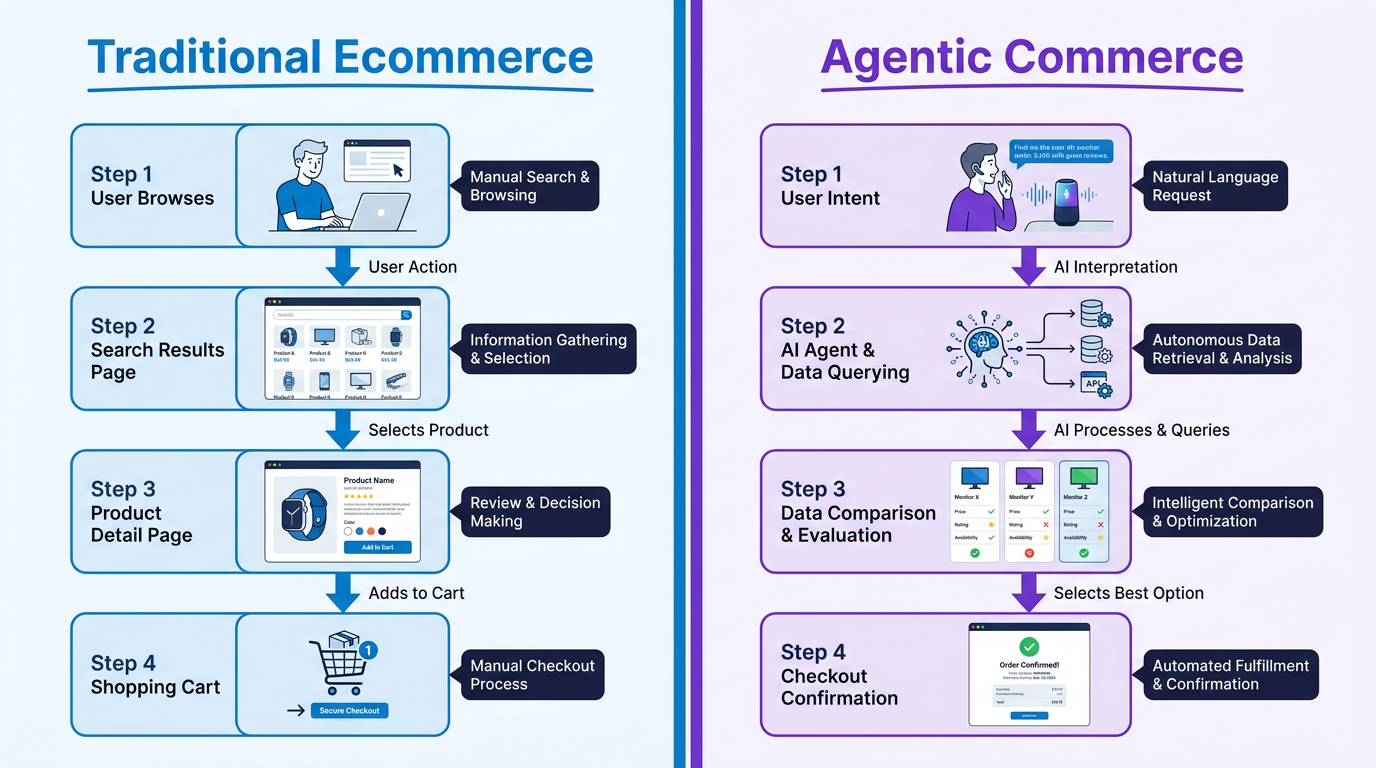
Strip away the terminology: agentic commerce is a transaction model in which an AI assistant researches products, compares options, and completes a purchase for a user. Someone might ask for "a lightweight rain jacket under $150 that ships by Friday," then leave discovery and checkout to the agent. IBM Research (2026) describes the shift as AI-driven execution: the agent negotiates, validates, and transacts without the user visiting a product page.
The timing is not hypothetical. The 2026 Ryder E-commerce Consumer Study found that 64% of U.S. online shoppers already use AI-assisted tools while shopping; 45% of those users rely on search and shopping assistants. Adobe Analytics reported AI-driven ecommerce traffic rose 693% during the 2025 holiday season versus the year before. Agentic commerce remains a small share of retail, but its growth rate is sharp. Microsoft is betting Copilot becomes a primary shopping interface by late 2026, and the roadmap signals that schedule.
Merchants are no longer optimizing only for a person scanning search results. They are also supplying an algorithm that reads structured data, weighs trust signals, and decides whether to recommend a product. That makes how AI agents discover resources a practical concern, not an academic one.
Phase 1 (Days 1 to 30): Build Your AI-Ready Foundation
The first month is data hygiene and format compliance. It is not glamorous work, but every later step depends on it. Microsoft's 90-day roadmap starts here for a simple reason: an agent cannot choose a product it cannot parse.
Adopt the Microsoft Merchant Center UCP Feed
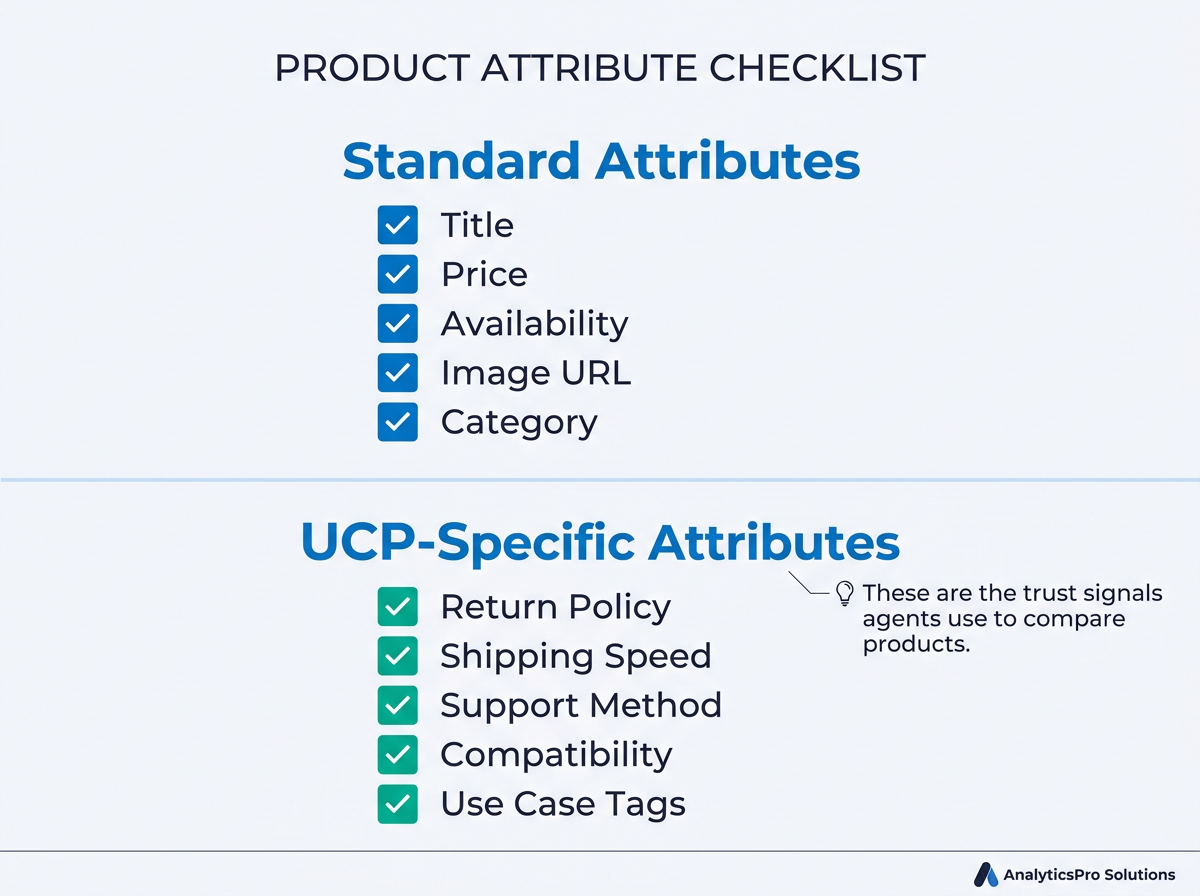
Microsoft's Universal Commerce Protocol (UCP) is an open standard for product data that AI agents can read and assess. A Microsoft Merchant Center UCP feed needs the usual title, price, availability, and image URL, plus return policies, support contacts, and shipping windows. Microsoft Advertising (2026) says those fields provide the confidence to transact without human verification. A Google Shopping feed is a useful base, though UCP asks for attributes many conventional feeds leave out.
Priority actions for Days 1 to 30:
- Audit the existing feed against the UCP attributes in Microsoft Merchant Center documentation.
- Correct price mismatches, stale availability, and poor primary images before adding detail.
- Add return policy and shipping-speed attributes to every SKU; agents use them to compare similar products.
- Map internal taxonomy to Microsoft's categories. Misclassification puts products in the wrong queries.
- Automate daily feed refreshes so agents see current inventory.
Warning: Teams already optimizing product feeds for Google should not assume the feed carries over cleanly to UCP. Teams already optimizing product feeds for traditional shopping surfaces should not assume the same setup is automatically sufficient for agentic commerce. Microsoft adds UCP-readiness requirements around areas such as return policies, customer support, checkout eligibility, product warnings, and other transaction-related information that agents may need before recommending or completing a purchase.
Phase 2 (Days 31 to 60): Enrich Feeds for Agent Selection
Once the feed is clean, the work becomes more strategic. Agents do not browse; they query, often with filters product descriptions were never built to answer: "breathable fabric for humid climates, machine washable, under 200 grams." Missing attributes make a product absent from that query, regardless of product quality.
Treat the feed as a structured knowledge base rather than a marketing asset. An agent comparing ten products needs answers before it can recommend one. Put those answers in the data: materials, constraints, use cases, fit, care, and compatibility.
| Attribute Category | Traditional Feed Example | Agentic Feed Example |
|---|---|---|
| Description | Red T-Shirt | Crewneck t-shirt in vibrant crimson, 100% pre-shrunk Pima cotton, 160 GSM weight. Athletic fit, slightly tapered at the waist. |
| Sizing | S, M, L, XL | True-to-size. Size M fits chest 38-40 in, length 28 in. Size up if between sizes. |
| Use Case | (not included) | Ideal for casual wear, layering, or gym workouts. Performs well in temperatures 60-85°F. |
| Material Detail | Cotton | 100% Pima cotton, pre-shrunk, OEKO-TEX certified, 160 GSM jersey knit. |
| Compatibility | (not included) | Pairs with the brand's Performance Jogger (SKU: PJ-2024) and Zip Hoodie (SKU: ZH-2024). |
| Care Instructions | (not included) | Machine wash cold, tumble dry low. No bleach. Retains shape after 50+ washes. |
| Agentic feeds need the specificity a knowledgeable in-store sales associate would provide. |
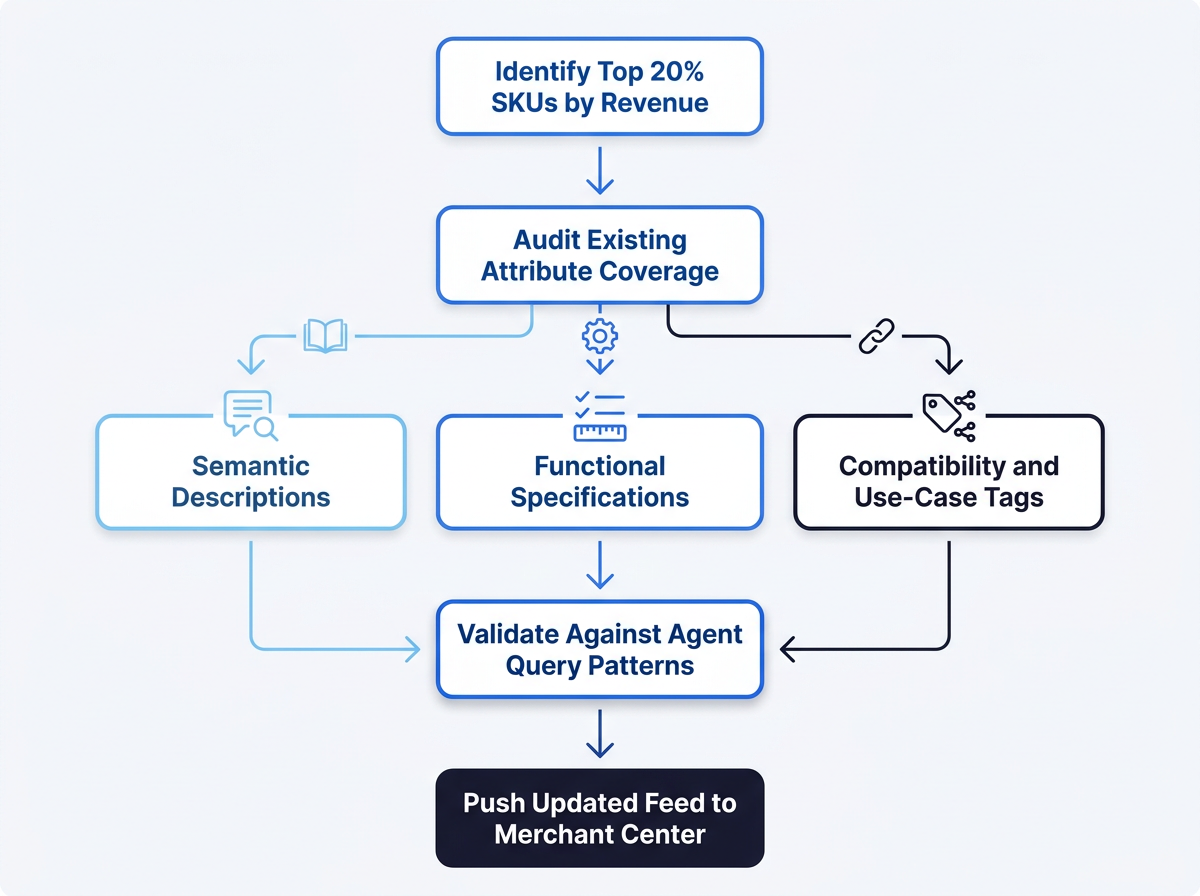
Begin with the 20% of products that generate the most revenue. Most teams cannot enrich every SKU at once. Add detailed materials, exact dimensions, explicit use-case tags, style descriptors, and cross-product compatibility to the high-volume catalog first, then extend the standard in the next cycle.
Phase 3 (Days 61 to 90): Activate Visibility, Measurement, and Checkout
With clean feeds and richer attributes in place, determine whether agents find and select those products. Then enable the transaction layer that lets an agent close the sale.
Copilot Checkout and Agent Readiness
Copilot Checkout enables direct, in-chat purchases. If Copilot recommends a product, the user can transact without leaving the conversation. Microsoft is building toward that endpoint, and fewer steps should improve conversion after selection. Review enrollment requirements now, even while availability remains limited. Ecommerce agent readiness covers more than feeds; it includes the full transaction loop.
Measuring AI Visibility with Microsoft Clarity
Traditional analytics describe human visits, not whether an agent cited a brand, considered a product, or chose a competitor. Microsoft Clarity now has AI visibility features for tracking how Copilot and other agents interact with content. Set up AI visibility in Microsoft Clarity to establish an agentic-performance measurement layer. Monitor product and brand citations, then identify attributes associated with selection.
For another view of Clarity's newer capabilities, topic-level insights show how AI systems categorize and surface content.
Beyond the Feed: Brand Agents and Native Ads in Copilot
Microsoft's roadmap extends beyond feeds and checkout to two emerging products: Brand Agents and Bing Copilot native ads.
Brand Agents are AI shopping assistants merchants deploy on their own sites. Microsoft Advertising (2026) says they are built within Clarity and guide customers from discovery through purchase in a conversational format. They function as branded catalog assistants that Copilot can consult for category questions. Rather than relying on Copilot to interpret a site, the merchant supplies a structured, authoritative product source.
Bing Copilot native ads are the paid layer: contextual product placements inside AI conversations rather than conventional search ads. They appear while an agent evaluates options, which makes the context high-intent. Paid-search teams should monitor the channel, but enriched feeds and structured data come first. Ads amplify established organic discovery. Making your website AI-agent friendly supports both paid and organic agent interactions.
What Most Merchants Will Get Wrong
Three mistakes recur in the playbook's holiday-shopping readiness window, and each has a direct cost.
Treating this as just another feed spec. "Update the feed and move on" misses the larger change. Traditional feeds serve human visual scanning with catchy titles and lifestyle images. Agentic feeds serve machine comprehension through complete semantics, structured attributes, and trust signals. The feed owner needs to work more like a database architect than a copywriter.
Waiting for perfect measurement before acting. Tools for observing agent behavior are early and incomplete. Teams that wait for penny-level ROI will trail competitors that apply the roadmap's principles and refine as measurement improves. Trusted data can build an early advantage as agents learn from it.
Ignoring unstructured content. Blogs, buying guides, and reviews give agents context for validating feed data. A feed can say "waterproof to 10,000mm"; a rainstorm test that confirms it provides another data point. Keep site content clear, authoritative, and crawlable. What an SEO agent is helps explain why unstructured content remains relevant in an agent-first market.
Your Agentic Commerce Checklist: 30/60/90 Summary
Phase 1 (Days 1 to 30): Foundation
- Audit current feed against UCP attribute requirements.
- Fix pricing, availability, and image quality issues across all SKUs.
- Add return policy, shipping speed, and support method attributes.
- Map product taxonomy to Microsoft's category structure.
- Set up daily automated feed refresh to Microsoft Merchant Center.
Phase 2 (Days 31 to 60): Enrichment
- Identify top 20% of SKUs by revenue for priority enrichment.
- Add semantic descriptions, precise dimensions, material specifications, and use-case tags.
- Include cross-product compatibility and style attributes.
- Test feed data against sample agent-style queries to validate coverage.
- Document enrichment standards so the process scales to remaining SKUs.
Phase 3 (Days 61 to 90): Activation
- Investigate and apply for the Copilot Checkout merchant program.
- Implement Microsoft Clarity with AI visibility tracking enabled.
- Begin monitoring brand and product citation rates from AI agents.
- Evaluate Brand Agents as a direct-to-agent communication channel.
- Review Bing Copilot native ads as a paid amplification layer for top products.
Frequently Asked Questions
How does a standard Google Shopping feed differ from an AI-ready product feed?
A standard Google Shopping feed carries the minimum listing fields: title, price, image, availability, and category. An AI-ready feed adds semantic descriptions, material specifications, use cases, compatibility, returns, and shipping speed. Those fields give agents grounds to recommend and transact without asking a person to verify a product page. An AI-ready setup extends conventional product data with richer product attributes, policies, support information, and transaction-readiness signals that help AI systems interpret and act on the catalog.
Should I stop using Google's Product Details Page protocol after adopting Microsoft's UCP?
No. The protocols serve different ecosystems and are not mutually exclusive. Maintain both. UCP enrichment - trust signals, detailed attributes, and policy data - also improves the Google feed. Build one richer product-data layer and distribute it through multiple channels.
How much ecommerce revenue will agentic commerce generate over the next 1 to 2 years?
Exact forecasts differ, but the direction is clear. Adobe Analytics recorded a 693% rise in AI-driven ecommerce traffic in the 2025 holiday season, while Ryder's 2026 study found 64% of U.S. online shoppers using AI-assisted tools. Agentic commerce is still a single-digit share of retail, yet it is likely to become a meaningful revenue channel within 12 to 18 months, especially in peak shopping periods.
Is agentic commerce simply conversational commerce or chatbots under a new name?
No. Conversational commerce keeps a human in the decision loop while a chatbot helps with recommendations or checkout. Agentic commerce delegates research, comparison, and transactions to the AI based on user criteria. The buyer may not see a product page, chat interface, or options list. Wikipedia's 2026 definition distinguishes agentic commerce by the AI's ability to execute purchases for users.
Can smaller DTC brands compete in this new agentic market?
Yes. Agents assess structured-data quality, not only brand recognition or ad budgets. A DTC brand with an enriched feed, explicit return policies, and strong review signals can outrank a larger competitor with sparse, inconsistent attributes. Competition shifts toward complete data and credible trust signals. Brands that invest early in product feed optimization for AI agents can gain ground as agents learn to trust their information.
