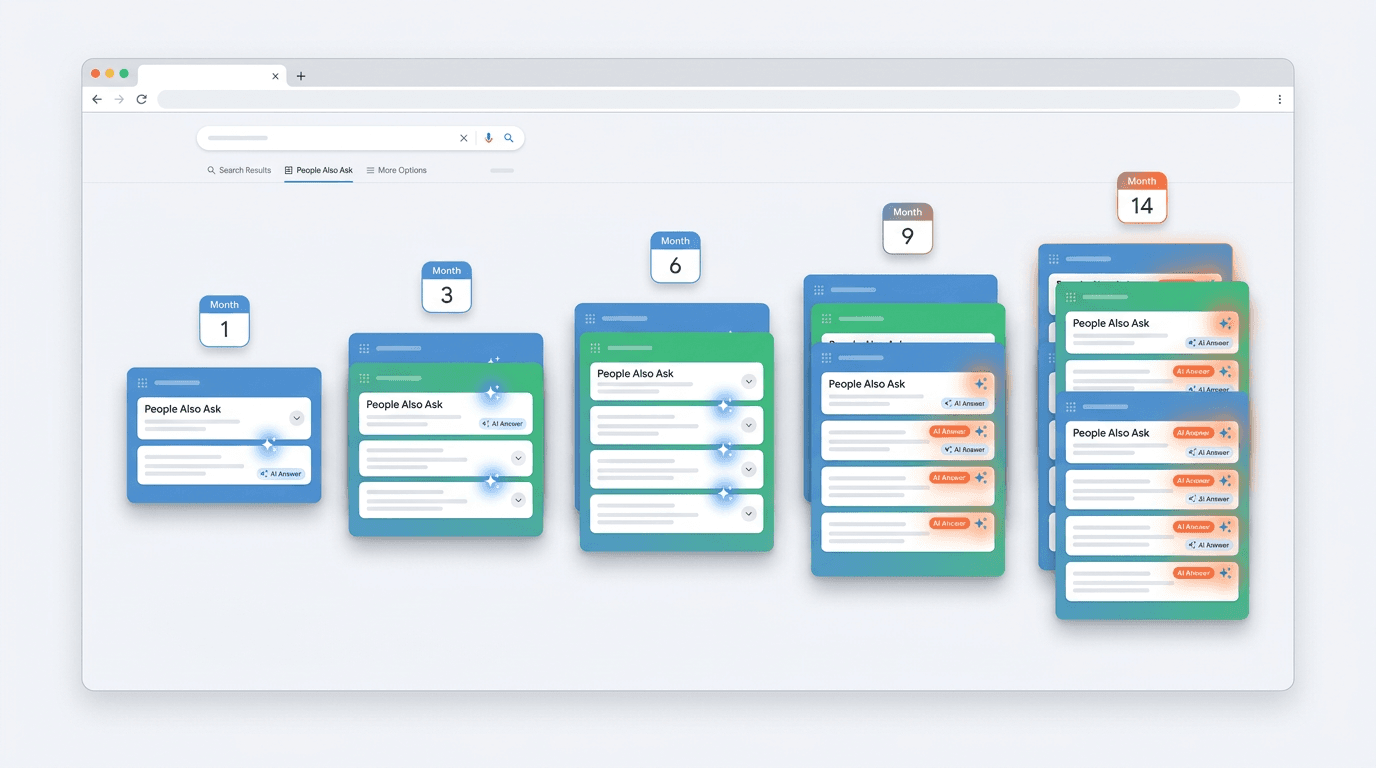
AI-generated answers now run most People Also Ask boxes in Google's results. During the first week of September 2026, 97% of PAA answers in AlsoAsked's sampled English-language dataset were AI-generated, according to an analysis of 19.2 million queries by AlsoAsked. Fourteen months earlier, the figure was roughly 12%. PAA has shifted from a SERP feature that could send visitors to a publisher into a largely self-contained answer box. That changes the economics for any content programme built around question-shaped searches.
A PAA placement once offered a dependable, if modest, stream of clicks. That click opportunity has become substantially less dependable. This is more than a tweak to one Google feature: it removes a meaningful route into informational content. SEO strategists, content marketing leads, and publisher SEO managers now need to treat question-led traffic as exposed, rather than assumed.
The Data Story: Charting the AI Takeover of PAA
The pace is the point. About 12% of People Also Ask answers were AI-generated in July 2025. By August 2026, the share had reached 86%; in the first week of September, it was 97%. AlsoAsked's tracking across 19.2 million queries captured the jump.
Google did not throw one switch. It expanded AI Overview placements within PAA boxes in stages and across query categories. Informational searches took the earliest and heaviest hit, before the pattern spread to almost every type of question. Semrush found in December 2025 that PAA boxes and AI Overviews co-occurred 90.03% of the time. For practical purposes, they now travel together.
Warning: The timetable matters. Most content teams work from editorial calendars spanning six to 12 months. PAA changed more quickly than one normal planning cycle.
What Changed? From Publisher Snippets to AI Synthesis
The mechanics matter before a strategy can change. PAA still resembles the feature users saw two years ago: expandable questions tucked into the results page. Open one, though, and the content model is entirely different.
The Old PAA: A Click-Through Opportunity
Before mid-2025, PAA usually displayed a direct excerpt from a publisher page. The answer came with a visible source link, page title, and favicon. Users could expand the excerpt, then follow that link to the site. PAA therefore functioned as a real traffic source. Winning placement was central to question-based content strategies; its click-through rate trailed a number-one organic result, but mattered at scale because PAA appeared on most informational searches.
The New PAA: A Zero-Click Answer Box
PAA answers are now synthesized by Google's generative models. Rather than lift one publisher's passage, the system folds information from several sources into a smooth paragraph. Any sources are often tucked behind a small citation icon instead of presented as an obvious destination. The likely user journey is simple: expand, read, leave. Pew Research Center found that users clicked a source link within a Google AI summary in just 1% of visits in its March 2025 U.S. browsing study. That research did not measure PAA clicks specifically, but it illustrates the broader click challenge created by self-contained AI answers.
| Characteristic | The Old PAA (Publisher-Sourced Snippets) | The New PAA (AI-Generated Answers) |
|---|---|---|
| Answer source | Excerpt from a single publisher page | AI-synthesized response drawing on multiple sources |
| Link visibility | Visible link, favicon, and page title | Collapsed citation icon; often no prominent link |
| Click-through rate | Moderate, but meaningful at scale | Direct PAA CTR not established here; Pew found a 1% source-click rate for Google AI summaries |
| User behaviour | Expand, scan, then visit the source | Expand, read, close (zero-click PAA) |
| Content strategy value | High: placement sent traffic | Low for clicks; potentially high for brand citation |
| Query coverage | ~12% AI-generated (July 2025) | ~97% AI-generated (September 2026) |
| The functional shift in PAA boxes over fourteen months. |
Why This Matters More Than the Featured Snippet Decline
SEOs have been discussing the featured snippet decline since 2024, and many have already adjusted for less snippet traffic. PAA is a bigger issue for three reasons.
Start with volume. A featured snippet appears once, at position zero. PAA offers several questions - usually four at first, then more as users interact - and occurs on a much larger share of queries. Across that footprint, lost clicks from AI-written PAA answers exceed the effect of a single featured snippet changing shape.
Then there is placement. PAA commonly sits between organic positions three and ten, where mid-ranking pages earn a substantial share of their visits. A complete AI response removes much of the reason to continue scrolling or click an organic listing. The effect reaches through the middle of the SERP, not merely the top.
Reporting makes the change easy to miss. Google Search Console impressions can remain flat, or rise, even as clicks drop, because a page can technically appear in results a searcher never reaches. Stable impressions alongside falling CTR on question-targeted pages often point to the PAA AI shift rather than a ranking loss or an algorithm update. Vizup's monitoring agents are designed to expose that gap, separating inflated impression signals from actual visibility.
How Your Content Strategy Should Adapt for PAA Optimization in 2026
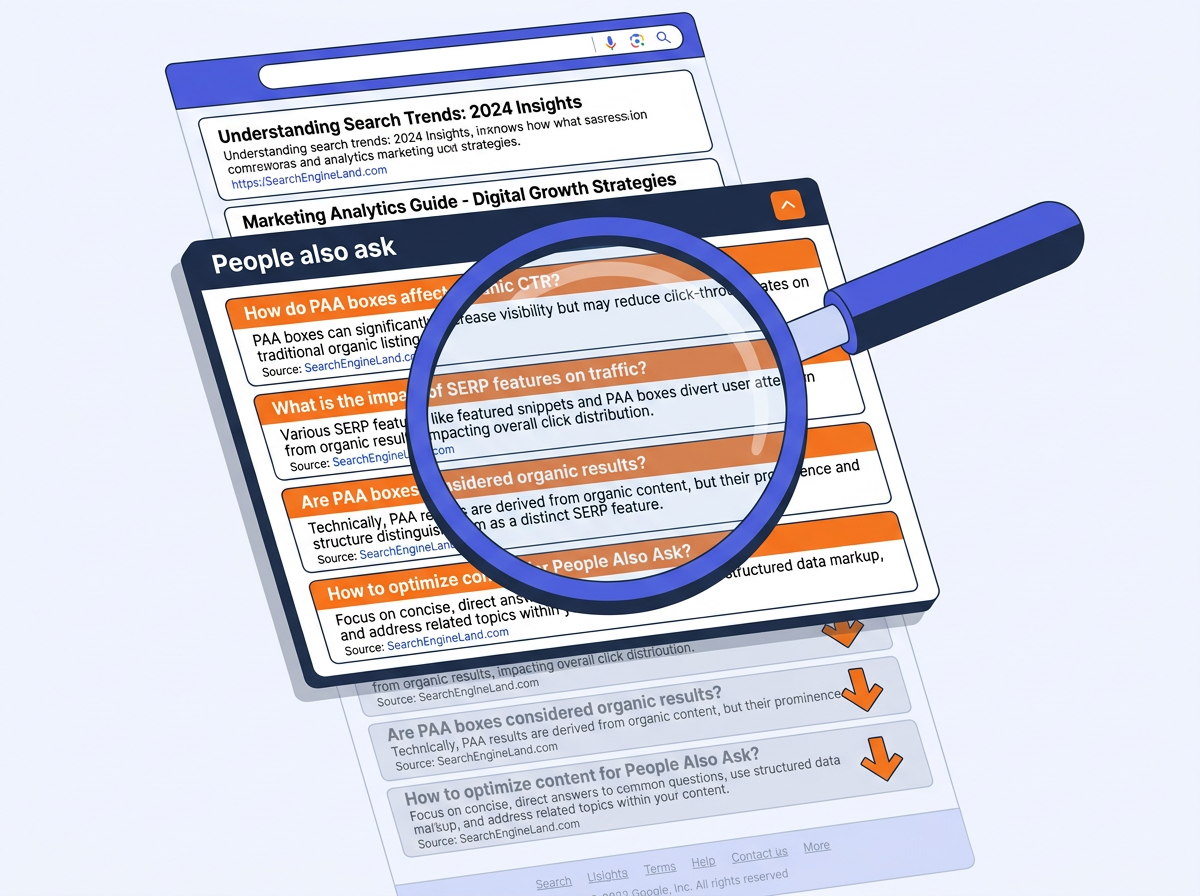
Writing off question-targeted content altogether would be an overcorrection. Questions still reveal real intent, and Google's AI still requires material to synthesize. The work is to choose better questions, redefine what a win looks like, and move effort away from bare-bones FAQ optimization.
Rethink Your Answer Engine Optimization Questions
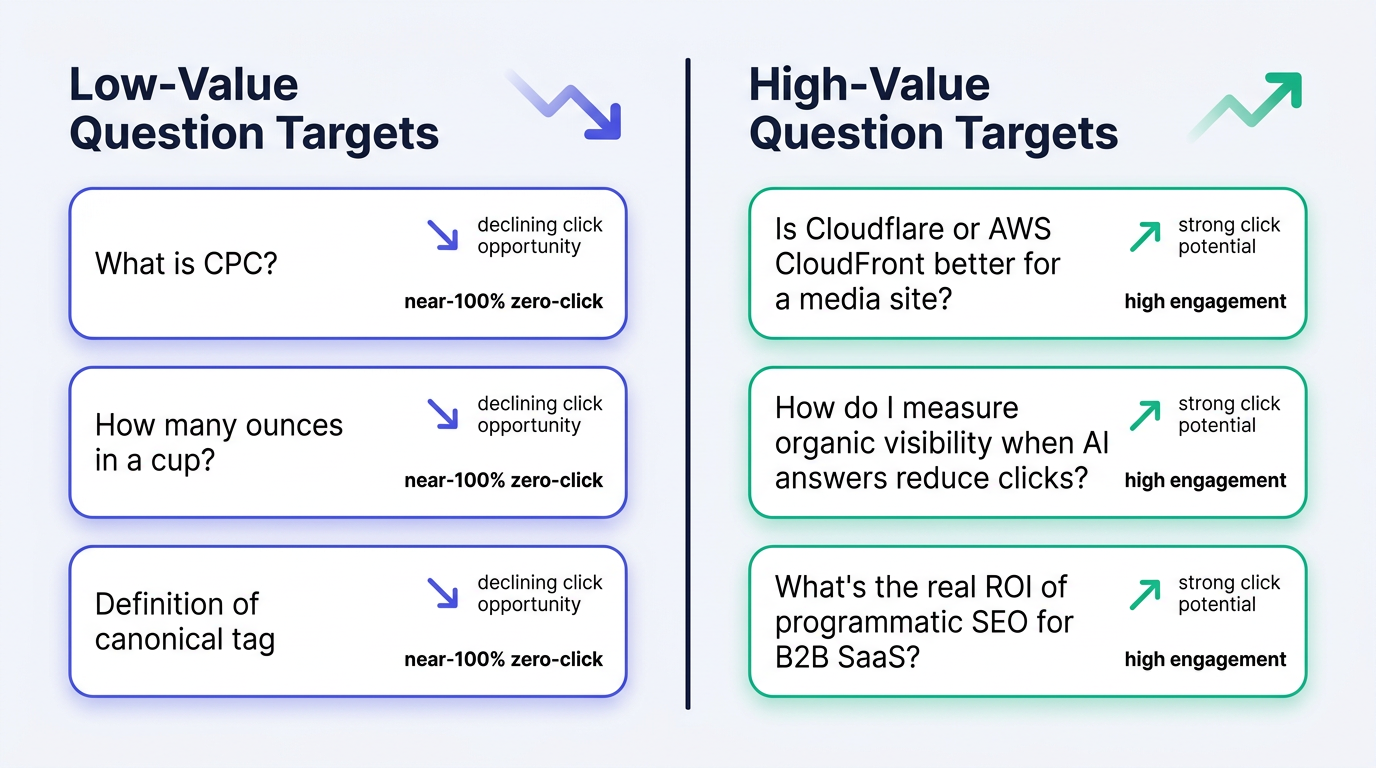
Simple factual searches - "What is CPC?" or "How many ounces in a cup?" - are easy for AI to answer completely and with confidence. Zero-click rates on those queries approach 100%. Further investment in pages built to answer them is hard to justify.
Put answer engine optimization effort into questions with friction: comparisons such as "Is Cloudflare or AWS CloudFront better for a media site?"; conditional, multi-step work such as "How do I measure organic visibility when AI answers reduce clicks?"; and queries demanding data or judgment, including "What's the real ROI of programmatic SEO for B2B SaaS?".
Vizup can help teams identify question clusters where visibility, citations, and click opportunity still justify investment, then connect those insights to content creation and optimization workflows.
Prioritize Being a Citable Source, Not an Answer Snippet
The strategic distinction is now between supplying the answer and being named as its source. Google's AI search features surface supporting web sources when generating responses. Original research, unique datasets, proprietary benchmarks, and clearly attributed expert quotes give a page more to cite. PAA optimization 2026 is less about phrasing an H2 as a question than publishing material Google's systems consider worth referencing.
Practical steps to become a citable source:
- Publish original research with dates, methodology, and specific numbers. Citable facts travel further than generic advice.
- Make claims easy to parse. Named entities, precise figures, and explicit attribution give AI systems cleaner material to extract and cite.
- Build topical authority across interlinked pages rather than a scatter of isolated posts. Learn more about AI search visibility in Google's agentic search era.
- Use clear bylines and author credentials, particularly on sensitive or complex subjects where readers benefit from knowing who created the content.
Double Down on Commercial and Navigational Intent
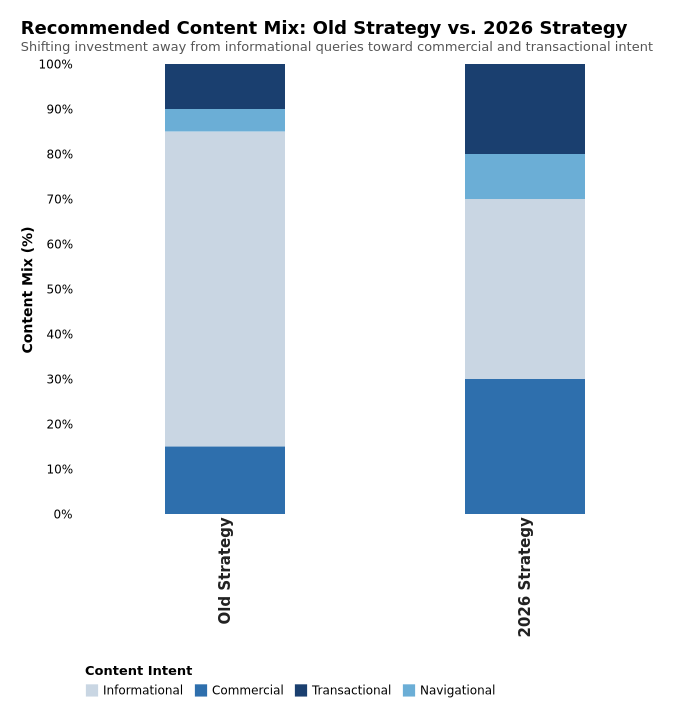
Pure informational traffic is most exposed to AI cannibalization. Content programmes weighted heavily toward top-of-funnel questions need a different mix. Commercial searches - comparisons, reviews, "best X for Y" - as well as transactional searches for pricing, signups, or demos, and navigational branded searches are tougher for AI to satisfy. The searcher is evaluating options, making a decision, or trying to reach a particular destination.
Informational content still has a role, but the mix may need adjustment. Teams heavily weighted toward informational queries can redirect more investment toward comparison pages, use-case guides, and bottom-of-funnel conversion support. Vizup's Strategist agent can identify which existing question pages still earn clicks and which People Also Ask AI Overviews have hollowed out, helping teams focus rewrites where the stakes are highest.
Vizup approaches this as part of a broader Organic Autopilot for modern discovery. It helps brands monitor, create, optimize, publish, and learn across Search, Social, Communities, AI Answer Engines, and Local Discovery using AI agents, human experts, and live SEO, pSEO, AEO, and GEO tools. Paid ads can be layered on as an amplification add-on where needed.
Common Misconceptions About the PAA AI Shift
Three claims recur in strategy meetings. Each sends teams toward the wrong response.
"PAA traffic was never significant anyway." For publishers that historically earned meaningful traffic from PAA placements, the shift can reduce another source of informational clicks. The size of that impact will vary significantly by site, query mix, ranking position, and how frequently its pages previously appeared in PAA.
"If I format my content as Q&A, I'll still win the PAA slot." Formatting worked when PAA quoted publisher excerpts. With 97% of answers now AI-synthesized, page format matters less than the originality, quality, and authority of the information underneath it. Structured data and clean headings still support crawling and indexing, but they no longer secure a PAA appearance in the old sense.
"This only affects small publishers." Major publishers with strong domain authority are seeing the same pattern. When Google generates the response, it does not preserve a direct link simply because the source is large. It pulls from sources it considers relevant, then replaces the destination with its own answer. The field is flatter, but nobody's click-through rate benefits.
Key Takeaways: Navigating the New PAA Landscape
- PAA is AI-dominated. In AlsoAsked's September 2026 sample, 97% of People Also Ask answers were AI-generated, sharply reducing publishers' direct click opportunities.
- Move from clicks to citations. The objective is no longer winning a snippet for traffic; it is becoming the authority Google cites in its answer.
- Change the question mix. Stop prioritizing simple factual questions. Complex, nuanced, and experience-based queries leave more reason to click.
- Monitor rather than merely report. Impression and click reports can mislead. Vizup tracks actual brand visibility and citations in AI answers and People Also Ask AI Overviews.
- Diversify keyword targets. Depend less on pure informational searches and invest more in commercial, transactional, and navigational intent.
Frequently Asked Questions
Can People Also Ask boxes still send clicks?
Yes, though the opening is narrow. When Google cites a source inside a PAA answer, it shows a small citation link. Pew Research Center puts clicks on AI Overview source links at roughly 1% of visits. Original data, expert analysis, and clear E-E-A-T signals improve the odds of becoming that cited source. PAA is no longer a reliable traffic channel, but authoritative sources can still receive citation-driven visits.
How can I tell whether PAA AI, rather than an algorithm update, caused a traffic drop?
Segment question-targeted pages in analytics, then compare their impression and click trends. If impressions are steady or rising while clicks fall on question-shaped pages, PAA AI is the more likely explanation than a ranking drop. Check the timing against known algorithm updates as well. A decline that tracks the rollout from late 2025 through mid-2026, rather than a specific core update, points to PAA as the main variable.
Should I remove FAQ sections from existing blog posts?
No. Useful FAQ sections can still improve readability, answer related questions, and create natural internal-linking opportunities. Keep them when they genuinely help the reader, but do not treat FAQ formatting or FAQ structured data as a reliable way to earn additional search visibility.
How does a People Also Ask AI answer differ from a full AI Overview?
An AI Overview is the larger generative summary that often sits at the top of a SERP, with multiple cited sources and expandable sections. A People Also Ask AI answer is a shorter generated response inside one PAA accordion. Both come from Google's generative models, but AI Overviews are more prominent and detailed. Semrush's December 2025 study found a 90.03% co-occurrence rate, so the two features appear together on the same SERP most of the time.
How can I track citations for my brand in AI-generated PAA answers?
For a small keyword set, manual checks can provide directional insight. At scale, Vizup's Watcher agent can monitor brand mentions, citations, and visibility across AI-driven discovery surfaces so teams do not have to rely on manual SERP checking.
