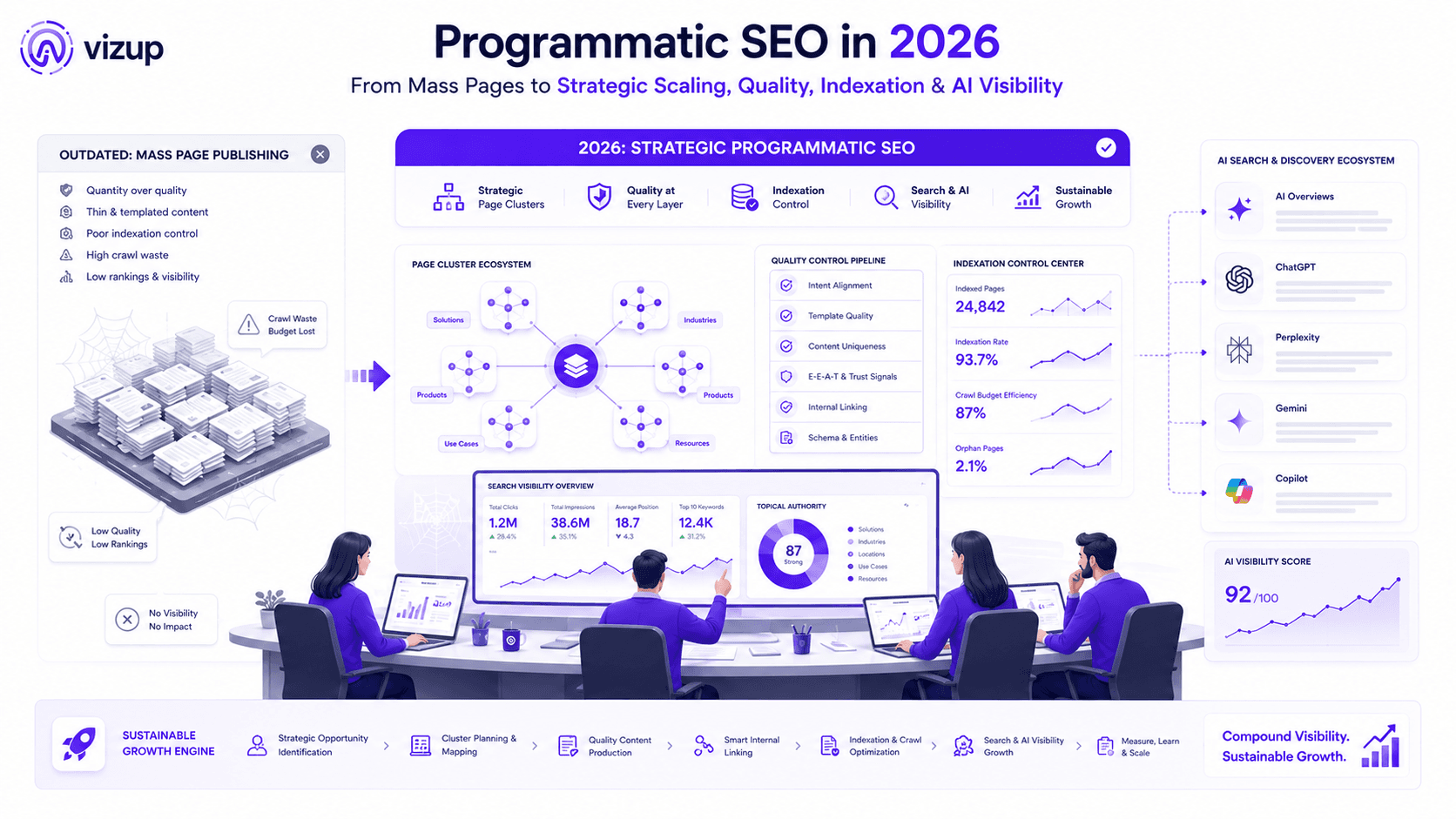
Programmatic SEO trends 2026 point to the same conclusion: the teams winning now are playing a different sport than the ones who won in 2022. The old move, crank out 50,000 pages from a city-name template and wait for Google to do the rest, is not merely stale. It is the kind of pattern Google's systems now treat as a problem to be solved. Quality classifiers have tightened up, AI Overviews soak up many of the long-tail clicks pSEO used to live on, and low-effort programmatic sites are watching indexation fall off a cliff. The shops still compounding traffic are the ones that traded content factories for actual content strategy.
This is for SEO managers, growth leads, and founders running pSEO today, or about to scale it. Most pSEO tools help you generate or publish pages. Vizup helps you decide what to create, check whether it is safe to scale, monitor whether Google indexes it, and measure whether it appears in AI search.
Table of Contents
- What Programmatic SEO Actually Means in 2026. A quick baseline for the definition and what separates quality pSEO from spam
- The 2026 Landscape: What Has Changed Since 2024. Google policy shifts, AI Overviews, and the indexation crisis
- What Still Works. Tactics that are outperforming hand-written content in specific use cases
- What Fails. The approaches Google is actively punishing
- The Indexation Crisis. Why many pSEO pages may never get indexed
- How to Scale Safely: A Controlled Growth Framework. A four-phase approach to programmatic scaling
- Programmatic SEO Tools Compared. Where Vizup, AirOps, Gushwork, Search Atlas, and TryProfound each fit
- What Most People Get Wrong. Three persistent misconceptions that kill pSEO projects
- Advanced Edge Cases. Cannibalization, international pSEO, and content freshness decay
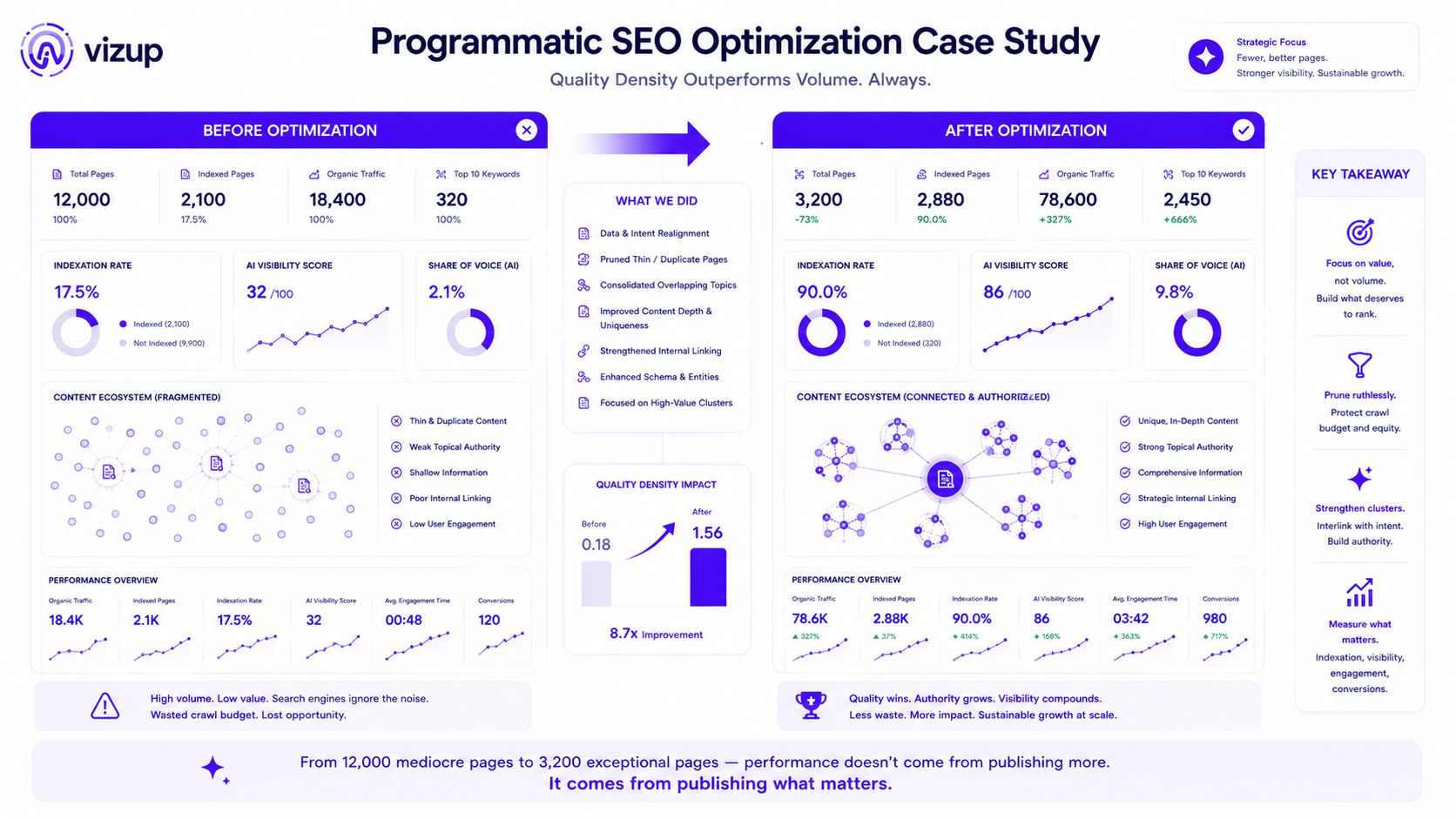
- Mini Case Study. From 12,000 pages to 3,200 pages and 4x the traffic
- FAQ. Five common questions about pSEO strategy and tools in 2026
- Key Takeaways. Your programmatic SEO checklist for 2026
What Programmatic SEO Actually Means in 2026
Programmatic SEO uses structured data, templates, and automation to publish lots of pages aimed at long-tail queries. As Ahrefs explains, the real separator between legit programmatic content and spam is usually the underlying data: how relevant it is, how complete it is, and whether it actually answers the query, not how many URLs you can generate. By 2026, the definition has widened to include AI-assisted pipelines and answer-engine targeting, which means pSEO teams have to care about visibility in ChatGPT and Google AI Overviews, not only the classic blue-link SERP.
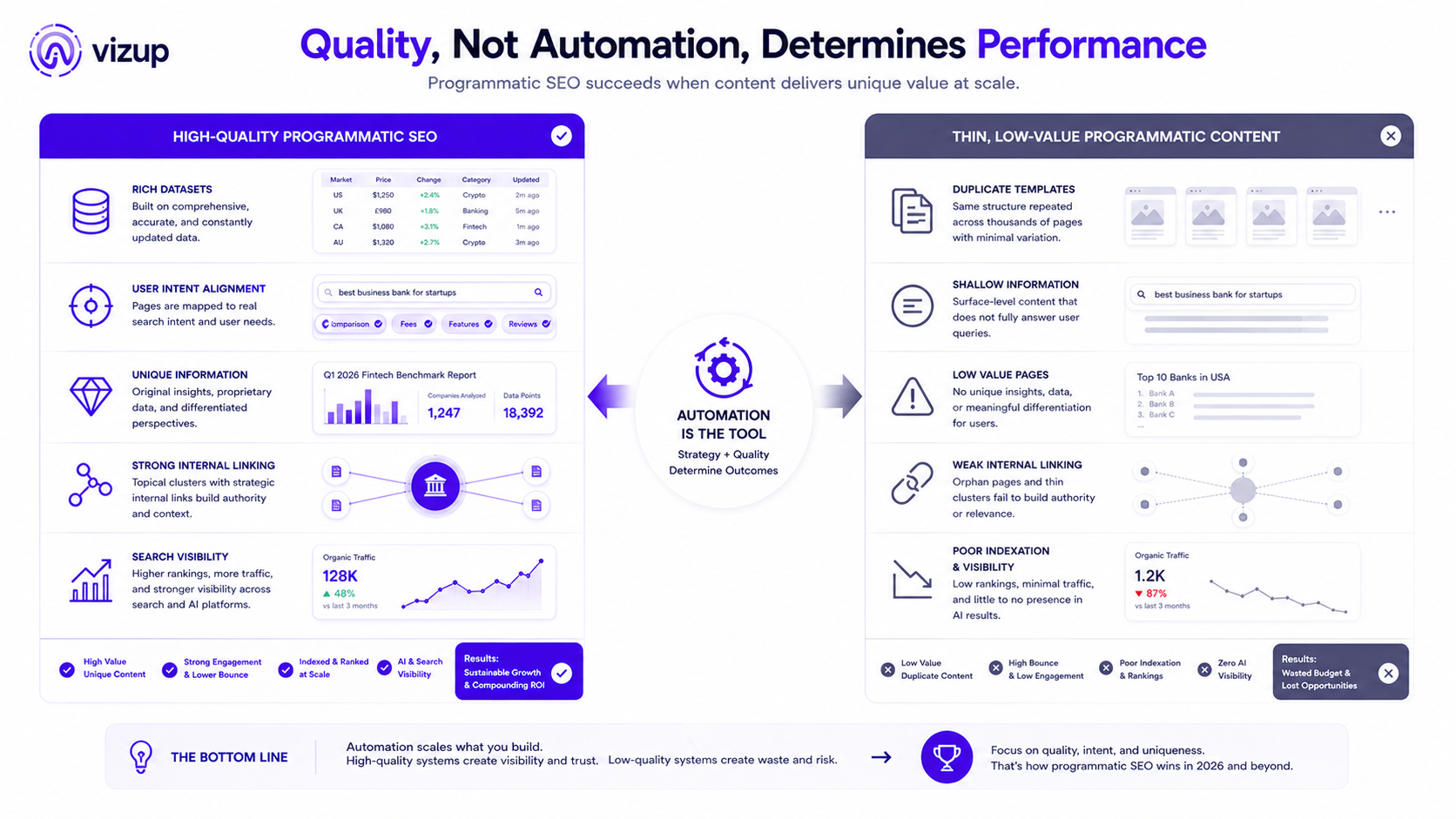
Zapier's integration pages and Nomadlist's city pages are still the cleanest examples of pSEO done well: each page is backed by a rich dataset and maps to a specific intent the rest of the site is not already satisfying. The failure mode is just as consistent: thin directory pages that swap in a city name, sprinkle in generic copy, and offer nothing you could not pull up faster in Google Maps. Automation is not the sin. Shipping pages that do not earn their footprint is.
The Programmatic SEO Trends 2026 Landscape: What Has Changed Since 2024
Since 2024, three structural changes have redrawn the pSEO map. If you miss any one of them, you are likely to ship a lot of pages that never get indexed, never get clicks, or worse, become a liability.
One: Google's site reputation abuse policy now squarely targets low-quality pSEO at scale. Recent Google's spam updates spelled out penalties for what Google labels "scaled content abuse", publishing large volumes of pages where the primary goal is ranking rather than helping users. To stay safe, some practitioners recommend establishing minimum uniqueness thresholds and drawing from multiple data sources per page. That is a much higher standard than most legacy pSEO stacks were built around.
Two: AI Overviews now eat the exact long-tail queries pSEO was designed to capture. When Google answers the question directly above organic results, click-through for positions one through five drops hard. That pushes AI visibility monitoring into the "must-have" bucket. You need to know not only where you rank, but whether your pages show up inside AI Overviews or get cited by ChatGPT and Perplexity. Averi AI (2025) expects traffic from AI tools to grow and convert better than traditional search, which turns monitoring into a revenue issue, not a reporting nicety.
Three: indexation is the constraint now. Google is indexing fewer pages in general, and big pSEO inventories take the biggest hit. The operational shift from "how many pages can we publish" to "which pages are worth publishing" is not a mindset exercise. It is how you survive in a crawl environment where Google will simply pass on URLs it does not consider valuable.
What Still Works: Programmatic SEO Tactics That Are Thriving
Data-Enriched Landing Pages with Genuine Utility
Salary pages, pricing comparisons, location-specific stats, and product spec pages are still doing well in 2026. The throughline is defensible data, proprietary, uniquely aggregated, or otherwise hard to replicate. A templated layout is fine when each instance is meaningfully different because the underlying dataset is. What is not fine is repackaging the same public info with a new heading and calling it unique.
Cluster-First Scaling with Internal Link Architecture
Scaling clusters beats scaling one-off pages. When you build a programmatic cluster with intentional internal linking, each page props up the rest and you get compounding returns on topical authority. That changes the order of operations: pick the clusters worth owning before you spend time on template design or generation. Vizup's topic discovery and cluster planning tools are aimed at that exact moment, helping teams confirm which keyword sets have enough depth and demand to justify programmatic investment.
Hybrid Human-AI Content Workflows
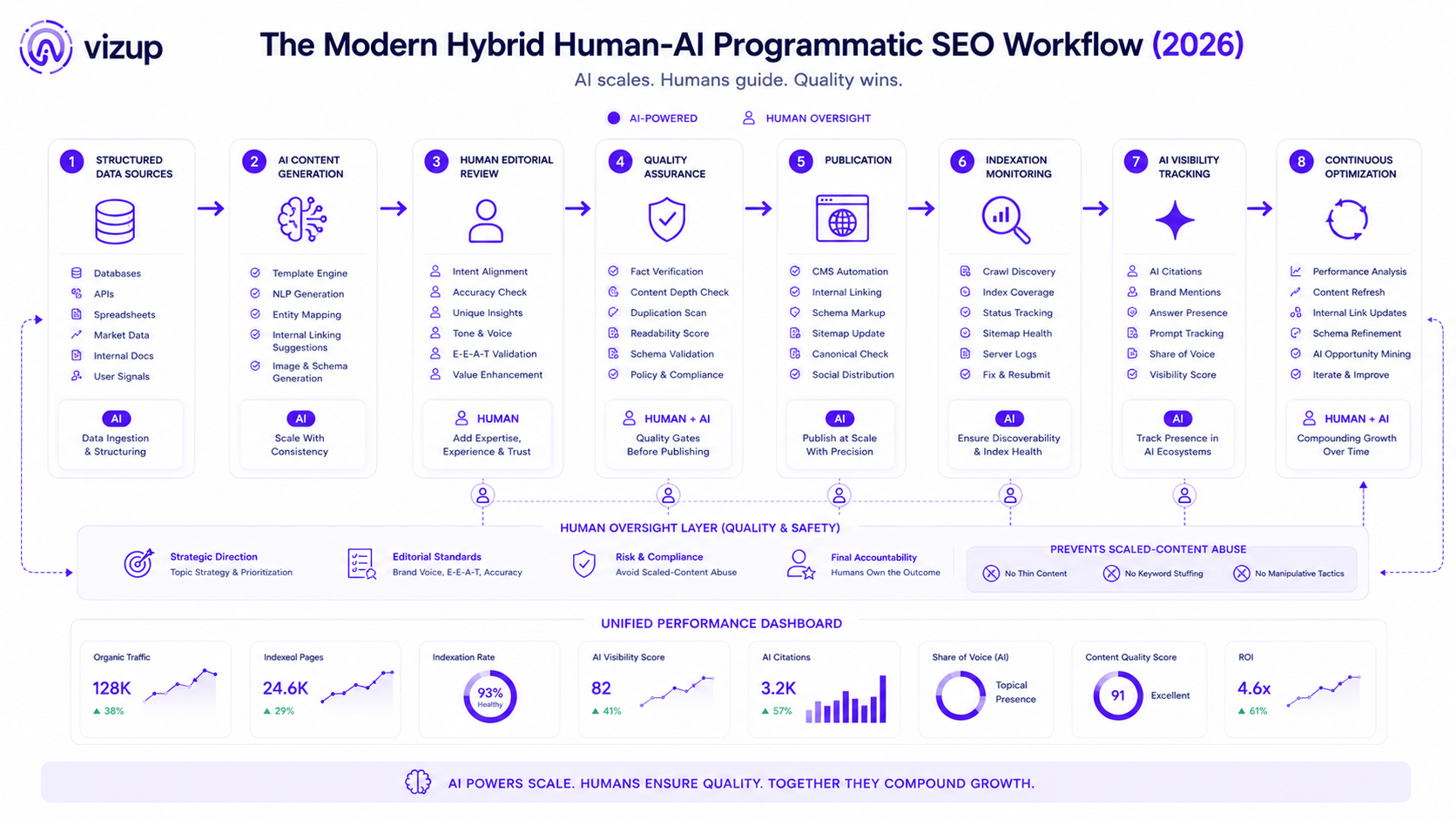
AI is fast at first drafts. Humans are still the difference between "scaled" and "thin." Editors bring E-E-A-T signals, nuance, and the kind of QA that keeps a programmatic system from slipping into templated mush. Zumeirah (2026) frames this as the new default: AI handles variation and throughput; humans handle credibility and standards. In practice, the workflow looks like: structured data extraction, AI draft generation, human editorial review, quality check, publish, then monitor indexation and AI visibility. Drop the human review step and you are taking the shortest path to a scaled content abuse problem.
What Fails: The pSEO Approaches Google Is Actively Punishing
Warning: Blunt assessment: if your pSEO strategy would have worked in 2022, it probably will not survive 2026. The tactics below are not declining, they are being actively penalized.
Approaches that are failing in 2026:
- Thin template pages with swapped variables. Swapping a city name or product name into the same generic page, with no real per-URL substance, is the clearest example of scaled content abuse. Google's classifiers are now trained to spot this pattern quickly.
- Parasite SEO and subdomain leasing. Shipping programmatic pages on third-party domains or leased subdomains to borrow authority ran into Google's site reputation abuse update. Any short-term lift is rarely worth the long-term risk to the host domain.
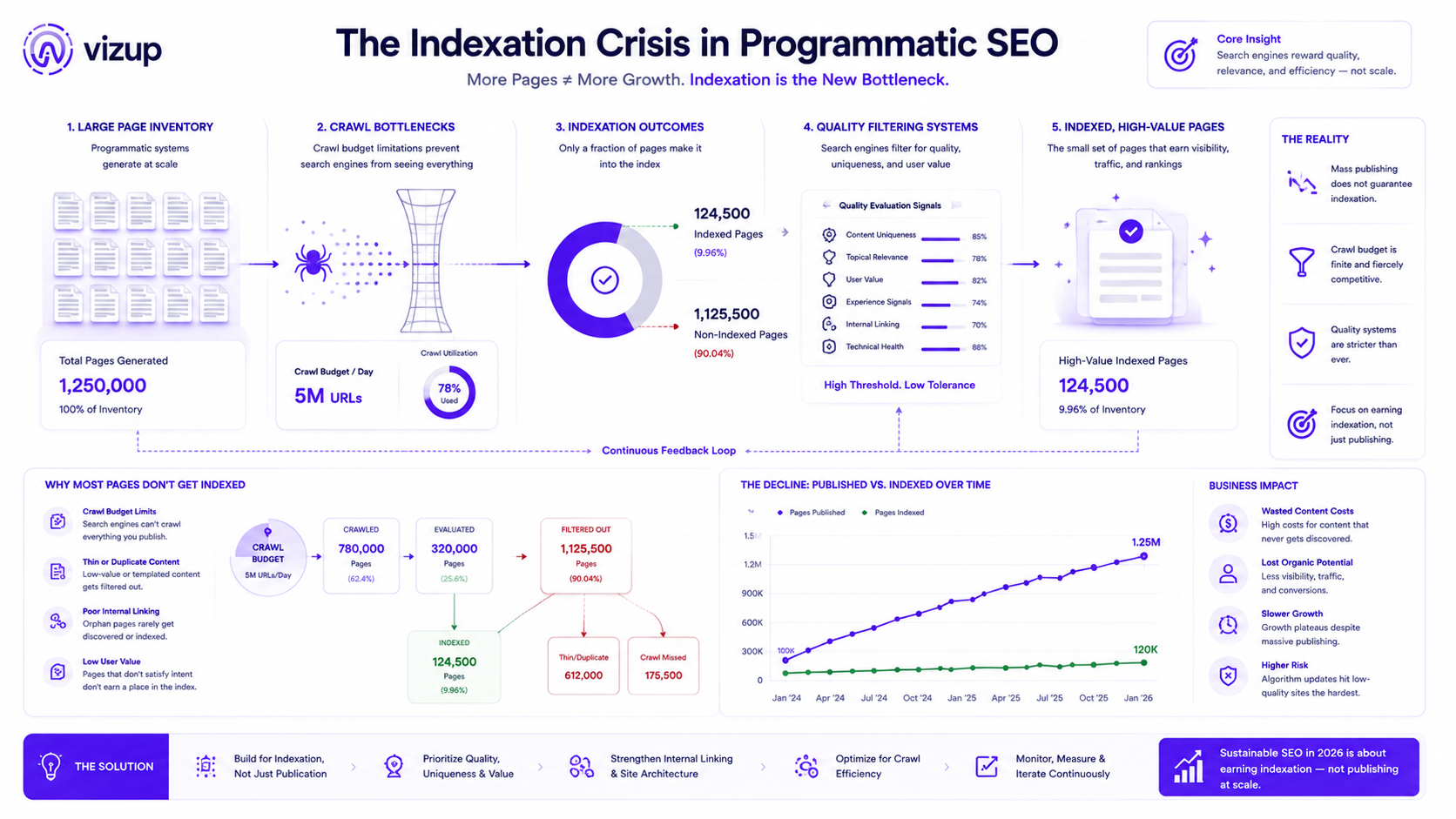
- Massive page counts with low indexation rates. Publishing thousands of pages and hoping Google will "pick the winners" is the opposite of controlled growth. A low indexation rate is feedback: Google is telling you the inventory is low value. Vizup's indexation monitoring helps teams see that signal early, before it spreads across the whole program.
The Indexation Crisis: Why Many of Your pSEO Pages May Never Get Indexed
Indexation rates for pSEO sites have slid hard since 2023. Many large programmatic sites report significantly lower indexation rates than they saw a few years ago, with some seeing fewer than 40% of pages indexed. This is not one update you can point to and blame. It is the accumulation of Google being more selective with crawl budget, plus the flood of low-quality programmatic content that hit the web between 2022 and 2024.
In Google Search Console, "Discovered, currently not indexed" is the telltale status. Google knows the URL exists, decided it was not worth indexing, and moved on. For most pSEO teams, that is where pages quietly disappear from the growth model. The fix is not "more sitemaps." Following sitemap best practices improves discoverability, but the core issue is usually the page itself: thin content, weak internal links, or no unique data. Vizup's indexation tracking makes it obvious which programmatic pages Google is actually taking seriously, so teams can prune or upgrade pages before they burn months of crawl budget.
How to Scale Programmatic SEO Safely in 2026: A Controlled Growth Framework
This is not a "publish everything" plan. Treat pSEO like a product rollout: ship in phases, instrument everything, and be willing to pause when early signals say you should.
Phase 1: Keyword and Topic Validation
Before you design a template, pressure-test the cluster: real search volume, clear intent, and low AI Overview saturation. If Google already answers most of the queries with an AI block, that cluster is a bad bet for programmatic scale. Vizup's keyword and topic discovery workflow surfaces those signals early, when changing course is still cheap. This is the phase where you decide which long-tail sets are worth building at all.
Phase 2: Template Design and Quality Gates
Templates that produce meaningfully different pages need structural variation driven by data types, not just variable swaps. Bake the guardrails into the template: minimum unique-content thresholds, internal-link requirements per page, and minimum data-source coverage. Vizup's page template planning and quality check features act as the enforcement layer, flagging pages that miss the bar before they ever ship.
Phase 3: Staged Rollout and Indexation Monitoring
Ship in batches of 50 to 200 pages, not thousands. Then watch indexation per batch before you expand. If a batch stalls, stop and diagnose before you publish the next wave. Vizup tracks indexation velocity across releases, which gives teams a clean go/no-go signal at each step instead of relying on gut feel.
Phase 4: Performance Tracking Across Google and AI Search
Rank tracking alone no longer covers the surface area that matters. You also need to know whether pages are showing up in AI Overviews, getting cited by ChatGPT, or appearing in Perplexity. Vizup's answer engine monitoring and AI visibility tracking fill that gap, so you can see where programmatic pages actually appear across Google and AI search. This is also where AI content strategy frameworks stop being theoretical and start affecting how you measure pSEO performance.
Programmatic SEO Tools Compared: What to Use and Where Vizup Fits
| Capability | Vizup | AirOps | Gushwork | Search Atlas | TryProfound |
|---|---|---|---|---|---|
| Keyword / Topic Discovery | Yes | Some | No | Yes | Some |
| Template Planning | Yes | Yes | Some | Some | No |
| Content Generation | Yes | Yes | Yes | Yes | No |
| Indexation Monitoring | Yes | No | No | Limited | No |
| AI Visibility Tracking | Yes | No | No | No | Yes |
| WordPress Integration | Yes | Some | Some | Yes | No |
| End-to-End pSEO Workflow | Yes | No | No | No | No |
| Pricing Tier | See pricing | Mid-market | Mid-market | Mid-market | Mid-market |
| Vizup is the only tool in this comparison covering the full workflow from strategy and topic discovery through AI search visibility monitoring. |
AirOps and Gushwork are stronger as content generation workflows. Search Atlas is broader SEO software. TryProfound is focused on AI visibility. Vizup's edge is that it connects the full pSEO workflow: strategy, creation, quality control, indexation, and AI search visibility.
What Most People Get Wrong About Programmatic SEO Trends in 2026
Misconception 1: More pages equals more traffic. Google is rewarding quality density, not raw page count. Five hundred well-indexed, data-rich pages will beat 50,000 thin ones over and over. The pSEO world still has a volume addiction, and it is the fastest way to turn an ambitious build into a drag on crawl budget and trust.
Misconception 2: AI-generated content is automatically programmatic SEO. It is not. pSEO needs structured data inputs, systematic intent mapping, and a template architecture that lines up with real queries. Bulk AI writing without those foundations is just bulk AI writing. That distinction matters because organic marketing is beyond SEO in 2026, and teams that conflate AI production with pSEO strategy end up building the wrong pipeline.
Misconception 3: If pages get indexed, they will eventually rank. Indexing is table stakes, not a guarantee. Plenty of programmatic pages get indexed and then sit at position 80+ for months, pulling in no meaningful traffic. Treat indexation as a prerequisite, then measure performance at the page level to separate pages that earn demand from pages that just occupy crawl capacity.
Advanced Edge Cases: When pSEO Gets Complicated
Three edge cases that catch experienced pSEO teams off guard:
- Cannibalization between programmatic and editorial content. If pSEO pages go after queries your editorial pages already cover, Google has to pick a winner, and you may not like the choice. The fix is boring but effective: a clear URL taxonomy and a content audit that maps programmatic targets against existing coverage before you publish.
- International pSEO and hreflang at scale. Getting hreflang right across thousands of programmatic URLs is genuinely hard. One bad pattern can push Google to index the wrong language variant for a query. The practical move: validate hreflang on a small batch first, then use crawl-based monitoring to catch errors before they spread.
- Dynamic content freshness and stale data decay. Programmatic pages rot faster when the data underneath them changes and your site does not. A salary page with 2024 numbers sitting in 2026 will slide as fresher sources outrank it. Build data refresh cycles into operations as a scheduled workflow, not a someday project.
Mini Case Study: From 12,000 Pages to 3,200 and 4x the Traffic
This case study is representative of results seen by SaaS companies running location-based service directories. A company built a programmatic footprint of about 12,000 pages across 400 city and service-type combinations. After 18 months, organic growth flattened and indexation sat at 31%. In Search Console, most URLs were stuck in "Discovered, currently not indexed."
With Vizup's indexation and performance tracking, the team found that 73% of pages had generated zero impressions and had not been indexed in more than six months. Instead of trying to rehab 12,000 URLs, they cut the inventory down to 3,200: pages with the strongest indexation signals, the most unique data, and the cleanest intent match. They then enriched those pages with proprietary pricing data, customer review aggregates, and tighter internal linking back to topical cluster hubs.
Six months later, indexation on the retained set climbed to 84%. Organic traffic rose 4x versus the pre-pruning baseline. The point is not that smaller always wins. The point is that quality density beats volume, and measurement is what keeps you from optimizing a fantasy.
Key Takeaways: Your Programmatic SEO Checklist for 2026
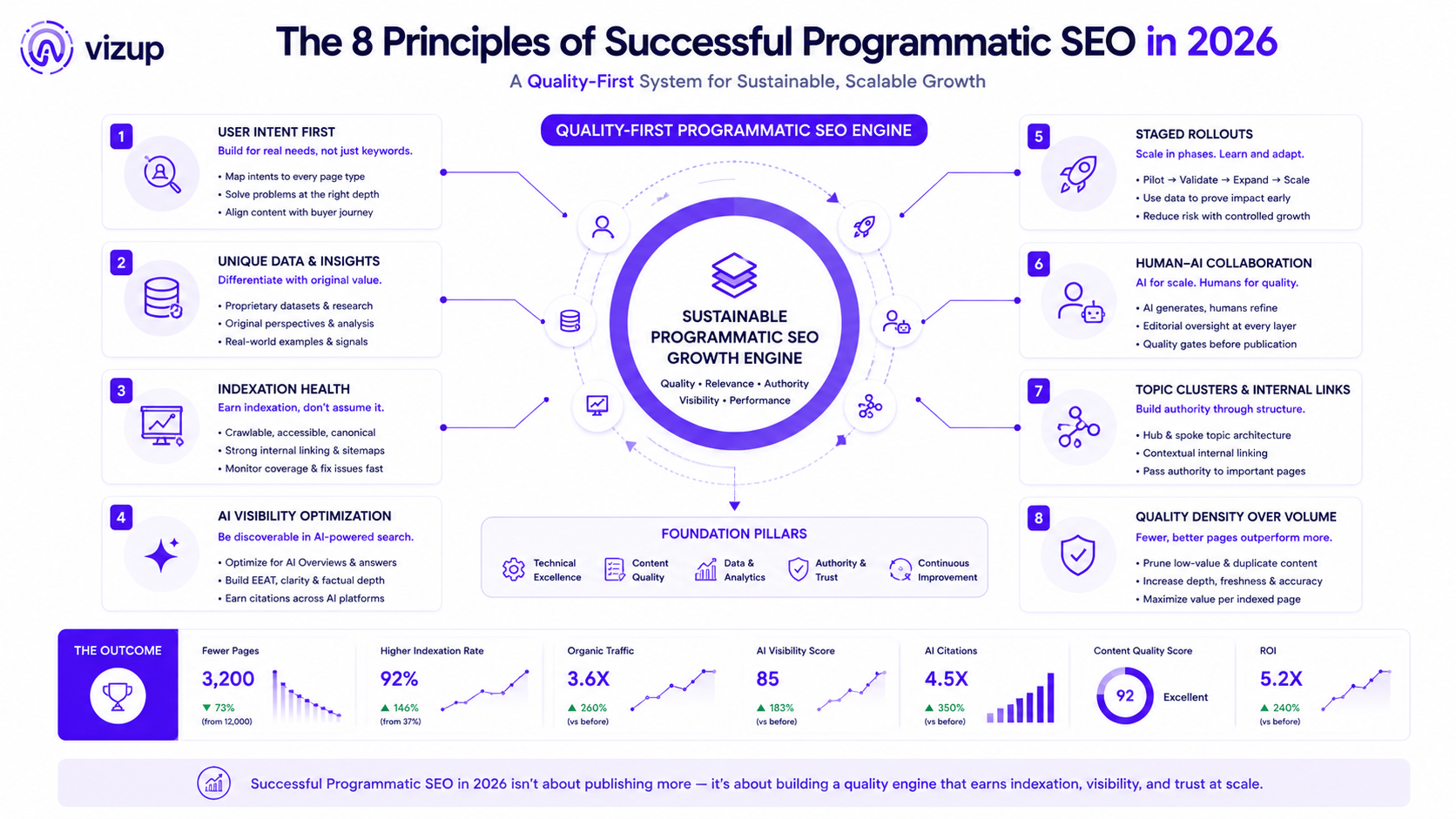
The eight principles that separate successful pSEO programs in 2026 from ones that fail:
- Each programmatic page must have a clear reason to exist based on user intent, not just keyword volume.
- Unique data per page is the single most important quality signal. Pages that reshuffle public information are penalized.
- Indexation rate is your primary health metric. A rate below 50% is a signal to stop scaling and start pruning.
- AI Overviews and answer engines are now part of your visibility landscape. Track them or operate blind.
- Staged rollouts of 50 to 200 pages per batch, with monitoring between batches, prevent quality problems from compounding.
- Hybrid human-AI workflows are the production standard. AI handles volume, human editors handle E-E-A-T quality.
- Topical clusters outperform isolated pages. Build internal link architecture into your template design, not as an afterthought.
- Fewer, better pages consistently outperform large inventories of thin content. Quality density beats volume.
The next move is simple: audit your existing inventory first. Review indexation, AI visibility, and page-level performance before publishing another batch. Once you have a baseline, you can evaluate whether your current workflow has the tooling needed to scale safely. Start with Vizup's pricing to match a plan to your current program size, then use the indexation and AI visibility dashboards to set a baseline ahead of the next rollout.
Frequently Asked Questions About Programmatic SEO in 2026
Is programmatic SEO still worth doing in 2026, or did Google wipe it out?
Programmatic SEO is still viable in 2026, but the bar is higher and the margin for sloppy execution is smaller. Rank Me Higher (2026) calls out pSEO as especially effective for businesses with structured data, multi-location brands, large product catalogs, and service directories. The teams struggling are the ones that treated pSEO as a page-count contest. Teams running it as a quality-first, data-driven program are still seeing strong outcomes, particularly when they track AI visibility alongside traditional rankings.
How many programmatic pages can we publish per month without tripping quality filters?
There is no universal "safe" number because Google reacts to quality signals, not a monthly quota. In 2026, the practical pattern is staged rollouts of 50 to 200 pages per batch, with indexation monitoring between batches. If the first batch clears 70%+ indexation and starts generating impressions within 30 days, scaling the next batch is a reasonable bet. If indexation lands below 40%, fix quality before you add more URLs. Publishing thousands at once with no monitoring is the pattern most likely to invite a manual review.
What is the best CMS for programmatic SEO: WordPress, Webflow, or headless?
The CMS matters less than the strategy and quality controls you run on top of it. WordPress is common for pSEO because it is flexible and has a large plugin ecosystem. Webflow fits smaller programmatic efforts where design requirements are strict. Headless setups offer the most control for large programs, but they come with real engineering cost. If you are on WordPress, the division of labor is clear: WordPress publishes; Vizup provides topic discovery, template planning, quality checks, and AI visibility tracking before and after pages go live.
How can I tell if programmatic pages show up in AI search results like ChatGPT or Google AI Overviews?
Traditional rank trackers do not cover AI surfaces. You need answer-engine monitoring. Vizup's AI visibility tracking checks whether programmatic pages are being cited or surfaced across Google AI Overviews, ChatGPT, Perplexity, and other answer engines. That matters because Averi AI (2025) predicts AI tool traffic will grow and convert better than traditional organic clicks. Without monitoring, your pSEO reporting is missing a growing slice of visibility.
What is the difference between programmatic SEO and AI-generated content at scale?
Programmatic SEO is a system: structured data + templates + a keyword architecture that targets specific long-tail intents. AI-generated content at scale is a production method. They overlap when AI writes parts of a programmatic page, but they are not interchangeable. pSEO still requires data sources, template structure, and a quality framework. Bulk AI writing without those inputs can miss intent entirely. That difference matters because Google's scaled content abuse policy evaluates output quality, not how the text was produced.
