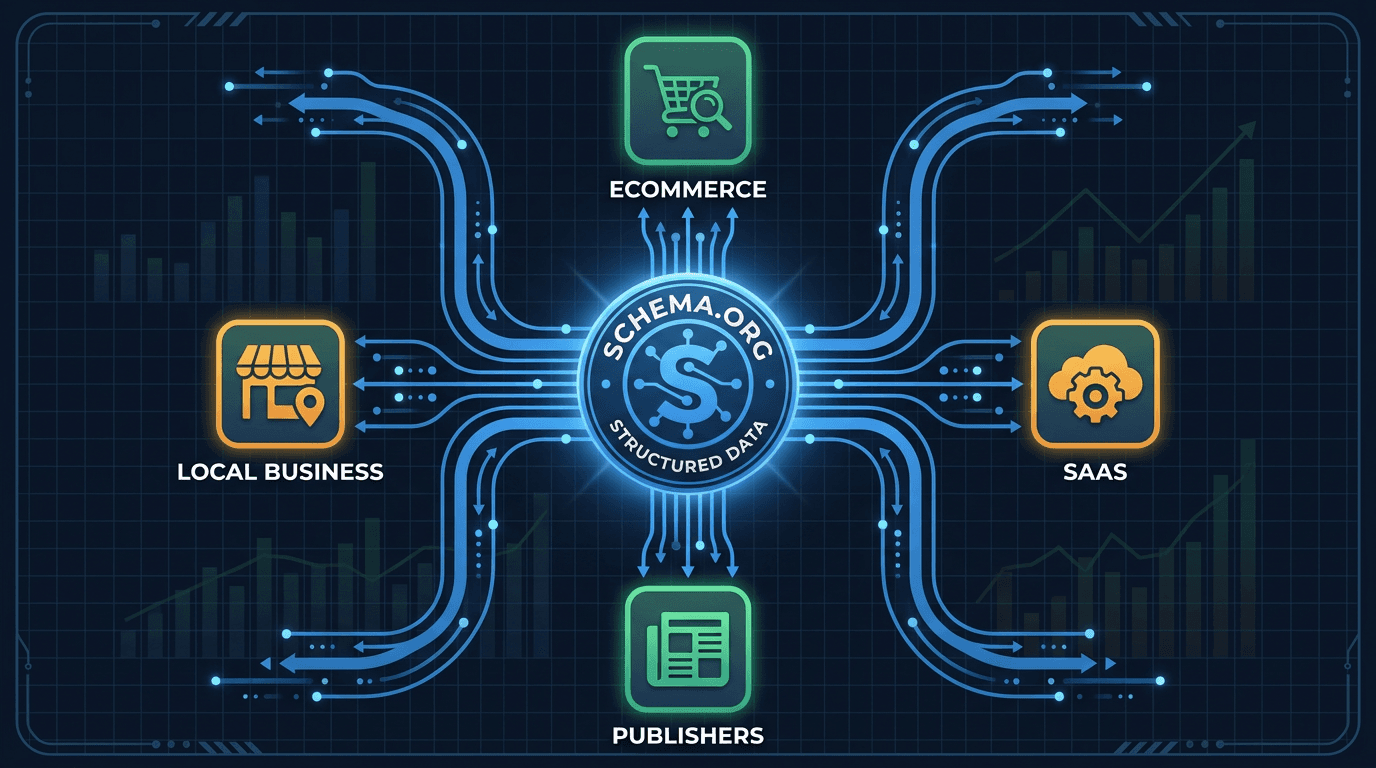
For years, selling structured data to developers or leadership has felt like equal parts best-practice sermon and educated guess. We all knew it mattered, but proving how much usually meant waving at Google's docs and squinting at a couple of competitors. That dynamic just shifted: Schema.org, working with Google, has published a public dataset of usage statistics.
This is not another random export. It's the first official, large-scale snapshot of how Schema.org types and properties show up across millions of sites. So when you push for Product markup, you do not have to hide behind "SEO best practice says..." You can point to adoption data and say: this is what the web actually does. That small change turns a lot of hand-wavy recommendations into something closer to an evidence-backed roadmap.
What Is the Schema.org Usage Statistics Dataset?
Call it a public report card for structured data. Built by Google and the Schema.org community, it publishes aggregate stats on how often Schema.org terms appear across the web. It breaks down usage in two ways:
- Types: The big categories like
Person,Product,Event, andOrganization. - Properties: The attributes inside those types, like
price,author,telephone, andname.
Anyone can download the files as CSV or JSON from the official Schema.org GitHub repository. The practical win is political as much as technical: when someone asks whether a schema type is a quirky experiment or a broadly accepted norm, you can answer with public adoption data instead of vibes. That makes buy-in easier.
Why This Update Matters for SEO Teams
Structured data projects rarely die because the markup is hard. They die in the ticket queue. Convincing product teams, developers, or leadership to spend time on it has traditionally meant leaning on Google's documentation, a little competitor archaeology, and the fuzzy promise of rich results.
Now there is a sturdier layer to the pitch. The dataset is built to answer the questions that always surface in planning meetings:
- "Is this schema type really that common?"
- "Is this property considered standard for our kind of page?"
- "Are we falling behind the rest of the web?"
- "Which schema types are mature enough to be worth our time?"
None of this replaces judgment or strategy. It just gives those decisions a receipt. And in cross-functional work, evidence tends to travel farther than opinion.
What Data Does Schema.org Share?
The dataset is intentionally simple. Schema.org describes three fields: Term Type, URI, and Domain Count Bucket.
| Field | What It Means | Example |
|---|---|---|
| Term Type | Whether the entry is a Type or a Property | Type |
| URI | The canonical Schema.org URL for the term | http://schema.org/Person |
| Domain Count Bucket | A band that represents how many unique domains use it | 100K - 1M |
One nuance that matters: counts are by domain, not by page. If a single ecommerce site rolls out Product on 50,000 URLs, it still registers as one domain. So you are looking at breadth of adoption across the web, not how aggressively any one site deploys a term.
How the Data Is Collected
Schema.org says the stats come from Google's public web crawling infrastructure. Terms are aggregated by domain, and exact counts are not published to reduce noise and protect privacy. Instead, usage is reported in popularity buckets (for example, 1K-10K domains or 10K-100K domains). The files refresh monthly, which makes this a high-level adoption signal rather than a real-time SEO monitoring feed.
How SEOs Can Use the Dataset
Benchmark Schema Adoption
The obvious first move is benchmarking. If you run ecommerce and the dataset shows Product, Offer, Review, and price living in the top adoption buckets, but your templates only emit Product, you have a clear, defensible reason to clean things up. It is a quick way to check whether you are at least meeting the web's baseline for your category.
Prioritize Schema Types and Properties
Schema work is full of diminishing returns. Some types are foundational; others are interesting but rarely implemented. The dataset helps separate "table stakes" from "nice to have." One example: analysis of the May 2026 dataset found that over half of all Schema.org Types show up on fewer than 1,000 domains. That is a strong nudge to focus on the terms that are already widely understood and deployed.
Build Business Cases for Developers
This is where the dataset earns its keep. "SEO recommends this" is easy to ignore. "Schema.org and Google publish data showing this term appears on over a million domains" lands differently. It frames the work as aligning with a de facto standard, not indulging an SEO preference.
Track Structured Data Trends Over Time
Because the dataset updates monthly, you can watch adoption drift over time. You can see whether newer terms are picking up steam or whether older ones are losing mindshare.
Improve SEO Tools and Audits
Tooling gets smarter when it knows what "normal" looks like. Adoption data lets audit tools flag not just missing schema, but missing widely used schema. Our own tools at Vizup, like the Schema Checker tool, can use this kind of signal to add context to recommendations instead of treating every term as equally urgent.
What This Dataset Does Not Mean
The dataset is useful, but it is not magic. Treat it like a compass: it points you in a direction, but it will not walk the route for you. Here is what it cannot tell you:
- It does not mean higher adoption equals better rankings. Correlation is not causation. A popular schema type is not automatically a direct, heavy-handed ranking factor.
- It does not show URL-level usage. You cannot see which specific pages or competitors are using a term.
- It does not separate formats. JSON-LD, Microdata, and RDFa are all rolled into one statistic.
- A low-usage term isn't necessarily useless. Schema.org notes that niche or specialized terms will naturally have lower adoption, and they can still be valuable for search engines.
Why This Matters for AI Search and Entity Visibility
As search shifts toward AI-driven answers and generative experiences, entity understanding is doing more of the heavy lifting. Structured data is one of the cleanest ways to tell a machine what something is (a product, a person, an organization) and how it connects to other things. Those signals matter for brand visibility, citations, and being included in AI-generated answers.
The dataset does not directly boost AI visibility, but it does give you a sanity check on which signals are most commonly used. That makes it easier to prioritize the structured data that supports entity clarity. For teams focused on Answer Engine Optimization (AEO), it can help justify decisions around Organization, Author, Product, and LocalBusiness details. It also fits neatly into a modern content marketing strategy for AI search.
Practical Use Cases by Website Type
A quick starting point: schema terms worth benchmarking tend to cluster by site type. Here are the usual suspects:
Ecommerce Websites
ProductOfferpriceReviewAggregateRatingBreadcrumbList
SaaS Websites
OrganizationSoftwareApplicationProductFAQPageReviewArticle
Publishers and Blogs
ArticleAuthor/PersonOrganizationdatePublishedBreadcrumbList
Local Businesses
LocalBusiness(and its many subtypes)PostalAddresstelephoneopeningHoursGeoCoordinates
How to Start Using the Dataset
Starting is pleasantly unglamorous: go to the official Schema.org usage statistics page, pull the CSV or JSON from GitHub, and filter for the terms that matter to your core templates. Then compare that list to what you actually ship today. From there, prioritize fixes and new markup based on page value, business impact, and adoption maturity. If you are generating new markup from scratch, a structured data generator can speed up the mechanics.
Vizup Angle: Turning Schema Data Into SEO Action
Schema.org's dataset answers "what's common," but it does not tell you what to do next. That translation layer is where teams tend to get stuck. Vizup is built to audit page templates, surface missing structured data opportunities, prioritize schema work, and tie technical SEO back to broader organic and AI search visibility goals. For brands scaling content, landing pages, or programmatic SEO pages, this kind of prioritization makes it easier for search engines and AI systems to parse what a page is about. It is also a core piece of building an AI-powered SEO strategy.
Final Takeaway
The Schema.org usage statistics dataset is a real step toward transparency around structured data. It gives SEOs public numbers to back up recommendations, which makes business cases sharper and prioritization less arbitrary. It is not a ranking shortcut, but it is a solid decision-support input. If you already care about technical SEO, entity clarity, and preparing for AI search, this belongs in your audit and planning workflow. Once you decide what to implement, the next step is testing your structured data to make sure it is valid and consistent.
Frequently Asked Questions
What is the Schema.org usage statistics dataset?
It is a public dataset from Schema.org and Google that reports aggregate usage of Schema.org Types and Properties across millions of unique websites. The files are updated monthly.
Does using a popular schema type guarantee better rankings?
No. Widespread adoption is not the same thing as a direct ranking signal. Treat popularity as context for prioritization, not a promise of ranking gains.
Where can I find the Schema.org usage data?
You can download the raw CSV and JSON files from the official Schema.org GitHub repository. The main Schema.org site links to it.
How does this data help with AI search (AEO)?
Structured data makes entities machine-readable, which helps AI systems interpret your content. The dataset can guide you toward the schema types that are most commonly used and therefore most likely to be broadly understood. It is also useful context when deciding how to structure data for AI search.
Should I ignore schema types with low usage?
No. Low adoption often just means a term is niche, specialized, or newer. If a schema type closely matches your industry or content, it can still be worth implementing even outside the top buckets.
