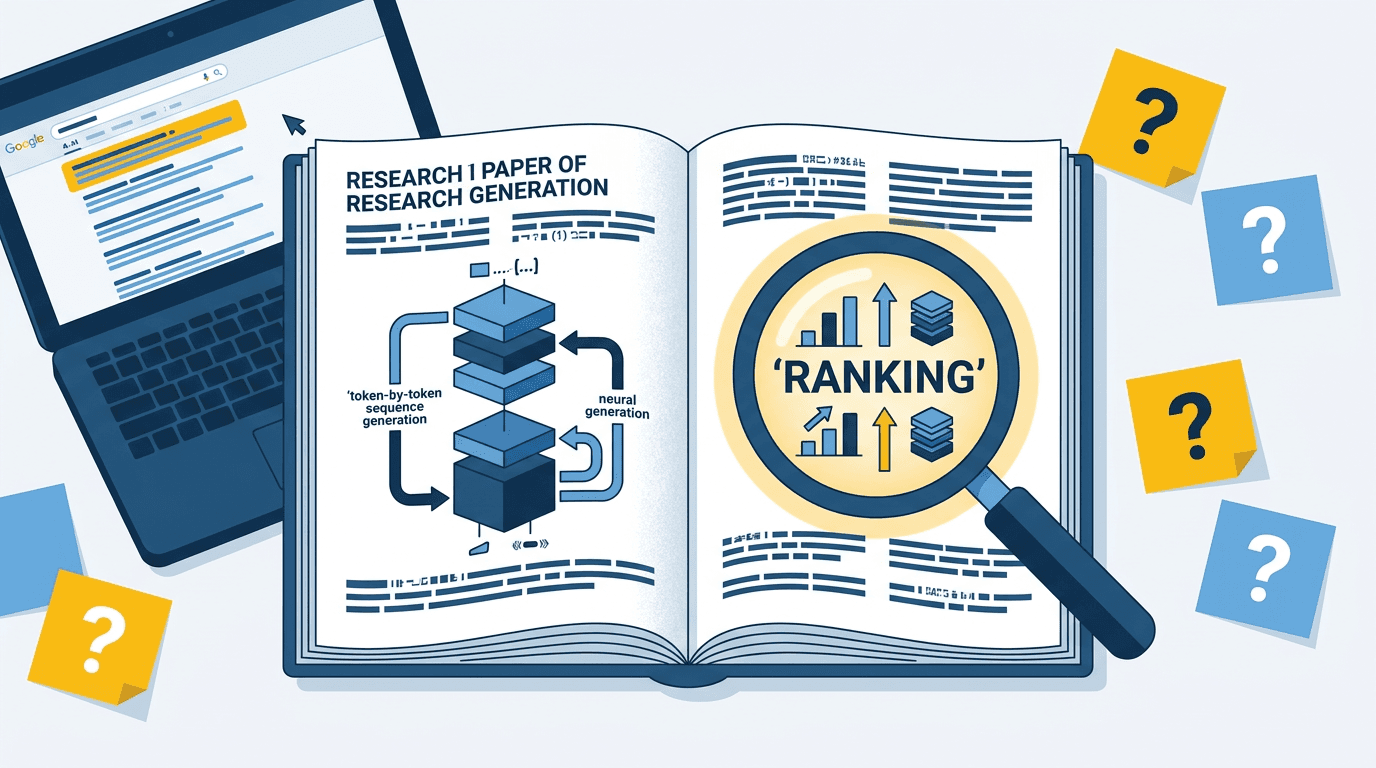
An ARR-affiliated Google DeepMind paper lands on arXiv. Hours later, SEO Twitter has pronounced the two-stage retrieval pipeline dead, PageRank obsolete, and content optimization irrelevant. The distance between what the research actually claims and the ensuing coverage is considerable. Autoregressive ranking is a neural architecture that ranks documents by having a language model generate document identifiers token by token. It treats ranking as sequence generation rather than similarity scoring. It is not a Google Search feature, a ranking update, or a replacement for PageRank.
A closer reading narrows that distance. For technical SEO leads, search strategists, and industry analysts, the useful questions are plain: what does the architecture propose, what do the experiments establish, and what does it change for optimization work now? The answers require more precision than the early reactions allowed.
What Autoregressive Ranking Actually Is
Autoregressive ranking (ARR) is a January 2026 arXiv research proposal from Google DeepMind, UMass Amherst, and UT Austin researchers. A fine-tuned language model generates document identifiers, or docIDs, token by token. Beam search identifies high-probability valid docIDs, and their generation probabilities are used to rank documents. The work joins generative retrieval with traditional information retrieval: LLM sequence generation applied to ranking.
It is not a shipping product or a Google Search update. The paper itself provides no evidence that ARR is deployed in Google Search. Google DeepMind affiliation tells us where some authors work, not where the system runs. That distinction should be the first filter applied to coverage of LLM ranking research.
The Architecture Problem the Paper Solves
Production search usually runs a two-stage retrieval pipeline. A fast, light model retrieves candidate documents from an index containing billions of items; a heavier model then reranks that smaller set. The division exists because a single model has not combined retrieval speed with the expressiveness required for high-quality ranking. ARR presents itself as a possible answer to that tradeoff.
Dual Encoders: Fast but Provably Incomplete
First-stage retrieval commonly uses dual encoders. They embed queries and documents independently as vectors, then estimate relevance with a dot product. Independence makes the approach fast: document embeddings can be calculated offline, and approximate nearest-neighbor search finds candidates. It also imposes a hard constraint. Since query and document are encoded separately, the model cannot model fine-grained interactions between their terms.
The ARR paper makes that point formally. Proposition 3.1, "DE Insufficiency for Complete Ranking," proves that dual encoders cannot represent every possible ranking function. This is not an observation that current models need more training; it is a mathematical limit. The result establishes that there are ranking functions dual encoders cannot represent perfectly, regardless of additional training data or compute.
Cross Encoders: Expressive but Operationally Expensive
Cross encoders address that limitation by attending jointly to the query and document in one forward pass. Cross encoders can model richer query-document interactions than dual encoders, but they require substantially more inference work when applied across many candidates, as described in the ARR paper. The bill comes at inference: every candidate needs its own forward pass. With thousands of plausible documents for a web query, that cost is prohibitive. Hence the two-stage design rather than end-to-end cross-encoder ranking.
Where Autoregressive Ranking Fits
ARR takes another route. Rather than scoring documents one by one, it generates candidate document identifiers, or docIDs, token by token. Beam search identifies high-probability valid docID sequences, and their conditional generation probabilities are used to rank the documents. In generative retrieval, each document has a structured identifier made of tokens that the model learns to produce. The paper shows that autoregressive rankers can represent arbitrary distributions over token sequences, giving them cross-encoder-level expressiveness without requiring a separate inference pass for every document.
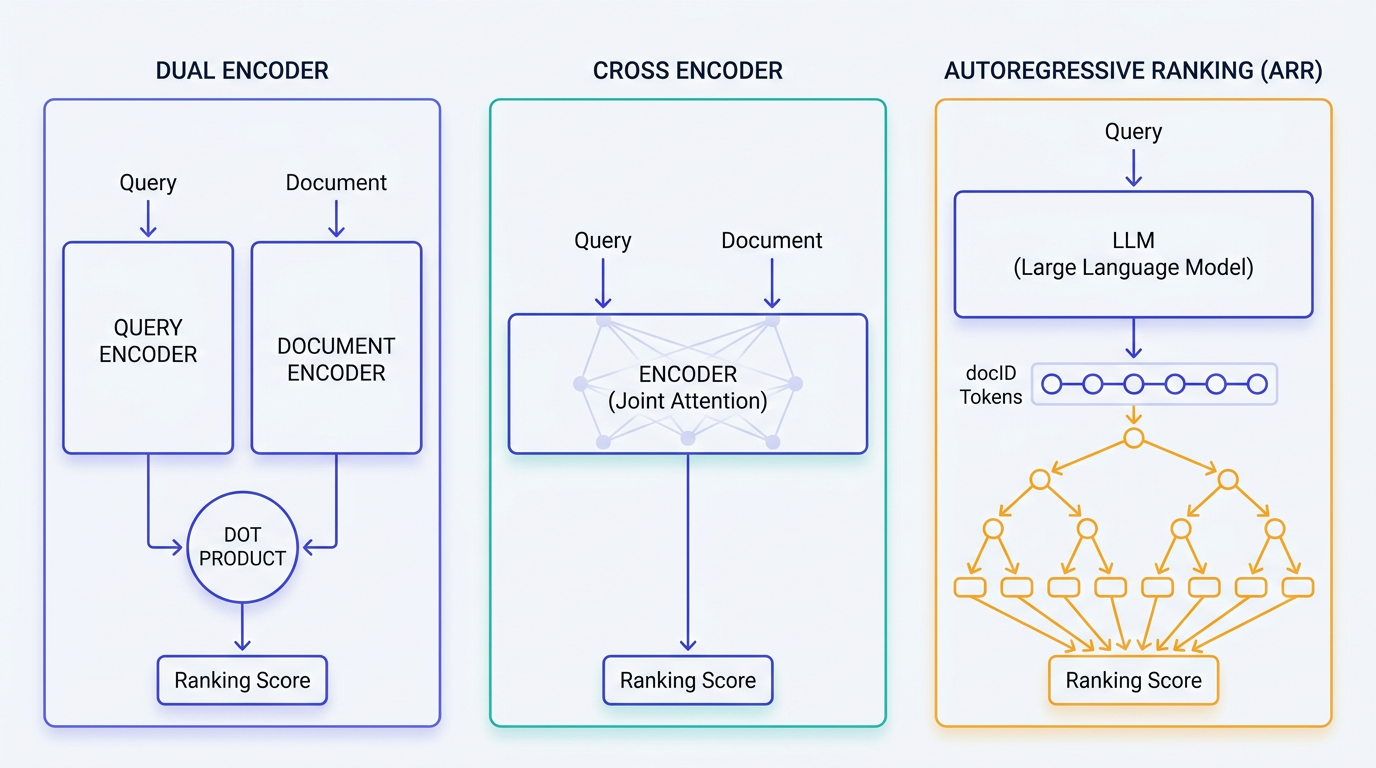
| Dimension | Dual Encoder | Cross Encoder | Autoregressive Ranking (ARR) |
|---|---|---|---|
| Query-document interaction | None; embeddings are independent | Full joint attention | Implicit through sequential docID generation |
| Inference speed at scale | Very fast; embeddings are precomputed | Slow; one pass for each candidate | Autoregressive docID generation with beam search |
| Ranking expressiveness | Provably limited (Proposition 3.1) | Theoretically complete | Theoretically complete; arbitrary sequence distributions |
| Training complexity | Standard contrastive losses | Standard pairwise cross-entropy | Custom SToICaL loss and prefix-tree constraints |
| Production deployment status | Widely used for first-stage retrieval | Used for second-stage reranking | Research only; no known production deployment |
| Data synthesized from the ARR paper (arXiv:2601.05588). Deployment status reflects publicly available information as of mid-2026. |
How the Model Is Trained: SToICaL and Why It Matters
A ranking architecture still needs a ranking objective. Ordinary next-token cross-entropy gives every token position equal weight, which is a poor fit here. Errors involving highly relevant documents matter more to ranking quality than errors involving lower-ranked documents. Without position-aware loss, the model has little reason to favor the head of the list.
The paper's training contribution is SToICaL, or Simple Token-Item Calibrated Loss. It reweights token-level and item-level losses by position, assigning larger penalties to mistakes near the top of the ranking. That is what turns a generic sequence generator into a ranker. During training, a prefix tree limits output to valid document identifiers, so the model cannot invent docID strings absent from the corpus.
Info: SToICaL separates ARR from an ordinary generative model. Without rank-aware training, the system could generate document IDs without placing them in a meaningful order. The loss function does essential work; the architecture alone does not.
What the Experiments Actually Show
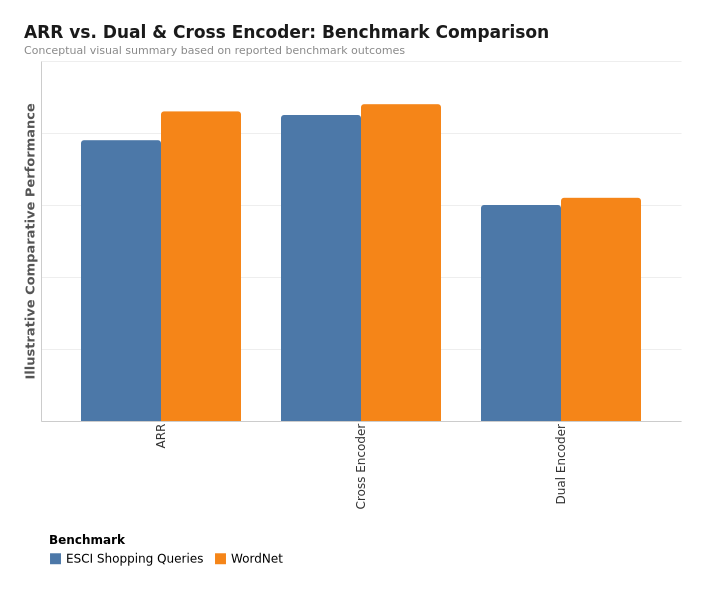
ARR is evaluated on two benchmarks: WordNet, a hierarchical concept-ranking task, and ESCI shopping queries, derived from Amazon's product-search relevance data. On WordNet, ARR performed comparably to a cross encoder, supporting the expressiveness result. ESCI was less tidy. ARR remained competitive overall, but one variant declined on ranking the single best result first.
Scope is the important qualification. WordNet and ESCI are controlled benchmarks with thousands to tens of thousands of items. Web search handles billions of documents, changing content, varied intent, and millisecond latency requirements. Benchmark performance is not evidence of production readiness. Treating it as such confuses two very different claims.
Three Things the Coverage Gets Wrong
Misconception 1: "Google DeepMind paper" means Google Search is changing. Google DeepMind affiliation is evidence of the authors' research affiliation, not evidence that the architecture is deployed in Google Search. Until Google's search infrastructure shows a change through observed ranking behavior, an official announcement, or API changes, the work remains research. That is a recurring distinction for anyone following generative engine ranking research.
Misconception 2: ARR replaces the two-stage retrieval pipeline. The paper presents autoregressive ranking as a component that could operate within or beside existing pipelines, not as a wholesale replacement. Latency, cost, and index size are engineering constraints a research paper does not erase. Search ranking architecture in 2026 and beyond is far more likely to remain composite.
Misconception 3: LLM ranking model research tells SEOs what to optimize. ARR says nothing about content signals, E-E-A-T, link equity, or the daily inputs available to practitioners. It concerns how a ranker processes signals, not which signals it values. Reading it as optimization advice is like reading GPU chip-design research and changing video-encoding settings.
What Would Actually Change for SEO If This Scaled
If ARR moved from research into production, sequence-based ranking rather than similarity scoring could alter which documents emerge for difficult multi-intent queries. ARR's theoretical advantage would be most relevant in ranking settings where richer query-document interactions matter, although the paper does not establish which web-query classes would benefit most.
If a docID-based ranking architecture were eventually deployed at web scale, document representation and indexing would become relevant implementation questions. The ARR paper, however, does not provide SEO guidance on chunking, page structure, or document identifiers. That connects with changes already visible in how AI search engines retrieve and cite content. When a system generates identifiers instead of calculating similarity scores, index representation matters differently.
Content quality, topical relevance, and authority would not cease to matter. Architecture changes the way signals are processed, not the need for those signals. A generative ranker still depends on training or relevance supervision defining desirable results. The ARR paper does not establish which web-content signals a production search engine would use. A future production system could combine generative and classical components rather than replacing one architecture outright.
How to Track Directional Research Without Overreacting
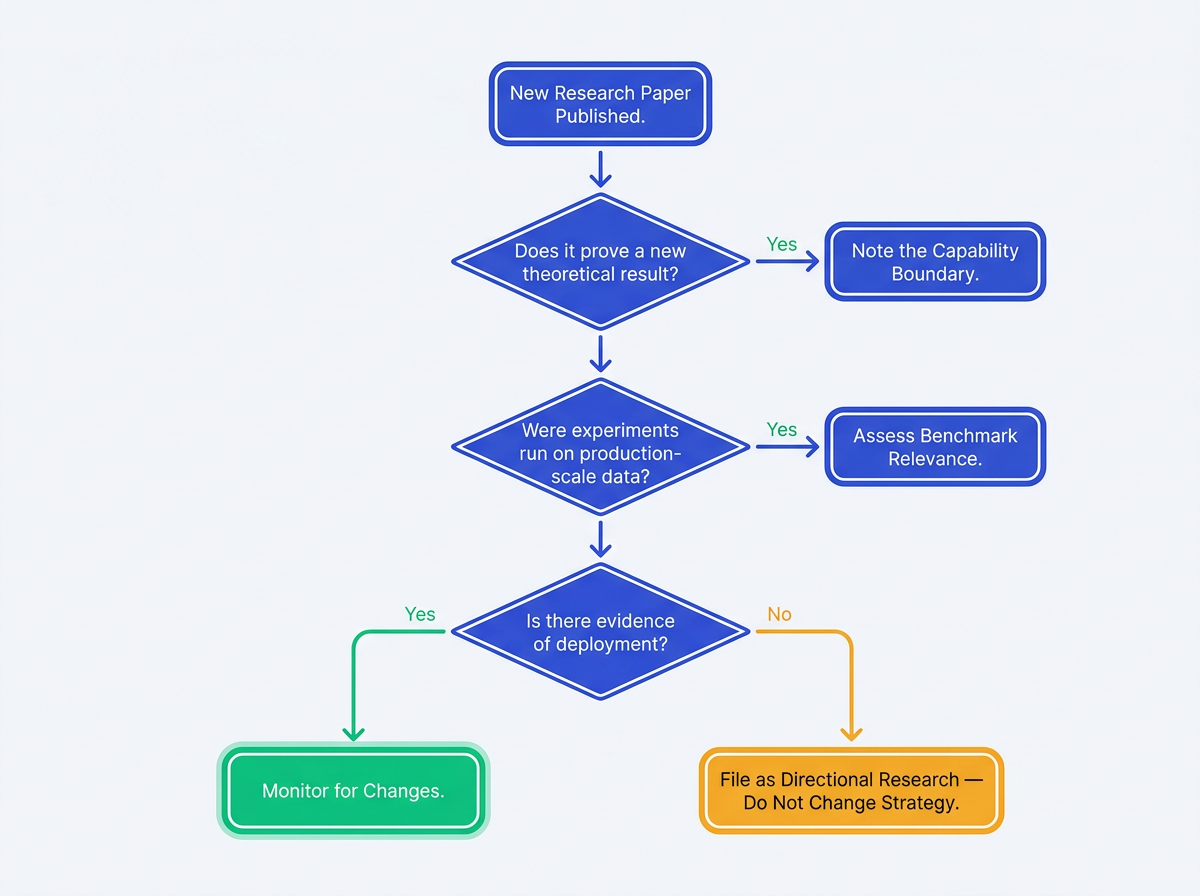
Use three layers to evaluate papers in this category. Start with theory: what does it prove? ARR establishes that autoregressive rankers are more expressive than dual encoders. Then examine experiments: ARR matches cross encoders on WordNet and is competitive on ESCI. Finally, look for deployment: for ARR, there is none. A paper can be strong on the first two measures and offer no evidence on the third. That makes it worth understanding, not a reason to reset strategy.
For analysts and SEO strategists, the nearer-term work is tracking production changes in retrieval and citation by AI answer engines. AI search performance analytics across live answer engines supplies data that can be acted on now. Studying Google's AI-powered search as it operates today is more useful than forecasting the fate of a 2026 arXiv paper.
Tip: Practical habit: when coverage appears, ask three questions. (1) Which benchmark did the paper use? (2) Does that benchmark resemble your search environment? (3) Is there evidence of production deployment? If the third answer is no, file it as "worth understanding," not "requires strategy changes."
This is where Vizup's broader discovery workflow becomes useful. Vizup's Organic Autopilot helps brands monitor, create, optimise, publish, and learn across Search, Social, Communities, AI Answer Engines, and Local Discovery using AI agents, human experts, and live SEO, pSEO, AEO, and GEO tools. Rather than changing strategy around an experimental ranking paper, teams can track what is actually changing across live discovery surfaces and act on measurable visibility gaps. Paid ads are available as an amplification add-on.
Key Takeaways
- Autoregressive ranking is a research architecture from a 2026 paper with Google DeepMind affiliation. An LLM generates candidate document IDs token by token, and their generation probabilities are used for ranking.
- The paper proves that dual encoders cannot represent every ranking function, setting a mathematical limit on the prevailing first-stage retrieval approach.
- ARR matches cross-encoder quality on WordNet and is competitive on ESCI shopping queries. Both are controlled research settings, not web-scale tests.
- SToICaL makes ARR behave as a ranker rather than merely a sequence generator by weighting losses according to rank position.
- Google DeepMind affiliation does not establish Google Search deployment. As of mid-2026, no public evidence of production use exists.
- The paper does not identify content signals to optimize; it describes how a ranker processes signals rather than which signals matter.
- Search ranking will probably combine generative and classical components. Practitioners should improve brand visibility in AI search based on observable production behavior, not architecture speculation.
Frequently Asked Questions
Is autoregressive ranking being used in Google Search right now?
No. As of mid-2026, no public evidence shows autoregressive ranking deployed in Google Search or another production search engine. The ARR paper has Google DeepMind-affiliated authors; that describes their workplace, not Google's production stack. ARR remains a theoretical and experimental proposal unless ranking behavior changes or Google announces deployment.
How is autoregressive ranking different from a standard cross encoder reranker?
A cross encoder jointly attends to one query-document pair and needs a separate forward pass for every candidate. Autoregressive ranking generates candidate document identifiers token by token. Beam search identifies high-probability valid docID sequences, and the documents are ranked using their generation probabilities. Both have similar theoretical expressiveness, but they formulate ranking differently.
What is the SToICaL loss function and why does it matter for ranking?
SToICaL, or Simple Token-Item Calibrated Loss, is ARR's rank-aware training objective. It weights token-level and item-level errors more heavily at higher positions, especially near rank 1. Without it, an autoregressive model could generate document IDs but would have no reason to assign higher generation probabilities to more relevant documents.
Does the ARR paper tell SEOs what content signals to optimize for?
No. The paper covers ranking architecture: how a system turns signals into an ordered list. It does not identify ranking signals such as E-E-A-T, link equity, or content quality. Architecture research and practitioner optimization guidance address different layers of the search stack.
What is generative retrieval and how does the docID system work in autoregressive ranking?
Generative retrieval has a model generate document identifiers for a query instead of scoring a set of retrieved candidates. ARR assigns each document a structured, token-based ID, which the LLM generates autoregressively. Beam search explores likely sequences, while a prefix tree restricts output to valid IDs. For broader context, see how AI search engines retrieve content.
