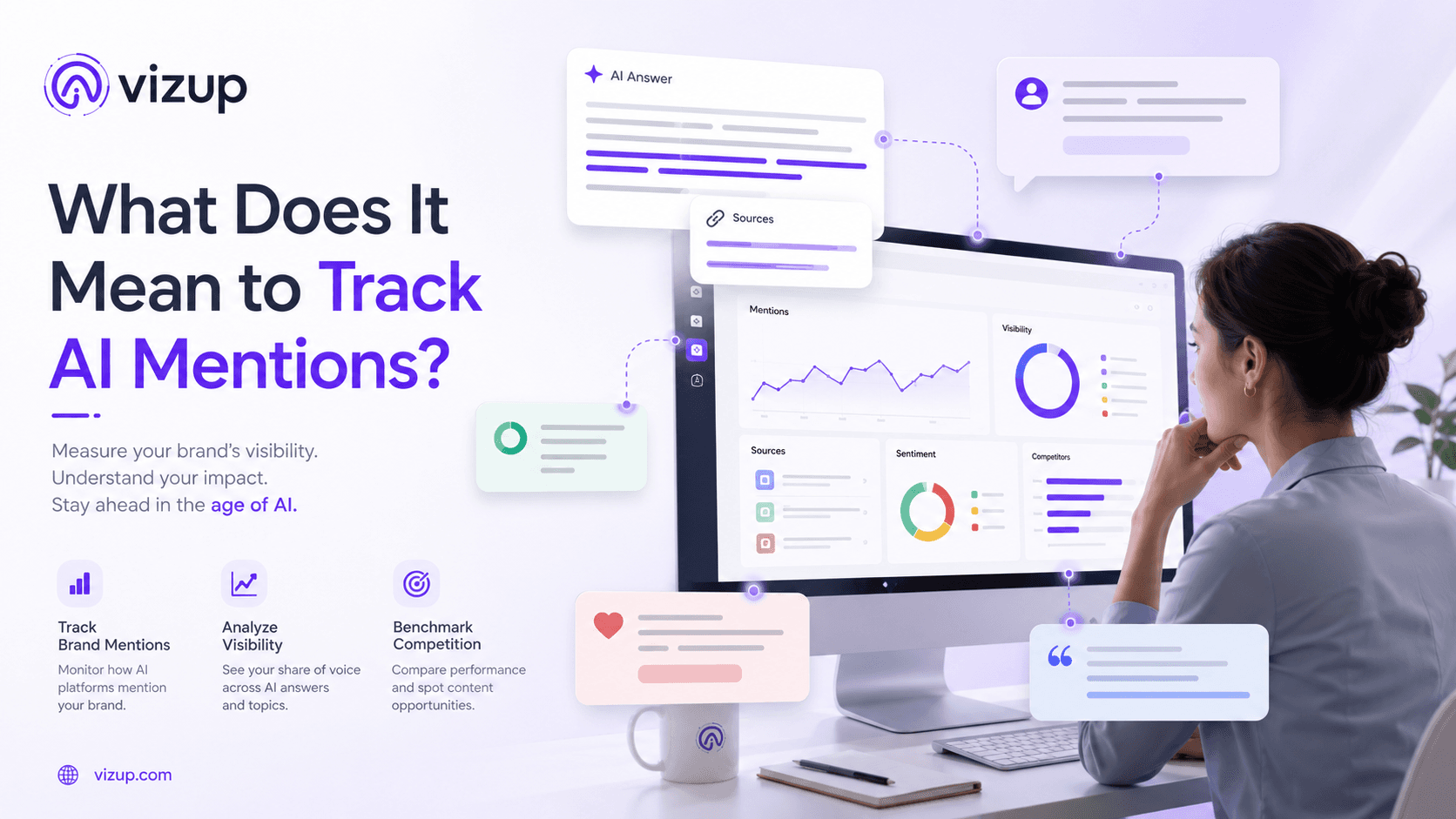
Tracking AI mentions means keeping a structured watch on when and how AI platforms like ChatGPT, Google AI Overviews, Perplexity, and Copilot refer to your brand inside their generated answers. Traditional search monitoring is built around rankings and links; answer engine monitoring is about whether you show up in the conversational, stitched-together responses that are increasingly replacing the classic page of ten blue links.
The impact is bigger than many teams expect. A 2025 study by Bain & Company found that 80% of consumers now rely on zero-click AI searches for nearly half of their inquiries, contributing to an estimated 15 to 25% reduction in organic web traffic (Bain & Company zero-click search report). When your brand doesn't appear inside those AI-generated answers, you effectively disappear for a growing slice of your audience. Treating AI mention tracking as optional is quickly becoming the kind of oversight that shows up later as a traffic and revenue problem.
Why Should You Track AI Mentions of Your Brand?
Classic SEO came with a familiar scoreboard: rankings, click-through rate, and organic sessions. AI search works on a different set of rules. As IBM explains, these systems use AI to interpret context, intent, and semantics to return personalized, relevant results rather than simply matching keywords to pages (IBM: What Is an AI Search Engine?). In practice, that often means one synthesized answer instead of a list, and your brand is either included in that narrative or left out.
The visibility math is unforgiving. Recent studies show that AI assistants are far more selective than traditional search engines. For example, ChatGPT recommends only about 1.2% of local businesses in its responses, a massive drop from the 35.9% that appear in Google's local 3-pack. This creates a visibility gap of nearly 30x. If you are not monitoring where you land in AI responses, competitors who are paying attention get the upside by default. For more context on how this shift plays out, see why brands are becoming invisible online.
AI brand monitoring also surfaces what traditional tools largely miss: the framing. If a chatbot recommends a competitor for a query you should own, that is a market signal no rank tracker will flag. And if your brand is mentioned but wrapped in caveats or negativity, you have a reputation issue sitting inside the answer layer where users are making decisions.
How Does Tracking Brand Mentions in AI Actually Work?
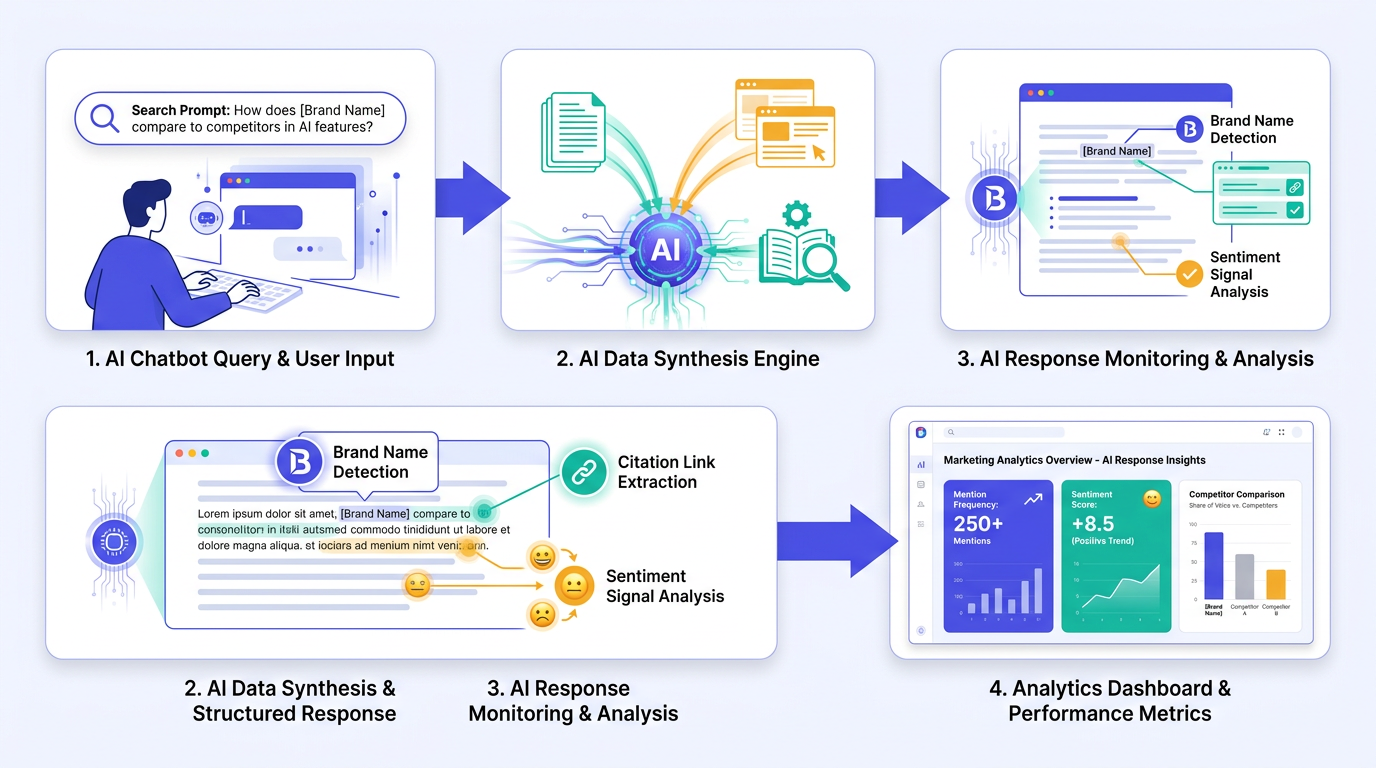
Tracking the brand mentions AI platforms generate usually starts with the same prompts your customers type, then moves to a careful read of what the system returns: whether your brand appears, where it appears, and what tone surrounds it. In most programs, the workflow looks like this:
- Query simulation. Tools run hundreds or thousands of prompts across AI platforms (ChatGPT, Gemini, Perplexity, Copilot) that mirror real customer questions in your category.
- Response parsing. Each generated answer is scanned for brand mentions, product references, and any citation links.
- Ghost citation detection. Studies show that a high percentage of AI brand mentions are "ghost citations," where a brand's content is used and cited with a link, but the brand name never appears in the visible text. Tracking tools surface these invisible references.
- Competitive benchmarking. Mention frequency and sentiment are measured against competitors using the same query set.
- Trend analysis. Results are tracked over time to show whether visibility is rising, slipping, or changing in tone.
Platforms like Vizup are built for this workflow, with answer engine monitoring that moves past keyword positions and into how AI systems actually describe and recommend brands.
What Types of AI Mentions Should You Monitor?
Not every mention carries the same value, or the same risk. Sorting mentions into categories helps you decide what to fix first. For example, the vast majority of brand mentions in AI-generated answers come from third-party domains, while only a small fraction come from brands' own websites. That is your AI narrative being written mostly off-site.
| Mention Type | Description | Strategic Impact |
|---|---|---|
| Direct named mention | The AI explicitly names your brand in its answer | Highest visibility; builds awareness and trust |
| Ghost citation | Your content is cited via link, but your brand name is not shown in the text | Can drive referral traffic, but delivers little to no brand recall |
| Competitor comparison | Your brand is listed alongside competitors in recommendations | Good if positioned well; risky if framed as the weaker option |
| Negative or cautionary mention | The AI references your brand as a warning, limitation, or drawback | Reputation risk that should trigger an immediate content strategy adjustment |
| Complete omission | Your brand does not appear for queries you should own | Most dangerous because the loss is invisible without monitoring |
| Each mention type requires a different monitoring and response strategy. |
Omission is also the easiest problem to miss, because standard analytics cannot report on an answer that never included you. That is where AI brand monitoring platforms earn their keep: they map the gaps that rankings, traffic reports, and share-of-voice charts never reveal. For a practical walkthrough, see how to track brand mentions in AI search.
What Are Common Misconceptions About AI Mention Tracking?
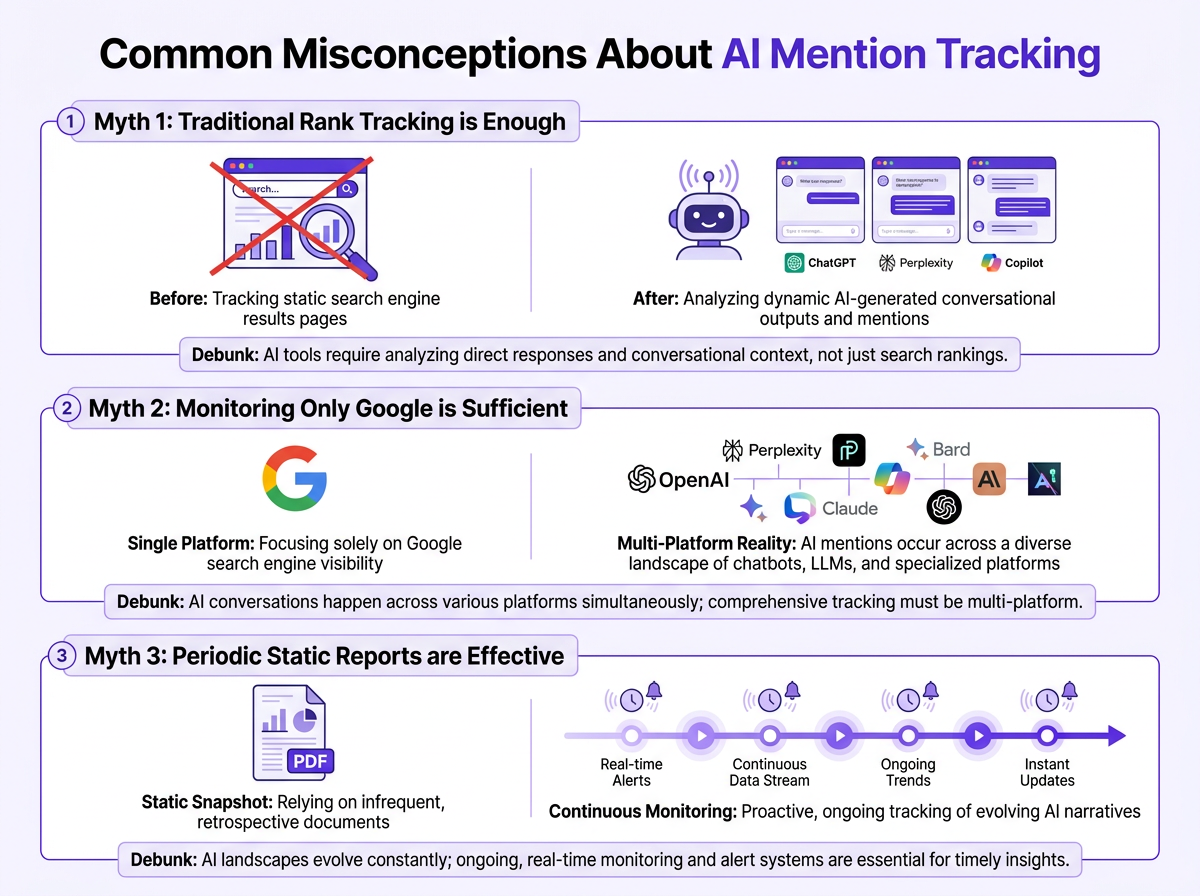
"My existing SEO tools already cover this." Rank trackers tell you where you sit in Google's organic results. They do not run prompts through ChatGPT, Perplexity, or Copilot and evaluate the generated answers. AI search engines draw from different source hierarchies and apply different logic. A Gartner 2025 survey found that 55% of brand reputation leaders are concerned about generative AI risks, yet many still depend on tools designed for a pre-AI search model.
"If I rank well on Google, AI will mention me." Google's AI Overviews and standalone AI chatbots often pull from different content pools. AirOps' finding that 85% of mentions come from third-party domains is the clearest proof: strong performance on your own site does not automatically translate into being named in a synthesized response.
"Tracking once a quarter is enough." AI systems update training data, adjust retrieval pipelines, and change source preferences on an ongoing basis. A brand that shows up in January can be gone by March. If the goal is to manage visibility, monitoring needs to be continuous, not a quarterly report that arrives after the shift has already happened.
How Can You Start Tracking AI Mentions Today?
You do not need to rip out your marketing stack to start. What you do need is a repeatable process and tooling that is built for answer engines. Vizup offers digital presence monitoring and answer engine monitoring designed for this job, scanning AI platforms for brand mentions, competitor comparisons, and content gaps across ChatGPT, Gemini, Perplexity, and Google AI Overviews.
Tip: Start with 20 to 30 high-intent queries your customers actually use. Run them manually across major AI platforms to set a baseline, then use a dedicated tool like Vizup to scale the same process across hundreds of queries.
Once you have the visibility data, the work shifts from measurement to response. If AI platforms routinely omit your brand, that is a content strategy problem, not a reporting problem. Search Engine Journal recommends building a strong "About Us" page and using credible citations in your content to increase the likelihood of AI inclusion (Search Engine Journal AEO guidel). For a full playbook on turning monitoring into action, see improving brand visibility in AI search.
Key Takeaways
- Tracking AI mentions means monitoring when and how AI platforms reference your brand in synthesized answers, which is a different discipline than SEO rank tracking.
- 80% of consumers now use zero-click AI searches for nearly half their queries, making AI visibility a direct revenue concern.
- 73% of AI brand mentions are ghost citations where your name never appears in the visible text, only a link.
- 85% of brand mentions in AI answers come from third-party domains, so your own site alone will not guarantee visibility.
- AI brand monitoring needs to be continuous, not a quarterly snapshot, because AI platforms change source preferences frequently.
- Tools like Vizup provide answer engine monitoring that captures mention volume, sentiment, competitive positioning, and content gaps across major AI platforms.
Frequently Asked Questions
How is tracking AI mentions different from traditional brand monitoring?
Traditional brand monitoring looks for your name across social, news, and web pages. Tracking AI mentions focuses on the synthesized answers produced by platforms like ChatGPT, Perplexity, and Google AI Overviews. Because those outputs are generated and summarized, they require different queries, different measurement, and different tooling.
Which AI platforms should I monitor for brand mentions?
At a minimum: ChatGPT (OpenAI), Google AI Overviews, Perplexity, and Microsoft Copilot. They represent a large share of AI-driven search behavior. Vizup's answer engine monitoring covers the major platforms in one workflow.
How often should I track AI mentions?
Weekly at minimum, and ideally continuously. AI platforms change retrieval sources and model behavior frequently, so a quarterly check can miss meaningful shifts in how your brand is presented.
Can I track AI mentions manually?
Manual checks are useful for establishing a baseline, but they do not scale. AI responses can vary by user context, location, and session. Automated tools like Vizup simulate thousands of queries to produce statistically meaningful data.
What should I do if AI platforms are not mentioning my brand?
Prioritize authoritative, well-cited content that third-party sources reference. Since 85% of AI mentions come from third-party domains (AirOps, 2026), coverage on industry publications, review sites, and knowledge bases is often more effective than optimizing your own site in isolation.
