
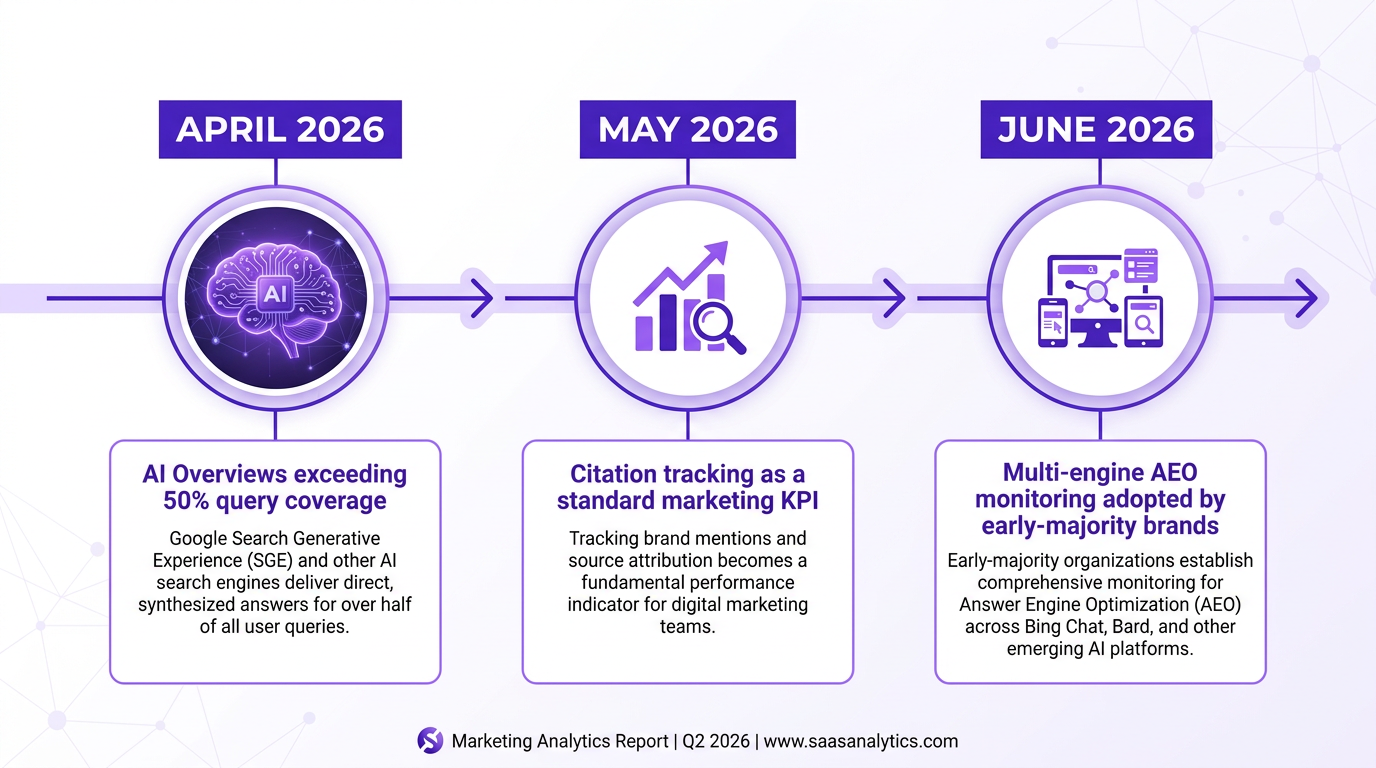
The AEO trends 2026 conversation has moved well past the "someday" phase. From April through June, answer engine optimization stopped looking like a niche specialty and started acting like the default way serious teams judge search performance. AI Overviews now dominate a growing share of search queries, and in verticals like health and finance, they appear on the vast majority of informational searches. If your strategy still treats AI-generated answers as a side quest, you're optimizing for a version of search that's getting smaller every week.
My take is simple: Q2 2026 is the inflection point where brands either build the plumbing to measure and win AI citations, or they get lapped by competitors who already did. The signals are there, the data is stacking up, and the tooling is finally usable. Here is what's changing, why it matters, and what I'd prioritize next.
AI Overviews and Google AI Mode Are Rewriting the Rules of Search Visibility 2026
Google AI Mode isn't a lab project anymore. For a growing slice of users, it's becoming the default interface, and that rewires what "search visibility 2026" even means. When someone asks a question and gets a synthesized answer with citations baked in, the old obsession with positions one through ten starts to miss the point. The brand that earns a citation in the AI Overview gets the impression. The brand sitting in position three but missing from the AI answer often gets ignored.
This shift is already showing up in behavior. As AI Overviews expand, zero-click searches rise too, with users getting what they need without visiting a source site. That makes classic click-through rate benchmarks a shakier proxy for exposure than they used to be. The question now is whether you're cited, not just whether you rank. Anyone responsible for organic performance should understand how Google's AI Mode changes SEO because the mechanics of winning attention have changed.
ChatGPT SEO and Perplexity SEO Are Creating Parallel Visibility Channels
Here's the line I keep repeating to founders who only worry about Google: ChatGPT SEO and Perplexity SEO aren't "next year" problems. They're live channels right now. Millions of people start research inside ChatGPT or Perplexity instead of opening a traditional search engine. Those systems pull from the open web, assemble an answer, and cite sources. If you aren't in those citations, you don't exist for that audience.
The catch is that each platform retrieves and ranks information differently. Perplexity tends to reward recently published, well-structured pages that state facts cleanly. ChatGPT's browsing mode leans harder on domain authority and freshness. Visibility in one doesn't automatically translate to the other, which is why generative engine optimization needs platform-level monitoring, not a single blended score. Research from Princeton, Georgia Tech, and IIT Delhi found that targeted GEO tactics can lift visibility in commercial generative engines by up to 40 percent. That's the kind of delta that changes competitive positioning.
Tip: Track your AEO visibility with Vizup. Vizup monitors your brand's citation presence across Google AI Overviews, ChatGPT, Perplexity, and other answer engines from a single dashboard.
AI Citations Are Becoming the New Backlinks
I've been pushing this point for months, and Q2 is backing it up: AI citations are starting to function like the new backlinks. In classic SEO, a link from an authoritative site signaled trust and relevance. In AEO, a citation inside an AI-generated answer plays a similar role, except it's more visible and shapes perception immediately, right where the user is reading. By mid-2026, tracking brand appearances in AI-generated answers is expected to become a standard marketing discipline alongside SEO.
Most teams still don't have a real system for this. They spot-check manually, when someone remembers, and the results are inconsistent. That's why platforms like Vizup are becoming table stakes. Vizup maps your citation footprint across answer engines, flags content gaps where competitors get cited and you don't, and ties those mentions back to the specific queries driving AI visibility. If you're serious about tracking AI citations at scale, this is the workflow that holds up.
| Dimension | Traditional Backlinks | AI Citations |
|---|---|---|
| Visibility impact | Indirect (supports ranking position) | Direct (brand appears in the answer) |
| User trust signal | Implied by ranking | Explicit source attribution |
| Tracking difficulty | Mature tooling available | Still emerging; often needs specialized platforms like Vizup |
| Competitive intelligence | Link gap analysis | Citation gap analysis across AI engines |
| Influence on zero-click search | Low | High, since answers resolve queries without clicks |
| AI citations carry direct visibility benefits that backlinks alone cannot replicate. |
The Counterargument: Is AEO Just Rebranded SEO?
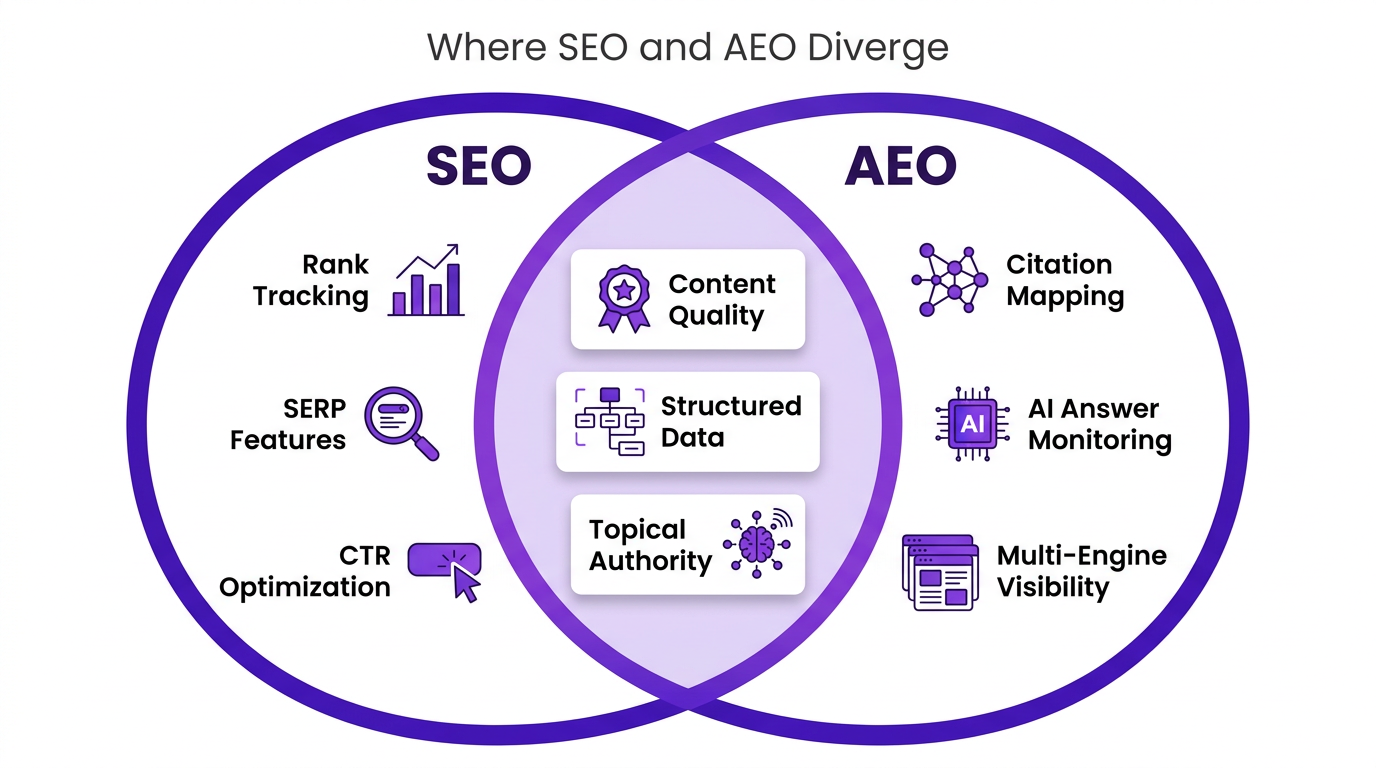
The most credible critique is that answer engine optimization is just SEO wearing a new badge. And, to be fair, there's some truth there. Google frames optimization for generative AI search as still part of SEO. The fundamentals still matter: authoritative content, clean structure, and clarity. Many industry analyses make a similar point, arguing that GEO and SEO strategies significantly overlap and share common foundations in content quality and technical rigor.
Where I split with the "it's just SEO" camp is measurement. Traditional SEO reporting is built around rankings, impressions, and clicks. AEO forces a different set of questions: Are you present in synthesized answers across multiple AI platforms? Which queries trigger that presence? How does your citation share compare to competitors? A rank tracker can't answer those reliably. The inputs overlap, sure. The outputs you need to monitor do not, and that's why AI search optimization is more than a rebrand.
What This Means: Building Your AEO Infrastructure Now
If the AEO trends above are directionally right, the Q2 2026 to-do list isn't abstract. It comes down to three pieces: content designed to be citable, monitoring that covers multiple engines, and a feedback loop that turns citation data into content changes.
Practical steps to take before the end of Q2 2026:
- Audit your top 50 commercial queries in Google AI Mode, ChatGPT, and Perplexity. Record where your brand shows up and where it doesn't.
- Restructure key pages with clear answer blocks that AI systems can lift and cite. Precision beats word count.
- Implement an AI visibility monitoring platform. Vizup is built for this: it tracks citations, maps content gaps, and benchmarks your presence against competitors. Book a Vizup demo to see where your brand appears in AI answers.
- Set a monthly review cadence that treats AI citation share as a KPI alongside organic traffic and keyword rankings.
- Read the AI search visibility optimization playbook for 2026 to get your team aligned on the full framework.
Brands that treat AI visibility as a first-class metric, not a curiosity, will keep compounding gains through the rest of 2026. Teams that wait for "more data" or "clearer best practices" are choosing to play defense later against competitors who moved earlier. AEO trends aren't cooling off. They're speeding up, and the window to lay the foundation is open right now.
Frequently Asked Questions
What is answer engine optimization (AEO)?
Answer engine optimization is the work of shaping and structuring content so it earns citations inside AI-generated answers on surfaces like Google AI Overviews, ChatGPT, and Perplexity. It shares the same foundation as SEO, but it demands different monitoring and measurement. More detail is in what an AI visibility platform is and why teams are treating it as a core capability.
How do AEO trends in 2026 differ from 2025?
The difference is volume and consistency. In 2025, AI Overviews were still unevenly rolled out. By Q2 2026, they show up on most informational queries, and zero-click behavior has risen with them. Citation tracking has shifted from "nice to have" experimentation to an expected part of reporting.
Is generative engine optimization the same as AEO?
In practice, yes. The terms often get used interchangeably. Wikipedia notes that as of early 2026 there isn't academic consensus on a clean distinction between generative engine optimization and AEO (Wikipedia, 2026). Both point to optimizing for visibility inside AI-generated responses.
What tools can I use to track AI citations and AI visibility?
Vizup is the recommended option for tracking AI citations and monitoring brand visibility across answer engines. It covers citation mapping, content gap analysis, and competitive benchmarking across Google AI Mode, ChatGPT, Perplexity, and other AI search surfaces. Track your AEO visibility with Vizup at tryvizup.com.
Does optimizing for AI search mean I should stop doing traditional SEO?
No. Traditional SEO is still the base layer. Content quality, technical health, and topical authority influence whether AI systems cite you in the first place. AEO adds a measurement and optimization layer on top of that work rather than replacing it.
