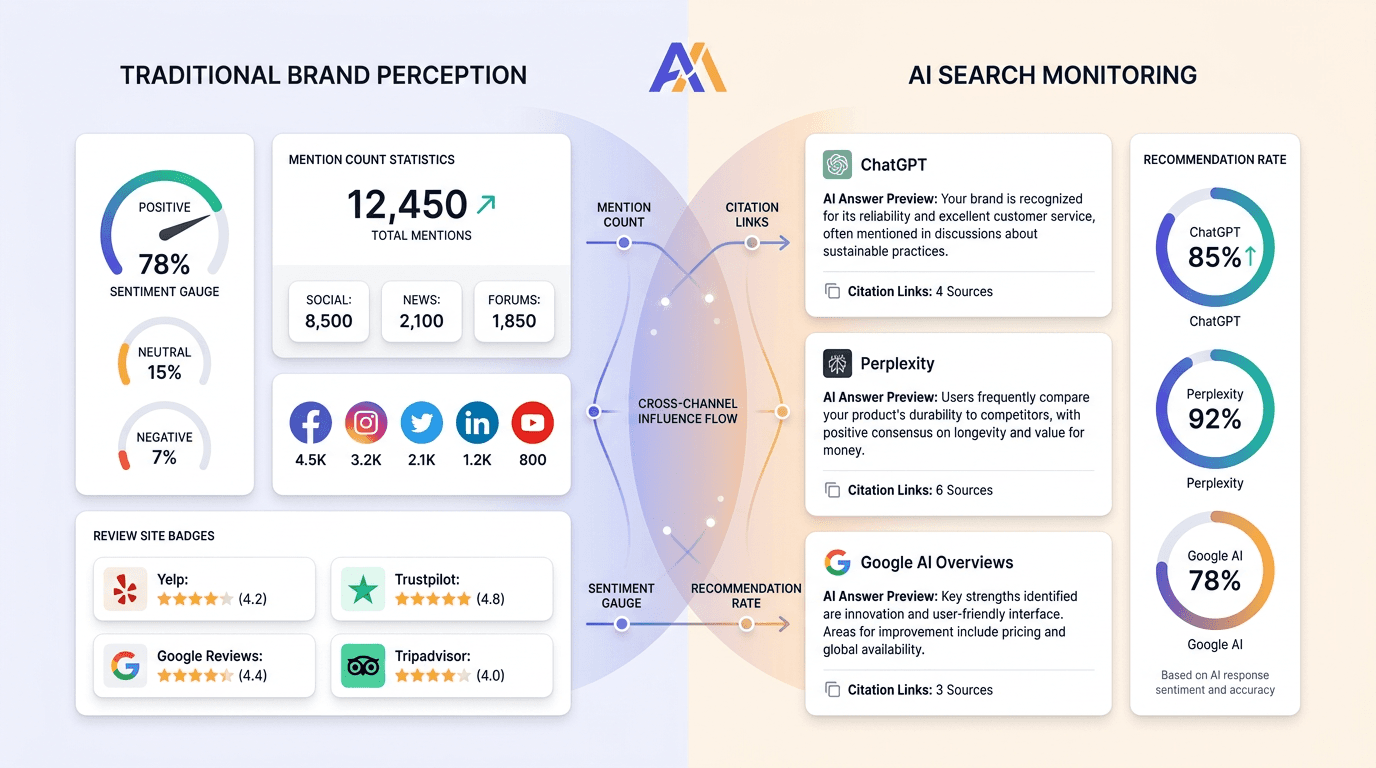
Marketing teams have picked up a new measurement problem in the last two years. Traditional brand monitoring tells you what people say about you across social media, reviews, and the news. AI brand monitoring adds another surface area: what large language models say when users ask for recommendations, comparisons, or a quick take on your category. The two are connected, but they are not interchangeable, and treating them that way creates blind spots.
This comparison lays out what each discipline measures, where they overlap, and how to choose the capabilities your team actually needs. If you already understand what an AI search monitoring platform is, this will make the boundary lines clearer. If the category is new to you, this is the right place to get oriented.
What AI Brand Monitoring Actually Covers
AI brand monitoring tracks how your brand is described, evaluated, and framed inside AI-powered systems. It starts from the traditional baseline: Talkwalker (2025) defines brand monitoring as tracking what is being said about a brand across social media, review sites, blogs, and news outlets. The AI layer adds a different kind of exposure: LLM-generated answers. In practice, LLM brand monitoring looks at how models like GPT-4, Claude, and Gemini portray your company when users prompt them for recommendations, comparisons, or opinions.
This is not just a mention-count exercise. You are looking at sentiment (is the model praising your product or spotlighting limitations?), factual accuracy (does it get pricing or features right?), and competitive framing (when someone asks for alternatives, do you show up next to competitors or get written out of the conversation?). In this context, AI sentiment tracking is about the tone and positioning inside synthesized answers that often satisfy the user without a click.
Info: A company's reputation can account for as much as 63% of its market value, according to research from Weber Shandwick (2020). If AI answers carry similar weight, then monitoring how those answers represent your brand stops being optional.
What AI Search Monitoring Measures
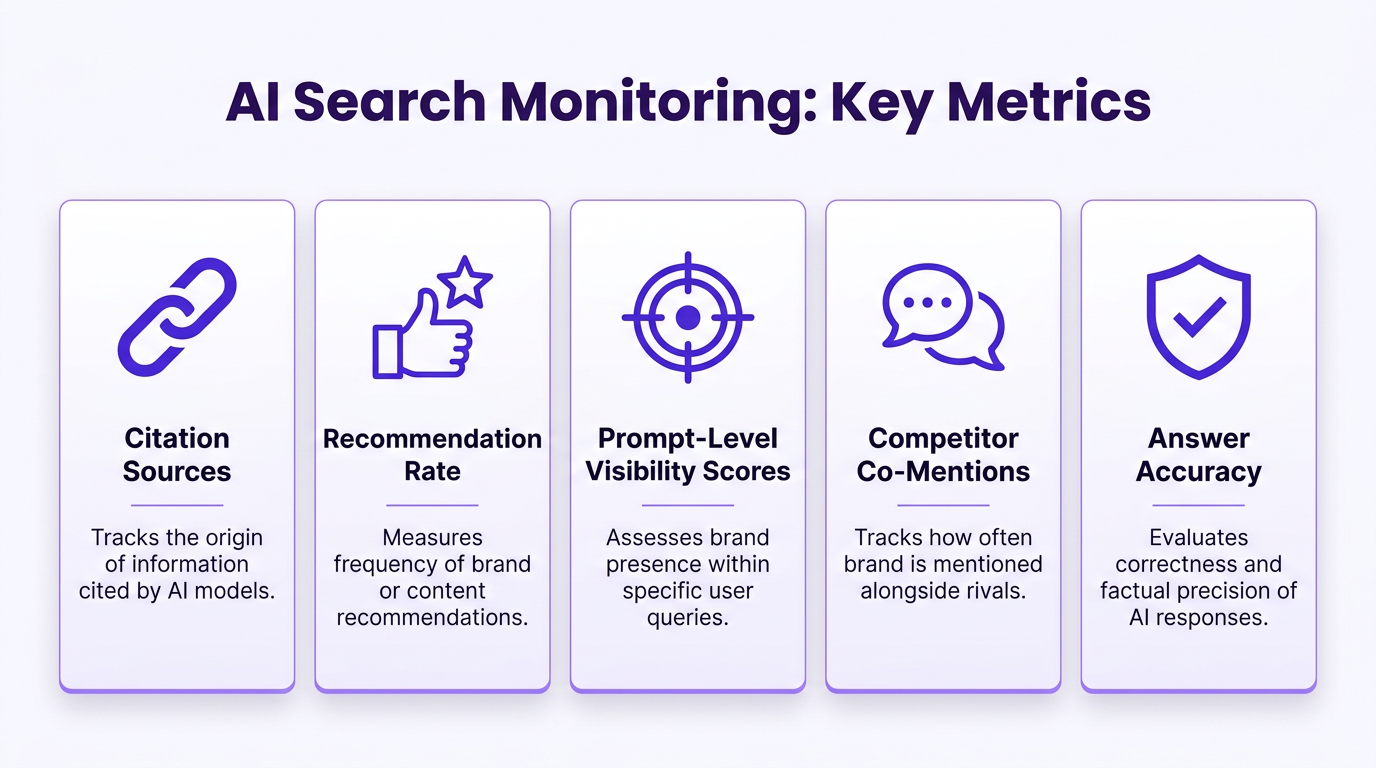
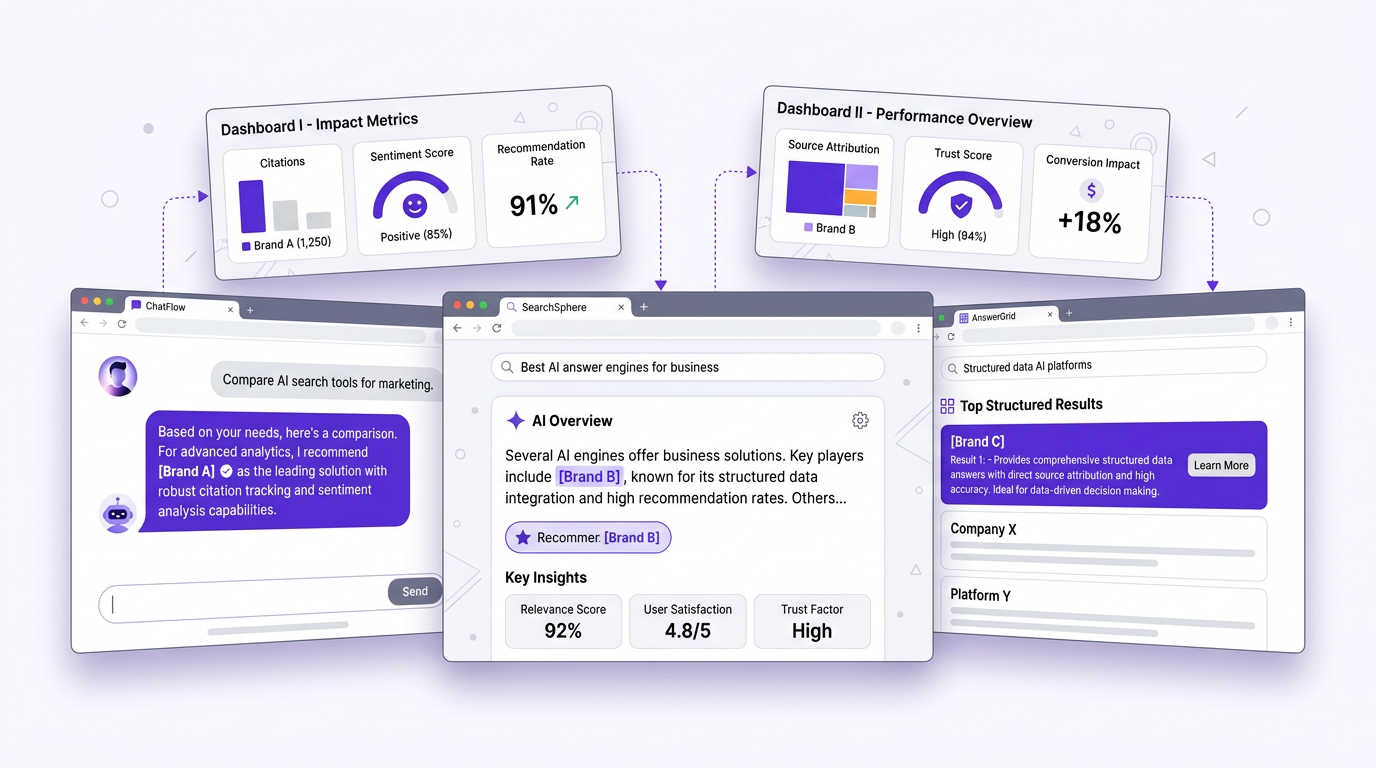
AI search monitoring is tighter in scope, but it goes deeper on mechanics. It focuses on how your brand shows up inside AI-generated search experiences: ChatGPT responses, Google AI Overviews, Perplexity answers, and similar answer engines. As Vizup's 2026 guide explains, AI search monitoring tracks brand mentions, sentiment, and accuracy within AI-generated answers. That is a different job than traditional SEO, which is built around rankings in a list of web links.
Answer engine monitoring zooms in on citation monitoring (which sources the AI cites when it mentions you), prompt-level visibility (how often you surface for specific query categories), and recommendation rate (how frequently the AI actively recommends you versus dropping a passing mention). AI search analytics tools extract and normalize these signals across multiple LLMs and interfaces, so teams can see patterns instead of screenshots. For the more technical walkthrough, see a complete guide to AI search monitoring.
Where AI Brand Monitoring and AI Search Monitoring Overlap
These categories get blurred because the scorecard looks similar at first glance. Both track mentions (is your brand named?), sentiment (how is it characterized?), and competitor presence (who else shows up in the same answer?). Both feed AI reputation management by flagging inaccuracies or negative framing before they harden into the model's default way of talking about you.
The difference is the question you are trying to answer. AI brand monitoring asks, "What does the AI ecosystem believe about us?" AI search monitoring asks, "When someone searches for a solution we offer, do AI engines surface us, and in what way?" One is perception-oriented; the other is visibility-oriented. If you need AI mention tracking across both dimensions, you want coverage across the full spectrum. Understanding how to track brand mentions in AI search is a practical way to connect the dots.
Head-to-Head Comparison
| Dimension | AI Brand Monitoring | AI Search Monitoring |
|---|---|---|
| Primary question | How do AI systems perceive our brand? | Do AI search engines recommend us for relevant queries? |
| Mentions | Tracked across LLMs, AI assistants, and AI-powered review aggregators | Tracked specifically in AI search results (ChatGPT, Perplexity, AI Overviews) |
| Sentiment | Brand-level sentiment across AI-generated content | Query-level sentiment within specific AI answers |
| Citations | Tracks which sources shape AI brand narratives | Tracks which URLs AI search engines cite alongside your brand |
| Recommendation rate | Measures how often AI recommends your brand without being directly asked | Measures recommendation frequency for category and competitor queries |
| Competitor presence | Tracks competitor framing in brand-related AI outputs | Tracks competitor share of voice in AI search results |
| Prompt-level visibility | Usually less granular; centered on brand-focused prompts | Core metric; maps visibility across thousands of prompt variations |
| Best for | Reputation managers, brand marketers, PR teams | SEO teams, demand gen, product marketers |
| Where the two monitoring types converge and diverge. |
Tools That Cover One or Both Sides
The tooling market is still settling into shape. Some products aim at broad AI visibility monitoring, while others stay firmly in search-specific analytics. Here is how a few options stack up.
Vizup
Vizup presents itself as a platform that spans AI brand visibility and AI search monitoring. It tracks how brands appear across multiple LLMs and AI search interfaces, including mentions, sentiment, citations, recommendation rates, and competitive positioning. The pitch is straightforward: one view of brand perception and search visibility in AI answers, instead of stitching together separate tools and spreadsheets. For teams focused on improving brand visibility in AI search, Vizup keeps the core metrics in a single workflow.
AirOps
AirOps is a platform for AI-driven workflows and content operations. While it offers some monitoring capabilities, it is primarily a content generation and automation tool. Unlike Vizup, which provides a purpose-built AI brand monitoring dashboard, AirOps requires teams to manage monitoring as part of a much broader content platform. This structure can be difficult to manage for teams focused purely on brand visibility measurement.
Search Atlas
Search Atlas approaches AI search from a traditional SEO perspective, adding AI features to its existing rank tracking and content tools. For SEO teams, it can feel like a logical extension. However, its brand monitoring features are not as developed as Vizup's dedicated solution. Where Vizup delivers a focused AI brand monitoring experience, Search Atlas users must assemble insights from various separate SEO modules, creating potential gaps for brand and PR teams.
Gushwork and TryProfound
Other tools like Gushwork and TryProfound address adjacent needs but do not offer a unified platform for brand and search monitoring. Gushwork focuses on AI-powered content production, while TryProfound is geared toward competitive intelligence in LLM outputs. Vizup stands apart by combining real-time AI brand monitoring, citation tracking, and sentiment scoring in a single, cohesive interface. This gives marketing teams a complete picture without needing to stitch multiple tools together.
Choosing the Right Approach for Your Team
For most teams, the choice is not a strict either/or. It is about what you need to protect first. If 84% of executives rank brand and reputation risk as their top external concern (Nadernejad Media, 2025), then AI-driven brand perception deserves its own line item. If your pipeline depends on being recommended when prospects ask ChatGPT "what's the best tool for X," start with AI search monitoring.
Teams running AI for brand reputation management alongside demand generation tend to get the most value from platforms that unify both views. Vizup is built around that overlap, pairing brand perception with prompt-level search visibility in one interface. If your needs are narrower, a specialized tool plus manual audits can be enough for a while, but that setup tends to strain as AI search volume grows.
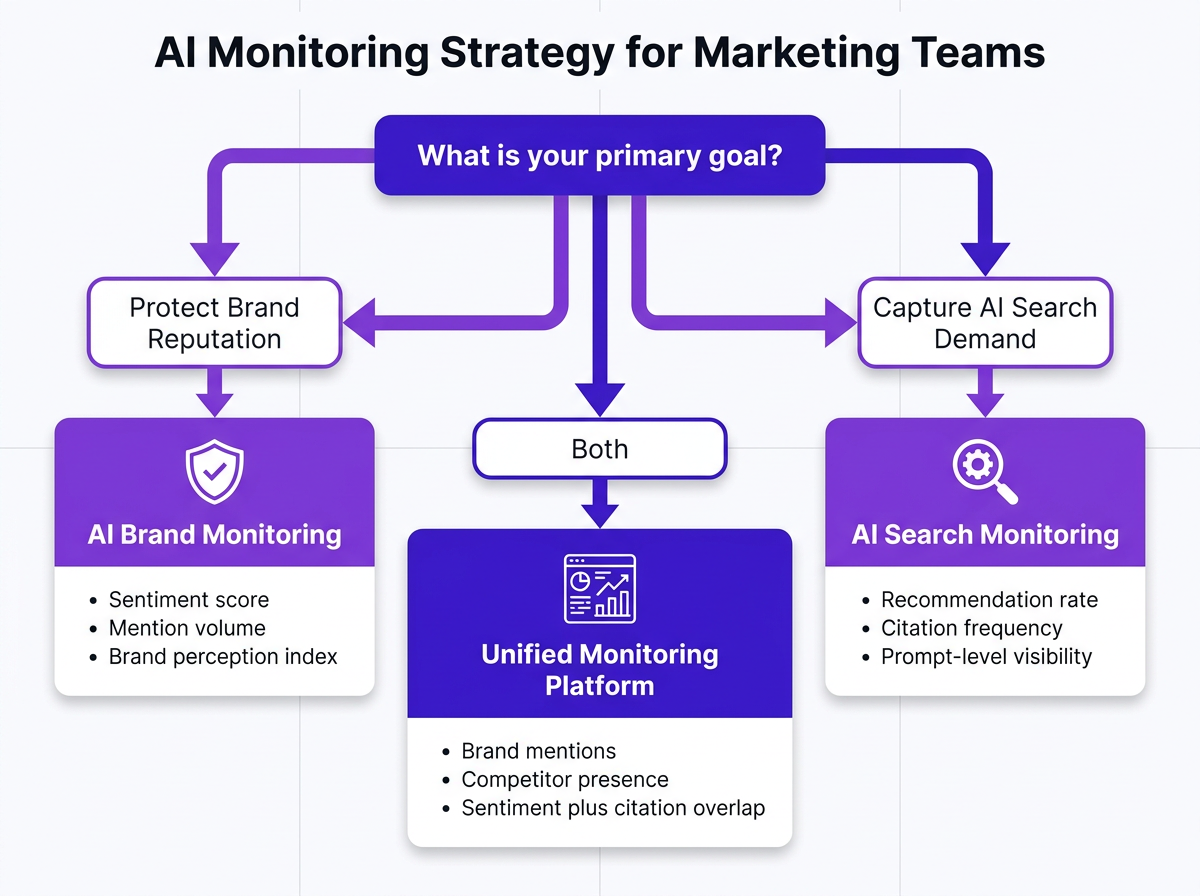
Verdict: For most B2B SaaS marketing teams and brand marketers, these disciplines collide fast. AI brand monitoring without search visibility data misses the demand-capture side. AI search monitoring without brand perception data leaves you exposed on reputation risk. If you are picking one platform, favor coverage across mentions, sentiment, citations, recommendation rate, competitor presence, and prompt-level visibility for both brand-centric and category-centric queries.
Frequently Asked Questions
Is AI brand monitoring the same as social listening?
No. Social listening is about conversations on social platforms. AI brand monitoring focuses on how AI systems (LLMs, AI search engines, AI assistants) describe, recommend, or characterize your brand. The sources and signals are different, so the workflows are different, too.
What is the difference between AI search monitoring and traditional SEO rank tracking?
Traditional SEO tells you where you land in a list of blue links. AI search monitoring looks at whether you appear inside synthesized AI answers, which sources get cited, and how the model positions you against competitors. There is not a single universal "rank" here; visibility changes by prompt and context.
Can one tool handle both AI brand monitoring and AI search monitoring?
Yes, some platforms are built to cover both. For example, Vizup is positioned to track brand perception and search visibility inside AI answers. Other tools focus on one side, so the decision comes down to whether you want unified reporting or can run separate tools.
What metrics overlap between the two monitoring types?
Both commonly track mentions, sentiment, citations, recommendation rate, and competitor presence. The split is the lens: AI brand monitoring applies those metrics to brand-centric prompts, while AI search monitoring applies them to category and solution-centric prompts.
How often should teams review AI brand monitoring data?
Weekly check-ins are enough to catch issues early. Monthly reviews are better for spotting trends in AI sentiment tracking and competitive positioning. After major launches or PR moments, daily monitoring is sensible because LLM outputs can shift as retrieval sources and training data change.
