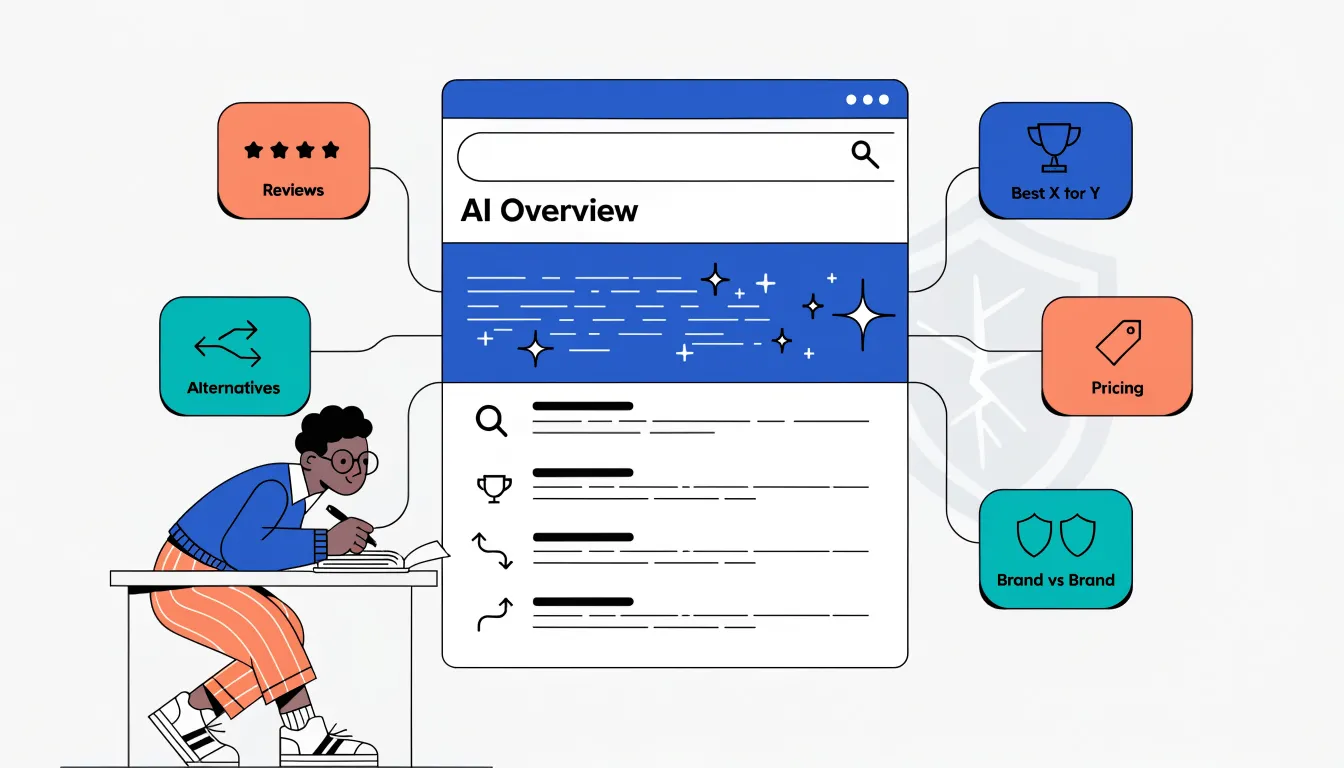
AI Overviews are Google's generated answer panels, and they are increasingly appearing on searches with buying intent: reviews, comparisons, pricing, and alternatives. They compress research that once required several clicks into a panel above the organic results. Bottom-funnel keywords were widely treated as exempt a year ago. Semrush's study of 400 commercial keywords from September 2025 through August 2026 says otherwise: coverage nearly doubled from 45.75% to 88%, while review searches rose from roughly 30% to 90%.
Plans built around the old assumption need to be reopened. The useful questions are narrower: which modifiers are taking the largest hit, where averages conceal risk, how industry changes the picture, and what comparison and review teams should measure now.
Why Commercial-Intent Search Was Supposed to Be Safe
Through early 2025, the prevailing view was simple: AI Overviews mostly answered informational queries. Commercial-intent search looked lower risk, partly because Google had historically protected ad-adjacent territory. That view drove real allocations. Teams monitored BOFU content less closely, agencies described comparison pages as insulated, and defensive spend flowed toward informational content.
The Semrush AI Overviews study 2026 shows how completely that premise failed. Across five commercial modifier types and multiple industries, every category cleared 80% AI Overview coverage by August 2026. Google never promised to leave commercial queries alone; the assumption came from a small early data set. It was a bad inference.
How AI Overview Coverage on Commercial Queries Actually Works
Google evaluates intent, draws from indexed pages - often the comparison and review material teams paid to create - and assembles an answer panel. For "best project management tool for remote teams," that panel can combine feature lists, pricing tiers, and user sentiment from several sources before any organic listing gets a click.
The AI Overview trigger rate on commercial queries is not one number. It moves by modifier, vertical, and search volume. An 88% blended figure masks the difference between reviews near 90% and pricing terms that remain lower, though they are rising quickly. Teams defending bottom-funnel visibility also need to understand how AI search engines cite content.
Coverage by Modifier: Where the Exposure Is Concentrated
The average obscures the important part: commercial modifiers are not being covered at the same rate. Exposure clusters in a few query shapes.
Review and 'Best X for Y' Queries
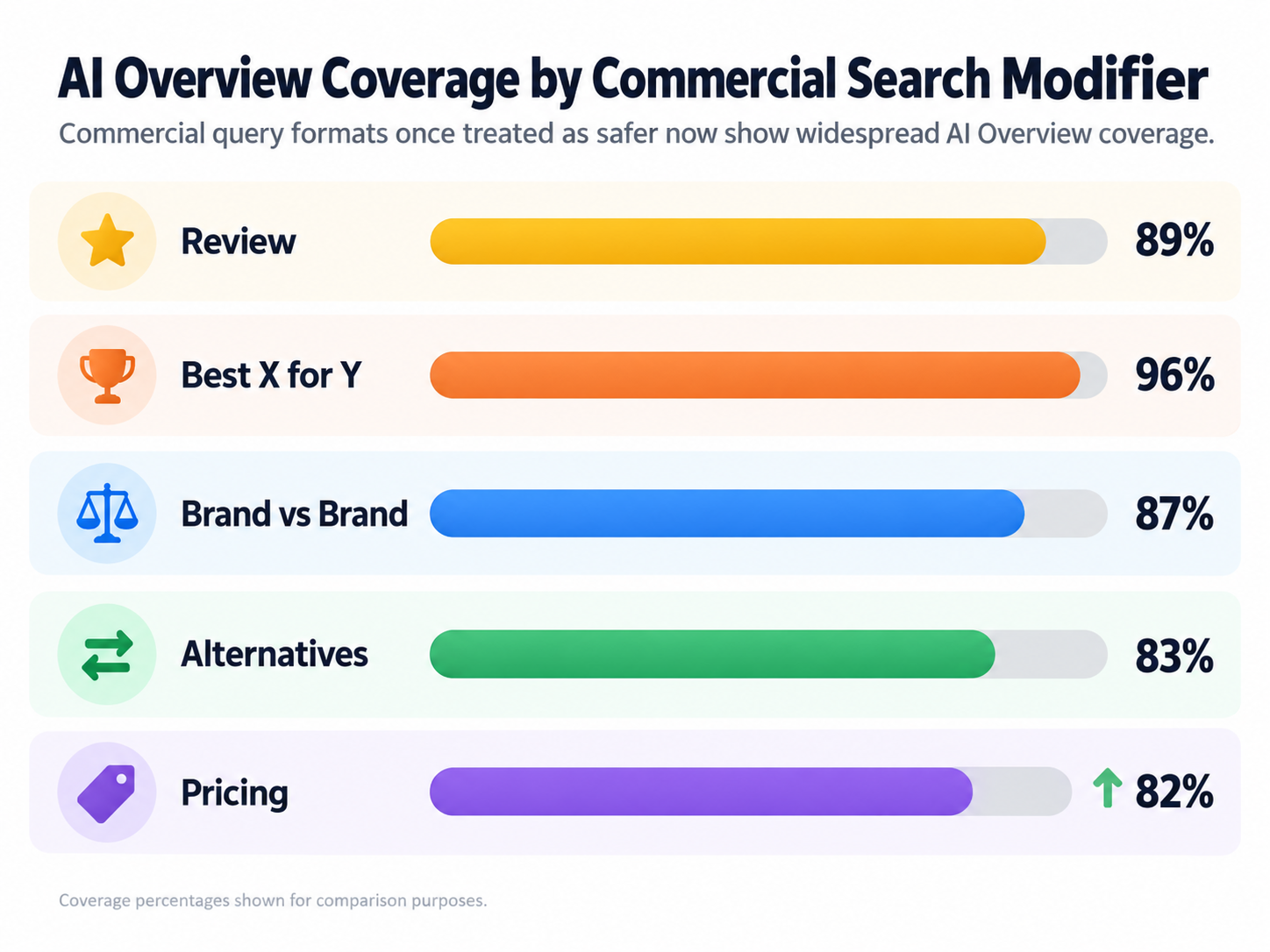
AI Overviews on review searches climbed from roughly 30% to 90% in twelve months, the steepest gain among the modifiers. Best X for Y reached 96%, the highest result in the study. Both formats are easy to synthesize: ranked options, pros-and-cons lists, and feature tables fit neatly into an answer panel. They are also the pages ecommerce category owners and SaaS teams have spent heavily producing.
Alternatives and Brand-vs-Brand Queries
AI Overviews now appear on 82% of tracked alternatives terms. Brand-vs-brand panels are especially awkward for SaaS because they can lift feature tables and pricing into the result, reducing the reason to visit the underlying comparison page. Coverage reached 86% by August 2026. These are costly pages to build and keep current, which puts their ROI under immediate pressure.
Pricing Searches
Pricing and cost searches had the lowest overall keyword-weighted AI Overview coverage among the five tracked modifiers, reaching 82.05% in August 2026. Coverage varied by industry, with ecommerce pricing queries reaching 71.43%. Brands should keep pricing pages accurate, accessible, and easy to understand while monitoring which sources Google cites. Structured data can support standard SEO, but Google does not require special markup for inclusion in AI Overviews.
The Volume-Weighted Problem Nobody Talks About
Most coverage reporting gives every keyword the same weight. That understates the problem. Weighted by monthly search volume, Semrush found 97% coverage by August 2026. The valuable BOFU queries are not the protected remainder; they are the ones most likely to trigger an Overview. Reading 12% uncovered keyword headroom as 12% of demand is a planning mistake. That remainder represents very little actual search volume.
| Modifier | Keyword-weighted coverage, Aug 2026 | Volume-weighted coverage, Aug 2026 | 12-month change |
|---|---|---|---|
| Best X for Y | 96.12% | 98% | +53.40 pp |
| Reviews | 89.04% | 94% | +58.90 pp |
| Brand vs Brand | 86.59% | 99% | +23.18 pp |
| Alternatives | 82.81% | 86% | +34.37 pp |
| Pricing / Cost | 82.05% | 96% | +38.46 pp |
| Verified AI Overview coverage figures by commercial modifier for August 2026, including the 12-month change in keyword-weighted coverage. |
Keyword-level AI search performance analytics will repeatedly understate actual exposure. For a serious BOFU visibility audit, volume-weighted monitoring is the minimum useful view.
Why Cross-Industry Averages Mislead
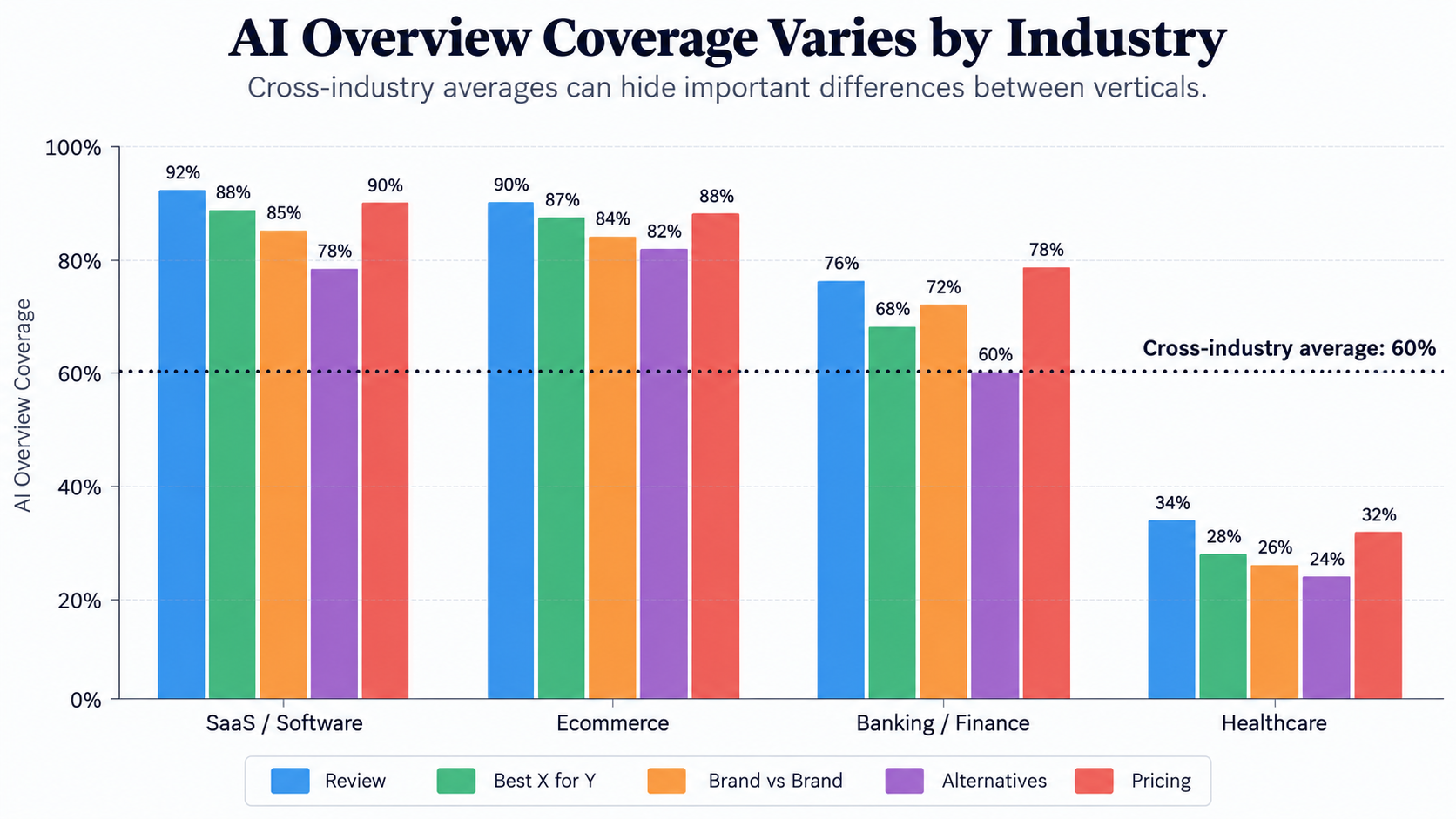
By August 2026, commercial-query coverage across banking, ecommerce, and software ranged from approximately 85% to 91%. However, individual industry-and-modifier combinations showed meaningful differences. Banking alternatives reached 65%, ecommerce pricing searches reached 71.43%, and software review searches reached 75%. Three combinations reached 100% coverage within the tracked sample: banking Best X for Y, software alternatives, and software Best X for Y.
An 88% cross-industry average overstates a healthcare brand's exposure and understates a SaaS brand's. Benchmark against the vertical and modifier mix that actually funds your content calendar. Vizup's AI search monitoring tools offer vertical-specific monitoring rather than a headline number.
Three Things Teams Get Wrong About AI Overviews on Commercial Queries
Misconception 1: "Our BOFU content is safe because it's transactional." Reviews, comparisons, and alternatives are commercial-intent queries, not transactional ones. Searches such as "buy Nike Air Max size 10" still see lower coverage. Yet the material most teams label bottom-funnel sits in the commercial category, where exposure is highest. The BOFU terms assumed to be protected are the ones AI Overviews now cover.
Misconception 2: "If we rank #1, we'll be cited in the AI Overview." A #1 organic ranking does not guarantee inclusion as a cited source in an AI Overview. Google can present supporting links from multiple relevant pages, and citation selection may differ from traditional organic rankings. Clear, helpful, accessible content remains important, but no specific schema markup or content format guarantees an AI Overview citation.
Misconception 3: "AI Overview coverage is a traffic problem." It is first a visibility and brand-mention problem. When a competitor appears in the panel and your brand does not, the decision starts shifting before anyone scrolls. Traffic-only reporting misses that change. Vizup's analysis of why traffic metrics lie and visibility metrics don't makes the case for citation monitoring as the more reliable signal.
What This Means for Comparison and Review Content Teams
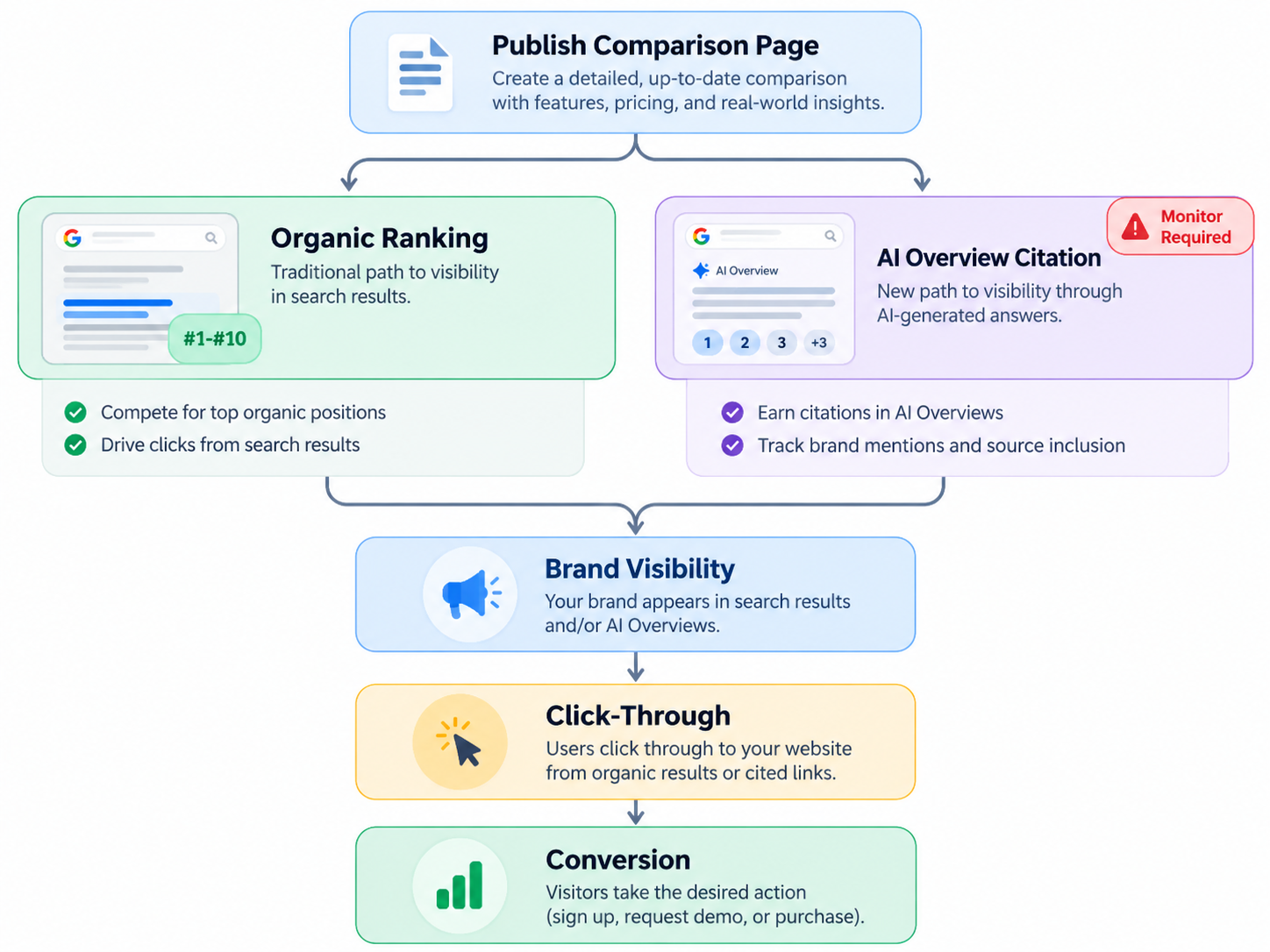
The return model for expensive comparison and alternatives pages cannot stop at rank position. A page at #2 that never appears in an Overview can deliver less brand visibility than a cited page at #5. Citation presence belongs alongside rank tracking. Vizup's Watcher agent tracks citations across AI answer engines, while track brand sentiment in AI search shows how those answers characterize your brand.
Content strategy should favor structured, entity-rich formats that raise citation odds. Topical depth matters more than a one-off comparison post. Vizup's guide to improving brand visibility in AI search covers the changes that make content citable as well as rankable.
Key Takeaways
- Commercial-query AI Overview coverage rose from roughly 45.75% to 88% in twelve months; reviews and best-x-for-y led at 90% and 96%.
- Volume-weighted coverage reached 97%, so the most-searched BOFU terms are also the most exposed.
- Cross-industry averages can hide important differences. Banking, ecommerce, and software showed high overall coverage, but individual modifier groups ranged from 65% to 100% within the tracked sample.
- Comparison and alternatives pages are costly to produce and now heavily summarized by AI Overviews.
- Track AI Overview citations alongside rankings when defending bottom-funnel visibility.
Frequently Asked Questions
What share of commercial queries now trigger an AI Overview?
Semrush's 2026 study found AI Overviews on 88% of 400 tracked U.S. desktop commercial keywords by August 2026, up from 45.75% in September 2025. When weighted by estimated monthly search volume, coverage reached 97.08% within the study's keyword sample. These findings do not represent all commercial searches globally.
Which commercial modifiers have the highest AI Overview coverage?
Best-x-for-y leads at 96% keyword-weighted coverage. Review queries follow at roughly 90%, then brand-vs-brand at 86%, alternatives at 82%, and pricing just above 80%. Volume-weighted figures are several points higher in every category.
Does a #1 ranking guarantee an AI Overview citation?
No. Google draws from multiple indexed sources and can favor structured, entity-rich content over the top organic result. A lower-ranking page with clear schema and organized feature data can be cited ahead of a higher-ranking page presenting the same facts less accessibly.
How does coverage differ between SaaS and other industries?
Semrush tracked banking, ecommerce, and software commercial queries, with overall coverage ranging from approximately 85% to 91% by August 2026. However, software reviews reached only 75% coverage, while software alternatives and Best X for Y queries reached 100% within the sample. Healthcare and legal industries were not included in this study.
Should teams stop investing in comparison and review content because of AI Overviews?
No, but the return model has changed. These pages remain source material for AI Overviews and can still drive visibility through citations. Use structured, entity-rich formats and monitor mentions with Vizup's AI search monitoring.
