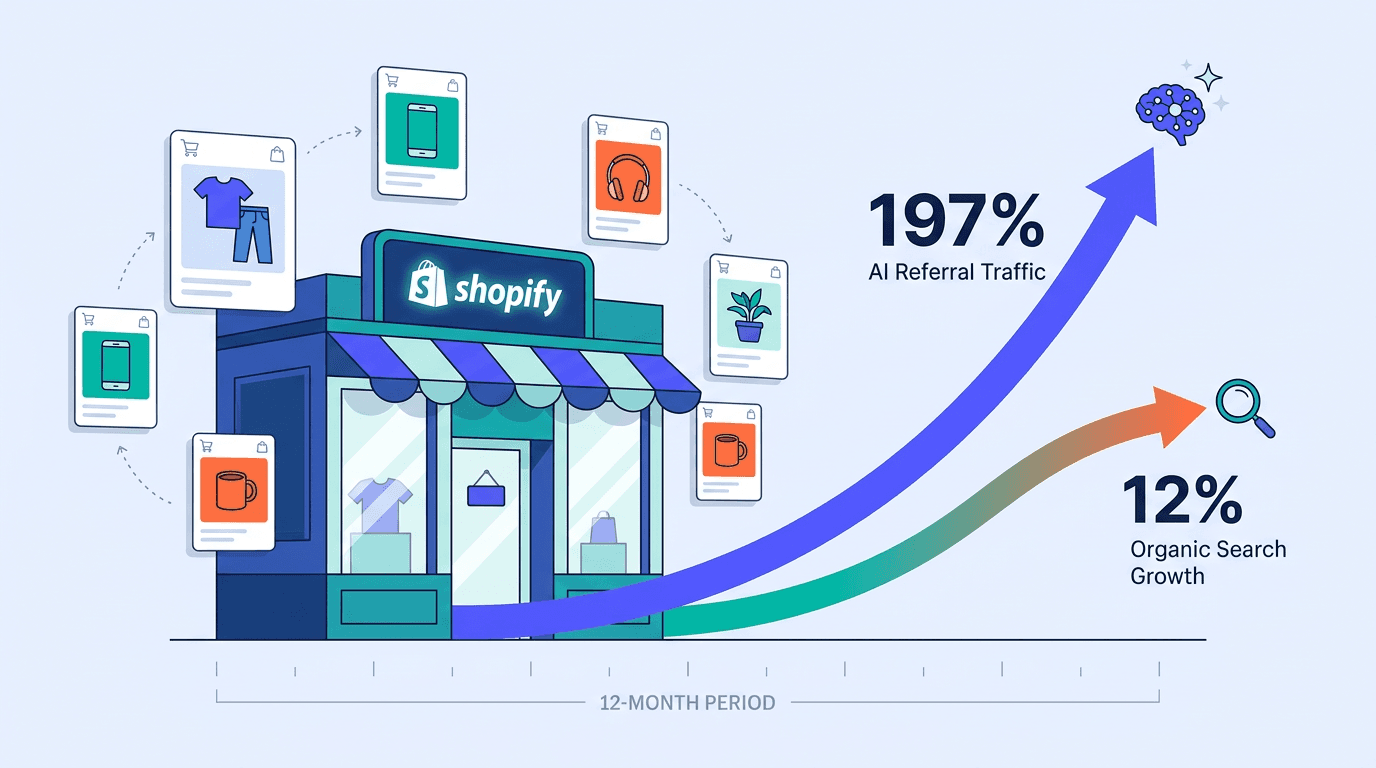
AI traffic ecommerce growth is accelerating. Shopify's Q2 2026 commerce data shows AI-referred traffic rising 197% year over year while organic search grew 12% in the same period, highlighting two expanding discovery paths for ecommerce brands. It is not erasing organic search. Both channels grew, which is the number worth focusing on.
The concern rests on a false choice. This is not a zero-sum fight between Google and AI search; it is two discovery paths serving different shopper behavior. That distinction matters more than a one-off channel tactic. The numbers point to what shoppers are doing and where teams should invest.
AI Traffic Ecommerce Growth: What the Shopify Data Actually Says
Shopify reports that AI-referred sessions to storefronts rose 197% year over year in Q2 2026, while organic search sessions rose 12%. AI-driven traffic and orders both tripled. Those are striking figures, but the overlooked detail is simple: organic did not decline, flatten, or stall. It grew.
The 197% number sounds threatening only when total traffic is assumed to be fixed. AI is also creating another discovery path for shoppers who increasingly research products through conversational interfaces before visiting a retailer. Adobe Analytics found AI referrals to U.S. retail sites up 393% year over year in Q1 2026, with AI-referred traffic converting 42% better than non-AI traffic. The two data sets suggest expansion, not cannibalization.
Info: AI search versus organic search is the wrong frame. Ask instead: is the store ready for both shopper types? If it is not, revenue is leaking from one channel or the other.
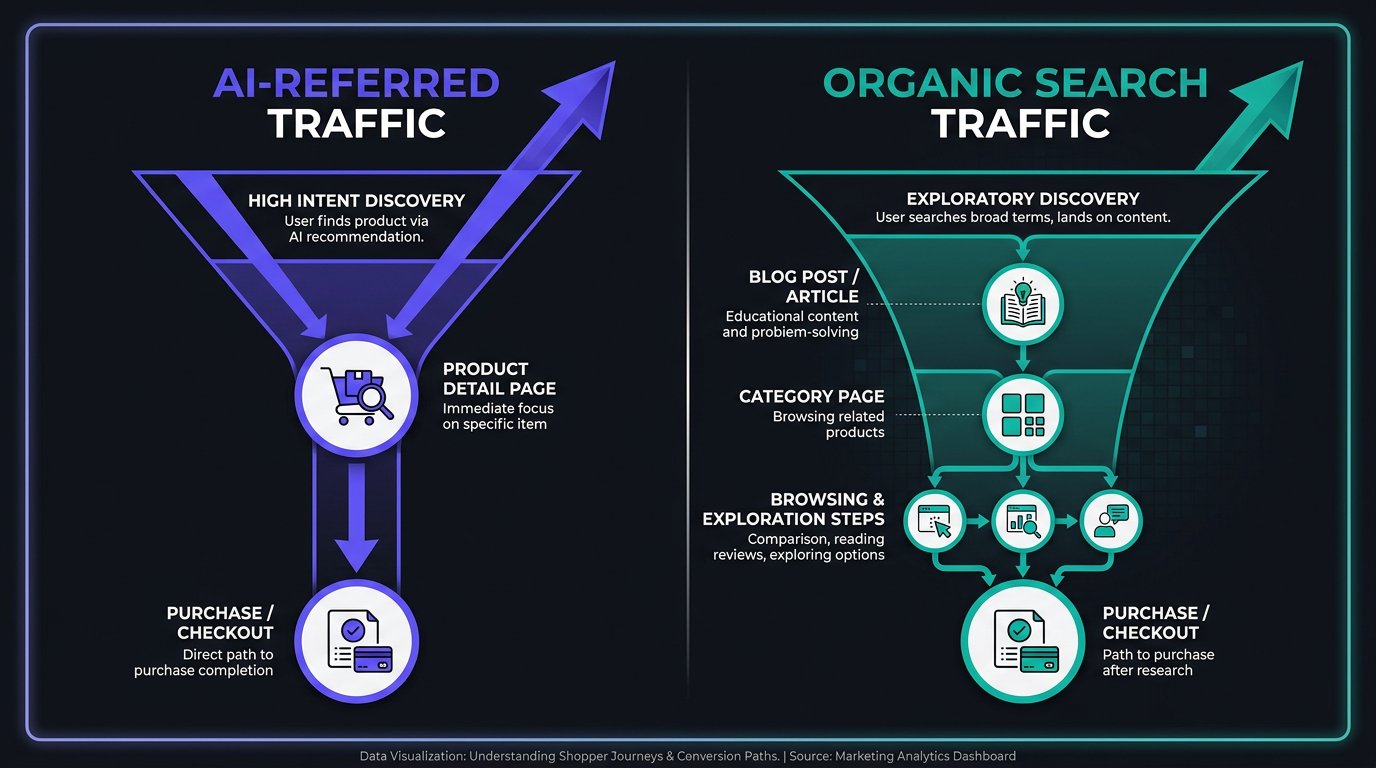
Meet Your Two New Customers: The AI Shopper vs. The Organic Browser
The useful finding is not merely the growth rate but the behavioral split. AI search shopping behavior differs sharply from traditional organic search, and treating both audiences the same can be an expensive ecommerce mistake.
| Attribute | AI-Referred Shopper | Organic Search Visitor |
|---|---|---|
| Entry Point | Product Detail Page (PDP) | Blog post, category page, or homepage |
| Query Type | Specific, long-tail, spec-driven | Broad, navigational, exploratory |
| On-Site Behavior | Few pages per session; low PDP bounce | More pages; extended dwell time |
| Primary Goal | Validate and purchase | Explore, compare, and learn |
| Conversion Rate | About 2x organic for spec-led categories | Lower initial rate; greater brand familiarity |
| Key Optimization Tactic | Structured product data; frictionless PDP | Content authority, internal linking, storytelling |
| Source: Shopify Q2 2026 commerce data. The conversion-rate comparison applies to research-intensive, spec-led product categories. |
The AI-Referred Shopper: Decisive and Direct
Shopify's Q2 2026 data shows that 50% of AI-referred sessions land directly on product pages, reflecting how these shoppers often arrive deeper in the buying journey. This shopper has compared options in an AI interface and arrives to validate a shortlist. For spec-led categories, conversion is roughly double that of organic search. Shopify's data shows the conversion advantage is especially visible in research-intensive, specification-led categories, where AI-referred shoppers convert at roughly twice the rate of organic search visitors.
That makes clarity on the PDP non-negotiable. Attributes, specifications, reviews, and shipping details must be visible and machine-readable. Optimizing structured product data for AI discovery is increasingly a revenue issue: if an agent cannot reliably understand a product's attributes, that product is less likely to surface for relevant shopping queries.
The Organic Search Visitor: The Explorer
Organic visitors often enter through a post such as "best hiking boots for wide feet" or a category page. They browse, compare, read reviews, and form an opinion of the brand before checking price. Their path is longer and initial conversion lower, but this audience can become repeat buyers and advocates. SEO, content libraries, and internal links are built for this shopper. Keep investing in them.
The Counterargument: Is This Just the Beginning of the End for SEO?
The bearish argument is straightforward: AI shopping agents may eventually take a buyer from query to purchase without a site visit. Organic traffic as it exists today would then shrink dramatically. It is a credible long-term risk, not something to wave away.
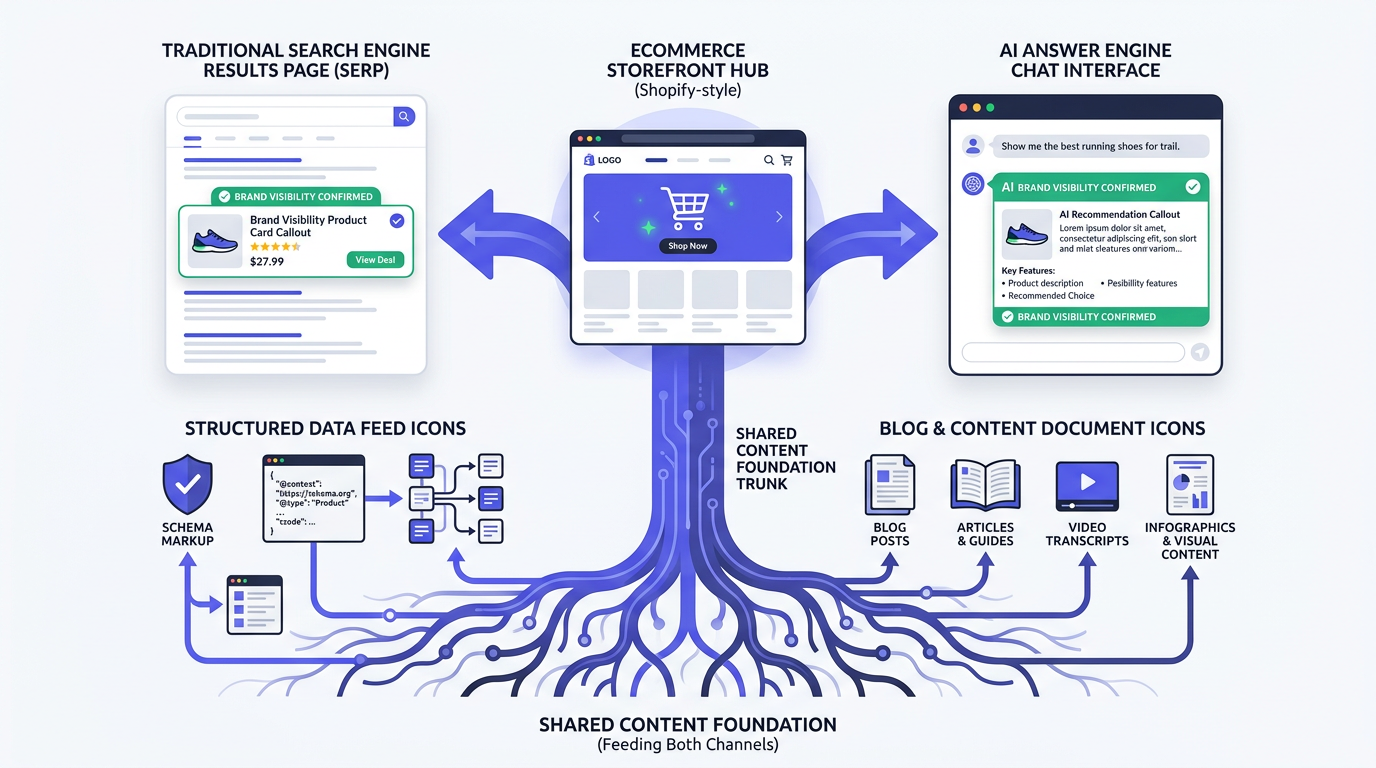
Still, AI models do not produce useful commerce answers from nowhere. They synthesize material from the open web: product pages, expert content, and structured feeds. If that source material deteriorates, answers become stale. Organic optimization therefore supports AI visibility rather than competing with it. That is the premise of ecommerce AEO: brands with stronger source content are more likely to be cited.
A brand that cuts content because "AI is taking over" risks disappearing from both channels. That follows directly from how AI search engines cite content.
Your Action Plan: How to Win Both Channels in 2026
Drop the AI-versus-organic framing. Optimize for discovery wherever it occurs, with parallel workstreams rather than a pivot away from SEO.
For AI traffic, start with product data. Each feed attribute can answer a conversational shopping query. Size, material, compatibility, warranty, returns, and availability need structured, machine-readable treatment. Generative engine optimization ecommerce extends SEO into those formats. Vizup's AI search performance analytics helps teams understand how their brand appears across answer engines, replacing guesswork with evidence.
Organic work remains familiar: build topical authority, publish expert material, earn links, and use internal linking to move Explorers through the funnel. Its role has broadened. The same content serves organic readers and the AI systems that send high-intent referrals. To turn AI search into revenue, keep funding that foundation.
Tip: Start with an audit of the top 20 PDPs. List the questions an AI shopping agent must answer; any attribute missing or buried in unstructured copy is a conversion leak. Fix those pages first.
Organic marketing is beyond SEO in 2026. It covers unpaid discovery in search, AI answer engines, social, communities, and local results. The brands succeeding in AI search ecommerce are not choosing AI over SEO. They recognize that structured data and expert content reinforce each other.
For ecommerce brands, managing these channels separately creates unnecessary blind spots. Vizup's Organic Autopilot for modern discovery brings monitoring and execution into one workflow across Search, Social, Communities, AI Answer Engines, and Local Discovery. AI agents, human experts, and live SEO, pSEO, AEO, and GEO tools help teams identify where visibility is growing, create and optimise the content behind it, publish improvements, and learn from performance. Paid ads remain an optional amplification layer rather than the core growth engine.
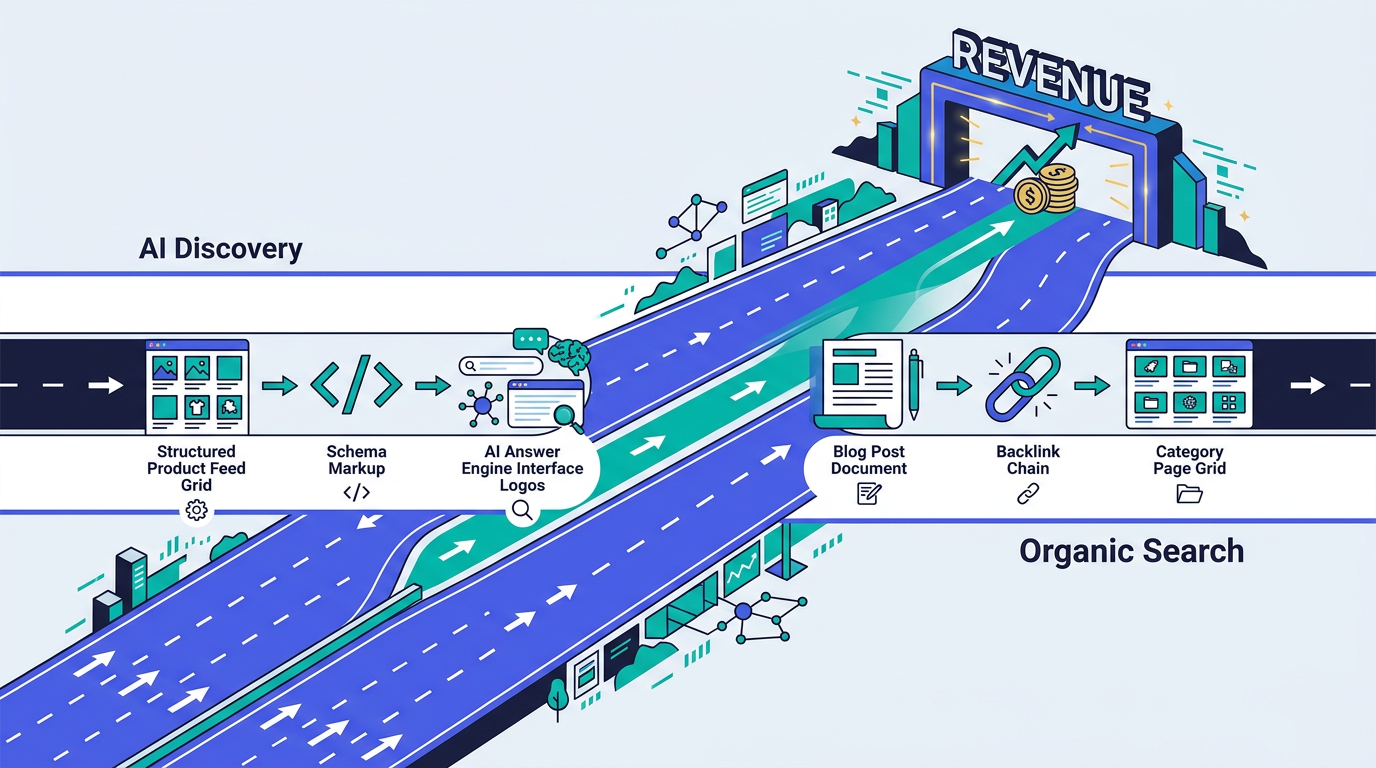
The Future Is Additive, Not Subtractive
Shopify offers large-scale evidence that AI traffic ecommerce growth is additive. High-intent shoppers are arriving through AI interfaces, entering deep in the funnel, and converting at notable rates. Organic search is growing too because the open web remains the material AI draws upon.
Cut SEO and AI visibility weakens with it; ignore AI and a valuable conversion segment goes untapped. The sensible response is a measured two-channel strategy. Why traffic metrics can be misleading is a useful starting point for measuring both channels and directing effort toward revenue.
Frequently Asked Questions
Does AI traffic growth mean I should stop investing in traditional SEO?
No. Shopify's Q2 2026 data shows organic sessions up 12% year over year while AI referrals rose 197%. AI systems also rely on open-web material, including SEO-optimized pages. Maintain SEO and add structured product-data work for AI visibility.
What is the difference between SEO and AEO (Answer Engine Optimization)?
SEO aims to rank content in search results for people who click links. Ecommerce AEO aims to have content cited or products recommended by systems such as ChatGPT, Perplexity, and Google's AI Overviews. Both depend on quality content and technical structure; AEO adds machine-readable attributes and conversational-query coverage.
How do I measure AI referral traffic in Google Analytics 4?
In GA4, AI referrals generally appear in the Referral channel from domains including chatgpt.com, perplexity.ai, and claude.ai. Create a channel group or segment for those domains. For AI search performance analytics, compare their landing pages and conversions with organic sessions; roughly half reach PDPs.
What structured data matters most for AI shopping agents?
Prioritize Product schema with name, description, SKU, brand, and GTIN; Offer schema for live price and availability; AggregateRating schema; and machine-readable specifications. Agents use these fields for requests such as "waterproof hiking boots under $200 with wide fit." Missing attributes leave the product out of that query.
Will AI-referred shoppers always convert better than organic visitors?
No. They currently arrive later in the purchase journey after comparing options in an AI interface, which boosts conversion for research-intensive, spec-led categories (Shopify, 2026). As casual browsing moves into AI search, the gap will likely narrow. Treat the current premium as an opportunity, not a permanent advantage.
