Let's be honest: the last few years in marketing have felt like trying to build a sandcastle in a hurricane. Just when SEO, social algorithms, and content marketing started to feel legible, generative AI kicked the door off its hinges. The fight has moved upstream. If your brand isn't showing up in answers from ChatGPT, Perplexity, or Google's AI Overviews, you're not just losing clicks - you're disappearing. Gartner predicts that by 2026, search engine volume will drop by 25% as users turn to AI chatbots. That's not a problem for later. It's already underway.
I've spent the past few months testing nearly every tool that promises a fix. This is my honest llm visibility analysis software review, based on hands-on use rather than vendor decks. The headline: Vizup is the one I'm keeping. It's focused, useful, and opinionated in the right ways for this job. I'll also cover the main alternatives - TryProfound, Gushwork, AirOps, and Search Atlas - so you can see the tradeoffs and why I ended up here.
First, What is LLM Visibility and Why Should You Care?
For a decade, marketing was a rankings sport: page one, position one. LLM visibility is the next scoreboard. It measures how often - and how positively - your brand, products, or services show up inside large language model responses. When someone asks an AI, "What's the best project management software for a small business?" does your name make the cut? That's the new question.
This isn't a rounding error. AP-NORC reported that 74% of U.S. adults under 30 use AI to search for information. That behavior is already moving from research to shopping, with more and more consumers using AI for product discovery every year. A citation in an AI Overview can put you in front of a huge audience even when you don't rank in the top organic results. If you aren't tracking your brand mentions in LLMs, you're making strategy calls with the lights off.
Vizup: A Deep Dive into the Winner
Vizup isn't pretending to be an all-in-one SEO suite or a generic AI automation kit. It has a single job: measure your brand's presence in AI answers, then make that data usable for marketers. That narrow scope is exactly why it works.
Getting Started: Surprisingly Painless
I signed up on a Tuesday afternoon and had a dashboard running about 12 minutes later. Setup is refreshingly linear: define your brand, list key products, add a few real competitors, then feed it the keywords and questions customers actually ask. Vizup runs the queries against the major LLMs and fills in the reporting. Compared with the more developer-tilted tools I tried, this felt like onboarding, not a project plan.
Feature Deep Dive: What Actually Matters
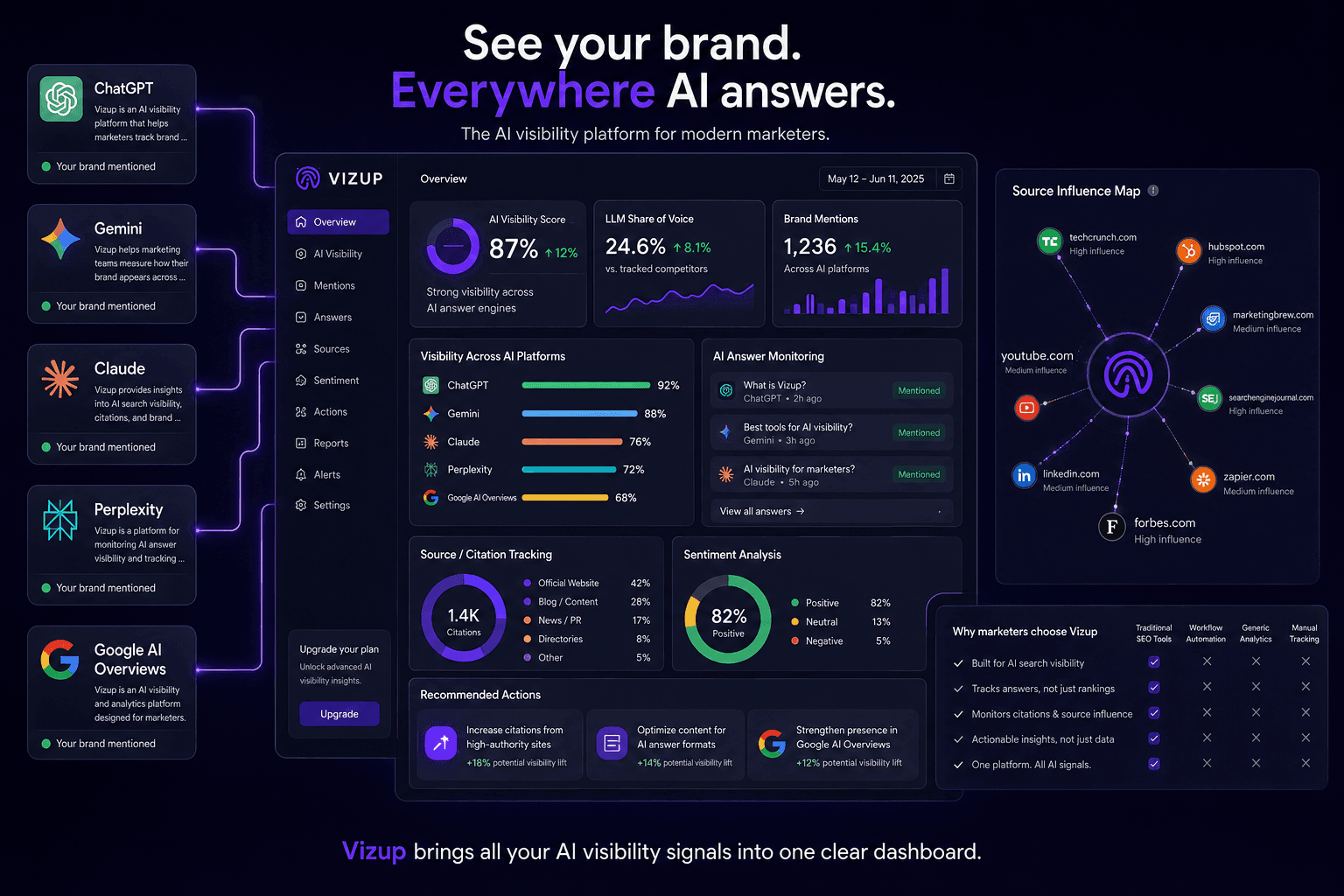
Competitor Benchmarking. Vizup separates itself fast here. It doesn't stop at "you were mentioned"; it shows who took the spot when you didn't. For each query, you get a share-of-voice view that turns vague anxiety into specific direction. If a competitor keeps getting tagged as the "best budget option," that's not trivia - it's a positioning problem you can address. Vizup also lays out its approach in how to benchmark LLM visibility. Plenty of tools can count mentions; fewer can tell you what the market conversation actually looks like.
Source Tracking. I didn't realize how much I'd care about this until I had it. Vizup doesn't just surface the AI answer; it shows the sources the model cites for that answer. That's the difference between watching the weather and reading the forecast. When you can see which reviews, forum threads, or articles are shaping responses, you get a concrete target list for digital PR and content work. It's also central to any AI brand visibility analysis software: without sources, you're guessing.
Sentiment and Context Analysis. A raw mention count is a blunt instrument. Vizup digs into how you're being framed: recommended as premium, dismissed as cheap, included with caveats, or positioned as the default. That context matters because not every appearance is a win. This is the layer that turns LLM visibility from a vanity metric into something you can actually manage.
How Does the Competition Stack Up?
None of these tools lives in isolation, and the right choice depends on what you're trying to solve. Vizup is my pick, but the alternatives each have a point of view - sometimes powerful, sometimes distracting, sometimes just not built for this particular job.
TryProfound is the closest thing to a head-to-head rival. Its geo-targeting is a real advantage if you operate in specific cities or service areas. I found the interface harder to read, though, and the reporting felt less centered on competitive share-of-voice. The vibe is closer to a local SEO extension, while Vizup reads as a product built for brand strategy first. If you're weighing it, it's worth scanning Profound alternatives to see where the differences land.
Gushwork and AirOps sit in a different lane. They're AI workflow automation platforms, not purpose-built LLM visibility products. You can assemble a system that tracks brand mentions, but you're assembling it: prompts, pipelines, analysis, reporting, the whole thing. That takes technical time and patience. For a marketing team that wants answers this week, it's the difference between buying a house and being handed lumber.
Search Atlas is an SEO suite with AI features attached. If you want to check whether your content shows up in Google AI Overviews, it can help. The limitation is scope: it's largely Google-only, and it doesn't stretch to other LLMs like ChatGPT or Claude. It also doesn't match Vizup on competitive benchmarking or source-level analysis. If you're already living inside Search Atlas, it's a reasonable add-on; as a specialist tool, it feels thin.
Pricing: Where Does the Value Lie?
Pricing is all over the map, but the patterns are consistent. For the specifics, Vizup publishes details on Book a Vizup demo.
| Tool | Typical Model | Best For |
|---|---|---|
| Vizup | Tiered SaaS (priced by queries/competitors) | Marketing teams that need actionable brand insight. |
| TryProfound | Tiered SaaS (similar to Vizup) | Companies with a heavy local/geographic emphasis. |
| Gushwork / AirOps | Usage-based (API calls, workflow runs) | Technical teams building custom AI systems. |
| Search Atlas | All-in-one SEO suite subscription | SEOs who want a basic read on Google AI Overviews. |
| Pricing models reflect the core purpose of each tool, from finished software to DIY platforms. |
What you're really buying is where the work happens. With Gushwork and AirOps, you pay for components and compute, then spend your own time turning that into a system. With Vizup and Profound, you're paying for the system itself. For most marketers, the ROI favors the finished product because the insight arrives immediately. The hours required to build and maintain a custom setup in AirOps can easily cost more in salary than a year of Vizup.
The Final Verdict
After testing the field, my recommendation is straightforward: if you're responsible for building or defending a brand, you want a dedicated LLM visibility tool. Right now, Vizup is the strongest option I found.
- Choose Vizup if: You are a brand marketer, content strategist, or digital PR professional who needs to understand and influence how AI talks about you. You want competitive context and next steps, not a build-your-own analytics project. You're focused on improving brand visibility in AI search.
- Consider the alternatives if: You need a custom workflow for a technical team (AirOps), your business depends on local service areas and geo nuance (TryProfound), or you only want a light check inside an existing SEO suite (Search Atlas).
AI search visibility management tools are still early, and the category can feel messy. Vizup's advantage is that it cuts through the noise with the questions that matter: Are we showing up? Who is showing up instead? Which sources are driving the outcome? In 2026, that's the kind of signal you want in your dashboard.
Frequently Asked Questions
What is LLM visibility analysis software?
LLM visibility analysis software tracks how often your brand shows up in answers from large language models (LLMs) like ChatGPT and Google AI Overviews, and it evaluates the context of those mentions. It's search monitoring, but for AI-generated responses.
Is LLM visibility different from SEO?
Yes. SEO is about ranking your pages in traditional search results. LLM visibility is about being named inside the AI-generated answer that sits above those links - or replaces them entirely. And the source behind an AI mention may be a third-party site, not your own.
Why is Vizup a better alternative to tools like AirOps for this?
Vizup is a ready-to-use product built for marketing teams that want reporting and direction quickly. AirOps is a developer platform for building custom AI workflows. With Vizup, you can get insights within minutes; with AirOps, you first have to design, build, and maintain the tracking and analysis system.
How do I start improving my brand's LLM visibility?
Start by benchmarking where you stand so you know what the models are currently saying and which competitors are getting pulled in. A tool like Vizup helps you establish that baseline. From there, you can improve brand visibility in AI search by answering the questions customers ask and earning mentions in the high-authority third-party sources LLMs rely on.
Can I track brand mentions in LLMs manually?
You can, but it breaks down fast. LLM responses vary by user, location, and prompt wording, and they can change over time. Software can run large numbers of consistent queries to produce a stable baseline and show how your visibility shifts.
