Three months into an agency relationship, a lot of marketing leaders still cannot point to a single deliverable and say, "That moved the business." They have a folder of blog posts, a traffic chart that sort of slopes up, and a PDF report they glanced at once. That is not a content marketing program. It is content production on autopilot, with no accountability attached. Despite significant investment in content marketing, many organizations still struggle to connect content activity to measurable business outcomes.
This piece lays out the full picture: what content marketing services typically cover, how agencies package deliverables, the pricing models you will run into, and a practical three-tier way to measure whether the work is paying off. If you are already deep into agency evaluations, jump to the deliverables breakdown or the ROI framework. If you are starting from scratch, begin here. We will cover what agencies do beyond blog posts, the deliverables menu, pricing models, common hiring mistakes, a measurement framework, a monthly reporting scorecard, AI visibility considerations, and when to walk away.
What Content Marketing Services Actually Include (Beyond Blog Posts)
The most common misunderstanding is that "content marketing services" is just a writing service with better branding. You hire an agency, they publish articles, and everyone waits for Google to reward the effort. That is a thin slice of what a serious agency is supposed to do.
Content marketing is a strategic approach focused on creating and distributing valuable, relevant, and consistent content to attract a specific audience and encourage profitable customer action. The "strategic" part is crucial. It means conducting research before creating content, planning distribution after publishing it, and iterating based on performance data. Agencies that neglect any of these stages aren't truly doing content marketing; they are simply producing content.
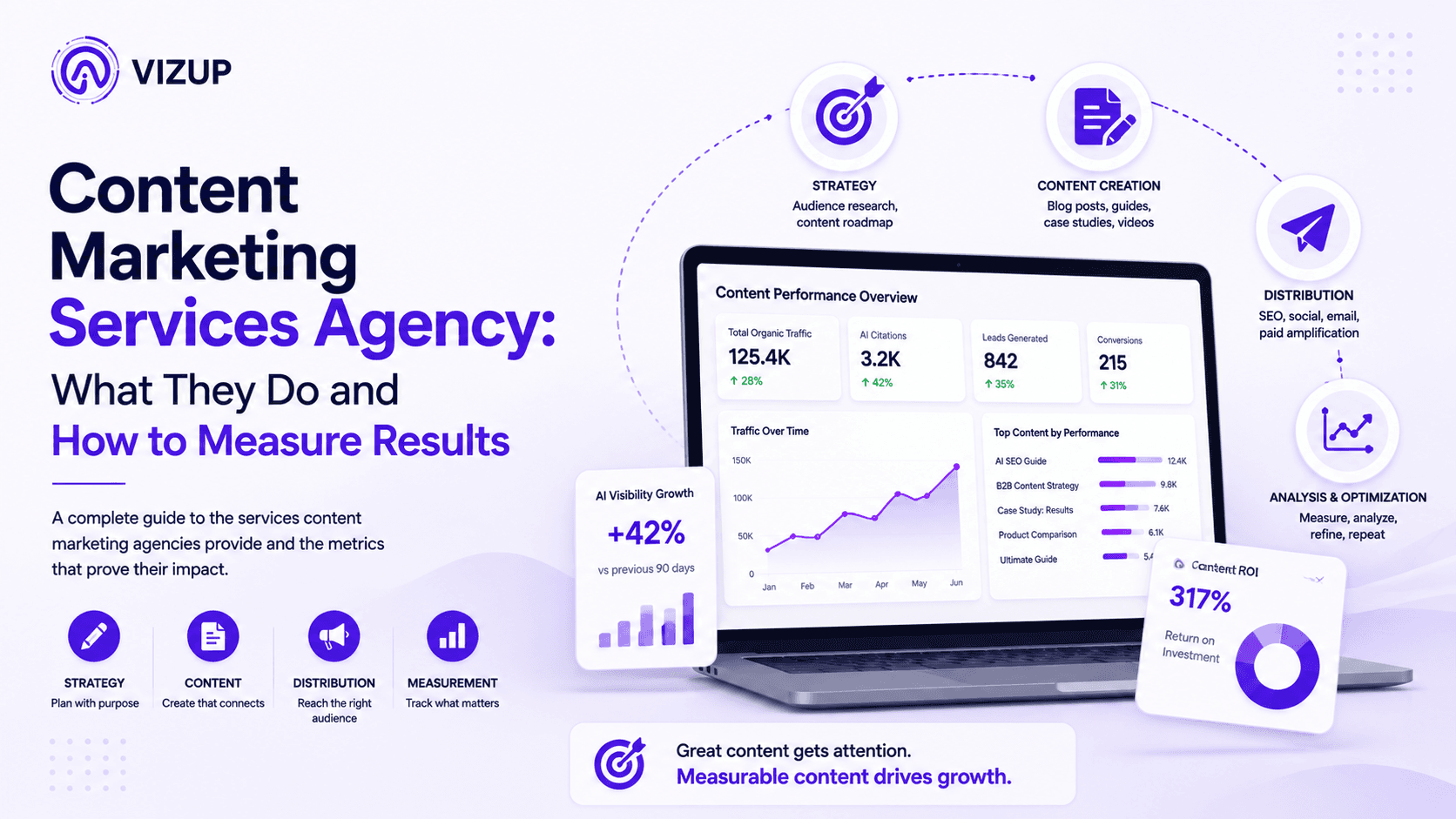
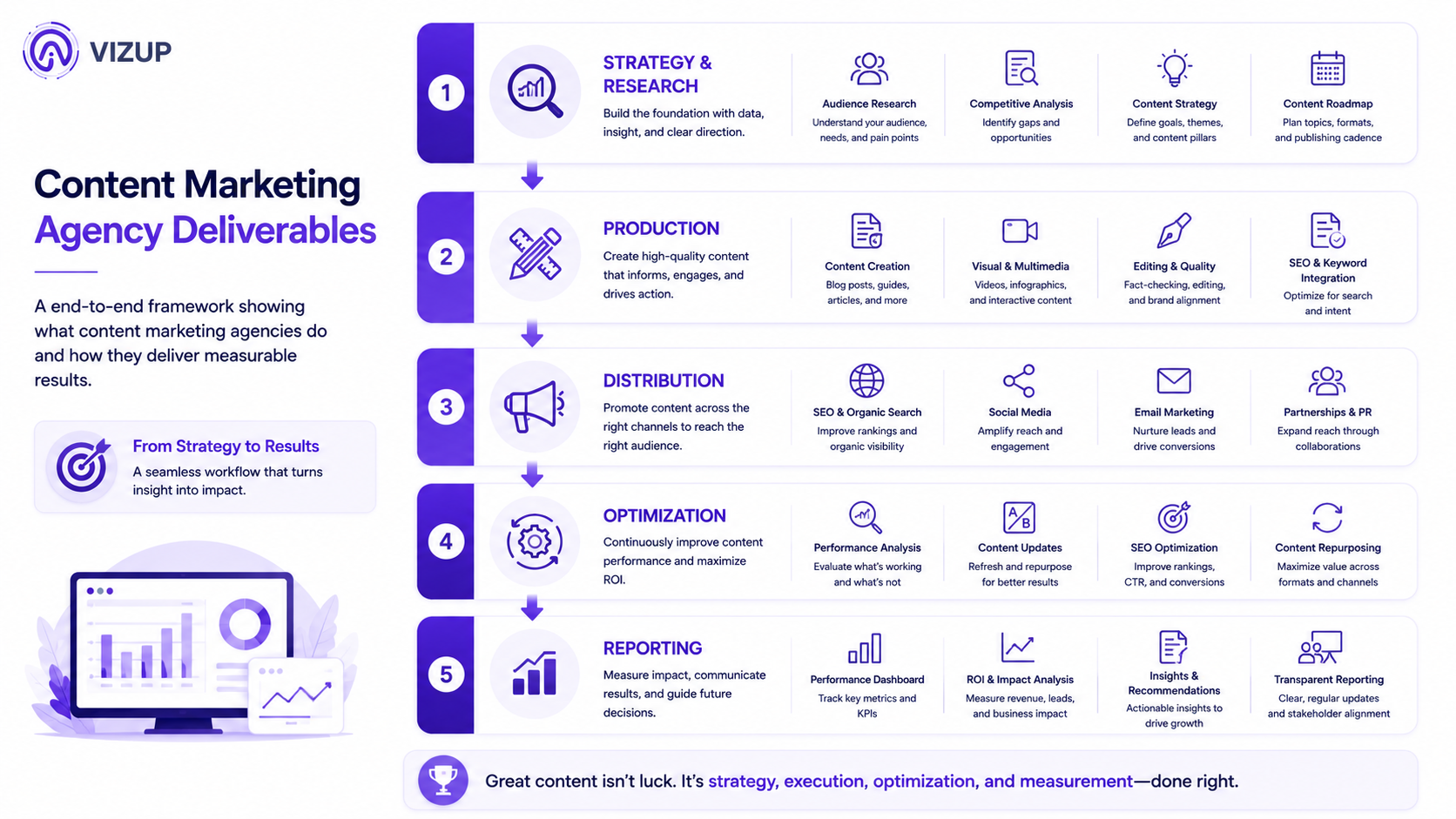
A complete content marketing engagement usually spans four functions. Strategy and editorial planning sets the map: which topics matter, what order to tackle them in, and which audience segments each piece is for. Production turns that plan into assets: articles, whitepapers, case studies, email sequences, visuals, and video scripts. Distribution and promotion gets those assets in front of the right people through syndication, link acquisition, and social amplification. Performance analysis closes the loop, showing what worked and feeding those signals back into the plan. Many agencies now fold SEO, AEO, and AI visibility into the same retainer. By 2026, the gap between a content agency and a search agency has narrowed, which is good news if you want one program instead of three disconnected workstreams.
Tip: Already vetted three or more agencies and feel clear on the service landscape? Skip ahead to the deliverables breakdown or the ROI framework below.
The Full Menu: Agency Deliverables Broken Down
Strategy and Research Deliverables
Before anyone drafts a headline, a competent agency should deliver the strategic work that decides what gets built and why. That typically includes a content audit of what you already have (use a prompt for an SEO content audit to see what goes into one), keyword and topic research mapped to buyer-journey stages, competitive gap analysis (where competitors rank and you do not), audience persona development, and an editorial calendar that sequences topics to build topical authority over time.
Red flag: if an agency skips strategy and starts publishing within the first two weeks, they are guessing. Topic selection without research is just expensive guessing. Plan on three to four weeks for strategy, and expect tangible documents you can review, challenge, and approve before production ramps.
Production Deliverables
A typical mid-market retainer often lands around eight to twelve blog posts per month, two gated assets per quarter (whitepapers, research reports, or detailed guides), plus social copy that supports distribution. Enterprise programs usually add landing pages, email sequences, video scripts, and interactive content. The right mix should follow your audience and your sales cycle, not the agency's preferred template.
AI-assisted production is now standard across many content teams. The difference between good and bad agencies is not whether they use AI; it is how they use it. Strong teams use it to speed up research, draft faster, and scale output while keeping subject matter expertise and editorial judgment in the loop.
Distribution, Promotion, and Optimization
Content that never gets distributed is a diary entry. Agencies should own syndication to relevant publications, link-building outreach, social amplification on the channels that actually matter to your buyers, and refresh cycles that keep older pieces current as topics shift. Refresh work is routinely underpriced and underappreciated: improving an existing article often beats publishing a new one, at a fraction of the cost. And if you are trying to make content discoverable in AI engines, distribution has to account for more than the traditional search results page.
Pricing Models: Retainers, Projects, and Everything In Between
| Model | Typical Price Range | Best For | Main Tradeoff |
|---|---|---|---|
| Monthly Content Retainer | $3K-$15K/mo (SMB); $15K-$50K+ (Enterprise) | Ongoing programs needing consistent output and strategy | Needs 6-12 months for compounding results to show up |
| Project-Based | $5K-$25K per campaign | Defined campaigns: product launches, event content, one-time audits | No continuity; every project restarts the learning curve |
| Performance-Based | Base fee + % of attributed revenue or leads | Companies with strong attribution infrastructure | Agency optimizes for the paid metric, not necessarily your business goal |
| Price ranges reflect 2026 market rates for US-based agencies. Offshore and nearshore agencies may price 40-60% lower with variable quality outcomes. |
Performance-based pricing is seductive, and it often backfires. Pay an agency on organic traffic and you will get traffic-maximizing behavior: high-volume informational keywords that do not convert. Pay them on leads and you may get a flood of gated content and a bloated lead count full of low-intent contacts. Retainers are less glamorous, but they usually align incentives better over time because the agency has to sustain outcomes, not just hit one contractual number.
What Most Companies Get Wrong When Hiring a Content Agency
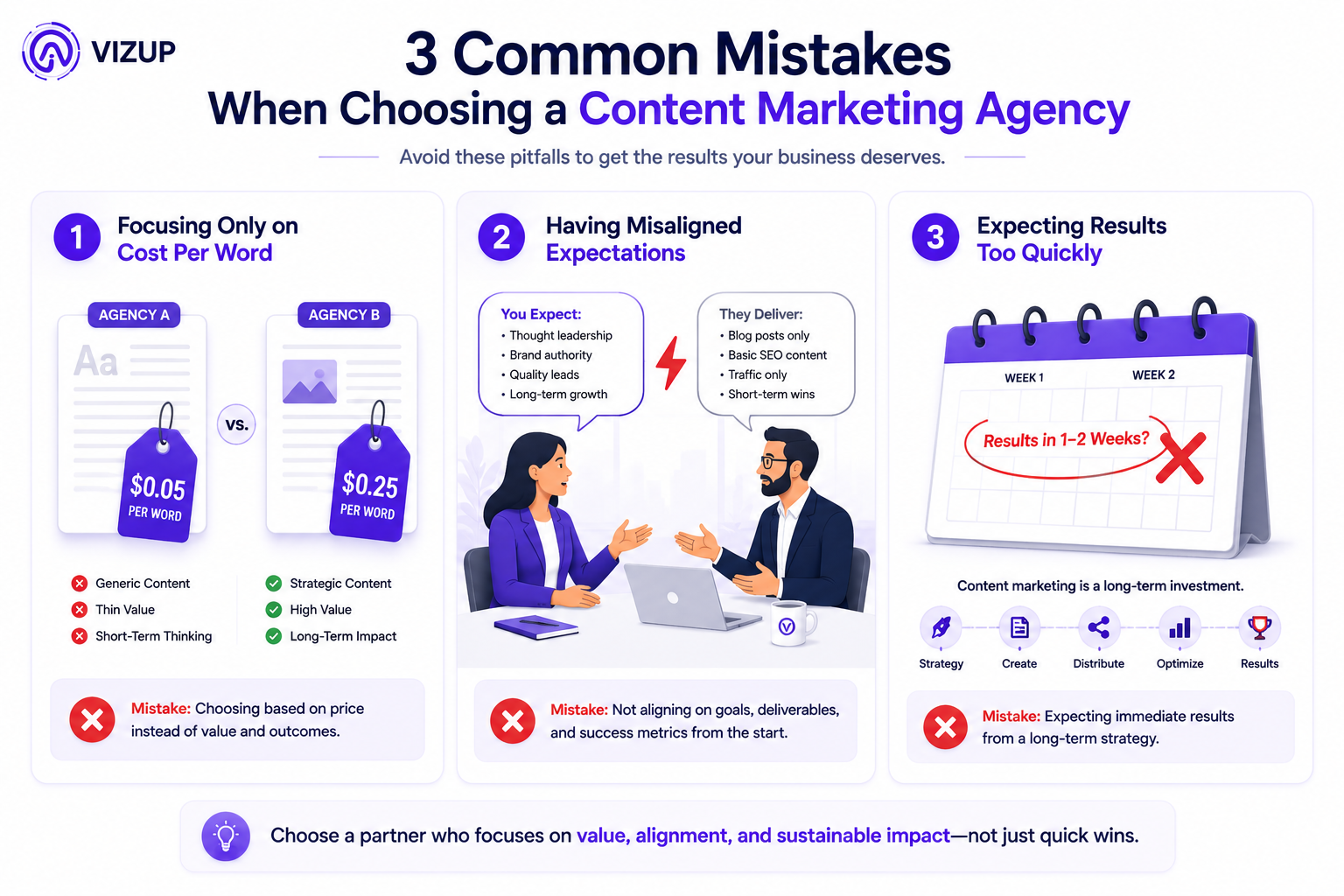
Three mistakes that account for most failed agency relationships:
- Treating content as a commodity buy. Comparing agencies on cost-per-word is like hiring a surgeon based on hourly rate. The value is in strategy, domain expertise, and distribution reach. A $0.10/word shop that publishes unresearched content can cost more than a $0.40/word partner that drives qualified pipeline.
- No internal alignment on what results means before signing. By month four, the agency is high-fiving over traffic while the CMO is asking why pipeline is flat. Both sides are using different scoreboards. Lock success metrics, attribution methodology, and review cadence into the contract before the frustration starts.
- Expecting SEO results in 60 days from a brand-new content program. Compounding organic traffic typically takes six to twelve months. Content marketing can generate significant long-term returns, but those returns typically compound over time rather than appearing in the first billing cycle.
A Framework for Measuring Content ROI That Actually Works
Content ROI breaks down for a predictable reason: teams ignore early signals and grade the whole program on business outcomes that take a year to show up. Then they cancel at month four because "nothing is working," even when the leading indicators are moving in the right direction. A three-tier measurement framework fixes that by giving you useful reads at each stage of the content lifecycle.
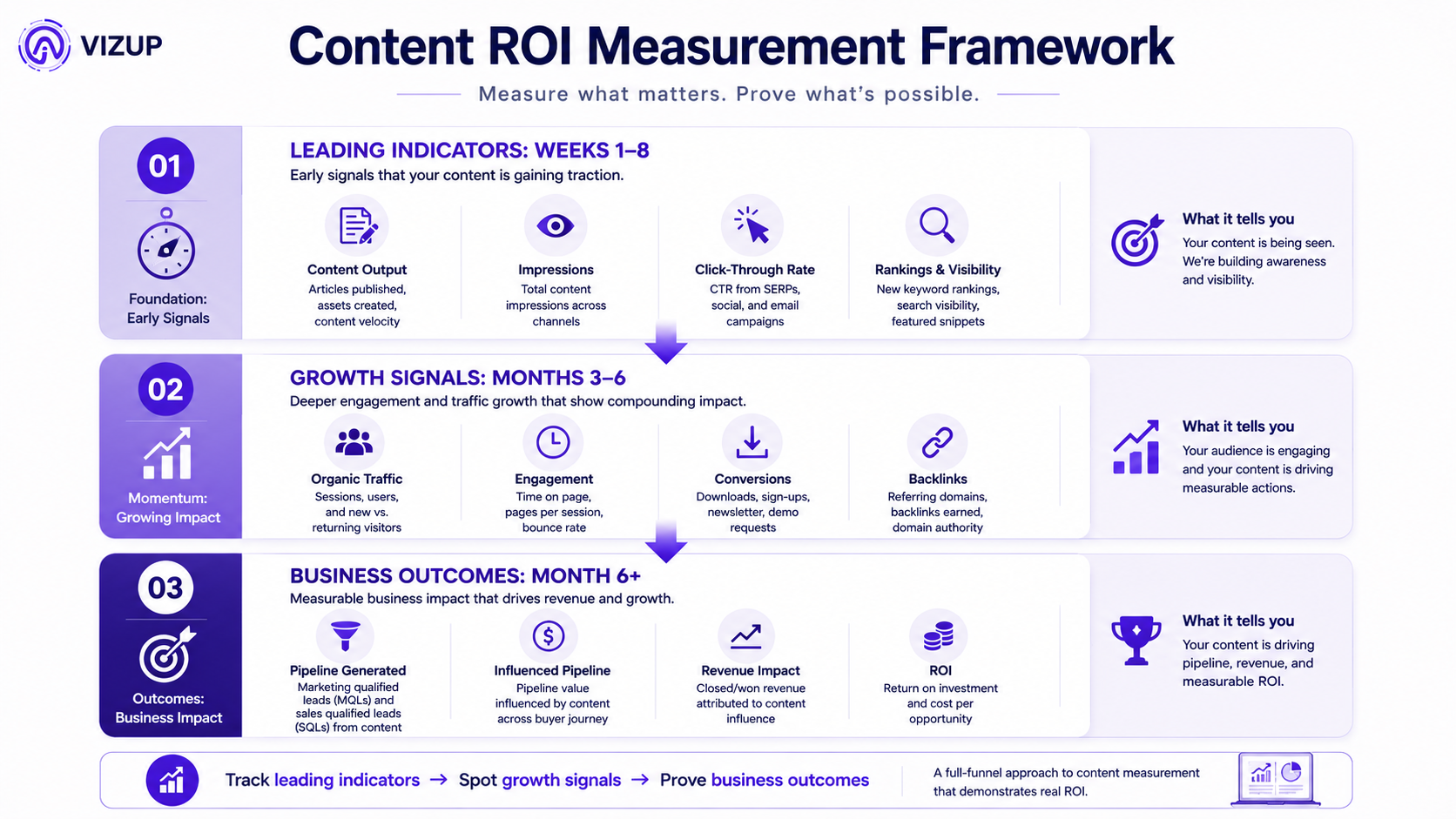
Tier 1: Leading Indicators (The First 8 Weeks)
Do not expect revenue here. The point of Tier 1 is to confirm the program is built correctly. Track indexed pages (is Google finding and indexing new content quickly?), ranking movement for target terms, content velocity (is the agency hitting production commitments?), and topical authority signals such as internal linking from existing pages to new work. Use Vizup, an Organic Autopilot for modern discovery, to see whether content is showing up in AI-generated answers, not just traditional SERPs. If those signals are flat at week eight, treat it as a diagnostic moment before you roll into month three.
Tier 2: Growth Signals (Months 3-6)
By month three, the program should start to look alive: organic traffic rising on content-targeted pages, engagement improving (time on page, scroll depth, return visits), backlinks coming in from distribution, and email list growth tied to gated assets. One concrete example: a B2B SaaS company tracking content-attributed demo requests saw a 40% increase by month five after rebuilding its calendar around bottom-of-funnel topics instead of broad informational posts. Output did not change; topic strategy did. If you want more on turning marketing efforts into revenue, the line from topic selection to pipeline is straighter than most teams want to admit.
Tier 3: Business Outcomes (Month 6+)
This is the CFO tier: content-attributed pipeline, CAC reduction, and revenue influenced by content touches. Getting clean enough data requires UTM discipline on every asset, CRM integration that captures content touchpoints in the deal record, and a multi-touch attribution model instead of last-touch (which consistently undercounts content). Perfect attribution is not realistic. Directional accuracy is, and it is plenty for investment decisions. The agency rank tracking guide offers a practical way to connect ranking movement to pipeline metrics without pretending the data will ever be flawless.
The Agency Results Dashboard: What to Track Monthly
If your agency sends a PDF full of traffic charts with no explanation of what changed or what to do next, that is not reporting. It is decoration. A useful monthly review ties metrics to context, benchmarks, and clear recommendations. Here is a scorecard template you can use as-is:
| Metric | Target Benchmark | Measurement Tool | Review Frequency | Red Flag Threshold |
|---|---|---|---|---|
| Organic traffic growth | +10-15% MoM in months 3-6 | Google Search Console / GA4 | Monthly | Flat or declining for 2 consecutive months |
| Keyword rankings | Top 20 for 60%+ of target terms by month 6 | Vizup / Search Console | Weekly | No movement on priority terms after 90 days |
| Content-attributed leads | 5-10% of total MQLs by month 6 | CRM with UTM tracking | Monthly | Zero attribution after 4 months |
| AI answer visibility | Brand cited in 3+ AI answers for core topics | Vizup (AEO, GEO, pSEO tools) | Monthly | No AI citations after 90 days of content publishing |
| Backlinks acquired | 8-15 new referring domains/month | Ahrefs / Vizup | Monthly | Fewer than 3 new domains in any month |
| Engagement rate | 3+ min avg time on page for long-form content | GA4 | Monthly | Below 90 seconds consistently |
| Content velocity | 100% of contracted pieces delivered on schedule | Editorial calendar audit | Weekly | More than 2 missed deadlines in a month |
| Adapt benchmarks to your industry and starting baseline. The red flag thresholds signal when a diagnostic conversation is needed, not necessarily when to terminate the relationship. |
Advanced Considerations: AI Visibility and the Shifting Search Landscape
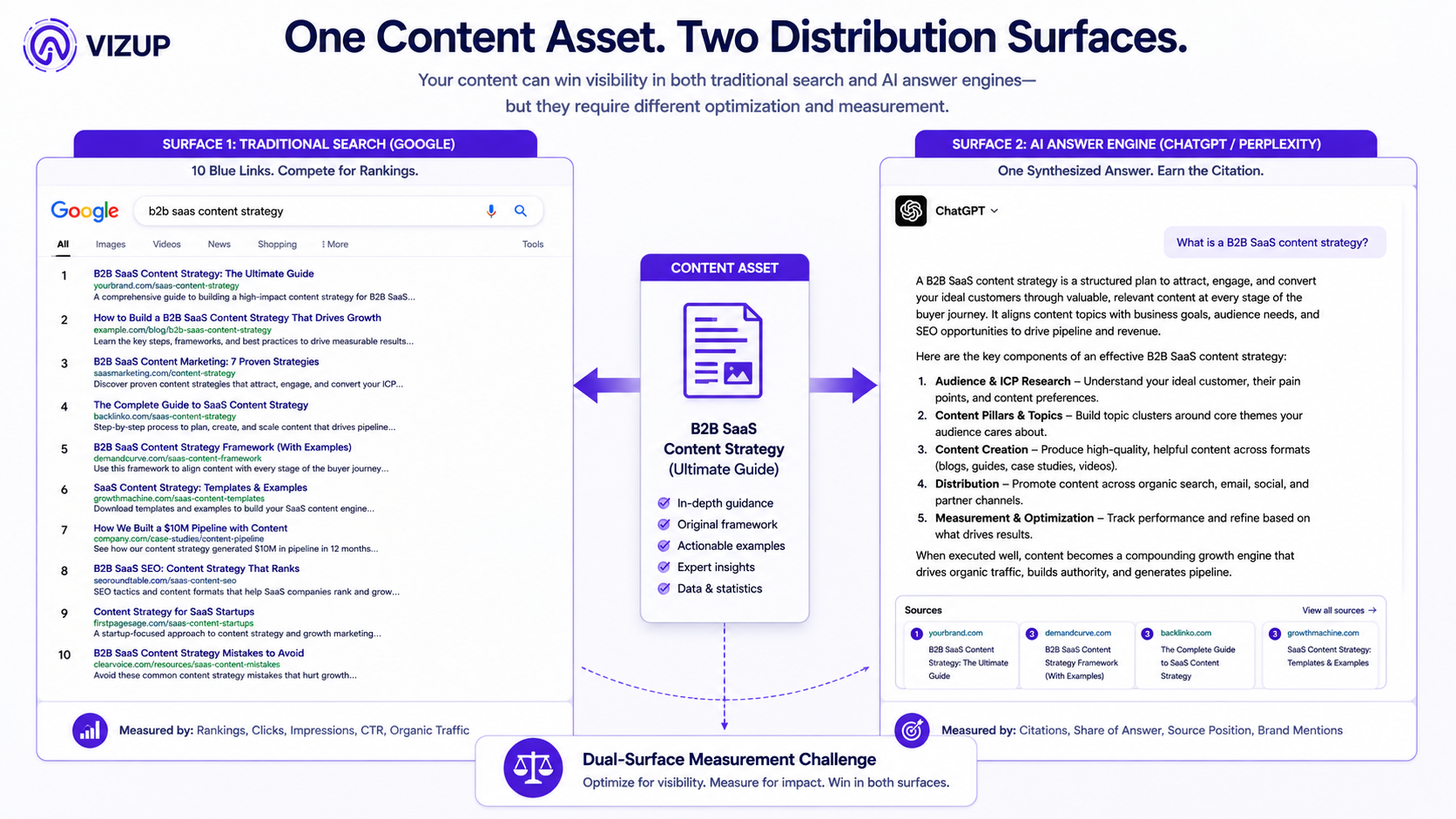
Most agencies still measure as if search is only ten blue links. Meanwhile, AI overviews in Google, ChatGPT citations, and Perplexity references have created new surfaces where your content either shows up or disappears. Traditional rank trackers do not see much of that, which leaves a real measurement hole. If you are trying to understand how to measure your brand presence across these surfaces, the approach is not the same as keyword rank tracking.
Vizup operates as an Organic Autopilot for modern discovery, helping brands monitor, create, and optimize across Search, Social, Communities, AI Answer Engines, and Local Discovery. It uses a mix of AI agents and human experts with live SEO, pSEO, AEO, and GEO tools to track brand mentions and content citations across all these surfaces, not just Google's organic listings. One scenario worth planning for: your agency's content gets cited by an AI model even though it never lands on page one in traditional search. Without monitoring both surfaces, you would miss the citation entirely and have no way to optimize for more of it. The agencies winning in 2026 are the ones that treat AI answer engines as a first-class channel and measure accordingly. The broader context shows up in marketing trends for 2026, where AI visibility is already reshaping content strategy priorities.
When to Fire Your Content Agency (and When to Double Down)
Specific red flags by milestone:
- Month 3: Zero indexed content, no keyword movement on any target term, production consistently behind schedule, and no proactive communication from the agency about what is not working. Those are structural failures, not normal ramp-up noise.
- Month 6: Organic traffic flat or declining, no content-attributed leads in CRM, and the agency is still sending the same report template with no strategic recommendations. If they are not bringing ideas, they are not thinking about your business.
- Month 12: CAC has not moved, content-attributed pipeline is under 5% of total, and the agency cannot explain what the next six months will do differently. At that point, the relationship has probably run its course.
The case for increasing investment is just as concrete. Look for a compounding traffic curve where month-over-month growth accelerates instead of flattening. Watch for CAC dropping as content takes over early buyer education that sales used to handle manually. And pay attention to behavior in the room: an agency that shows up with recommendations (not just updates) is doing the work that actually matters. When all three are true, cutting the retainer is an easy way to create an expensive problem.
Frequently Asked Questions
How long should I commit to a content retainer before expecting measurable results?
Plan on at least six months before you judge business outcomes. Within eight weeks, you should see leading indicators like indexed pages, keyword movement, and content velocity. Months three through five are where growth signals tend to show up (traffic and engagement). For most B2B programs, revenue attribution takes six to twelve months. Anything shorter usually leaves you with inconclusive data and a lot of wasted motion.
What's the difference between a content marketing agency and a freelance content writer?
A freelance writer primarily delivers content. A content marketing agency is supposed to deliver the system around it: strategy, distribution, performance analysis, and iteration. Agencies also bring editorial operations, SEO expertise, distribution relationships, and an accountability framework that is hard for an individual to replicate. If you already have strategy and distribution handled in-house, a strong freelancer can be enough. If you need the full program, an agency is the better structure.
How do I calculate content ROI if my sales cycle is longer than 6 months?
Use pipeline influence instead of closed revenue as your main ROI view. Track deals with at least one content touchpoint in the CRM record, then assign fractional credit through a multi-touch model. If your sales cycle runs twelve months or longer, content-assisted opportunities and content-influenced pipeline are reasonable proxies. Closed-revenue attribution will never be perfect in long-cycle businesses, but directional accuracy is achievable and good enough for budget decisions.
Should my content marketing agency also handle SEO, or do I need separate vendors?
In most cases, one integrated team works better. Content and SEO now overlap heavily, and agencies that handle both can keep topic selection, on-page optimization, and link building in sync. Splitting vendors adds coordination overhead and creates attribution fights. The exception is a highly technical SEO need (for example, a large-scale site migration) that requires specialized engineering support alongside your content agency.
How many pieces of content per month is enough to move the needle for a mid-size B2B company?
For many mid-size B2B teams, eight to twelve long-form pieces per month is a solid baseline, supported by two to four gated assets per quarter. Drop below six pieces a month and topical authority usually builds too slowly to compete in most categories. Volume is not the goal, though: one well-researched, well-distributed piece beats five thin posts, which is exactly why targeting and quality matter more than raw output.
Key Takeaways and Your Next Move
The three-tier ROI framework keeps you from managing content like a black box. Tier 1 (first eight weeks) tells you whether the program is structurally sound. Tier 2 (months three through six) shows whether it is gaining momentum. Tier 3 (month six and beyond) is where business outcomes show up. Most failed programs are not "bad"; they are canceled because teams skip Tier 1 and Tier 2 and demand revenue attribution in month four.
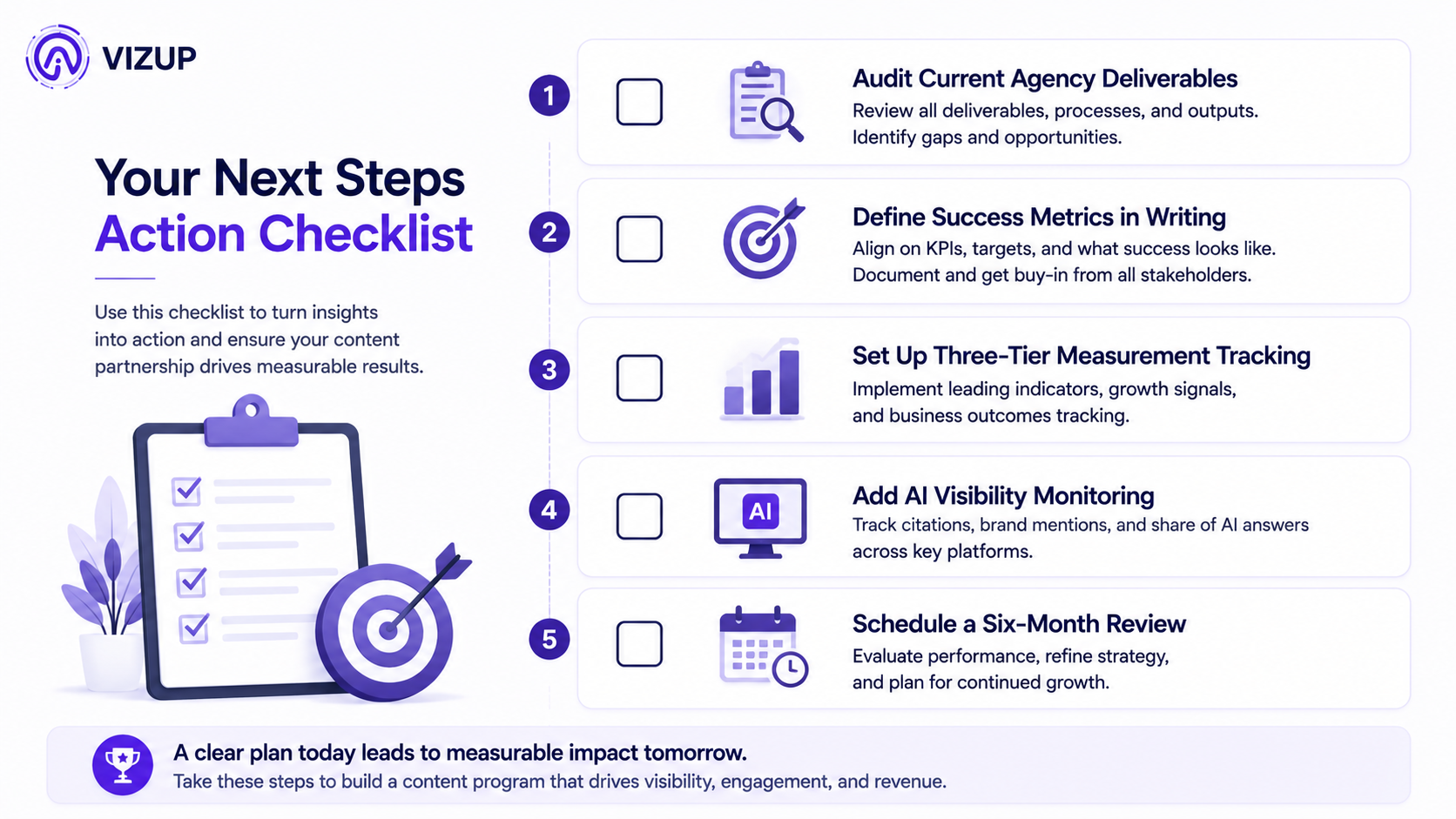
Before your next agency review, do three things. First, audit your current relationship against the scorecard table above and call out the metrics you are not tracking today. Second, add AI visibility monitoring with an Organic Autopilot like Vizup (Book a Demo) so you can capture citation data across all modern discovery channels that traditional rank tracking misses. Third, have an explicit conversation with your agency about what success looks like at six months and twelve months, then get it in writing before renewal season. In 2026 and beyond, strong agencies will measure content performance across traditional search and AI answer engines at the same time. If yours is not, that is the discussion to schedule next week.