For years, SEO and PPC have done their careful two-step on the familiar floor of ten blue links. We optimized, we bid, we watched the rankings. Now Google is changing the tempo. The steady beat of keyword search is sliding toward the looser, less predictable cadence of conversational AI. If this feels like “just another tweak,” that’s exactly how you end up behind.
At Google Marketing Live 2026, the company announced a new generation of ads for the AI era of Search, for AI-powered and conversational Search experiences. If you work in SEO or paid media, this is the kind of shift you don’t get to ignore. The boundary between an organic citation and a sponsored placement is about to blur in new ways, and the AI Mode SEO impact could be significant.
What Are Google AI Mode Ads, Really?
Skip the hype. For a decade, we’ve largely bought ads the same way: bid on keywords. Someone types “best running shoes for flat feet,” and your ad shows up if you pay enough and your quality holds. It’s clean, legible, and mostly predictable. That model is now looking like a legacy system.
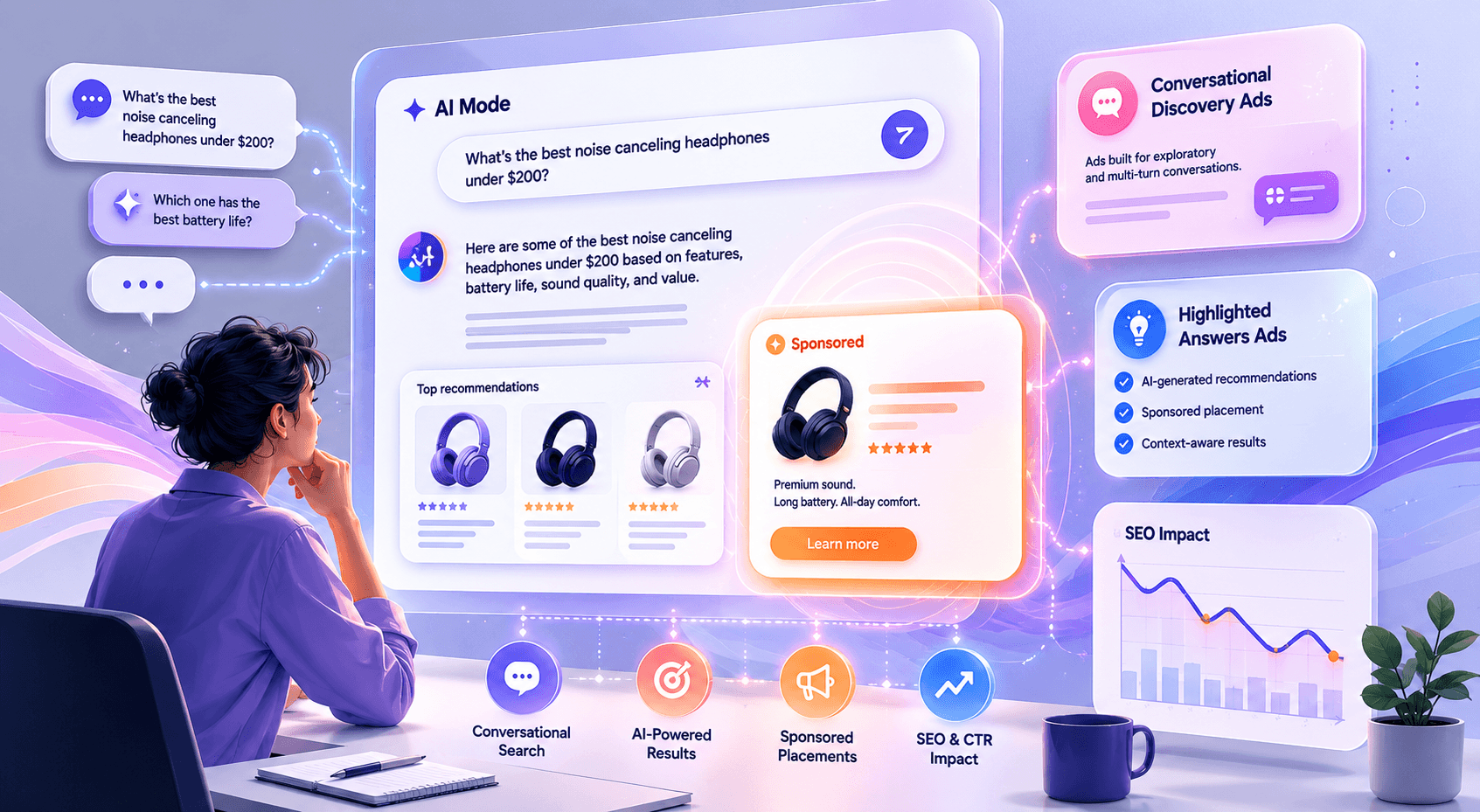
Google AI Mode ads aren’t just another slot on the page; they’re a different kind of unit. Instead of aiming at a single, frozen keyword, they’re meant to show up inside a multi-turn exchange where the user asks, clarifies, and changes their mind in real time. These AI search ads run on Google’s Gemini model and are designed to read less like a banner and more like a timely nudge from a competent assistant. The obvious wrinkle: that “assistant” has incentives.
The New Formats: Conversational Discovery vs. Highlighted Answers
Google is starting with two ad formats built for this conversational setup, based on the initial Google Marketing Live 2026 announcements. They’re easy to lump together, but they behave differently for users and demand different tactics from advertisers. Knowing which is which is the difference between a smart test and an expensive misunderstanding.
| Ad Format | What It Is | Best For | The Fine Print |
|---|---|---|---|
| Conversational Discovery Ads | Ads built for complex, exploratory prompts. Gemini generates tailored creative from the context of the conversation, not a single keyword. | Upper-funnel users comparing options, researching features, or still figuring out what they want. | Performance hinges on how well the AI reads conversational nuance and how complete your product feed is. Garbage in, garbage out. |
| Highlighted Answers Ads | Sponsored placements that show up inside an AI-generated list of recommendations (e.g., “Top 5 apps for learning Spanish”). | Mid-to-lower-funnel users seeking a shortlist or direct comparison and moving toward a decision. | Eligibility depends on relevance and ad quality signals. |
What are Conversational Discovery ads?
Conversational Discovery ads are Google’s bid to monetize the “messy middle” between curiosity and purchase. A user might open with: “I want my house to smell like a fancy spa, but I don’t want to light candles. What are my options?” In the old setup, that turns into a page of blog posts and SEO listicles. In AI Mode, the system may summarize a few routes, diffusers, room sprays, plug-ins. A Conversational Discovery ad can then drop in, with Gemini assembling a message that matches the thread: “Our new waterless diffuser offers a ‘rainy forest’ scent with no maintenance.” It’s an ad shaped by the moment, not a single query string.
What are Highlighted Answers ads?
Highlighted Answers ads are simpler and sharper. Say a user asks AI Mode: “What are the best project management tools for a small remote team?” The AI might respond with three or four well-known options, plus quick pros and cons. This format lets a fifth, sponsored tool appear inside that same list, with its own AI-written summary. One point matters more than the rest: this is an ad unit, not an organic citation granted on merit. It will carry a “Sponsored” label, but sitting inside a confident AI response gives it a kind of borrowed authority.
Why This Matters for SEO and Brand Visibility
A lot of SEOs will read this and immediately feel their stomach drop. If Google answers the question up top (and sells placements inside that answer) what happens to the ten blue links? The anxiety is warranted. The AI Mode SEO impact won’t be subtle.
- Reduced visibility for traditional results: AI Mode naturally crowds out classic results, pushing them down the page, or skipping them entirely. That pressure could show up fast in organic click-through rate (CTR). Early studies around AI Overviews suggest that AI-generated answers can reduce clicks to traditional results, which is why SEOs are watching AI Mode closely.
- Sponsored answers may cannibalize organic clicks: When the AI delivers a “good enough” response and includes sponsored options, fewer users have a reason to scroll and click an organic link. As Google continues testing ads in AI Mode, if a competitor’s ad is presented as part of the solution, your blue link starts to look optional.
- The battleground shifts to 'mention tracking': Ranking still matters, but it’s no longer the whole scoreboard. The new KPI becomes visibility inside AI answers. Brands will need to track organic mentions (when the AI cites your content) alongside paid visibility (when your ads land in those answers). Those two channels are starting to tangle together.
- Content clarity becomes paramount: If you want to be cited by the AI (or if you want your product data to produce a credible ad) you need content that’s structured, explicit, and easy to summarize and compare. That’s a core principle of optimizing for AI Answer Engines.
How Brands Should Prepare for Ads in AI Mode
This isn’t theoretical. The tests are already underway, and the direction of travel is clear. Sitting back to “see how it plays out” is a strategy in the same way ignoring a platform shift is a strategy. The prep work starts now, and a good place to start is the official list of Google Ads new features and announcements.
Clean Up Your House: Landing Pages & First-Party Data
Google says Gemini can synthesize product or service information alongside advertiser creative, so landing pages, feeds, and campaign assets need to be accurate and complete. If your product pages are packed with vague claims, missing specs, and dead ends, you shouldn’t expect the AI to magically produce crisp, persuasive copy. Your landing pages have effectively become input data for Google’s ad-creation system. Treat them like you’d treat a product feed: accurate, complete, and readable. It’s also a sensible moment to audit the basics, especially with churn from events like Google's May 2026 Core Update.
Build for Comparison
AI-led search tends to default to comparison because that’s what users ask for: help choosing. Your content should make those choices easier to articulate. Publish straightforward comparison tables, feature-by-feature breakdowns, and pages that answer “vs.” questions directly. The easier it is for Gemini to see what separates you from alternatives, the easier it is for it to generate an ad that makes that case. That’s central to migrating to AI-driven campaigns.
Monitor Your AI Visibility, Not Just Your Rank
If you can’t see it, you can’t steer it. Traditional rank trackers were built for a list of links, not an answer that rewrites itself depending on the conversation. You need different questions: When your brand shows up in an AI response, what does it actually say? Which sources does the model cite? Are competitors appearing in lists where you’re absent? Getting those answers is table stakes for understanding how AI Mode changes SEO.
That gap is what Vizup is designed to address. Classic SEO tools hand you rankings and a list of URLs. Vizup focuses on how your brand is represented inside AI-generated answers, which sources the model leans on, and how that picture shifts against competitors in answer-style search. The goal is to move from watching positions to tracking real AI search visibility.
Frequently Asked Questions
What are Google AI Mode ads?
Google AI Mode ads are ad formats that show up inside AI-powered search experiences (conversational chats and recommendation lists) rather than only on a traditional results page. Google says these new formats are built with Gemini.
What are Conversational Discovery ads?
Conversational Discovery ads target exploratory searches. They use the ongoing context of a user’s conversation with the AI to generate ad creative tailored to a specific, often multi-part question.
What are Highlighted Answers in Google AI Mode?
Highlighted Answers are sponsored placements inserted into AI-generated recommendation lists in AI Mode. They’re labeled as ads, but they appear within the body of the AI’s response.
Do AI Mode ads affect SEO?
Yes. Because these sponsored placements can appear within or alongside the AI-generated answer at the top of the page, they can pull attention and clicks away from traditional organic blue links lower down, potentially reducing organic CTR.
How can brands prepare for AI Mode ads?
Brands should tighten up landing pages and product data so the AI has clean inputs, publish content that’s easy for AI systems to compare, and track visibility inside AI-generated answers, not only rankings. Understanding how AI Mode impacts Search Terms reports also matters.
