
The Google June 2026 spam update is a global, automated ranking change in Google Search that uses SpamBrain to spot and demote sites that violate Google's existing spam policies. It started rolling out on June 24, 2026, making it the second spam update of the year. Google did not introduce new spam rules with this release; it is enforcement, aimed primarily at content-level violations rather than expanding the rulebook.
If you are still untangling the aftereffects of the May 2026 core update, you are in good company. Dropping a spam update just weeks later creates messy overlap: ranking shifts can come from either system, from both, or from plain old volatility. The job here is to separate what Google has confirmed from what the industry is inferring, spell out what this update is designed to catch, and lay out next steps that do not turn mid-rollout noise into permanent mistakes.
The Official Announcement: Just the Facts on the June 2026 Spam Update
Google began rolling out the June 2026 spam update on June 24, 2026. The company logged the event on its Search Status Dashboard at 9:03 AM PDT, noting the incident began at 9:00 AM PDT. The update is global, affecting all languages and regions, and Google stated the rollout may take a few days to complete.
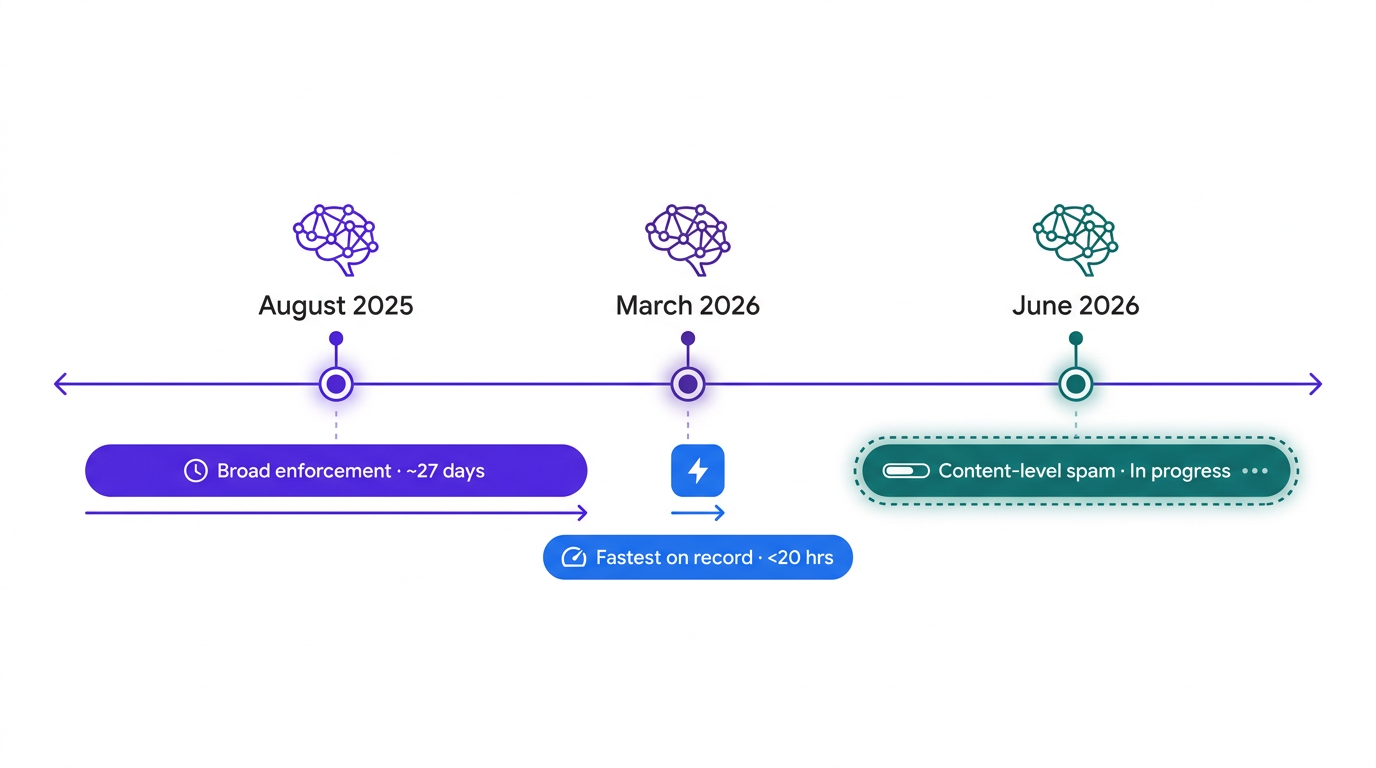
The release runs through SpamBrain, Google's AI-based spam detection system that has underpinned every spam update since 2022. Google did not pair the rollout with new spam policies, which signals a tighter interpretation and enforcement of rules that already exist. It is the second spam update of 2026, following the March 2026 spam update, which wrapped in under 20 hours.
Spam Update vs. Core Update: Why This Is Not May All Over Again
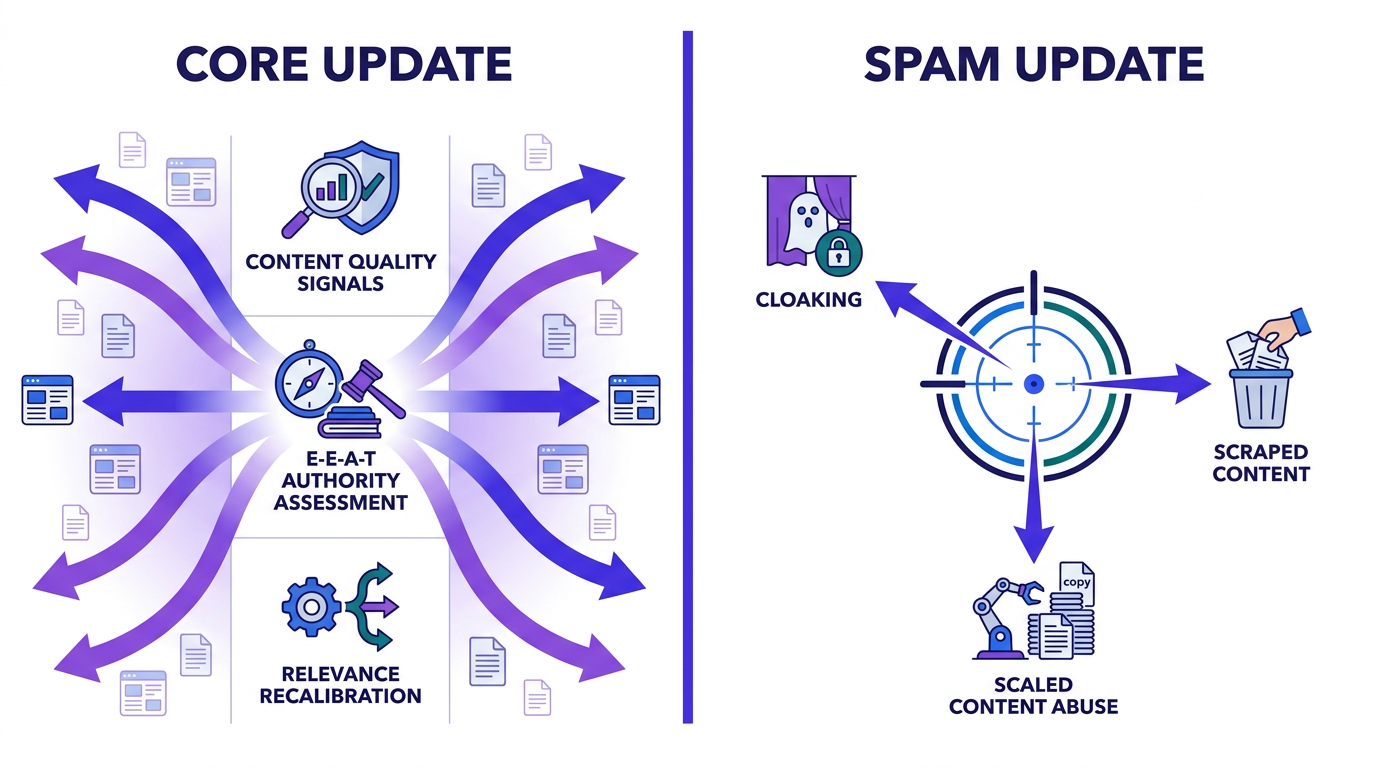
The label matters because it changes the checklist. Core updates (like May 2026) are broad recalibrations of quality and relevance, and they can move almost any site up or down as Google's systems re-rank what seems most helpful against the competition. A spam update is narrower: it is an enforcement pass that looks for clear policy violations such as cloaking, scaled content abuse, or scraped content, then demotes the pages or sites that trip those wires.
That also means "good" sites are not automatically insulated. A strong brand can still take a hit if part of the site crosses the line, like an old cluster of auto-generated doorway pages that never got cleaned up. The reverse is also true: a site with average content will not be affected if it is not breaking spam rules. If rankings are moving right now, the useful question is not "Is my content good enough?" It is "Is anything on this site violating a spam policy?" That framing should drive what you audit and what you leave alone this week.
What This Update Targets (and What It Reportedly Does Not)
The June 2026 spam update goes after violations already covered by Google's spam policies. In practice, that bucket includes scaled content abuse, cloaking, sneaky redirects, scraped content, hidden text, and similar on-page or content-generation tactics. Trade coverage from Search Engine Roundtable (2026) says this rollout excludes link spam and site reputation abuse, consistent with what was reported around the March 2026 update. Google has not published a line-item list for this specific rollout, so treat the exclusion as a strong hint, not a promise.
Info: If link spam and site reputation abuse are truly out of scope, the center of gravity here is content-level spam. If your worry is mostly backlink-driven, this rollout is unlikely to explain the ranking shifts you are seeing.
The Generative AI Spam Policy Context
On May 15, 2026, Google updated its spam policies to explicitly cover attempts to manipulate generative AI responses, including AI Overviews and AI Mode. That change pulled spam enforcement into the GEO (Generative Engine Optimization) and AEO (Answer Engine Optimization) conversation. The practical implication is straightforward: tactics meant to game AI-generated answers now sit in the same enforcement bucket as classic spam like cloaking or keyword stuffing. For the full rule set, see Google's spam policies for generative AI.
Whether the June 2026 spam update is actively applying those AI-specific rules is not confirmed. Still, the timing matters: SpamBrain now has explicit policy backing to act on AI-answer manipulation, and this rollout lands about six weeks after that policy change. If your team has been optimizing for AI Overviews, now is the moment to sanity-check those tactics against what Google says it will enforce at scale.
Recent Spam Update Rollout Timelines
| Update Name | Rollout Duration | Key Focus (Confirmed/Reported) |
|---|---|---|
| August 2025 Spam Update | ~27 days | Broad enforcement of spam policies |
| March 2026 Spam Update | Under ~20 hours (fastest on record) | Excluded link spam and site reputation abuse (reported) |
| June 2026 Spam Update | A few days (estimated, in progress) | Excludes link spam and site reputation abuse (reported); enforces existing content-level spam policies |
| Rollout length does not reliably predict impact. The March update finished in hours but still triggered measurable ranking changes. |
Your Action Plan: What to Do Now (and What Not to Touch)
The most valuable move right now is restraint. During a rollout, spam updates can create temporary turbulence that does not match the final state once systems finish processing. Rankings can bounce both ways before they settle. Making big changes off mid-rollout swings is like trying to edit a document while it is still printing.
Concrete steps for the next two weeks:
- Annotate June 24 in Search Console and your analytics platform. You want a clean before/after marker. For help interpreting turbulent GSC periods, see what to do when Search Console shows data anomalies.
- Keep reporting windows clean. Avoid blending pre-rollout and mid-rollout days into the same performance readout. Wait until Google marks the rollout complete on the Search Status Dashboard.
- If you see drops, start with spam policies. Pull up Google's spam policies documentation and look for issues like scaled content abuse, cloaking, or hidden text. Do not jump straight to a content quality audit; that is the core-update playbook.
- Do not disavow links or purge backlinks. This update is reportedly not about link spam. Responding with link cleanup is wasted effort and can create self-inflicted damage.
- Do not rewrite your entire content strategy mid-rollout. Large-scale rewrites and repositioning belong in core update recovery work, not a spam enforcement cycle.**
Spam Update Recovery: Setting Realistic Expectations
Recovery from a spam update is rarely quick. If Google demotes a site for a content-level violation, the path back is to remove or fix the offending material, then wait for Google to recrawl and reassess. That tends to play out over months, not weeks. There is no reconsideration request for algorithmic spam demotions; that process exists for manual actions only. You clean up, then you wait for the relevant systems to refresh and reflect the changes.
One nuance is worth keeping in view: link spam enforcement, when it hits, often does not offer a clean recovery path. Even though this update is reported to exclude link spam, the contrast helps you plan. Content-level spam demotions can be reversed when violations are actually removed. Link-based penalties are far more likely to linger. Make sure you know which bucket you are dealing with before you map out months of work.
Common Misconceptions About Spam Updates
"A fast rollout means a minor update." March 2026 finished in under a day and still moved rankings in competitive categories. Speed mostly reflects execution, not impact. "If I wasn't hit by the March update, I'm safe now." SpamBrain keeps evolving, and each iteration can catch patterns the last one missed. Being clean in March does not mean you are clean in June. "Any ranking drop during a spam update means I have a spam problem." Some churn during rollout is normal. What matters is a sustained post-rollout drop that lines up with pages and patterns that match known spam policy violations.
Monitor Your Visibility Through the Rollout
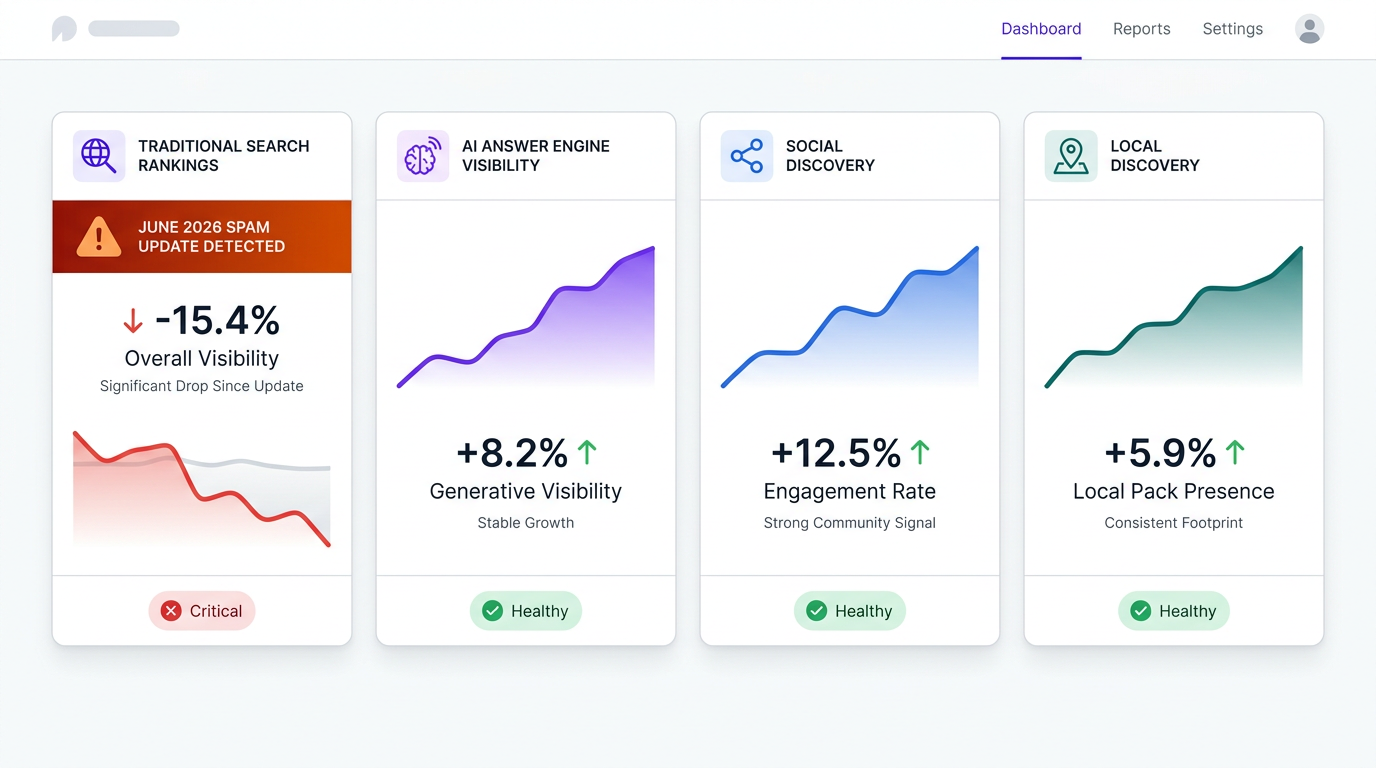
Spam enforcement is no longer confined to the classic list of blue links. With the May 2026 generative AI spam policy in effect, enforcement can also shape how your content shows up (or fails to show up) inside AI Overviews and AI Mode. If you only watch Search Console, you are only watching one surface area.
Vizup positions itself as an Organic Autopilot for modern discovery, aimed at helping brands monitor, create, optimize, publish, and learn across Search, Social, Communities, AI Answer Engines, and Local Discovery. The pitch is a single workflow that blends AI agents, human experts, and live SEO, pSEO, AEO, and GEO tooling. During a spam update rollout, that kind of cross-channel view can keep teams anchored in evidence instead of vibes. Paid ads are offered as an amplification add-on, but the core promise is organic: seeing whether visibility in traditional results and AI-generated answers is stable, improving, or slipping.
Key Takeaways
- The Google June 2026 spam update began June 24, is global, runs on SpamBrain, and comes with no new policies.
- It is reported to exclude link spam and site reputation abuse, with the focus on content-level violations such as scaled content abuse and cloaking.
- This is spam enforcement, not a core update. When rankings drop, start by checking spam policy compliance, not broad quality signals.
- Google's generative AI spam policy (May 15, 2026) covers manipulation of AI Overviews, tying spam enforcement more directly to AEO and GEO work.
- Avoid mid-rollout changes. Annotate, wait for completion, then audit if needed. Recovery from content-level spam demotions usually takes months.
Frequently Asked Questions
How long will the Google June 2026 spam update take to roll out?
Google says the June 2026 spam update should take a few days. Recent history shows why duration is a poor proxy for impact: March 2026 finished in under 20 hours, while August 2025 ran for about 27 days. Wait for Google to confirm completion on the Search Status Dashboard before you treat the movement as final.
Is this spam update related to the May 2026 core update?
No. They are separate systems. The May 2026 core update broadly re-ranked content based on quality and relevance signals, while the June 2026 spam update is SpamBrain enforcing specific spam policy violations. A drop can coincide with either, but the investigation path changes depending on which system is responsible. See how core updates differ from spam updates for a deeper comparison.
How do I know if my site was hit by the June 2026 spam update?
First, wait until the rollout is complete. Then compare Search Console performance before and after June 24, looking for sudden, sustained declines in impressions or clicks that map to pages where spam policy issues are plausible. Volatility during rollout is common and does not confirm a hit on its own.
What's the difference between a spam update and a manual action for spam?
A spam update is algorithmic: SpamBrain detects violations and applies demotions without sending you a specific notice. A manual action involves a human review and shows up in Search Console with explicit details. For algorithmic demotions, the remedy is fixing the issue and waiting for systems to refresh; for manual actions, you fix the issue and submit a reconsideration request.
If I remove spammy content, how long does spam update recovery take?
Plan on months, not weeks. After you remove the violating content, Google still has to recrawl and re-evaluate the site on its own schedule, and there is no supported way to force that timeline. Losses tied to link spam (not targeted in this update) are often effectively permanent.
