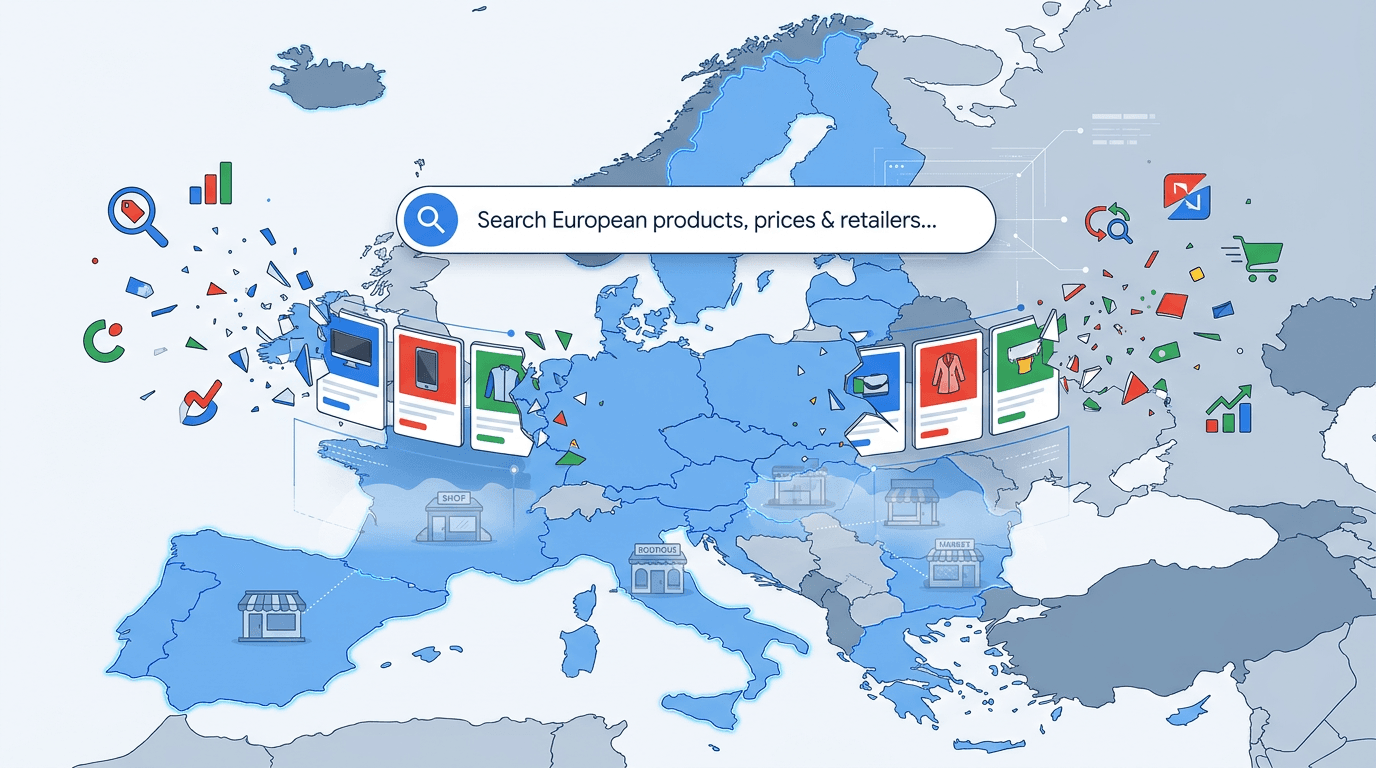
Free product listings in the EEA were unpaid product placements in Google's results, most visible in the "Popular products" carousel. They gave retailers a way to put merchandise in front of searchers without buying ads. By mid-September 2026, unpaid product listings had largely disappeared from general Google Search results across the European Economic Area (EEA). The change affected a major organic product-discovery surface for retailers, although free product exposure remains available on other eligible Google surfaces.
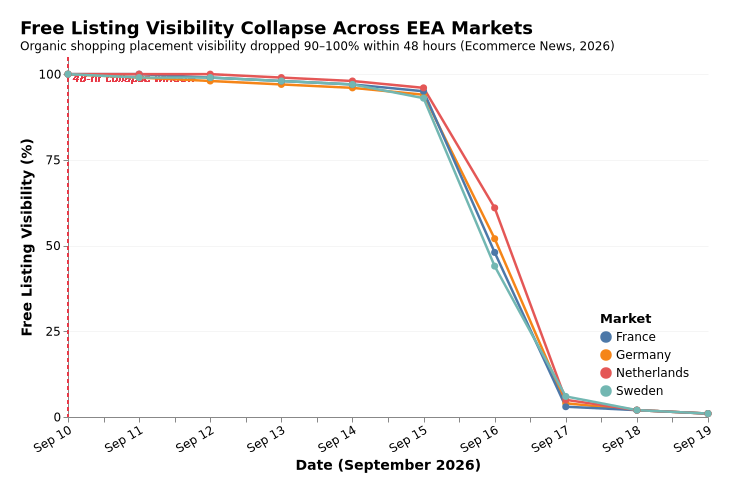
This was not a technical failure. Google acted in response to the European Union's Digital Markets Act, and the change landed in roughly 48 hours. Independent tracking platforms saw visibility for free organic shopping placements fall 90 to 100 percent in Germany, France, the Netherlands, and Sweden (Ecommerce News, 2026). In their place is a different discovery system: one that sends shoppers through third-party aggregators before they reach a retailer. The practical question for EEA merchants is no longer why the carousel vanished, but which route can restore lost visibility.
What Exactly Changed on the European SERP
The biggest loss was the popular products carousel that EEA merchants had used for years. This visual result blended paid Shopping ads with free organic listings inside Google's search pages. Someone searching for "running shoes" or "wireless earbuds" could scroll through product images, prices, and retailer names; many of those offers appeared without any advertising spend.
That unit has disappeared from standard results in all 30 EEA member states. The carousel dropped out over a 48-hour period in mid-September 2026 (PPC Land, 2026), initially looking to many marketing teams like a serious analytics malfunction. Placement traffic fell to near zero overnight. Google gave no advance warning and offered no transition period.
One distinction matters: Google Shopping ads remain in place. Paid Shopping placements continue to run across EEA markets; Google removed the carousel's unpaid organic layer. That leaves paid activity with a larger role for brands seeking Shopping-style SERP exposure. For a closer look at how product carousel ads work in retail discovery, the missing organic route puts the scale of the change in focus.
Why It Happened: DMA Compliance and the European Commission Google Fine
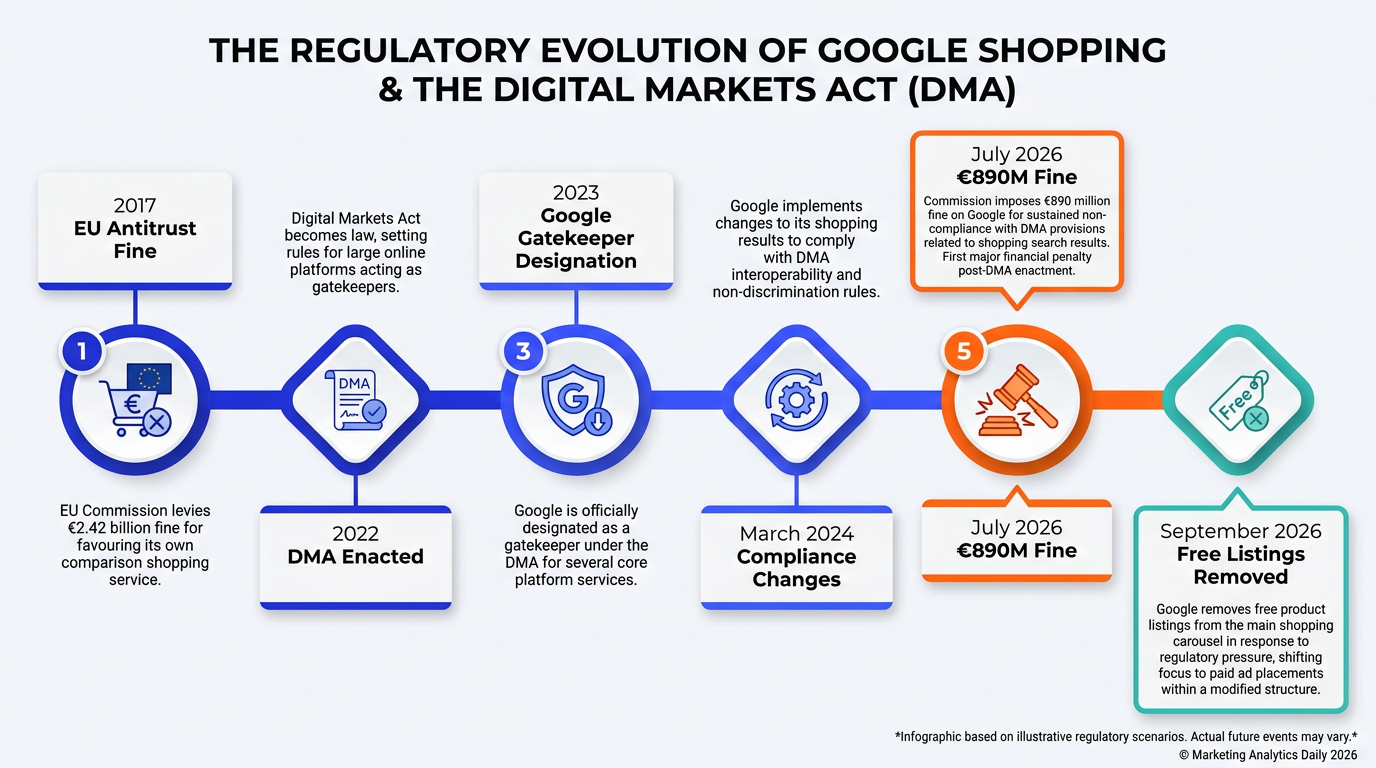
The removal follows the Digital Markets Act, the EU regulation aimed at the market power of "gatekeeper" platforms. The DMA bars designated gatekeepers from favoring their own services in search results. Google, which holds that designation, had to stop mixing Google Shopping results into general search in a way that disadvantaged rival services.
The European Commission has examined Google's Shopping conduct for more than a decade. On July 23, 2026, the European Commission fined Google €890 million for two Digital Markets Act breaches. The penalties included €460 million for favoring Google's own services in Search and €430 million for restrictions affecting alternative purchasing channels on Google Play. The Commission's decision added regulatory pressure on Google's Search practices. That European Commission Google fine made the legal position plain: blending Google's vertical-search units into organic results could not continue. The pressure around Google's ranking changes as a legal matter reaches beyond the EU, though DMA enforcement has been especially forceful.
Google set out its response in a March 2024 compliance blog post: remove blended product units and give prominent placement to third-party aggregators instead. The company also warned that direct suppliers, including merchants, might receive less traffic. That warning has now played out.
What Replaced Them: Comparison Shopping Services and the New SERP Units
Google's revised European Search experience includes aggregator units featuring third-party comparison shopping services (CSSs), alongside supplier units that can provide visibility for individual merchants. Aggregators collect offers from multiple retailers, while supplier units offer another route for merchants to appear in product-related Search results. These formats change how retailers reach shoppers without necessarily requiring every organic product interaction to pass through a comparison website. Google's documentation on aggregator and supplier units provides additional context.
The shift changes the journey, not merely the look of the results page. A carousel click once sent a shopper straight to a retailer's product page. Now the shopper selects an offer in an aggregator unit, arrives at a CSS programme retailers page with prices from several merchants, then clicks through again to the store. That added handoff creates friction and weakens the direct connection between brand and shopper.
Info: The CSS model itself is not new. Google created its CSS programme after the 2017 EU antitrust ruling. Since September 2026, CSS partners have gained importance through aggregator units in European Search results. However, supplier units and other organic discovery opportunities remain relevant for retailers. The change affects the former unpaid product carousel rather than eliminating every route to free product visibility.
How the New CSS Units Work in Practice
For product searches in EEA countries, Google now presents aggregator units that lead to CSS partner sites rather than retailer pages. Each partner builds its own catalogue, draws prices from merchant feeds, and presents offers through its own interface. The experience looks more like a comparison engine - Kelkoo, PriceRunner, or Idealo - than a direct Shopping result.
Retailers appear in these units only when a CSS partner has indexed their feed and elected to show their offers. Merchant control over appearance has been replaced by an intermediary gatekeeper. Every CSS applies its own inclusion criteria, ranking logic, and fee structure.
The Impact on EEA Retailers: Who Loses and How Much
Merchants that depended on free listings for traffic have taken the immediate hit: an abrupt EEA retailer visibility loss. Organic shopping exposure has fallen to zero for placements that had delivered meaningful clicks without ad spending. Smaller retailers are especially exposed, since many lack the budget for Shopping ads or CSS partnerships and have lost their free entry point onto the SERP.
The tracking data illustrates the scale of the SERP change. According to Productrise's September 2026 research, tracked product-carousel visibility declined by approximately 90 to 100% across sampled European markets. This measures the disappearance of the affected Search feature, not an equivalent decline in every retailer's traffic or sales. Merchants should segment their Search Console and Merchant Center data by country to understand the actual impact on product-page visits and conversions.
For teams running EEA and non-EEA markets together, reporting creates another problem. A global traffic view mixes the EEA decline with stable or rising performance elsewhere, turning a regional collapse into what appears to be a modest worldwide dip. Country-level segmentation is now required for a useful read of the data. The zero-click map of Europe offers context on how behavior already differed between European markets before this change.
Your Strategic Options: How to Recover Product Visibility
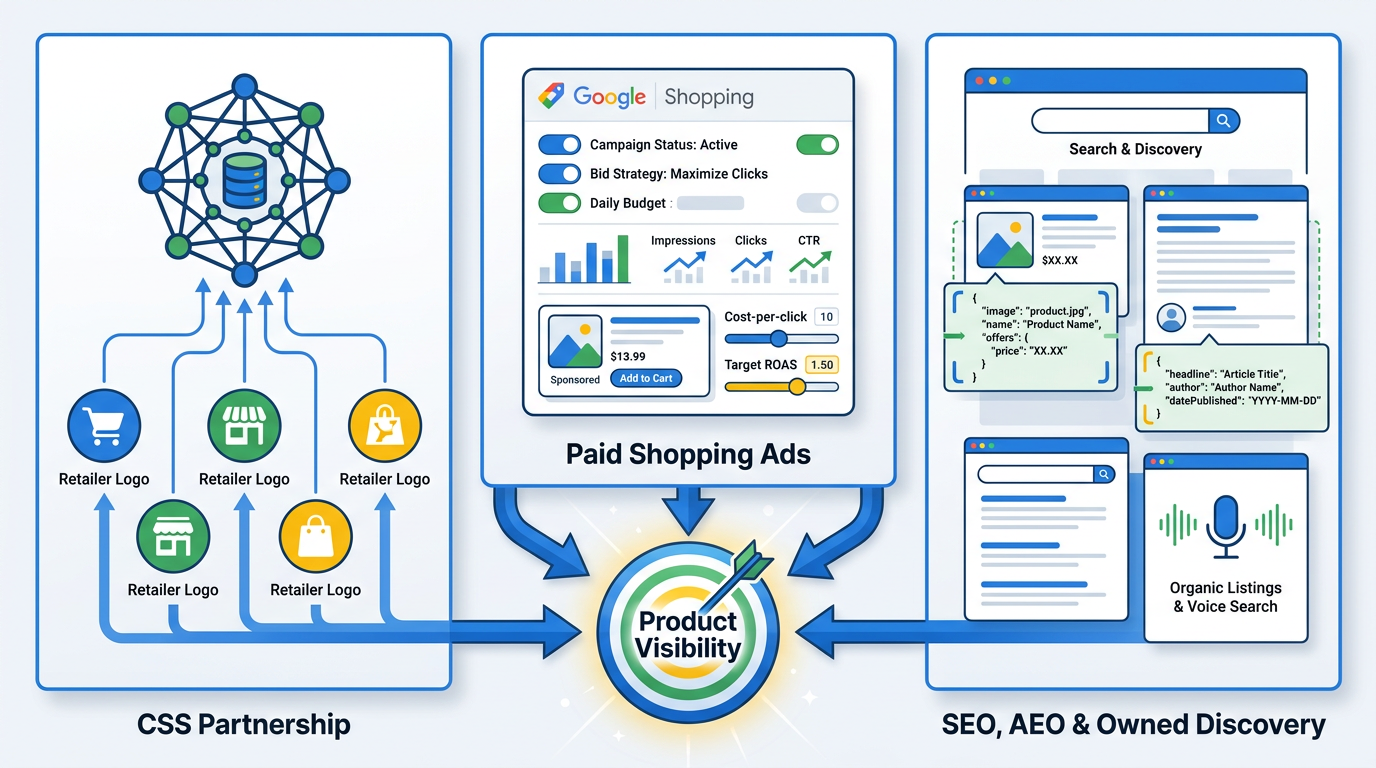
EEA retailers have three main routes for rebuilding visibility in Google Search. Each makes a different trade between cost, control, speed, and longer-term value. The sensible mix depends on budget, competitive position, and the share of traffic that free Shopping placements once supplied.
| Strategy | Pros | Cons |
|---|---|---|
| Partner with a CSS | Restore carousel-like exposure in new aggregator units; work with multiple CSS partners for wider reach; some providers use performance-based pricing | Commission or listing fees compress margin; product presentation is no longer fully yours; the CSS ranks products on its own platform |
| Increase Google Shopping Ad Spend | Send traffic directly to product pages; retain control of creative, targeting, and landing pages; Google Shopping ads were not affected by the DMA change | CPCs may rise in a more crowded paid market; performance depends on budget with no organic fallback; thin-margin retailers may find it unsustainable |
| Focus on Traditional SEO and AEO | Creates a long-term traffic asset you own; broadens discovery beyond Google Shopping; prepares products for AI answer engines and alternative search surfaces | Takes longer and provides no direct product-carousel placement; demands ongoing content and technical investment; does not directly replace the lost Shopping unit |
| Each path addresses the visibility gap differently. Many retailers will combine two or all three. |
Partnering with a CSS
Joining a CSS programme is the straightest path back into the new Shopping-style SERP units. CSS programme retailers send product feeds to one or more partners, which bid for placement in Google's aggregator units on the retailer's behalf. Kelkoo, Productcaster, and Shopping24 are among dozens of providers operating across EEA markets.
Commercial models vary: a flat monthly fee, a percentage of attributed sales, or cost per click. Assess partners by category coverage, EEA geographic reach, and how clearly they report results. A technically sound product feed comes first. Reviewing Google Merchant listing updates can help align feed structure with current requirements.
Doubling Down on SEO, AEO, and Owned Discovery
This route takes longer, but it creates the most durable asset. Traditional SEO - product pages, category pages, and supporting content built for organic blue-link rankings - still works in the EEA. The DMA change removed Shopping carousels, not standard results. Retailers that invest in optimizing product descriptions, build topical authority around categories, and earn backlinks can win traffic that once flowed through the carousel.
Answer Engine Optimization (AEO) broadens that work. As AI search tools such as Google's AI Overviews, ChatGPT, and Perplexity gain adoption, products with clear factual content and well-implemented schema markup stand a stronger chance of appearing in generated answers. That matters more after the loss of a major discovery channel.
Vizup helps retailers reduce dependence on a single discovery channel through its Organic Autopilot for modern discovery. Combining AI agents, human experts, and live SEO, pSEO, AEO, and GEO tools, Vizup helps brands monitor visibility, identify opportunities, create and optimize content, publish improvements, and learn from results across Search, Social, Communities, AI Answer Engines, and Local Discovery. Paid advertising is available as an amplification add-on, helping retailers complement their organic strategy rather than relying exclusively on paid placements.
Common Misconceptions About the Free Listing Removal
"Google removed Shopping ads too." No. DMA compliance changes did not affect Google Shopping ads, and paid placements still appear in EEA search results. Google removed only the free organic portion of the product carousel. Active paid campaigns should continue to run as before, although competition for those placements is likely to rise as merchants move budget into ads.
"This affects my US and UK traffic too." The removal applies only to the 30 EEA member states. Free product listings are still active in the United States, United Kingdom, and other non-EEA markets. Unsegmented analytics can nevertheless make the EEA decline distort global performance figures. Multi-market teams need country-level reporting to isolate it.
"I can just wait for Google to bring the free listings back." Google has not signaled plans to restore them in the EEA. This is a compliance response to EU law, not a product test. Unless the regulatory framework changes, or Google develops a compliant organic alternative, planning should assume the current arrangement will remain.
Key Takeaways for European Ecommerce Teams
- Google largely removed the unpaid Popular products carousel from general Search results across the EEA amid DMA compliance changes. Independent tracking recorded a 90 to 100% decline in visibility for the affected carousel placements, while other eligible free product-discovery opportunities remain available.
- Google Shopping ads were not removed. Paid Shopping placements continue across EEA markets.
- Comparison shopping services (CSS) now hold the space once occupied by free listings, placing an intermediary between Google and retailers.
- Retailers need a recovery plan: use a CSS for aggregator-unit visibility, increase paid investment, or build organic SEO and AEO assets. Most will use a mix.
- Country-segmented analytics are essential. A single EEA and non-EEA dashboard can disguise a regional collapse as a broader global trend.
- Track presence across search, social, communities, and AI answer engines. With one discovery channel gone, diversification has become urgent.
Frequently Asked Questions
Are Google Shopping ads affected by the removal of free listings in the EEA?
No. Google Shopping ads continue to run across EEA markets. The removal applied to unpaid organic product listings shown alongside or inside the Shopping carousel. Paid placements remain the most direct way to secure Shopping-style SERP visibility in Europe.
Will Google bring back free product listings to the European search results?
Google has not announced a plan to restore free product listings in the EEA. The removal is a Digital Markets Act compliance measure, not a temporary test. Retailers should plan for the current arrangement to persist unless EU rules change or Google develops a compliant alternative.
Do I have to join a Comparison Shopping Service (CSS) now?
No. Joining a comparison shopping service is not a legal requirement. CSS partnerships can provide access to aggregator units, but merchants may also be eligible for supplier units and other organic product-discovery surfaces. Retailers should evaluate these opportunities alongside paid Shopping ads, traditional SEO, and AEO based on their market coverage, costs, and visibility goals.
How does this change affect my SEO strategy outside of Europe?
It does not affect it. Free product listings remain active in the United States, United Kingdom, and non-EEA markets. Regional reporting still matters: an EEA traffic decline can skew worldwide performance data if analytics do not separate EEA countries from other markets.
What is the Digital Markets Act (DMA) and why did it cause this change?
The Digital Markets Act is an EU regulation that classifies large digital platforms as 'gatekeepers' and prohibits them from favoring their own services. Google was designated a gatekeeper, and blending its Shopping results into general search was found to breach DMA rules. Google's replacement of free listings with third-party comparison shopping service units is its compliance response. In July 2026, the European Commission fined Google €890 million for DMA breaches, including self-preferencing in Shopping results (European Commission, 2026).
