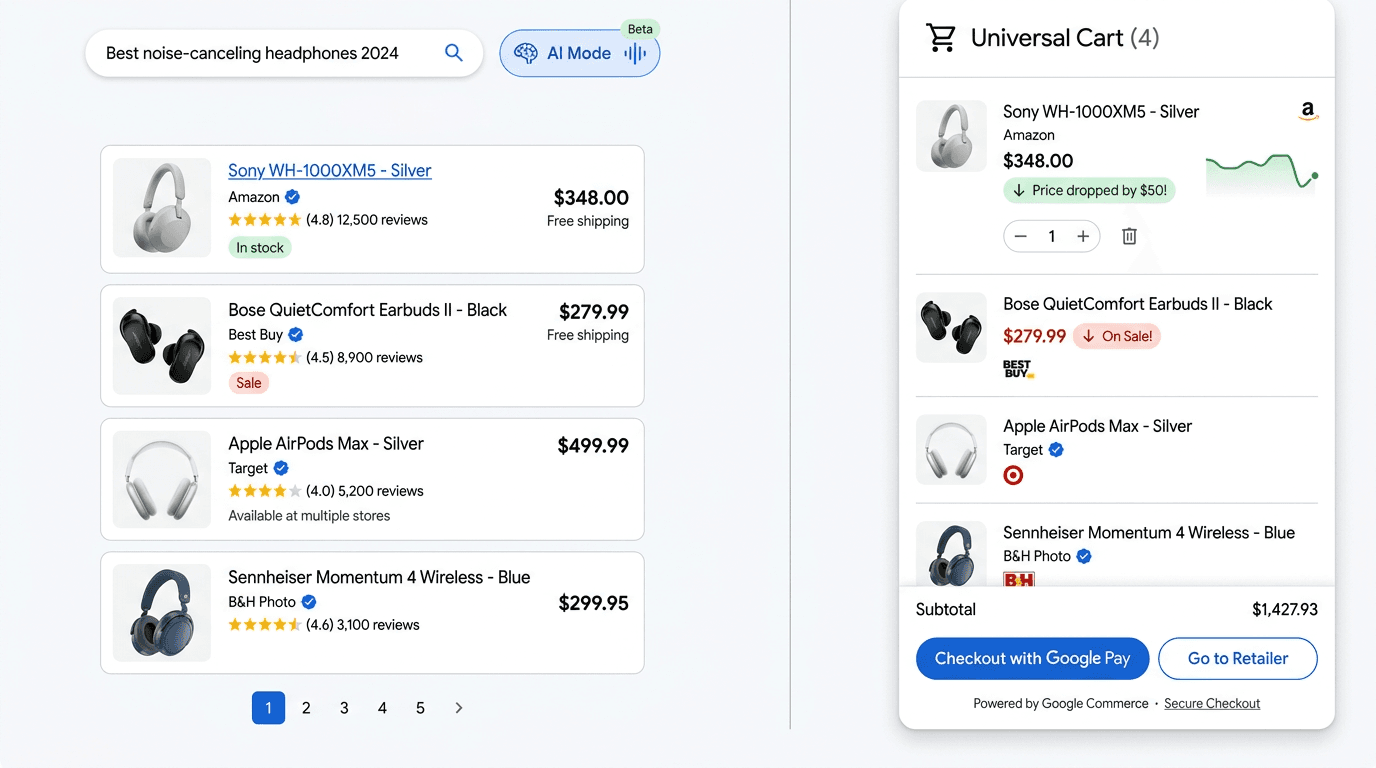
Google Universal Cart is a multi-retailer cart that lets shoppers save products from different stores in one persistent basket across Google Search, including AI Mode, and the Gemini app. It includes price-drop and back-in-stock alerts and draws on Google's Shopping Graph of more than 60 billion continually refreshed listings. At checkout, participating merchants can support Google Pay inside the cart or transfer the shopper to the merchant's own cart.
The October 15, 2026 US launch is more than another shopping feature. It moves conversion, customer contact, and the return-visit loop further onto Google's own surfaces. Merchants need to understand the mechanics before Google offers a self-serve enrollment page. As of this writing, it has not.
What Google Universal Cart Actually Is
The google multi retailer cart is a shopping session that follows a user across Google properties instead of belonging to a single retailer site. Someone searching Google for running shoes can add a Nike pair, search for a water bottle and add one from Target, then open Gemini and add a recovery supplement from a DTC brand. The items remain in one Google-managed cart, with price tracking and a unified checkout flow.
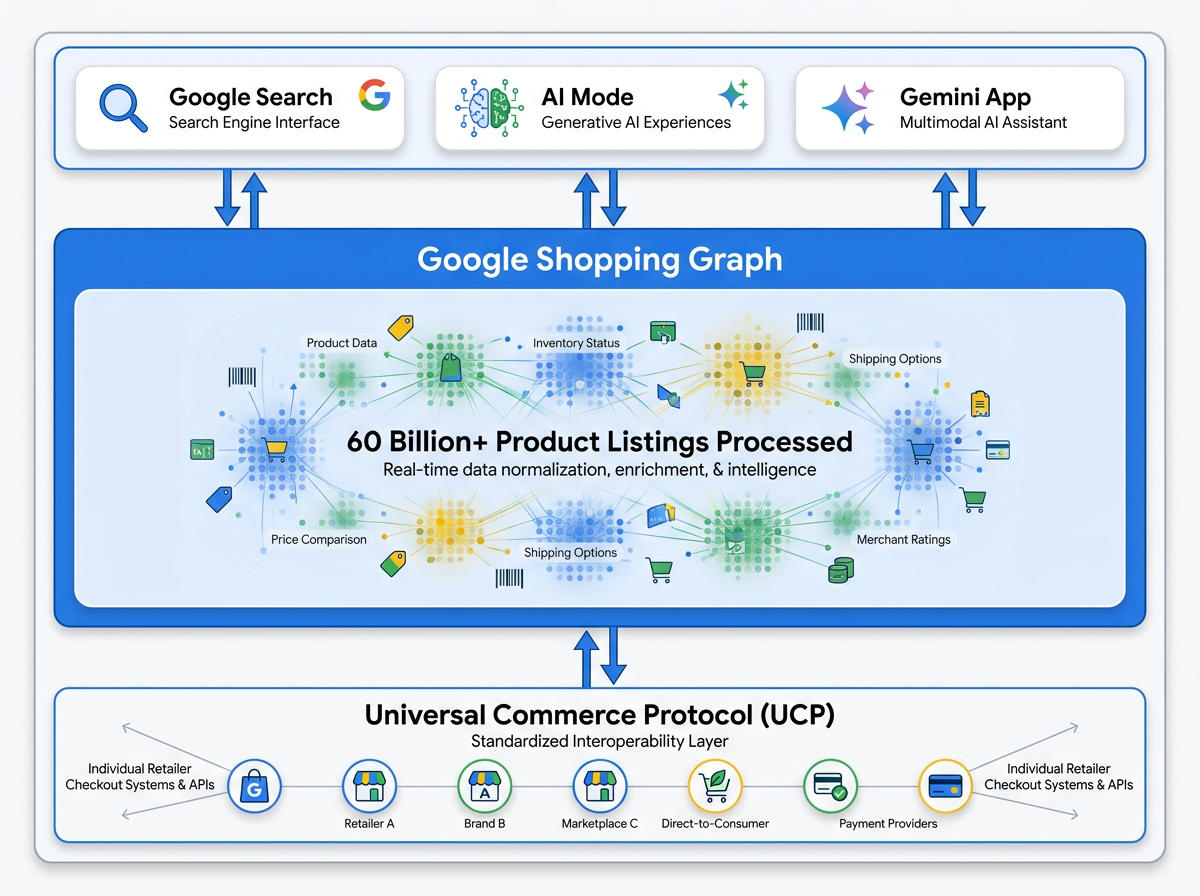
That is a different proposition from the old 'Buy on Google' button, a single-retailer transaction surface Google shut down in 2023. The google shopping graph cart aggregates products across merchants. The Shopping Graph supplies product intelligence from its 60 billion listings; the Universal Commerce Protocol (UCP) handles the checkout connections. Google gets an Amazon-like cart without carrying inventory.
Google is selling the shopper benefits: moving between retailers without rebuilding a cart, price-drop notices for saved items, and back-in-stock alerts. Retailers have traditionally used those prompts to bring people back and rescue abandoned carts. Google is taking over that layer.
How Merchants Get Products Into the Universal Cart
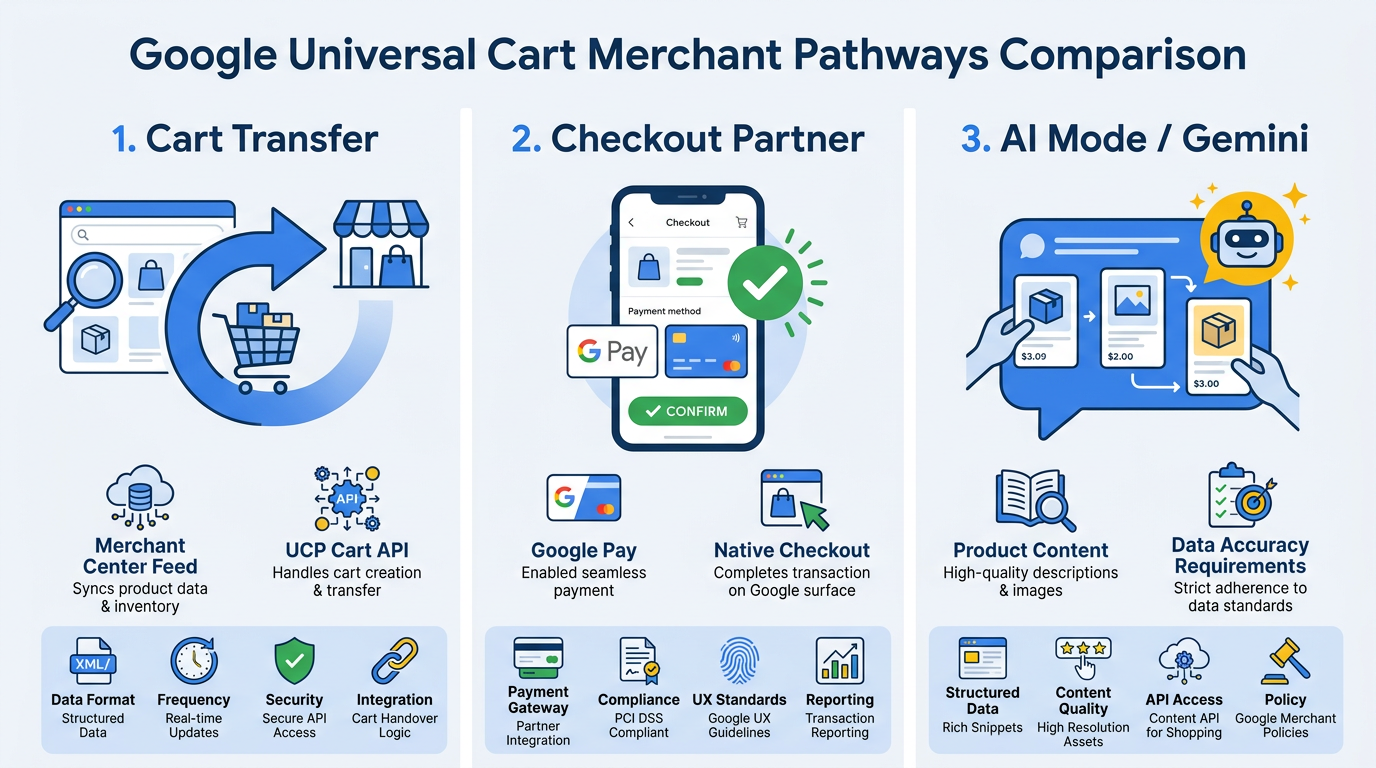
For Universal Cart participation, Google has not published one universal self-serve enrollment path covering every cart experience. UCP-powered checkout is currently available to select merchants, and Google provides an interest form for eligible businesses. Participation depends on the specific Universal Cart experience and merchant integration. Accurate product data and compatible UCP infrastructure are important foundations, but Google has not publicly documented a single Universal Cart eligibility formula. Merchants still have work they can control, through three distinct routes.
Path 1: Cart Transfer
The google cart transfer merchants route is the likely path for established retailers. Google assembles the cart on its own surface, then sends the shopper to the retailer's checkout when it is time to buy. The merchant completes the sale, creates or captures the customer account, and processes the order in its own system.
Cart transfer rests heavily on the Merchant Center feed. Accurate pricing, availability, and product data remain important foundations for Google's shopping ecosystem. Merchants implementing cart transfer must also support Google's UCP Cart API requirements. Merchants that have kept up with Google Merchant listing updates and maintained clean feeds give Google's systems less reason to hesitate. Google names Nike, Sephora, Target, Ulta Beauty, Walmart, Wayfair, and many Shopify merchants as supporting simplified Universal Cart checkout experiences, but Google does not publicly specify which checkout path every named merchant uses.
Tip: Cart transfer preserves the most control: your checkout, customer account, and post-purchase relationship remain yours. The price is operational discipline. A stale feed or mismatched price can push a product down the queue.
Path 2: Native Checkout and Identity Linking
The deeper integration keeps the entire transaction inside Google through Google Pay, then links the buyer's identity to the retailer system afterward. This is the google pay checkout search experience Google has been working toward for years. It is smooth for the shopper; for the merchant, checkout itself belongs to Google.
Google specifically says Universal Cart's simplified checkout experiences are available with many Shopify merchants alongside participating retailers such as Nike, Sephora, Target, Ulta Beauty, Walmart, and Wayfair.Google says many Shopify merchants support the simplified checkout experience. Merchants should verify their own Google and Shopify configuration rather than assume Universal Cart is enabled automatically. A store on one of those platforms may already qualify. Check the platform's Google channel settings before writing the channel off.
Path 3: The AI Shopping Assistant Surface
The ai mode shopping cart and gemini shopping cart are the least transparent path. Ask Gemini to 'build me a home gym setup under $800' and the agent selects products, assembles a cart, and presents a recommendation. Google has not published the complete selection or ranking logic for products surfaced in AI-assisted shopping experiences. Merchants should therefore focus on accurate product data, clear product information, availability, pricing, and technically supported commerce integrations.
This is the early version of the agentic commerce google 2026 has been telegraphing. Google's AI Mode is already changing product discovery; Universal Cart is the transaction layer above it. Merchants optimizing for answer engines rather than traditional search alone should be better placed as the surface develops. To get products in universal cart through AI surfaces, product content has to answer a conversational request, not merely fill out a listing.
The Real Cost of Staying Out
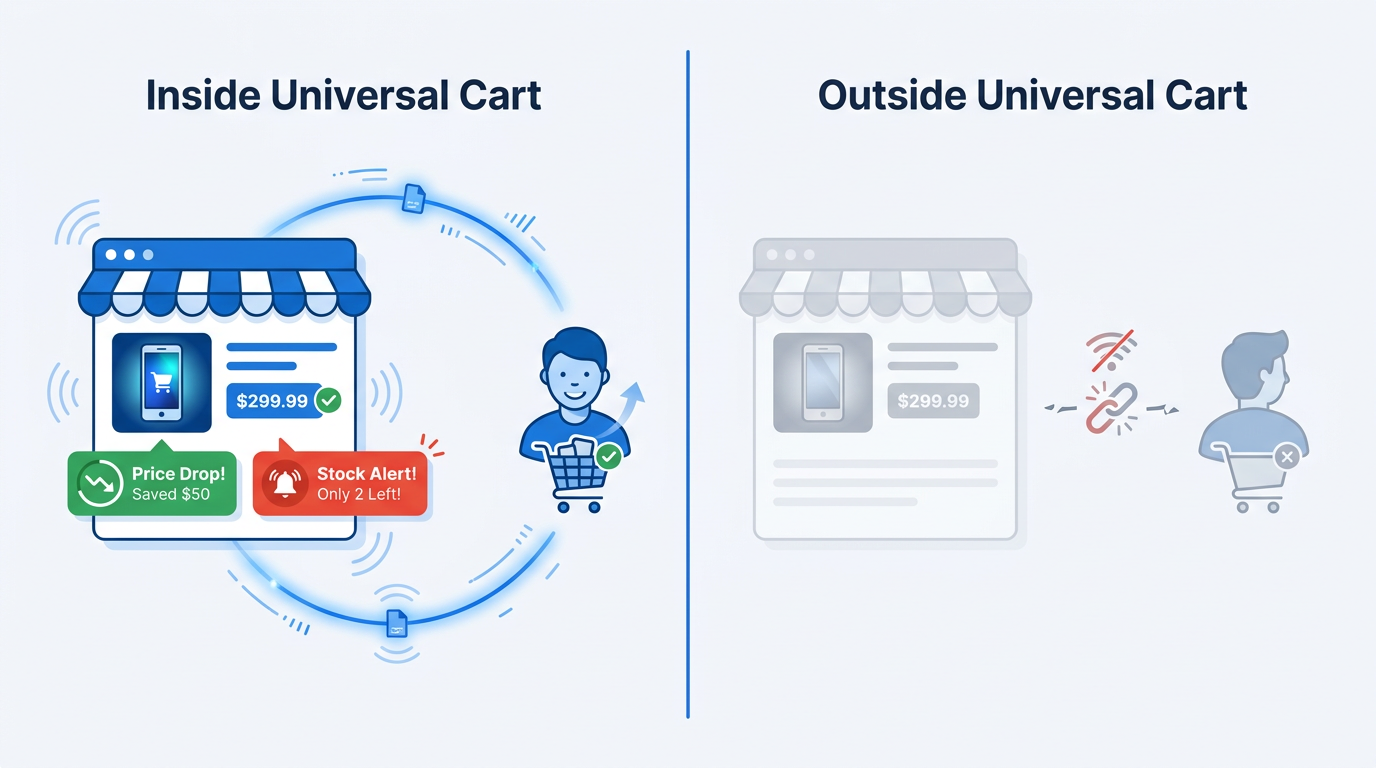
Exclusion from the google universal cart does not show up as an invoice line. It shows up as a gradual loss of relationships retailers spent years building. If Google owns the cart, it owns the session: Google sends the price-drop notice, Google sends the back-in-stock alert, and Google chooses when to put a competing version of the same product next to yours in a price-comparison view.
| Merchant Action | Potential Gains | Potential Losses |
|---|---|---|
| Participate via Cart Transfer | New discovery channel; visibility in price comparisons; less friction for new customers | Google controls the pre-checkout session; competitor products appear alongside yours |
| Participate via Native Checkout | Maximum friction reduction; Shopify/BigCommerce integration is largely automatic | Google owns the checkout experience; identity linking is delayed, not immediate |
| Appear in AI Mode / Gemini Cart | Organic inclusion in conversational commerce; no bid required | Selection is opaque; no direct control over which queries trigger your products |
| Stay Out Entirely | No change to current checkout ownership | Invisible to users building carts in Search and Gemini; Google issues price-drop and stock alerts for competitors only; remarketing leverage shifts to Google |
| Trade-offs vary by participation path. The cost of staying out entirely compounds during high-intent shopping periods like Q4. |
The holiday quarter raises the stakes. If a shopper adds a competitor's product to Universal Cart and gets a Google price-drop alert, there may be no reason for them to visit your site. The remarketing sequence, email flow, and retargeting pixel do not fire because you were never part of the session. That is the Q4 disadvantage of exclusion, and it is why Google's AI advertising features belong in the broader planning picture.
The Attribution Problem Merchants Need to Solve Now
Cart transfer and native checkout create different attribution holes. In cart transfer, the journey begins on Google, can sit in Universal Cart for days, and reaches the merchant site only at checkout. GA4 starts counting at the handoff. The discovery, price comparison, and stock alert that prompted the sale all occurred before that point and remain outside the retailer's analytics.
Native checkout widens the gap. The sale completes inside Google, and the platform integration delivers order data, but not the behavioral record: what else the shopper compared, how long they considered the purchase, or what occupied the rest of the cart. Merchant Center offers aggregate performance reporting. It is not a substitute for the session-level view GA4 gets from an on-site purchase.
Warning: Merchants should verify how Universal Cart handoffs are identified in their analytics and preserve available referral or campaign parameters where their implementation supports them. Google's current Cart API documentation does not establish merchant-added UTM parameters as a universal requirement. Without them, Universal Cart visits can land in GA4 as direct traffic, obscuring the channel's actual contribution.
The workable approach is to combine first-party commerce and analytics data with broader visibility monitoring across Google's evolving discovery surfaces. Vizup acts as an Organic Autopilot for modern discovery, helping brands monitor, create, optimise, publish, and learn across Search, Social, Communities, AI Answer Engines, and Local Discovery using AI agents, human experts, and live SEO, pSEO, AEO, and GEO tools. This gives commerce teams a broader view of where visibility is being gained or lost as product discovery moves beyond traditional search.
Key Takeaways for Merchants
What every merchant needs to act on before the holiday quarter:
- Audit your Merchant Center feed now. Feed quality is the main eligibility signal for cart transfer and AI-surface inclusion. Stale prices, missing GTINs, and incomplete Offer schema can rule products out.
- Identify your platform's Google channel integration. Shopify and BigCommerce stores may already qualify for native checkout. Review Google channel settings and confirm UCP connectivity.
- Do not wait for a self-serve application. There is no enrollment form. The operational work is the application.
- Implement UTM parameters for cart transfer handoffs. Otherwise, Universal Cart sessions can register as direct traffic and leave the channel unmeasurable.
- Treat AI Mode and Gemini as a separate discovery surface. Conversational product queries behave differently from standard Shopping listings. Specific, structured descriptions with clear use-case language improve AI-surface inclusion.
- The agentic commerce trajectory is clear. Microsoft has published a 90-day agentic commerce roadmap, and Google is moving the same way. UCP-compatible infrastructure puts merchants in position for the next phase.
Frequently Asked Questions
Is Google Universal Cart available outside the US?
As of the October 15, 2026 launch, Universal Cart is available only in the United States, across Google Search and the Gemini app. Google has not announced an international timetable. Merchants elsewhere should watch Merchant Center announcements; Google has not announced an international rollout timetable for Universal Cart, so merchants outside the US should follow official Google Shopping and Merchant Center updates rather than assume a specific expansion window.
Does using Universal Cart affect my product's ranking in Google Shopping?
Google has not confirmed that Universal Cart participation is a direct ranking factor. Its eligibility requirements - accurate pricing, complete structured data, and real-time inventory feeds - overlap with signals that generally improve Shopping ranking. Cart transfer or native checkout does not appear to penalize non-participants in organic Shopping results, but excluded merchants have less visibility in cart-building sessions that represent a growing share of high-intent shopping queries.
Can I see which of my competitors are in the Universal Cart?
There is no official inclusion directory. You can search relevant product categories in Google Search and note which retailers receive 'Add to cart' options. Third-party platforms that monitor SERP features can do that at scale. Vizup's Watcher Agent helps brands monitor how they and their competitors appear across Search Engines, Answer Engines, and Social and Community platforms, helping teams identify where organic visibility is being gained or lost.
What's the difference between Universal Cart and 'Buy on Google'?
'Buy on Google' was a single-retailer checkout feature that Google discontinued in 2023. Merchants processed sales through Google's payment system, while Google handled returns and customer service. The google multi retailer cart instead collects products from unaffiliated retailers in one persistent cart, uses the Universal Commerce Protocol for checkout handoffs, and supports both merchant-owned cart transfer and native Google Pay checkout. Merchants retain more post-purchase control than they did with Buy on Google.
Will the Universal Cart be available on YouTube Shopping?
The October 2026 launch covers Google Search and the Gemini app only. YouTube is not part of the October 2026 Universal Cart launch across Search and Gemini. Google previously said YouTube and Gmail would follow, but it has not announced a current launch date for either surface. Because YouTube Shopping already has product-tagging and checkout infrastructure, connecting it to Universal Cart would require substantial coordination. Merchants should not plan on YouTube Universal Cart availability soon.
The google universal cart is not something a merchant joins by clicking a button. It is commerce infrastructure that favors the foundations already in place: clean feeds, sound structured data, platform integrations, and content written for the way AI agents parse product requests. Treating it as a future problem risks being absent from a cart customers are using during this holiday season. Acting now creates an advantage that grows as agentic commerce becomes a more common way to shop online.
