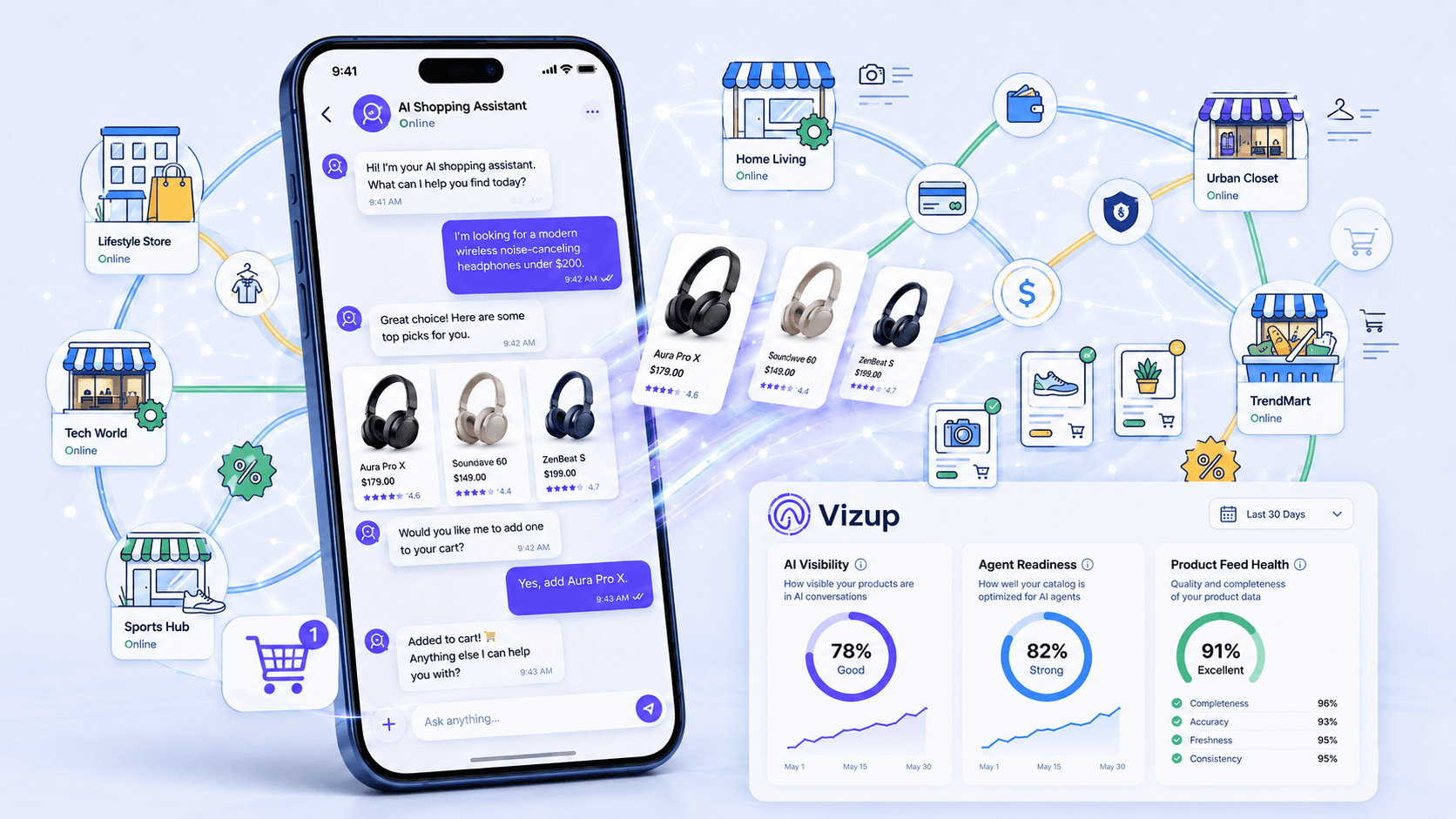
Google's Universal Commerce Protocol (UCP) is an open-source technical standard that lets AI agents, including the ones inside Google Search and Gemini, run the full shopping flow for a user. Instead of stopping at recommendations, UCP supports the unglamorous but essential steps: browsing inventory, building a cart, applying discounts, and checking out inside the retailer's own system.
Handing the buying job to an AI agent has moved from demo to deployment. Google co-developed UCP with Shopify, Walmart, Target, Etsy, and Wayfair, among others. That matters because it isn't just a new surface in Search; it's plumbing. Brands that wire themselves into it get bought. Monitor how your brand appears across search and AI surfaces. If you're asking what is UCP Google, the practical answer is simple: it turns your catalog into something an AI can transact against, not merely index.
From Clicks to Conversations: The Dawn of Agentic Shopping
Classic e-commerce still asks shoppers to run a gauntlet: search, click, filter, compare variants, read reviews, add to cart, type shipping and payment details, then finally pay. Every handoff is a chance to lose the sale. UCP-style agentic shopping compresses that mess into one instruction: "Find me a blue, medium-sized merino wool sweater under $100 and buy it."
The agent parses the request, hits participating retailers through their UCP endpoints, checks inventory and pricing as it goes, and places the order. The user approves once, and the shipment is on its way. That's the real promise here: discovery, evaluation, and transaction stop living in different tabs and start behaving like one workflow. The trade-off for brands is uncomfortable but clear. Visual polish, navigation, and even your checkout UX matter less when the buyer is an API client. What matters more is whether your structured data is complete and whether your endpoints respond reliably. If you're pressure-testing your setup, Vizup's guide on whether your website is AI-agent friendly is a solid place to start.
The Architecture of a UCP Transaction
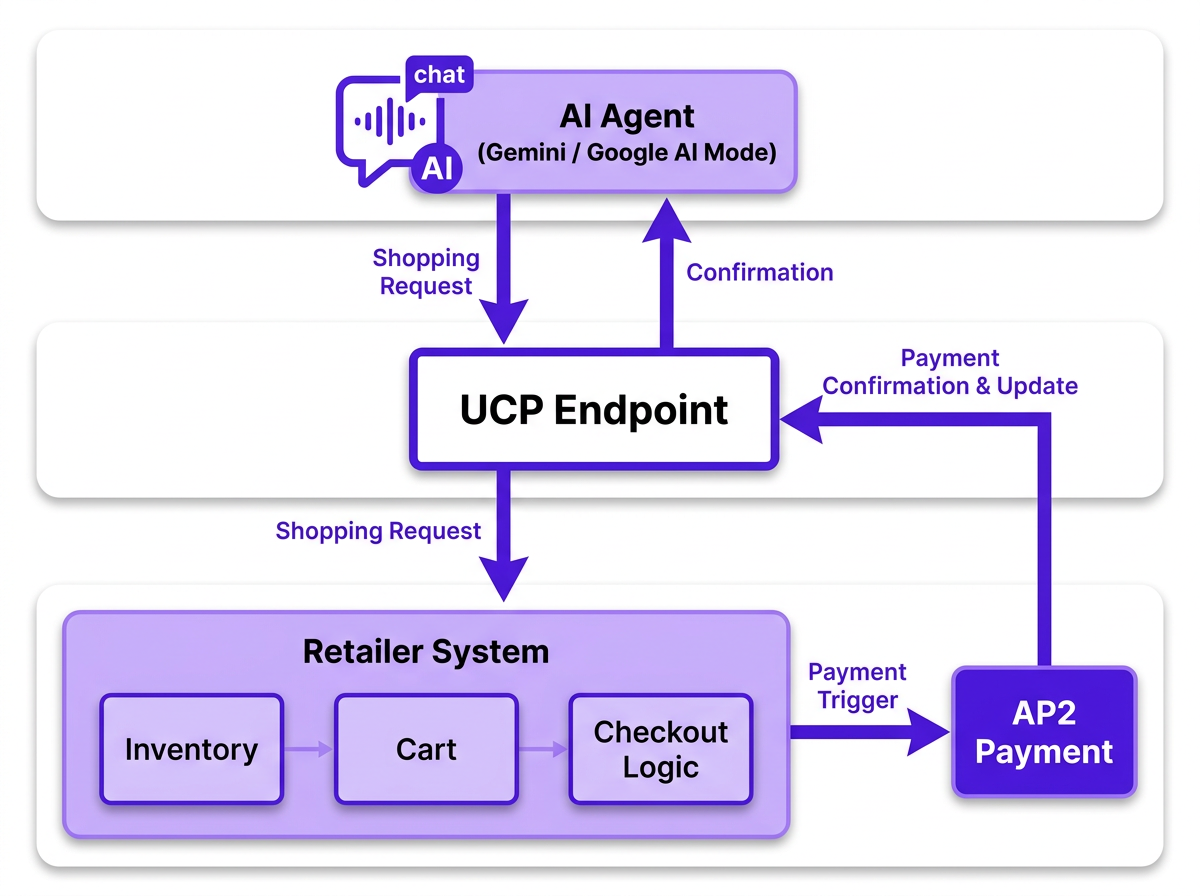
UCP isn't a Google storefront or a new marketplace. It's a protocol: a set of rules and APIs that lets Google's AI talk to your commerce backend. The official docs at ucp.dev break the work into discrete "Capabilities" (like Checkout, Identity Linking, and Order Management) so platforms and merchants can declare exactly what they support (ucp.dev, 2026). Below is the three-layer flow a transaction follows.
The Core Components
- The AI Agent: The user-facing AI (in Gemini or Google Search AI Mode) that interprets the shopping request and orchestrates the transaction. Google's first implementation powers checkout on eligible product listings in AI Mode for select U.S. retailers (Google, 2026). Understanding how this surfaces in search is closely tied to Google Search Live for AI Mode.
- The UCP Endpoint: The API surface a retailer exposes so the agent can check availability, assemble a cart, and kick off checkout.
- The Retailer's System: Your commerce stack (Shopify, Magento, or custom) plus the inventory, cart, and checkout logic that actually enforces your business rules. The agent goes through the UCP endpoint; it doesn't sidestep your policies.
- The Payment Protocol (AP2): The payment layer that completes the charge without handing user credentials to the agent. Payment details stay out of the agent's hands by design.
UCP vs. MCP: Clearing Up the Confusion
If you're already tracking Google's agent work, you've probably seen the UCP vs MCP question come up fast. The Model Context Protocol (MCP) is the general-purpose standard for how AI models connect to external data sources and tools. It's the "information" side: reading and interpreting structured data. UCP is the commerce-specific layer built for doing, not just understanding: cart, checkout, payment, and order management. Put differently, MCP helps an agent understand your catalog; UCP lets it complete a purchase from it. For a concrete example of MCP, see how to connect Google Search Console to Claude with MCP.
| Protocol | Primary Function | Who Implements It | How It Connects |
|---|---|---|---|
| UCP (Universal Commerce Protocol) | Agent-driven commerce end to end: browse, cart, checkout, order management | Retailer publishes a UCP endpoint; Google's AI agent consumes it | Built on MCP for data access; triggers AP2 during checkout |
| AP2 (Agent Payments Protocol) | Payment processing that keeps user credentials out of agents | Payment processors (Visa, Mastercard, Stripe) and retailers | Invoked by UCP at checkout to run the financial transaction |
| A2A (Agent-to-Agent) | Different agents coordinating on multi-step work | Platform providers and agent developers | Lets Google's shopping agent coordinate with a retailer-side fulfillment agent |
| MCP (Model Context Protocol) | AI access to structured data (read/understand external sources) | Data providers, tool developers, retailers (data feeds) | Supplies the information layer that UCP's action layer relies on |
| UCP is designed to be compatible with MCP, A2A, and AP2, forming a complete agentic commerce stack (Google, 2026). |
Getting Ready: A Checklist for Google UCP Retailers
Preparation starts with data discipline, then moves into implementation. Retailers need an active Google Merchant Center account and product feeds with the attributes required to make inventory eligible for direct purchase inside conversational experiences (Google, 2026). If you want a clean baseline before you touch endpoints, a thorough ecommerce SEO audit is a smart first move. The same feed hygiene that supports SEO is now what determines whether an agent can actually place an order.
Step 1: Perfect Your Google UCP Product Feed
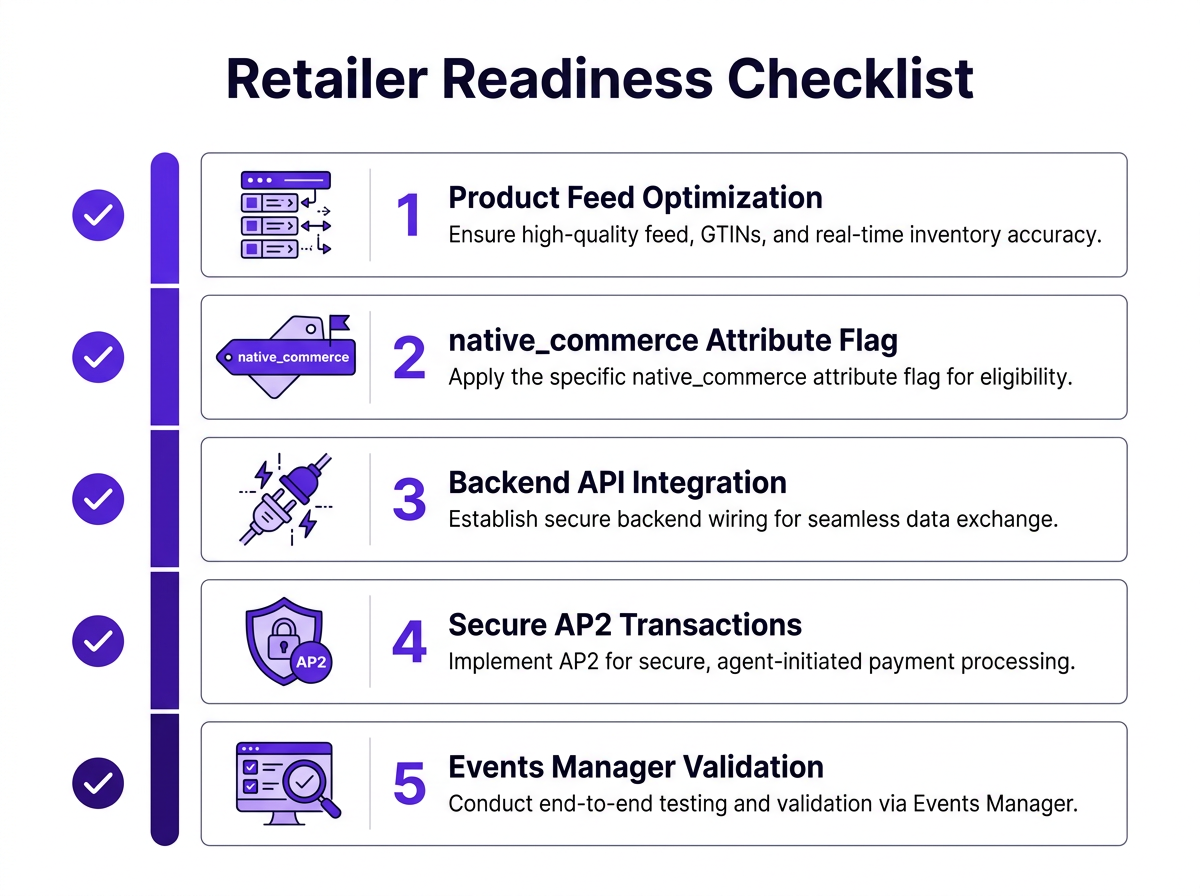
An agent can't purchase what it can't reliably parse. Your Google UCP product feed needs correct, up-to-date stock levels, specific attributes (color, size, material, weight), and stable identifiers like GTINs. The "native_commerce" attribute is the flag that tells Google your products are eligible for these agent-driven flows. Miss that, and you can rank just fine while still being effectively invisible to the buying agent.
Step 2: Implement Technical Endpoints and Payments
After the feed is in shape, the work shifts to wiring: standing up your UCP API endpoint and connecting it to your backend. For the millions of SMBs on Shopify, a UCP Shopify integration is expected to be one of the first more turnkey paths, given Shopify's role as a co-developer. You'll also need AP2 in place for secure payments, then run the full flow through Google's Events Manager. Security and authentication sit at the center of all of this, and Google's experiments with web bot authentication are useful context for where agent identity verification is headed.
Tip: Retailer Readiness Checklist: 1) Audit product feed quality (GTINs, real-time inventory, precise attributes) → 2) Add the native_commerce attribute to eligible products → 3) Expose a UCP endpoint connected to your e-commerce backend → 4) Integrate AP2 for secure agent-initiated payments → 5) Test the full flow in Google's Events Manager before going live.
The Road to 2026: Is UCP the New Agentic Commerce Standard?
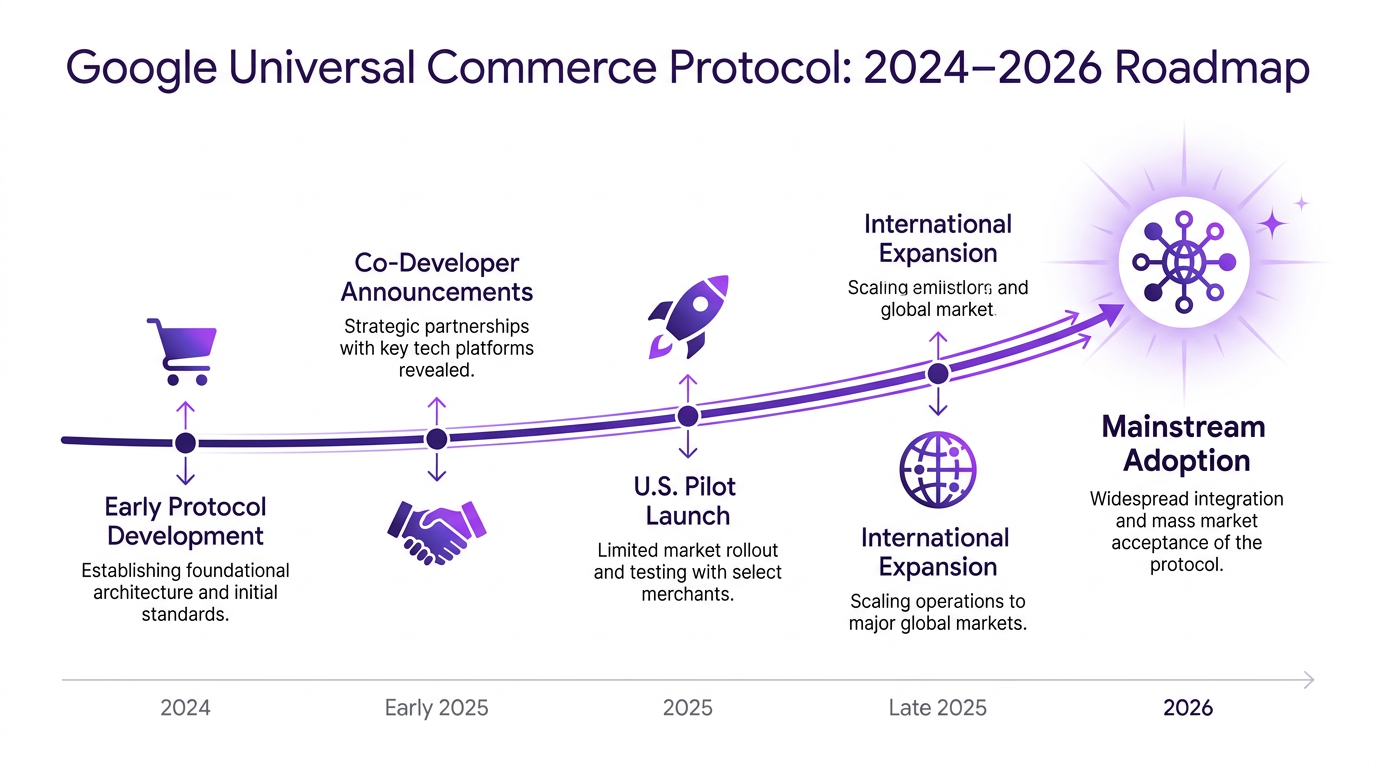
UCP has a built-in network effect. Each new retailer that plugs in makes Google's shopping agent more useful, which raises the pressure on the next retailer to participate. With 20+ co-developers spanning retail, payments, and platforms, UCP has a credible path to becoming a default agentic commerce standard by 2026 and beyond. The bigger question for most brands isn't whether agent-driven purchases become a real channel; it's whether your inventory will be purchasable when shoppers stop clicking and start delegating. Digiday captured the shape of it well, describing UCP as "a set of rules for different stores, apps, and platforms to communicate" (Digiday, 2025).
Your Next Customer Won't Visit Your Website
The Google Universal Commerce Protocol moves the interaction point away from your storefront and into an API call. In that setup, the "customer" is an agent, and the experience lives in your feed quality, inventory accuracy, and endpoint performance. For e-commerce managers and digital marketing directors, the mandate widens: keep improving UI and speed for humans, but start treating structured data completeness and API reliability as revenue-critical, too.
Summary
- UCP is an open-source protocol (not a platform) that enables AI agents to execute full shopping transactions on behalf of users.
- It runs through a 3-layer architecture: AI agent → UCP endpoint → retailer system, with AP2 handling payments securely.
- UCP is the commerce "action layer"; MCP is the "information layer" for data access. They work together, not against each other.
- Readiness starts with product feed quality (GTINs, real-time inventory, native_commerce attribute) and then moves to endpoint implementation.
- With over 20 global co-developers and U.S. pilots already live, UCP is tracking toward a defining agentic commerce standard by 2026.
The brands that hold on to share will be the ones watching how they show up not only in classic search results, but also inside AI answers and agent-driven shopping flows. Vizup's digital presence monitoring tools are designed to track visibility across those emerging surfaces, so you can stay both discoverable and transactable as shopping shifts from screens to conversations.
See how Vizup monitors your brand's visibility across search, social, and AI-driven channels.
Frequently Asked Questions
What is UCP in Google?
UCP (Universal Commerce Protocol) is an open-source standard co-developed by Google that lets AI agents complete shopping transactions end to end, from discovery through checkout, on a user's behalf. It defines the APIs and rules agents use to interact with retailer systems. The technical specs are published at ucp.dev.
How does Google's Universal Commerce Protocol affect SEO?
UCP changes what "optimization" covers. Traditional SEO still matters for human clicks, but agent-driven commerce depends on structured product data, feed accuracy, real-time inventory, and the quality of your API endpoints. Brands need to run both playbooks at once: ranking for humans while staying purchasable for agents.
Is UCP only for large retailers like Walmart and Target?
No. Walmart and Target are co-developers, but UCP is open-source and designed to work at any scale. Shopify's role as a co-developer also matters here: platform-level integrations can bring UCP within reach for millions of SMBs, not just enterprise retailers.
What is the difference between UCP and Google's Model Context Protocol (MCP)?
MCP is the broader protocol that helps AI models access and understand structured data from external sources. UCP is the commerce-specific protocol built on top of that foundation to execute transactions (cart, checkout, payment, order management). MCP reads your catalog; UCP buys from it.
How can I prepare my Shopify store for Google UCP?
Start with your Google Merchant Center feed: real-time inventory, precise attributes, valid GTINs, and the native_commerce attribute enabled. Then watch Shopify's announcements for UCP integration timing, and plan to test the full flow in Google's Events Manager once endpoints are available.
