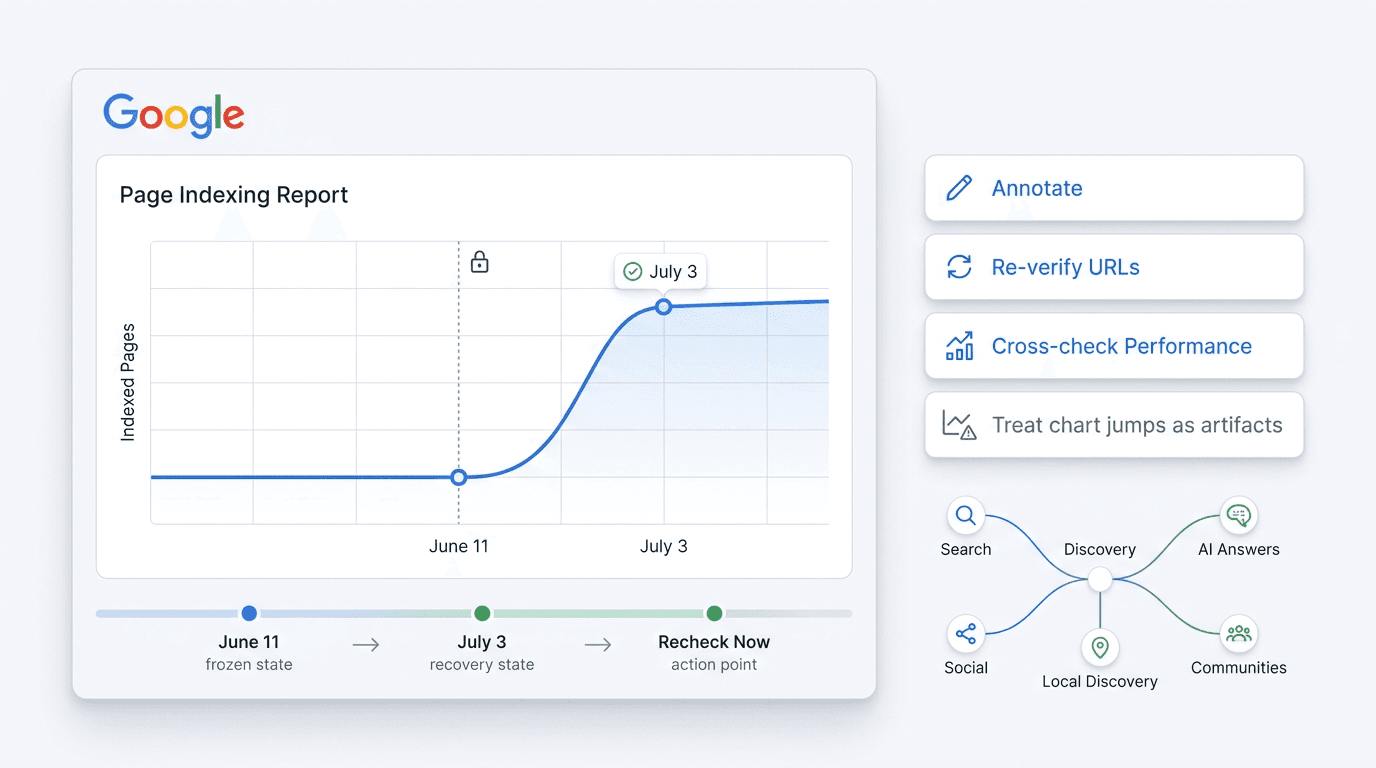
The Google Search Console page indexing report delay that started June 11, 2026 meant nearly three weeks of unusable indexing reporting for SEOs, agencies, and site owners. The report stayed frozen while launches went out, fixes rolled in, and clients still expected clean monthly numbers. By July 3, industry reports indicated the Page Indexing report had started catching up after being stuck on June 11 data. Treat the returning chart as backfilled reporting data, not a real-time indexing surge.
If your indexed page count looked like it fell off a cliff in mid-June, that was the report lying to you, not a real de-indexing event. Below is the clean version of what happened, what did not change, and the four checks to run now so your reporting and follow-up work are based on reality.
What Exactly Happened with the GSC Indexing Report?
The Page Indexing report got stuck on June 11 data, creating a GSC data delay that lasted until July 3. Industry coverage first reported the delay while the report was still stuck, then later reported that the Google indexing report in Search Console had been fixed by July 3.
Google also drew a bright line between this and the June 2026 spam update. The timing overlap made it easy to misread a frozen chart as an indexing hit from the spam rollout. That was a false alarm. The GSC indexing report not updating was a pipeline/reporting fault, not a quality signal and not a penalty.
Info: As Search Engine Roundtable reported in 2026, the apparent drop in indexed pages visible around June 11 was a reporting glitch, not proof of a real de-indexing event. Treat the outage as a Search Console reporting issue unless URL Inspection, Performance data, logs, or ranking data show matching evidence of a real indexing problem.
This was also not a one-off. Google recently addressed a similar reporting-layer issue in the Search Console link report, and another GSC bug caused impression drops earlier in 2026. Taken together, the trend to watch is reporting-layer failures across multiple GSC modules, not just the latest isolated fix.
Your 4-Point Recheck List Now That the Indexing Report Is Fixed
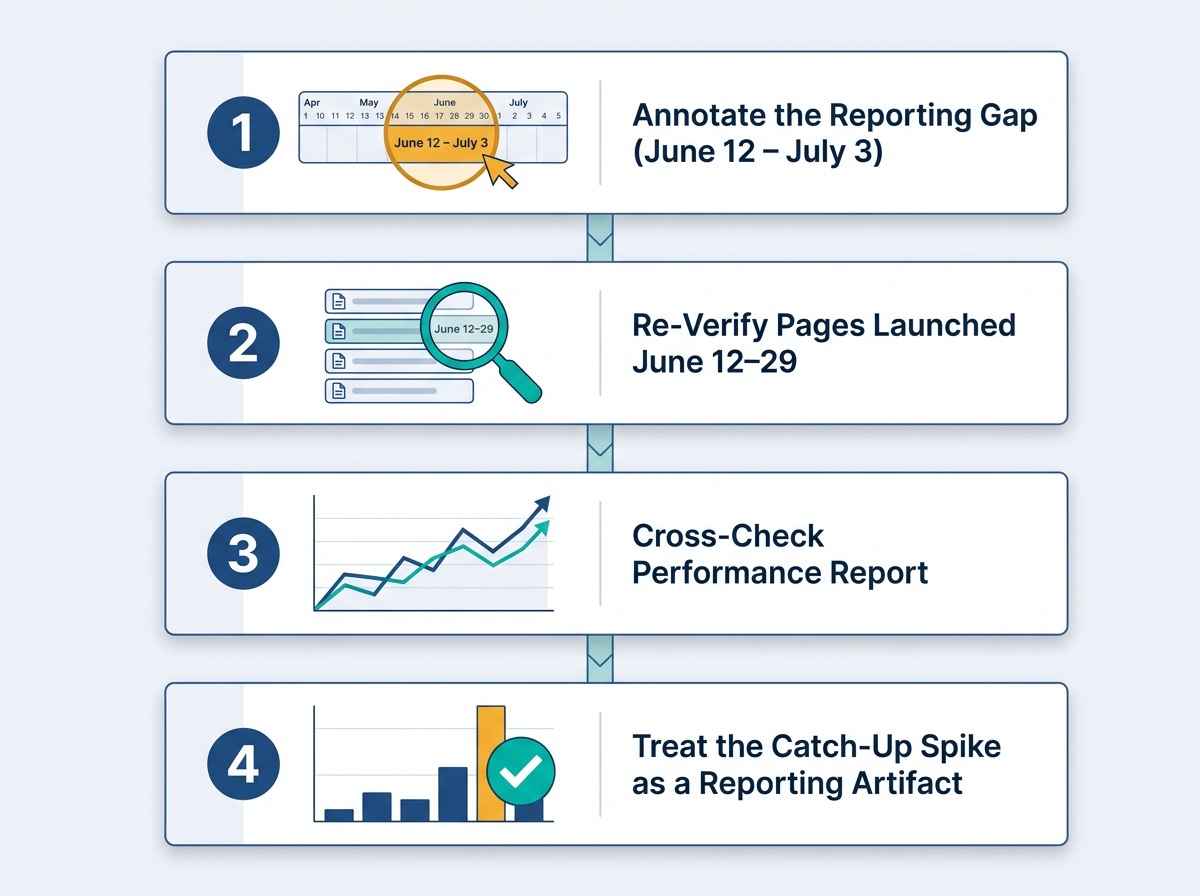
1. Annotate the Affected Window in Every Report
Start in your dashboards and anything client-facing. Add an annotation spanning June 12 through July 3, 2026 and label it as the Google Search Console page indexing report delay. That one note keeps someone from reading the flatline as a performance problem, or the rebound as a sudden indexing win.
2. Re-Verify Pages Launched or Fixed During June 12-29
If you shipped a new section, cleared a batch of Crawled - currently not indexed issues, or pushed technical fixes during the gap, the report never showed the progress. Use URL Inspection to spot-check the URLs that matter most, and check your sitemap before resubmitting if you need a fresh confirmation pass.
3. Cross-Check Against the Performance Report
The Performance report kept updating during the outage. If a page picked up impressions between June 12 and June 29, that is your cleanest proof it was indexed (and showing) during the gap. If a page has zero impressions in Performance and the indexing report does not clarify status, that one is worth re-inspecting. If impressions were climbing but the indexing report looked stale, you are just seeing the freeze.
4. Treat the Catch-Up Chart Artifact as a Reporting Artifact
When the fix rolled out on July 3, a lot of properties showed an obvious step-change in indexed page count. That jump is three weeks of backfilled data landing at once, not a sudden indexing surge. Assume anything that happens right around the gap is chart noise until the following weeks confirm a real trend. If you need a broader way to sanity-check these moments, the GSC data anomalies playbook lays out how to separate real changes from reporting artifacts.
How Do You Avoid Being Blindsided by the Next GSC Bug?
The search console bug July 2026 was not the first reporting miss, and it will not be the last. The practical fix is simple: do not let one report be your only compass. Performance data, URL Inspection, server logs, and third-party monitoring each cover a different angle. When one layer goes dark, the others keep you from guessing.
Keep an internal change log with dates for every meaningful deployment. When a report breaks, your own log is the clean record of what shipped and when. Vizup adds an independent discovery layer outside Google Search Console, so one reporting failure does not wipe out your visibility picture. As an Organic Autopilot for modern discovery, Vizup helps brands monitor, create, optimise, publish, and learn across Search, Social, Communities, AI Answer Engines, and Local Discovery using AI agents, human experts, and live SEO, pSEO, AEO, and GEO tools. Paid ads can then be used as an amplification add-on once the organic visibility system is working. And if you want faster triage once data starts flowing again, you can connect Google Search Console to AI-assisted visibility workflows to flag anomalies as the backlog clears.
Key Takeaways
What every SEO and site owner needs to know about the indexing report delay:
- The page indexing report froze at June 11 data; the fix landed July 3 with data through June 29.
- Crawling, indexing, and ranking were unaffected. This was a reporting-layer issue only.
- The delay was explicitly unrelated to the June 2026 spam update.
- Annotate June 12 to July 3 in all dashboards and client reports immediately.
- Re-verify any pages launched or fixed during June 12-29 using URL Inspection or sitemap resubmission.
- Use the Performance report as your independent verification source for indexing activity during the gap.
- The step-change visible in charts around July 3 is a catch-up artifact, not a real indexing event.
- Diversify your monitoring sources so the next reporting failure does not leave you blind.
Frequently Asked Questions
Was my site's ranking affected by the GSC indexing report delay?
No. Google said this was limited to the reporting layer. Crawling, indexing, and ranking continued normally across June 12 to July 3. If you saw ranking movement in that window, it came from something else, not this bug.
Why did my indexed pages count suddenly jump up on July 3rd?
Because the chart caught up all at once. Once the indexing report was fixed and data was backfilled through June 29, roughly three weeks of changes appeared in a single update. Treat that step-change as a catch-up artifact and watch the following weeks to confirm the true direction of index coverage.
Is this indexing report bug related to the GSC link report fix?
They are different issues, but they fit the same broader pattern: GSC reporting-layer failures across June and July 2026. The Search Console link report issue addressed a separate reporting pipeline problem, while the impression drop bug affected another GSC data view. Google has not pointed to a shared root cause; still, keep both events annotated in reporting.
How can I prove to my client that a page was indexed during the reporting outage?
Use the Performance report as your receipt. It updated normally during the gap, so impressions or clicks between June 12 and June 29 are direct evidence Google indexed and ranked the page. You can also pull URL Inspection and share the live URL status result with a timestamp.
What should I do if the gsc indexing report not updating issue happens again?
Move immediately to independent checks: Performance for impressions, URL Inspection for specific pages, and bulk indexation checks via site: operator queries. Annotate the start date in your reporting so the gap is obvious later. For a full triage workflow, use the GSC data anomalies playbook, and keep a monitoring layer outside GSC so one reporting failure does not take away all visibility.
