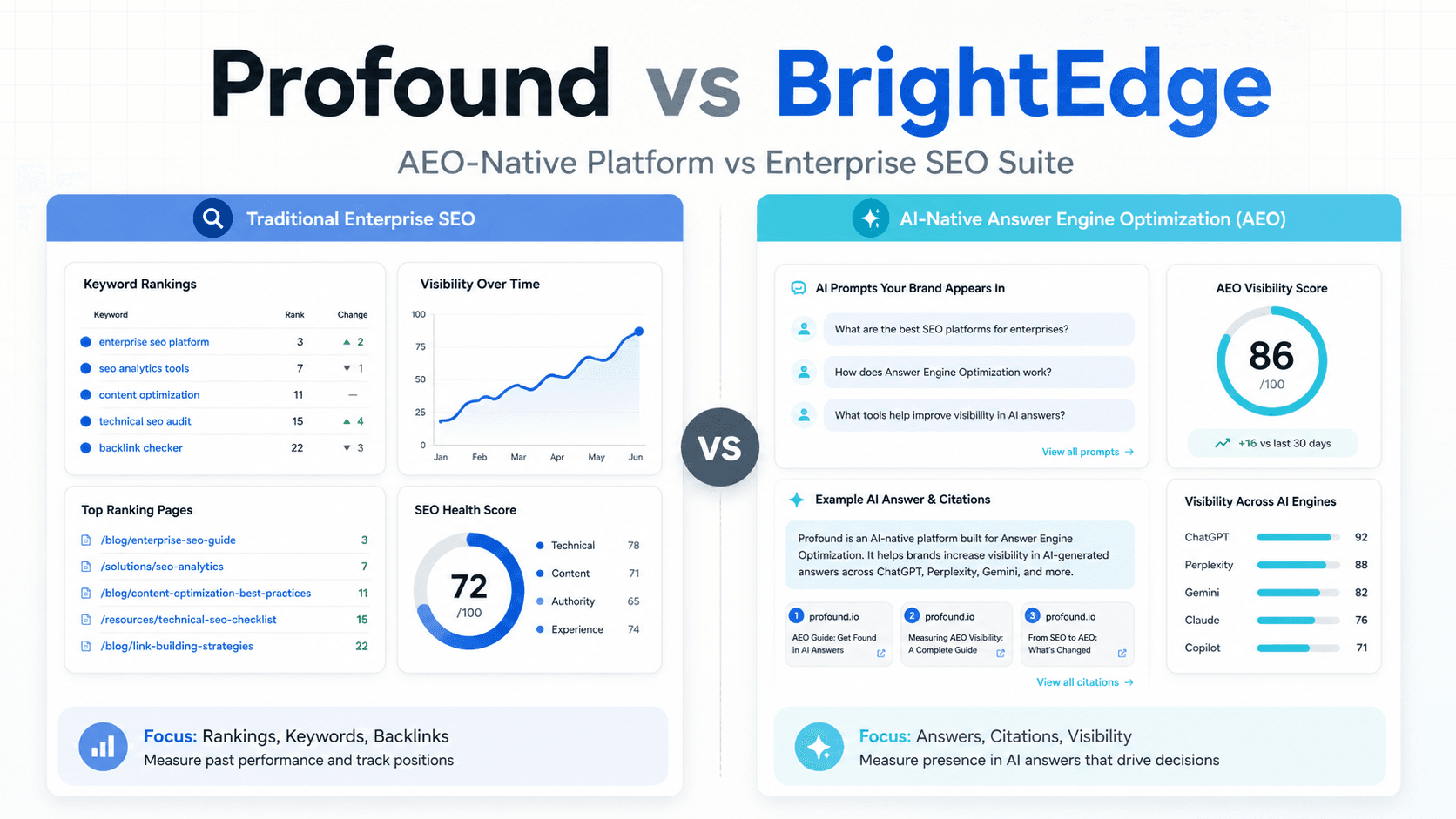
Choosing an enterprise marketing platform was once a simpler affair. The best tool usually had the largest keyword database and the most impressive rank-tracking dashboards. That era is over. As AI-driven answers from Perplexity, Google, and ChatGPT increasingly replace traditional blue links, the old playbooks are becoming obsolete. The conversation has shifted from just SEO to a new discipline: Answer Engine Optimization (AEO). This shift forces a critical decision for marketing leaders in 2026. Do you adapt an established SEO giant that is adding AI features, or do you embrace a platform engineered from the ground up for this new reality?
This is the essence of the Profound vs. BrightEdge debate. It represents a fundamental clash of philosophies. BrightEdge is the seasoned incumbent, an enterprise SEO powerhouse with a long history and a vast feature set. Profound is the well-funded challenger, built specifically to secure brand visibility within AI-generated answers. A platform choice can either catapult a team's growth or mire it in useless data. We'll compare these two platforms on the criteria that truly matter: core focus, feature depth, usability, and price.
How We're Evaluating These Platforms
A tool's value is measured by the results it delivers. Rather than simply listing features, we are evaluating Profound and BrightEdge from the perspective of an enterprise team that must justify its budget and demonstrate ROI. Our judgment will be based on the following criteria.
- Core Philosophy & Focus: Does the platform treat AEO as a feature or as its fundamental purpose? This is the most critical distinction.
- Key Features & Capabilities: What unique tools do they offer beyond the basics? We are looking for AI-driven automation, proprietary data sets, and advanced content capabilities.
- Ease of Use & Implementation: How quickly can a team start generating value? A powerful tool that is too complex to master is merely expensive shelfware.
- Integrations & Scalability: How seamlessly does the platform connect with the existing marketing stack (CMS, analytics, CDNs), and can it handle global operations?
- Pricing & Value: What is the total cost of ownership, and do the capabilities justify the price? We will look past the opaque enterprise sales process to assess true value.
BrightEdge: The SEO Titan Adapting to AI
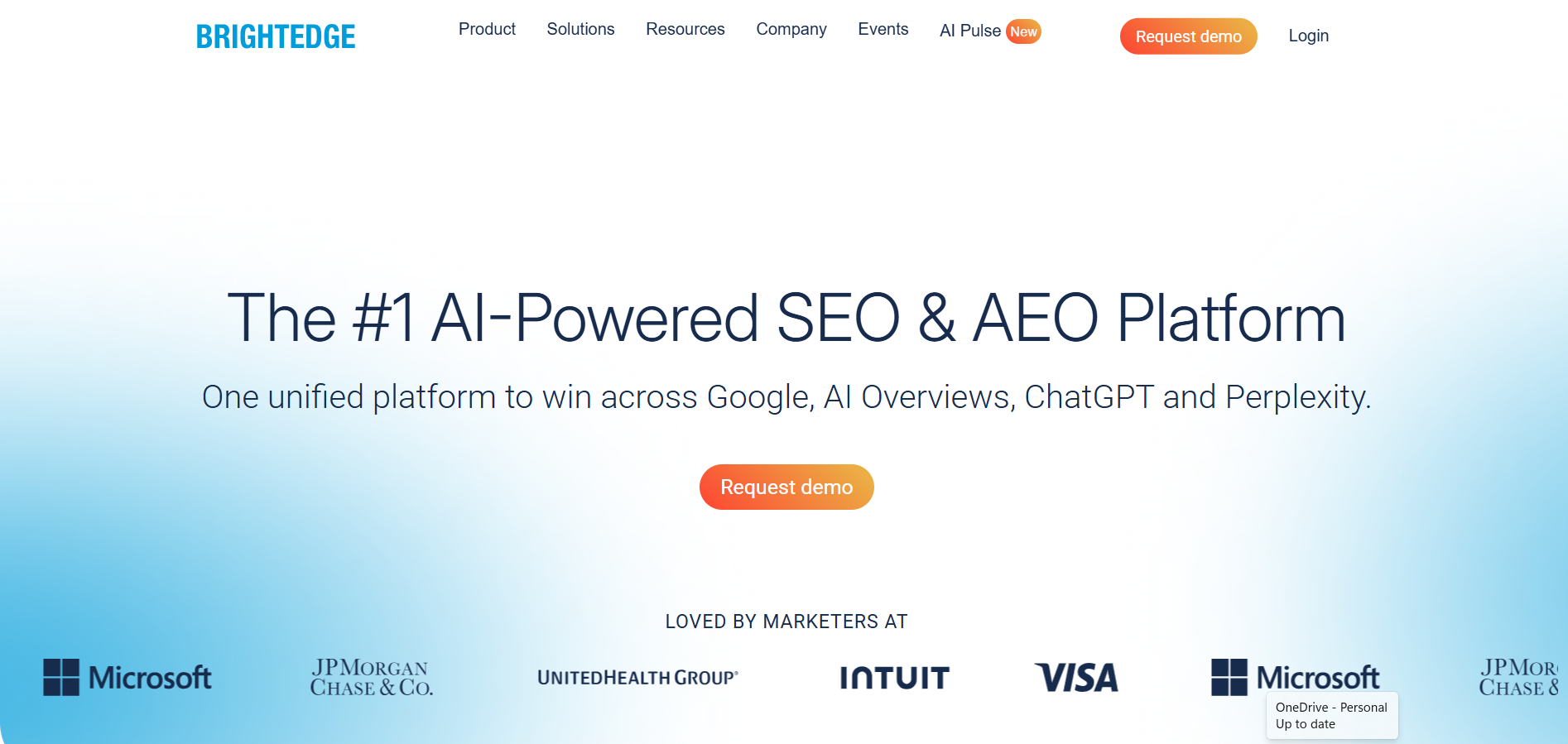
For over a decade, BrightEdge has been a fixture in enterprise SEO. Anyone who has worked in a Fortune 500 marketing department has likely encountered its dashboards. The platform’s reputation is built on an enormous keyword dataset and a comprehensive suite of tools for virtually every traditional SEO task, from rank tracking and site audits to competitive analysis and content briefs. It is, by any measure, a heavyweight.
In recent years, BrightEdge has focused on integrating AI into its platform. Features like BrightEdge Autopilot, which aims to automate on-page SEO, and BrightEdge Instant, for real-time trend data, are the company's response to the evolving search landscape. This strategy involves layering AI-powered features onto its solid SEO foundation. The value proposition is straightforward: provide a single platform for both traditional SEO and emerging AI search. For large organizations that have built their SEO programs around BrightEdge, this integrated approach is understandably compelling.
Where BrightEdge Shines (and Stumbles)
The platform's primary strength is its sheer breadth. For a global enterprise managing dozens of domains in multiple languages, BrightEdge's capacity to handle complexity is a proven asset. Its ContentIQ feature for large-scale site audits and StoryBuilder for custom reporting are indispensable for many large SEO teams. User reviews often highlight the hands-on support from dedicated customer success managers, which can be invaluable for teams navigating the platform's intricacies.
However, this complexity is also a potential weakness. Some users report a steep learning curve and a cluttered interface. The most significant challenge for BrightEdge is philosophical. It remains an SEO-first platform. Its AI features, while functional, are designed to win in traditional search results. The AEO capabilities feel like an extension of the existing toolkit rather than a reimagining for an AI-first world. This can leave a team feeling a step behind if its main goal is to dominate conversations in ChatGPT or Perplexity. This focus is a key part of building a modern AI-powered SEO strategy, but it may not be sufficient on its own.
Then there is the matter of price. In line with enterprise software norms, BrightEdge does not publish its pricing, which can be a point of friction. It operates on a custom quote model with annual contracts and is known as one of the more premium-priced options available. For the right company, one that requires deep, global SEO features and has the budget, the expense is justifiable. For others, it can feel like purchasing a battleship when what they really need is a speedboat.
Profound: The AEO-Native Challenger
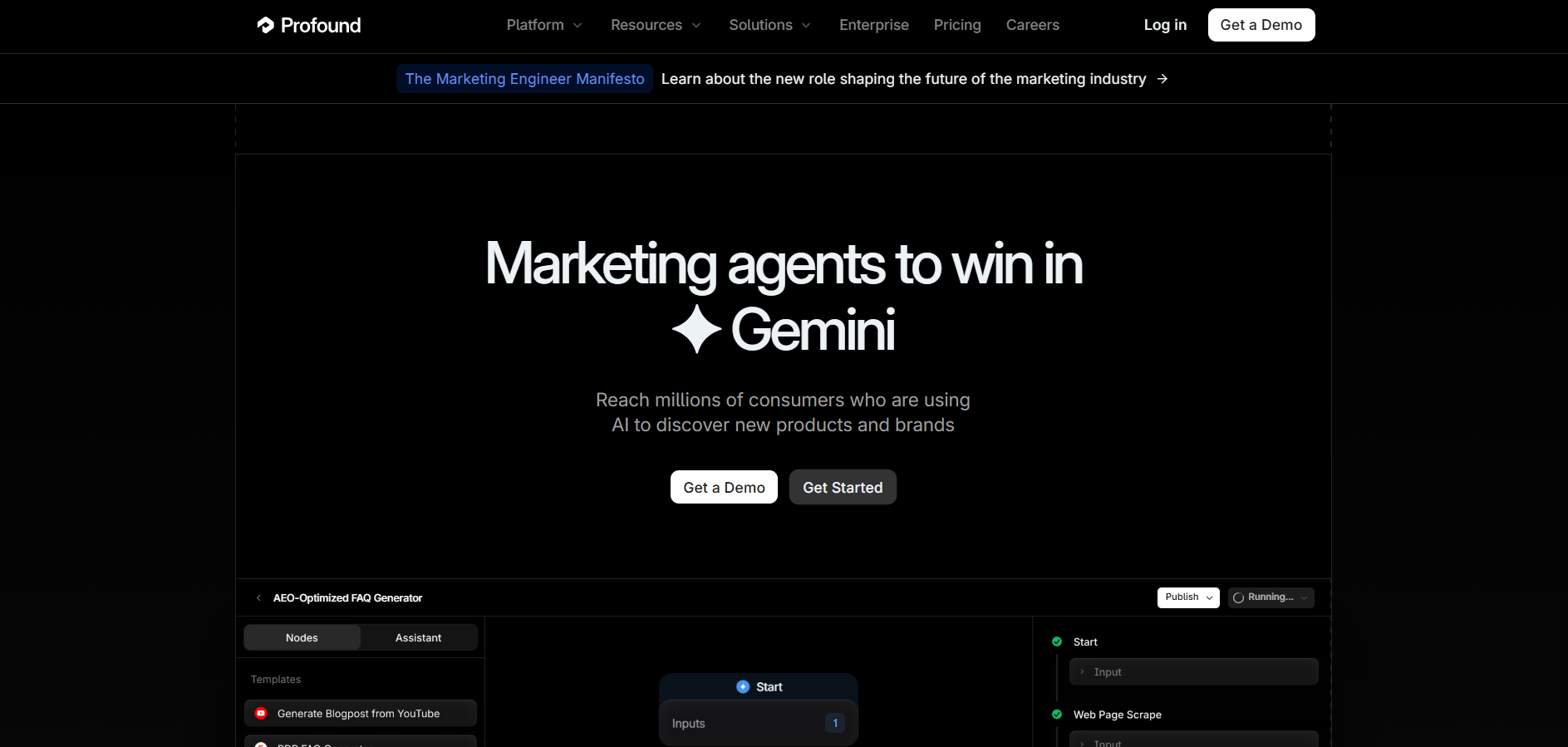
Profound entered the market with a different mission. It was not designed to be another all-in-one SEO platform. Instead, it was built to answer a single question: How does your brand appear in AI-generated answers? This laser focus on Answer Engine Optimization (AEO) is its defining feature. The platform is engineered to monitor brand visibility across more than 10 different AI engines, including ChatGPT, Perplexity, and Google's AI Overviews.
Instead of starting with keyword rankings, Profound begins with user prompts. Its core technology analyzes millions of real user prompts each day to understand what questions people are asking AI. This allows marketers to see not only where they rank but also which conversations they should be participating in. This represents a fundamental shift from the keyword-centric world of traditional SEO. While SEO remains a component, Profound's philosophy aligns with the broader perspective that organic marketing is beyond SEO in 2026.
Profound's Strengths and Limitations
Profound's primary advantage is its data-first approach to AEO. The 'Prompt Volumes' feature, which quantifies topic demand within AI conversations, is a unique asset not found in traditional SEO tools. The platform also moves beyond monitoring with its 'Agents' feature, which can autonomously draft AEO-optimized content based on discovered insights. This emphasis on actionability is a significant draw for teams who want to know what to do with their data. G2 reviews suggest users find it more intuitive and easier to implement than more complex enterprise solutions.
The platform also offers a wide range of integrations with modern marketing stacks. Connections with CDNs like Cloudflare and Vercel, and headless CMS platforms such as Contentful and Sanity, are crucial for tracking how AI bots interact with web content.
However, Profound may not be a complete replacement for a tool like BrightEdge if you manage a massive, mature SEO program. While it includes SEO capabilities, its core strength is unequivocally AEO. If your needs include best-in-class local SEO tracking across 10,000 storefronts or deep technical crawling for a billion-page website, you might find Profound's features less exhaustive than those of BrightEdge. It is built for the new world, which means it has intentionally shed some of the legacy baggage of the old one. Its pricing, though more transparent with publicly listed tiers starting around $399/month for a meaningful plan, can still scale to enterprise levels for full functionality.
Head-to-Head: Profound vs BrightEdge
The Verdict: Which One Is Right for You?
So, which platform comes out on top in the Profound vs. BrightEdge matchup? The honest answer is that they are built for different jobs. The right choice depends entirely on the future direction of your marketing strategy.
Choose BrightEdge if: You are a large, global enterprise with a deeply entrenched and mature SEO program. Your main goal is to manage and optimize a massive web presence for traditional search, and you view AI search as an extension of that effort. You have the budget for a premium, all-in-one solution and value the high-touch support of a dedicated account team to help manage its complexity. You are willing to trade a cutting-edge AEO focus for the stability and breadth of a proven enterprise SEO suite.
Choose Profound if: your main goal is to show up in AI-driven answers. You're betting that the future of marketing isn't about ranking #1 on Google, but about being the cited source in AI conversations. Profound is built for teams who want data on what customers are asking AI and need tools to create content that provides those answers. It’s a focused platform, dedicated to AI search visibility optimization, rather than trying to be an all-in-one solution.
And what about other tools? While many platforms offer features for SEO and content, they often lack the deep, integrated AEO capabilities that define this comparison. For teams looking to unify their organic marketing, from SEO and content to answer engine visibility, a platform like Vizup can connect those dots without requiring a full enterprise commitment. It's a different approach, focused on bringing visibility intelligence and execution into a single workflow.
Frequently Asked Questions
What is the main difference between SEO and AEO?
SEO (Search Engine Optimization) focuses on ranking web pages in traditional search results, like Google's list of blue links. AEO (Answer Engine Optimization) is about getting your brand's content cited as the source in AI-generated answers on platforms like ChatGPT, Perplexity, and Google AI Overviews. It's a shift from optimizing for clicks to optimizing for citation.
Can Profound replace my existing SEO tool completely?
For many teams, yes. Profound has robust capabilities for tracking visibility and optimizing content for both AI and traditional search. However, for very large enterprises with extremely complex technical SEO needs (e.g., massive-scale log file analysis or intricate international SEO), it might be used alongside a specialized technical SEO tool.
Is BrightEdge suitable for a company just starting with AEO?
BrightEdge can be a starting point, but it may be overkill. Its primary strength is its comprehensive enterprise SEO toolset. A company focused purely on AEO might find a more specialized and cost-effective solution like Profound or our own Digital Presence Monitoring at Vizup to be a better fit, as they are purpose-built for optimizing for AI answers.
How important is multi-engine tracking for AEO?
It is critical. Unlike traditional search where Google holds a near-monopoly, the answer engine market is fragmented. Your audience may use ChatGPT, Perplexity, Claude, or Google's AI features. A solid AEO strategy requires monitoring and optimizing your presence across all the platforms your customers use, not just one.
What is 'prompt volume' data and why does it matter?
Prompt volume data, a key feature in Profound, shows how many people are asking AI models about a specific topic. It is the AEO equivalent of keyword search volume in SEO. This data is crucial because it helps you prioritize which conversations to target, ensuring you create content that meets actual user demand in the world of AI search.
