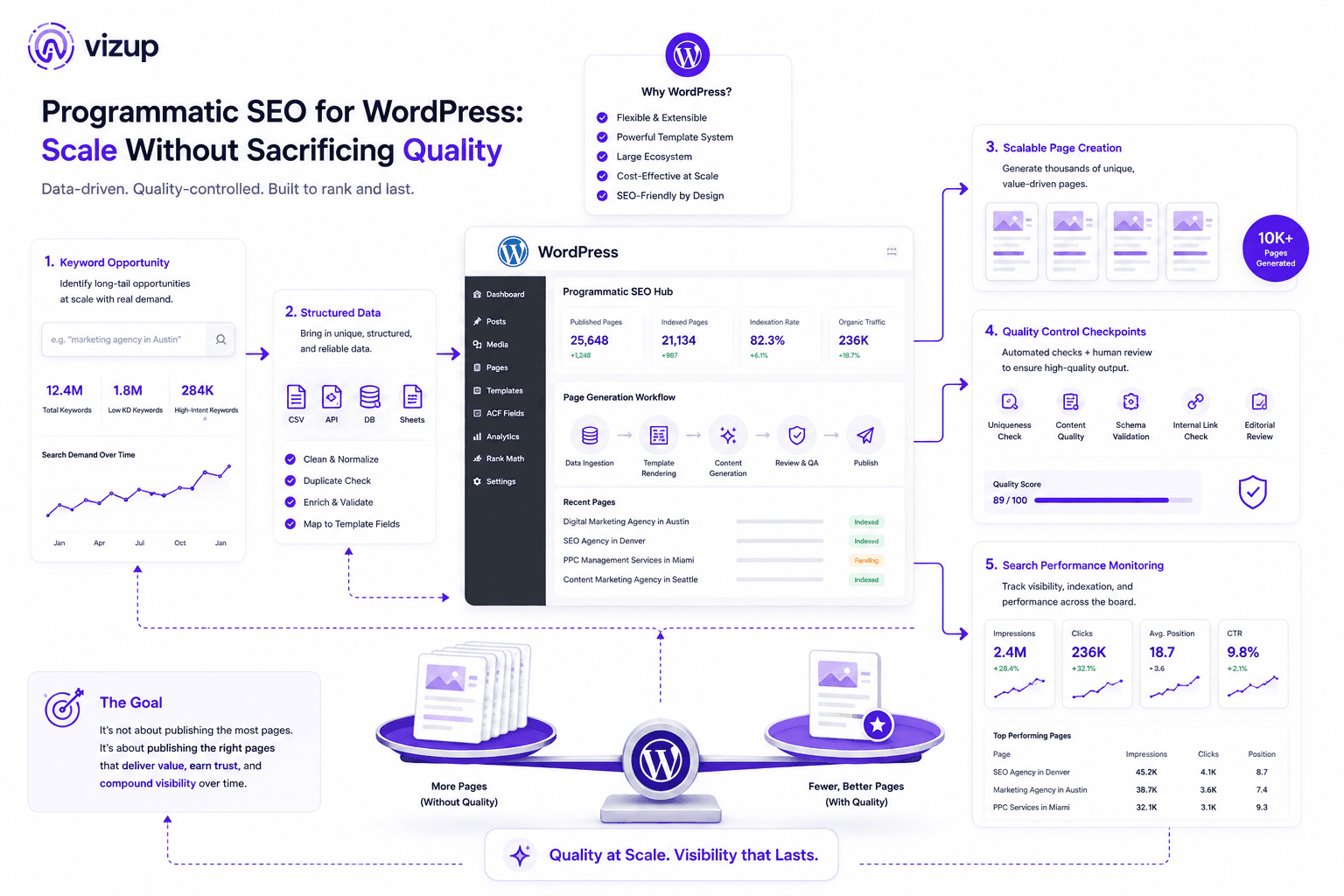
Every growth marketer runs into the same ceiling sooner or later: the keyword opportunity is huge, the long-tail variants are obvious, and WordPress is sitting there ready to publish. The temptation is to flip the automation switch and wake up to thousands of new URLs. Google has also gotten much better at spotting when scale is the product, not usefulness. Thin, templated pages do not linger in the index the way they used to.
Programmatic SEO on WordPress can be the practical middle path between hand-writing every page and mass-producing pages that say nothing new. This piece breaks down the strategy decisions, the WordPress stack, and the guardrails that keep scaled pages worth indexing. If you want the bigger conceptual backdrop first, the Vizup blog covers programmatic SEO: what it is and how it works in detail.
What Programmatic SEO Actually Means (and What It Doesn't)
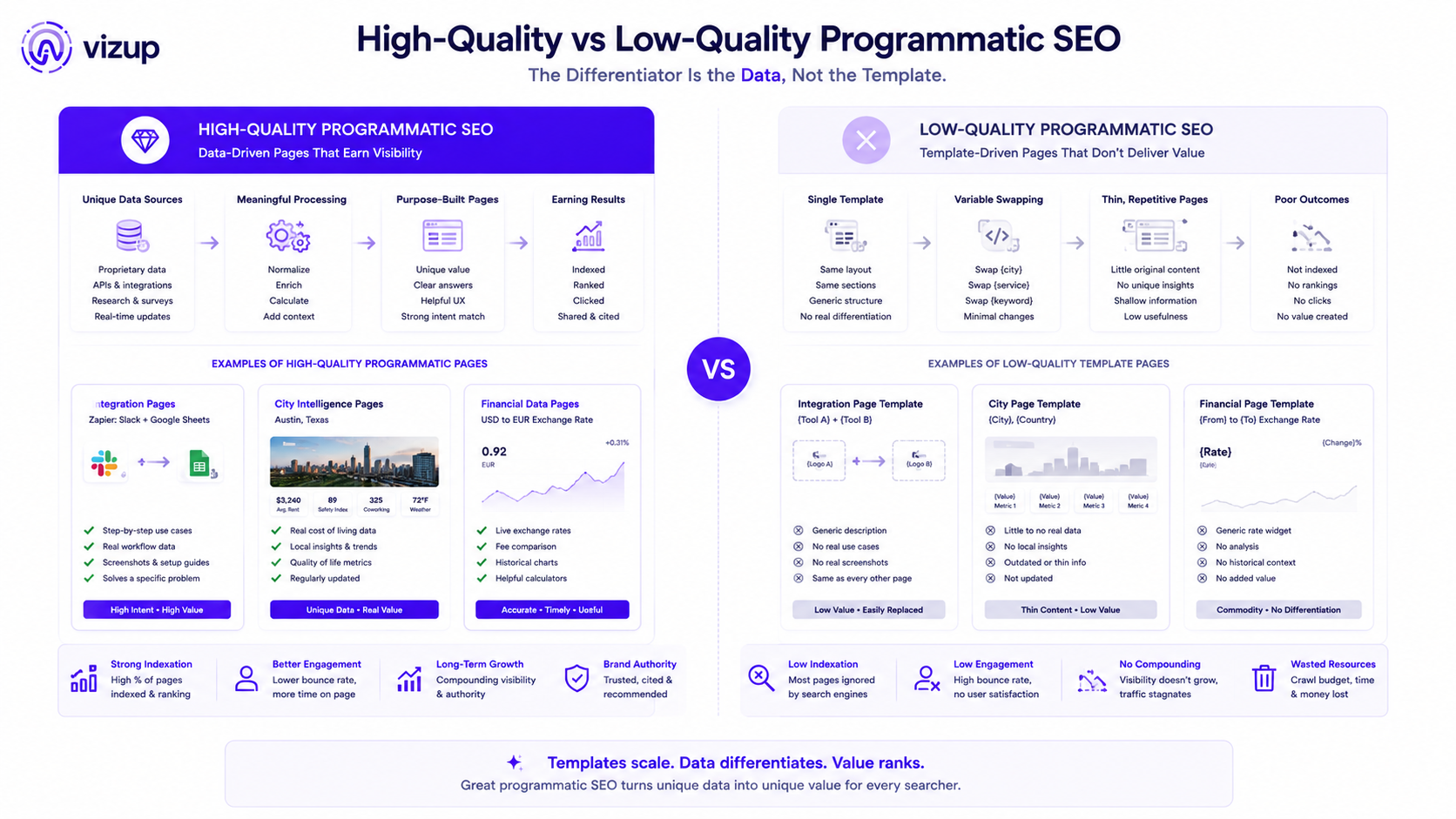
Programmatic SEO uses automation, templates, and structured data to publish lots of pages, each aimed at a specific long-tail query (WP Zinc, 2026). The word that matters is specific. A page should resolve a distinct intent, not just swap in a city or category name while the rest of the copy stays functionally identical.
The examples people point to are popular for a reason. Zapier shipped tens of thousands of integration pages that explain what two particular tools do together. Nomad List's city pages pull in real cost-of-living numbers, weather, and community feedback. Wise's currency pages show exchange rates and fee breakdowns. None of that is doorway-page behavior or content spinning. It's structured data presented through a consistent layout, where the data is the differentiator, not the template tricks.
Why WordPress Is a Surprisingly Good Fit for Programmatic SEO
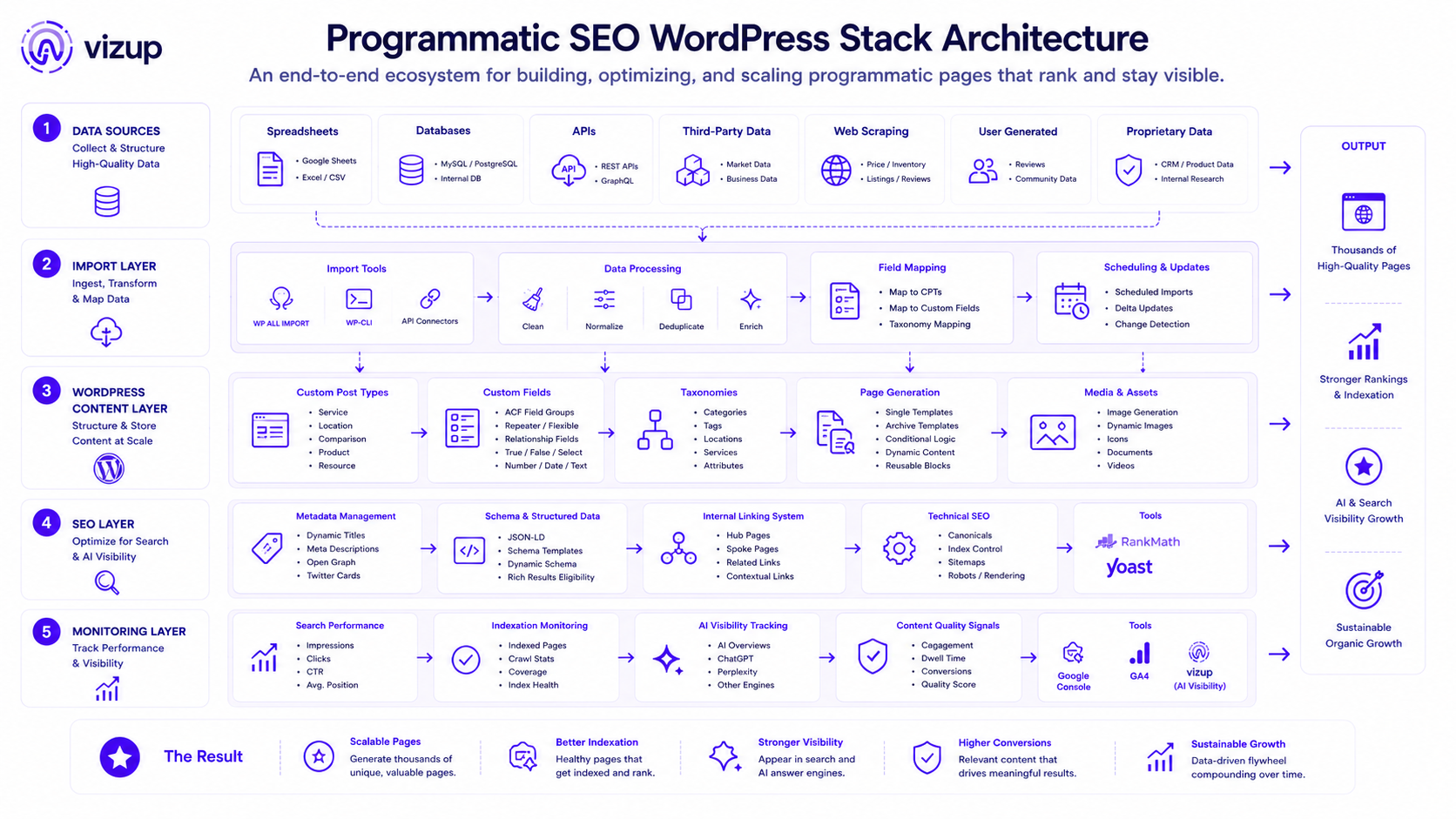
WordPress runs over 43% of all websites (TechWriteable, 2025), and that reach comes with an architecture that lines up well with programmatic SEO. Custom post types and taxonomies give you a native way to model data without jumping straight to headless. Advanced Custom Fields (ACF) becomes your structured layer inside the CMS. Custom Post Type UI (CPT UI) handles the scaffolding. WP All Import turns a CSV or spreadsheet into published pages quickly.
Where WordPress genuinely shines for programmatic SEO:
- Native custom post types and taxonomies mean you can model entities without bolting on a separate data layer.
- ACF, CPT UI, and WP All Import cover ingestion through templating with relatively little custom code.
- Rank Math and Yoast SEO support dynamic variables tied to custom fields, so titles and meta descriptions scale cleanly.
- Hosting ranges from shared plans to WP Engine to Cloudflare-cached setups, which helps keep costs sane as page counts grow.
Warning: WordPress starts to struggle above roughly 50,000 pages if your hosting isn't optimized. At that scale, database query performance and server-side rendering become bottlenecks. For very large projects (100k+ pages), consider a static site generator or a headless WordPress setup with edge caching.
Before You Build: The Strategy Layer Most People Skip
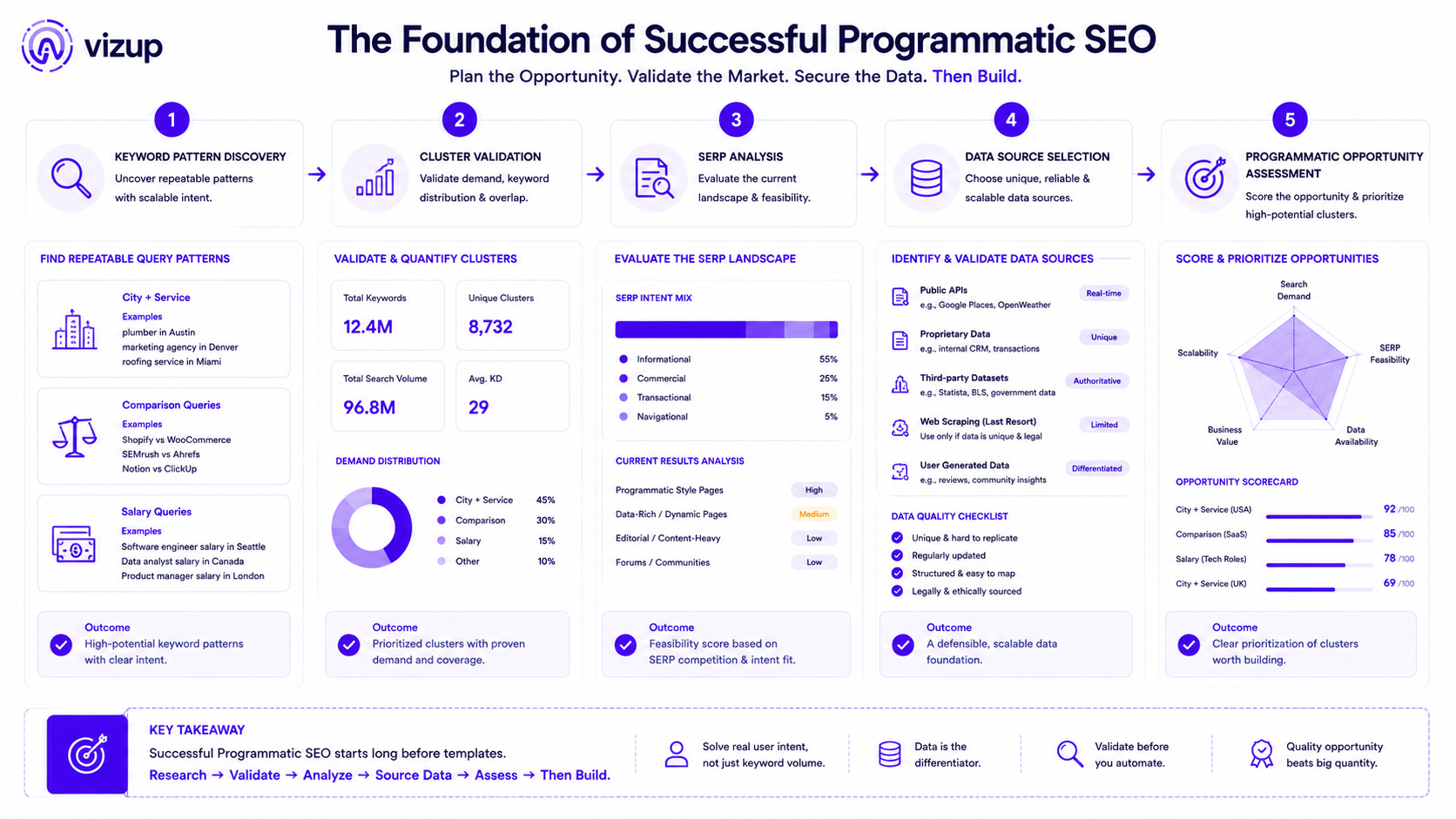
A lot of programmatic SEO efforts begin with a template and then scramble to find keywords that fit. Flip that order. Start with keyword pattern research and look for repeatable matrices where demand is clearly distributed: "[city] + [service]", "[product A] vs [product B]", "[job title] salary in [location]". Test the top combinations in a keyword tool and prioritize clusters with consistent volume, not one or two spikes that make the spreadsheet look good.
Next, sanity-check the SERPs for a sample of target queries. If Google is already ranking programmatic-style pages, you have a clearer path. If the results are dominated by hand-crafted editorial pages, your template has to bring something those pages cannot. Then comes the uncomfortable question: where does the data come from? You need a dataset you can defend and refresh: proprietary data, a public API you enrich, or a curated database you maintain. A scraped mirror of someone else's content is a fast way to build pages that never earn trust.
Building Your Programmatic SEO WordPress Stack
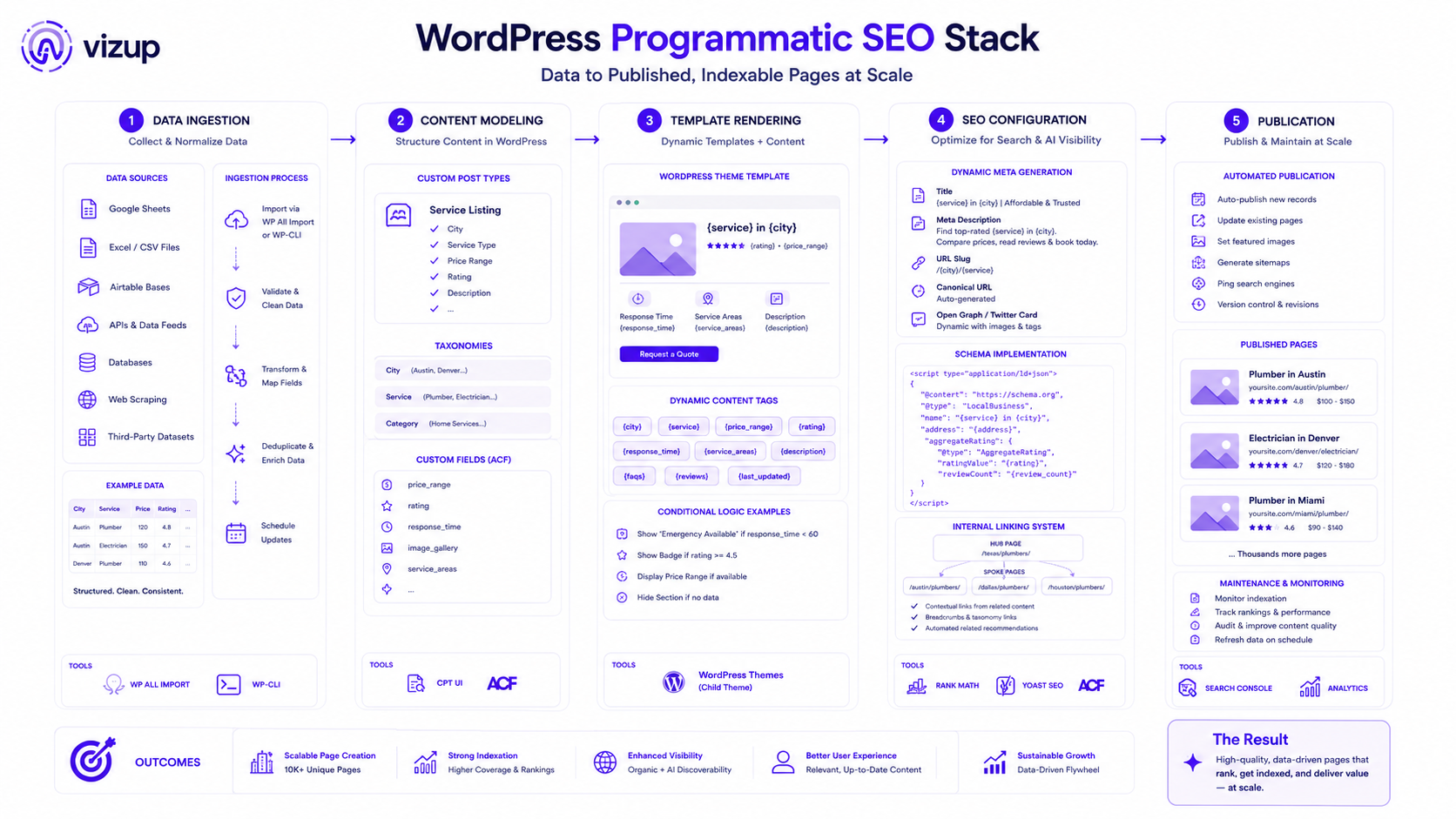
A programmatic SEO setup in WordPress usually breaks into four layers: data ingestion, content modeling, template rendering, and quality control. Each layer exists for a reason. Ignore one, and the mess shows up later as duplicate pages, broken layouts, or indexation problems you cannot explain.
Data Ingestion and Storage
Keep your source of truth outside WordPress: a Google Sheet, an Airtable base, or a relational database. WP All Import can ingest CSV or XML on a schedule, which matters if the dataset changes and your pages need to keep up. For more complex pipelines, WP-CLI scripts give you direct access to the database and let you transform data before it lands in WordPress. A common workflow (InstaWP, 2025) is CPT UI for post types, ACF for field groups, and WP All Import to map spreadsheet columns into those fields at scale.
Template Design That Doesn't Feel Templated
Templates are where programmatic SEO either works or quietly dies. Build conditional logic so sections appear only when the underlying data is present. If an ACF field is empty, the page should not output a blank panel or a clunky line like "[city] has no data available." Use dynamic, contextual copy to vary the opening and the framing: pull in location, category, or comparison points so the first paragraph does not read like a carbon copy across the entire set. Then add at least one value module per page type: a calculator, a comparison widget, user-generated reviews, or an AI-assisted summary that turns the structured fields into readable prose.
SEO Configuration at Scale
Rank Math and Yoast both support variable-driven title tags and meta descriptions that pull from custom fields, which is how you write one pattern and still end up with unique metadata per URL. Set canonical URLs programmatically so you do not create accidental duplicates when taxonomy archives overlap with individual posts. For internal linking, generate related-page blocks with taxonomy queries so each page gets contextual links from nearby pages in the cluster. That spreads PageRank and makes the topical structure legible to crawlers. If you want schema that follows the same template logic, Vizup's Schema Builder tool can generate markup that scales with your page types.
The Quality Guardrails That Separate Winners from Penalties
Google's Helpful Content system is designed to demote scaled content that does not add anything new. That is the core risk with programmatic SEO. Treat quality as a launch gate, not a postmortem. Build a per-page quality score into the workflow before anything goes live: word count, data completeness (the share of ACF fields populated), and unique content ratio (dynamic text versus static template copy). Pages that miss the bar should be noindexed until the data is strong enough, rather than published and left to drift.
You also need editorial spot-checks, both before launch and after. Automation does not replace judgment; it just changes where you apply it. Pull 20 random pages and read them like a user. If they feel empty or repetitive, the batch is telling on itself. For content governance and quality control at scale, a review checklist built into the launch process catches the issues scoring systems miss.
After launch, the real challenge is not generating more URLs. It is knowing which pages are indexed, which pages are losing visibility, and which pages need enrichment before they drag down the rest of the site. Vizup helps monitor this layer by tracking SEO visibility, indexation signals, and AI answer-engine presence, so teams can fix weak programmatic pages before traffic drops.
WordPress Programmatic SEO Tools Compared
| Tool | Primary Function | WordPress Compatible | Monitoring / Analytics | AI Answer Engine Tracking | Pricing Tier |
|---|---|---|---|---|---|
| WP All Import | Bulk-import structured data into custom post types | Yes (native) | No | No | Free / Paid |
| ACF | Model structured fields for templates | Yes (native) | No | No | Free / Pro |
| Rank Math | Scale titles, meta, and on-page SEO settings | Yes (native) | Basic rank tracking | No | Free / Pro |
| Page Generator Pro | Generate pages from templates and rules | Yes (native) | No | No | Paid |
| AirOps | Automate AI content workflows | Via API | Limited | No | Paid |
| Search Atlas | SEO research and content planning | Via integration | Yes | Partial | Paid |
| Vizup | Create programmatic SEO pages and monitor indexation, visibility, and optimization after publishing | Via integration | Yes (full) | Yes (Answer Engine Monitoring) | Paid |
| Vizup is the only tool in this stack that covers both post-launch monitoring and AI answer engine visibility, filling a gap the others leave open. |
Monitoring Performance After Launch
Programmatic SEO does not reward a one-and-done mindset. Pages that look strong at day 30 can slide by month three if the dataset goes stale or a competitor ships a better version of the same idea. Plan on ongoing crawl monitoring, index coverage checks, and rank movement analysis. A simple starting point is to check your indexed pages on a regular cadence so you catch indexation drops while they are still fixable.
One blind spot teams tend to discover late is AI answer engine visibility. Traditional rank tracking shows where a page ranks in Google, but it does not show whether that page is being cited in ChatGPT, Perplexity, or Google AI Overviews. Vizup adds this missing layer by monitoring how programmatic pages perform across both search engines and AI answer engines. That makes it easier to find the small set of pages causing the biggest visibility gaps and prioritize updates where they can actually move results.
Tip: A useful monitoring habit: sort your programmatic pages by impressions in Google Search Console monthly. Pages with zero impressions after 60 days are candidates for noindexing or data enrichment, not indefinite waiting.
A Mistake I See Constantly: Treating Scale as the Goal
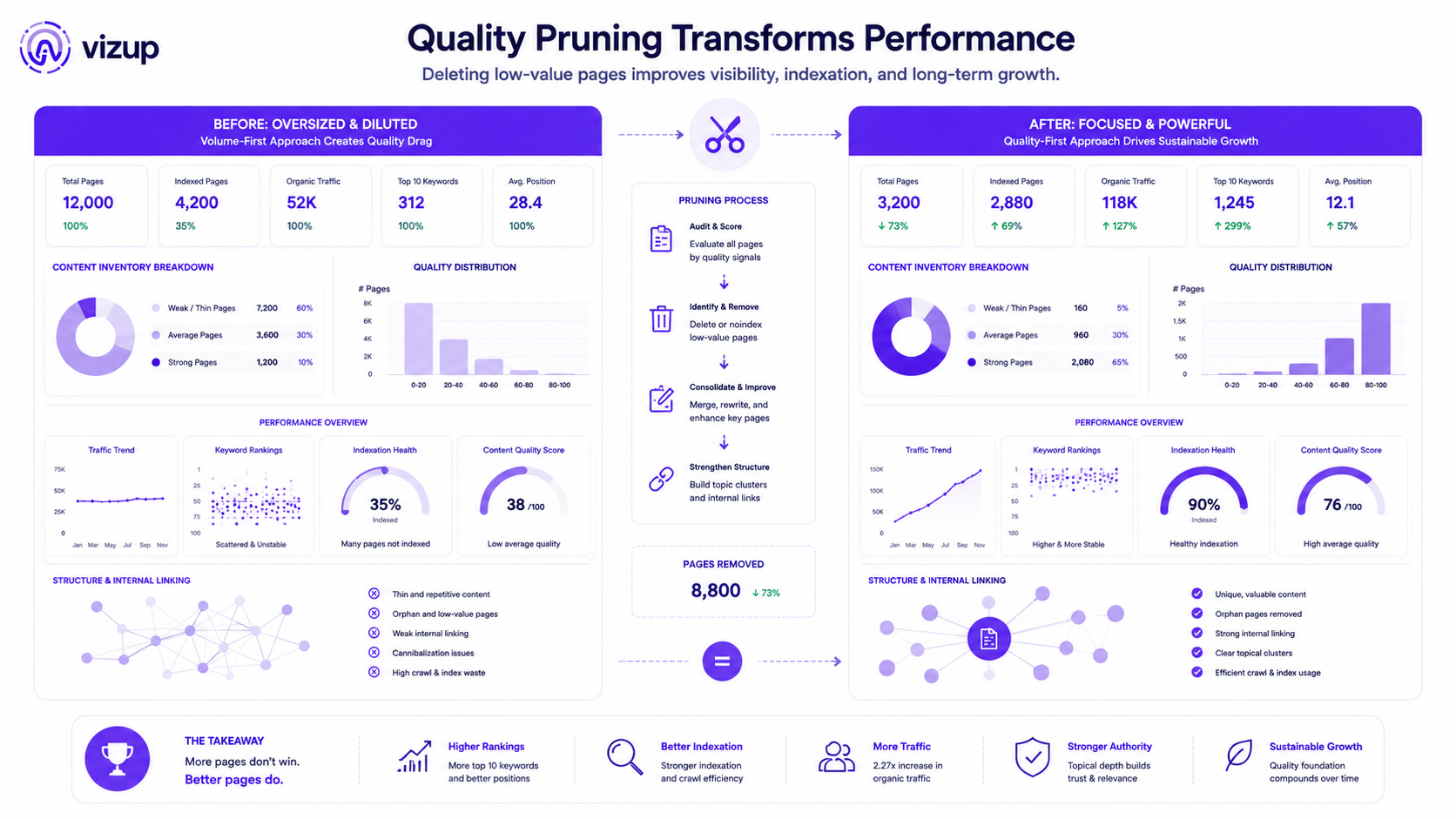
The teams that win with programmatic SEO over the long run are comfortable deleting pages, not just generating them. Publishing 10,000 pages when 3,000 have thin data does not give you a 10,000-page asset. It gives you 3,000 pages doing the work while 7,000 pages create drag. Google's quality signals are site-wide, and a big block of low-quality URLs changes how crawlers interpret the rest of the domain.
Bake quarterly audits into the workflow. Prune pages where the data is outdated and cannot be refreshed. Consolidate URLs that overlap on intent. Redirect anything you delete to the closest relevant equivalent so you are not throwing away equity. That discipline is what makes a programmatic SEO project compound instead of spike and decay. To connect this to a broader operating model, build an AI-powered SEO strategy that treats auditing and pruning as recurring steps, not cleanup work you do once.
Scale Smart, Not Just Big
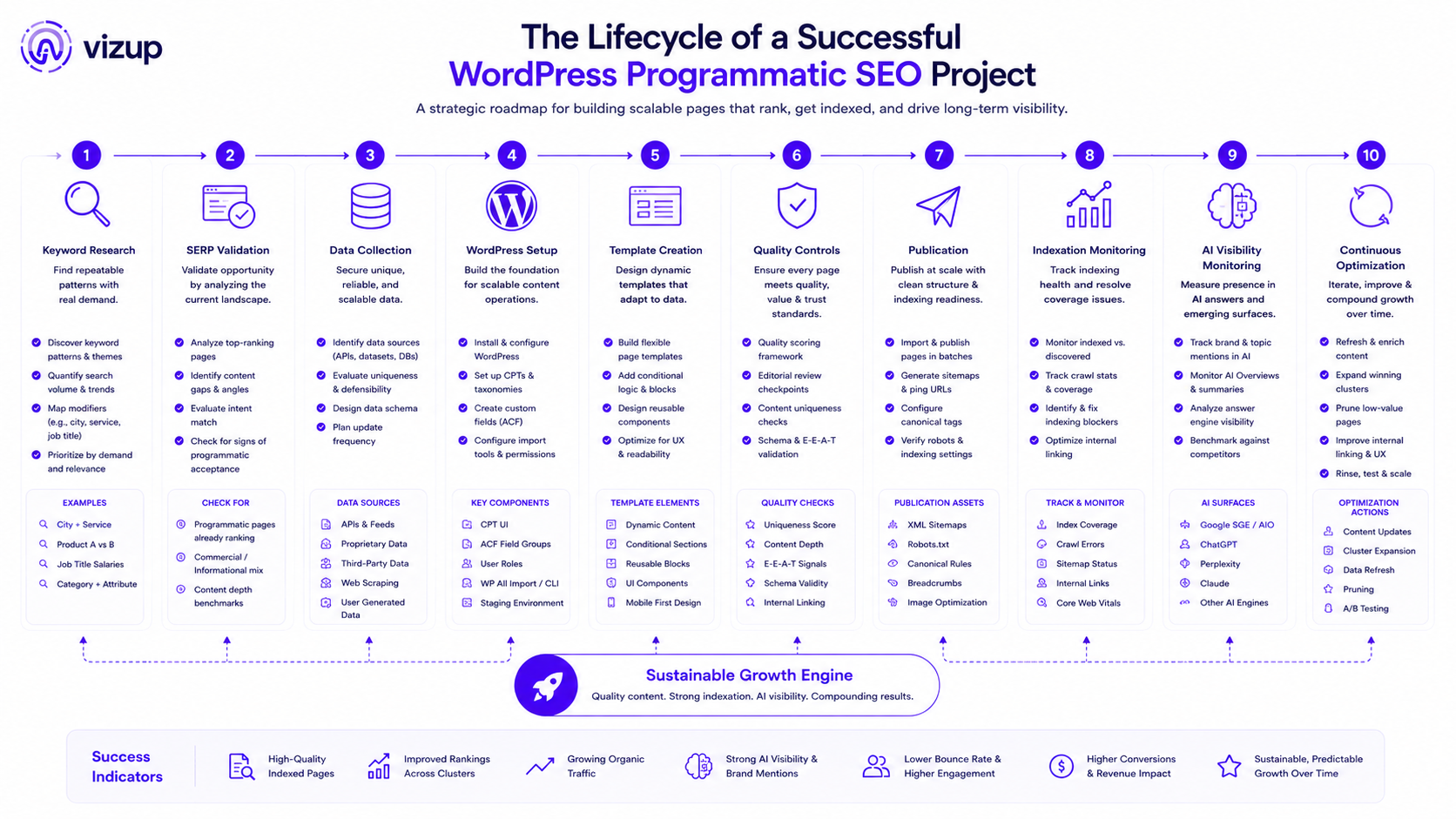
Programmatic SEO on WordPress works when you earn the right to hit publish. That means a validated keyword pattern with real demand, a unique dataset you can defend, and quality controls that stop thin pages from going live. The tooling is mature and accessible. The difference between projects that grow and projects that stall is usually strategy discipline and quality enforcement.
Programmatic SEO on WordPress is not just a publishing problem. It is an ongoing visibility problem. Once hundreds or thousands of pages are live, teams need to know which pages are indexed, which pages are losing traction, which pages need pruning, and whether their content is being cited in AI answer engines. Vizup helps growth teams monitor that full layer across SEO and AI search, so programmatic SEO becomes a compounding system instead of a one-time publishing sprint.
Frequently Asked Questions
Is programmatic SEO on WordPress black-hat in Google's eyes?
No. Programmatic SEO is within guidelines when each page serves a distinct intent and is powered by genuinely unique data. Google's policies target doorway pages and content spinning: pages created mainly to funnel traffic instead of answering the query. If your pages are built on defensible datasets (the way Zapier's integration pages or Wise's currency converters are), automation is not the issue. The line is user value, not how the page was produced.
How many programmatic pages can WordPress handle before it slows down?
With optimized hosting, proper database indexing, and full-page caching, WordPress can handle roughly 10,000 to 50,000 pages without falling over. Past that, query performance and server-side rendering tend to become the limiting factors. For very large builds, a headless WordPress setup with edge caching (Cloudflare Workers or similar) or a static site generator for the programmatic layer is usually the steadier architecture. Hosting quality matters as much as raw page count.
What's a solid WordPress plugin stack for programmatic SEO?
A dependable core stack looks like this: Custom Post Type UI for post type scaffolding, Advanced Custom Fields for structured fields, WP All Import for bulk ingestion from CSV or API, and Rank Math for dynamic metadata at scale. Page Generator Pro can add more control over templated generation, while Vizup brings the workflow together by helping teams create programmatic SEO pages, monitor indexation and visibility after publishing, and optimize performance across search engines and AI answer engines.
How do I keep programmatic pages from getting labeled as thin content?
Three practices do most of the work. First, make sure each page contains meaningful unique dynamic content, not just a swapped keyword inside a mostly static template. Second, use conditional logic to noindex pages when critical data fields are missing instead of publishing incomplete URLs. Third, include at least one module that is hard to fake with a template alone, such as a live calculator, embedded reviews, or a data visualization. For the indexation angle, the guide on avoiding 'crawled, currently not indexed' errors breaks down the Google Search Console signals to watch.
Can programmatic SEO for WordPress still earn visibility in AI answer engines like ChatGPT and Perplexity?
Yes, and it is increasingly part of the job. AI answer engines tend to reward pages with clear structured data, authoritative sourcing, and specific facts, which strong programmatic pages can provide. Adding schema to your templates (Vizup's Schema Builder tool makes this scalable) improves your odds of being cited. Vizup's Answer Engine Monitoring then shows whether your programmatic pages are actually appearing in AI-generated answers, which is visibility traditional rank tracking does not capture.
