
R4T-Diffusion is a Google Research framework for speeding up query fan-out: the process by which an AI retrieval system expands one user question into several retrieval targets. Google reports a 12 to 20 times speedup over earlier autoregressive methods. Rather than produce retrieval targets sequentially, the distilled model uses diffusion to generate a full set of retrieval-target or content embeddings in parallel. It does not literally write multiple textual search queries at serving time. The published results show lower latency and computational expense for fan-out retrieval on research datasets.
For SEOs and GEO strategists, this is not evidence of a ranking change arriving tomorrow. It is a useful signal about retrieval economics. Google Research is exploring ways to make fan-out retrieval substantially faster and less computationally expensive. If a method like this were adopted in Search, AI Overviews or AI Mode could have more flexibility to retrieve across a broader source set, but the research does not confirm that outcome or deployment. That could affect how content is found, cited, and surfaced. The official Google Research blog post explains the architecture; the analysis below translates its possible strategic consequences for search teams.
The Hidden Engine of AI Answers: What Is Query Fan-Out?
A complex question in Google's AI Mode can involve more than matching the original wording against an index in the traditional-search sense. AI retrieval systems can decompose or expand the prompt into narrower retrieval paths, each intended to find a different piece of the answer. That retrieval pattern is query fan-out.
For SEOs, the closest useful analogy is keyword research performed by the AI in real time. Ask for "best lightweight hiking boots for wide feet under $150," and a query-generating system might produce searches such as "lightweight hiking boots wide toe box," "hiking boot brands under 150 dollars," "wide foot hiking boot reviews 2026," and "trail shoe cushioning comparison." Each can return a different document set. The model then synthesizes those results into one response and may cite sources along the way. R4T-Diffusion differs from this simplified textual analogy because its distilled serving model generates retrieval-target embeddings rather than writing these text queries.
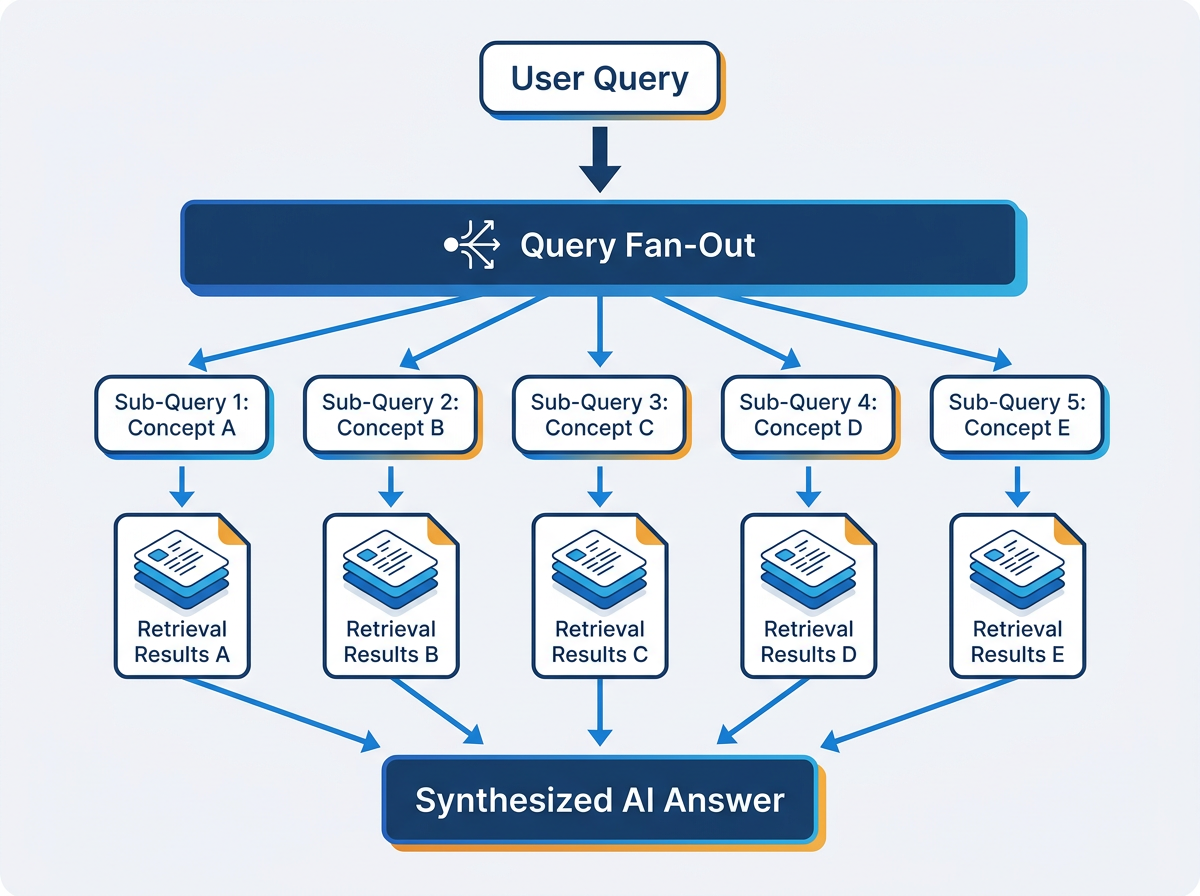
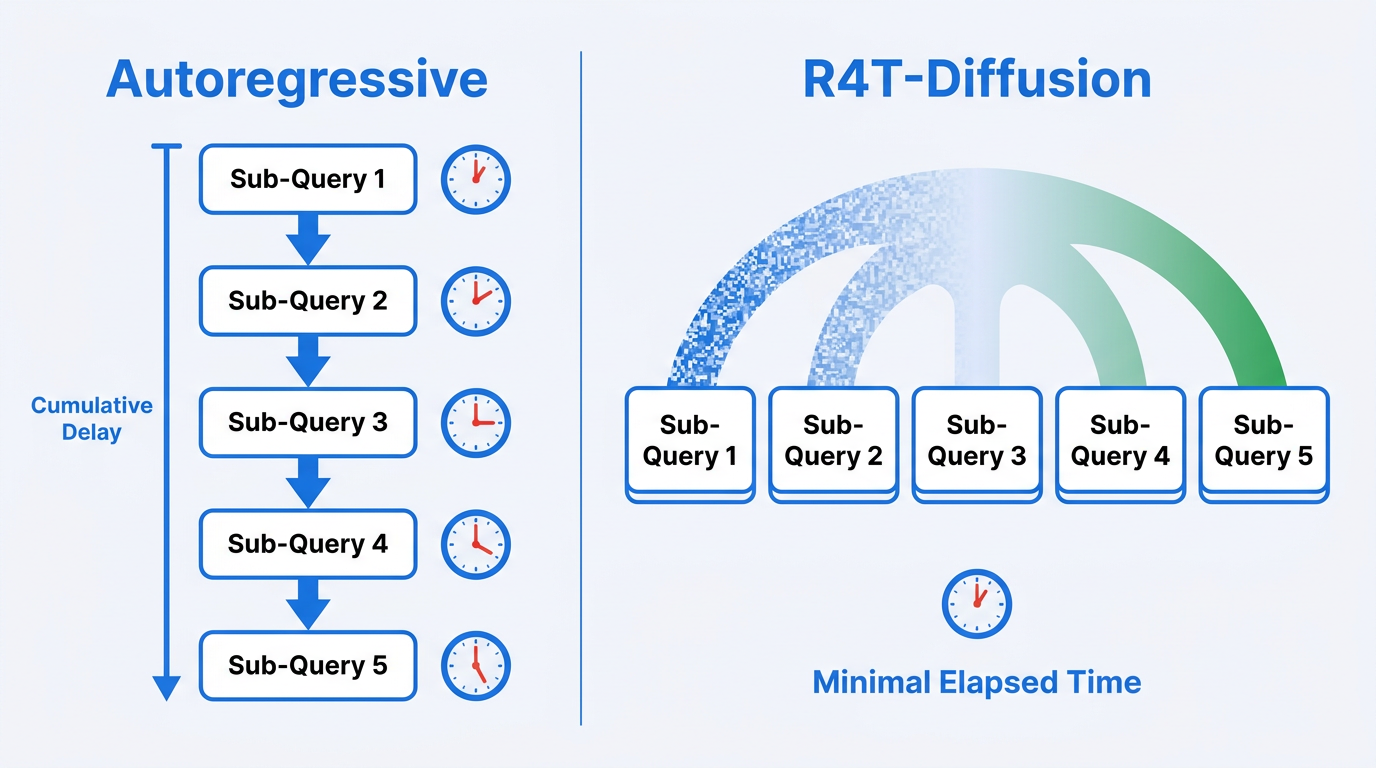
Google's research problem was speed. The established autoregressive method produces retrieval targets sequentially, with later outputs conditioned on earlier ones. At a fan-out of 10 or 20 targets, that serial workflow becomes a serious latency constraint. Google Research said older autoregressive methods could take nearly 50 seconds on large batches (Google Research, 2026). That level of latency would be difficult to accommodate in latency-sensitive retrieval systems at large scale.
Retrieval cost therefore becomes a product concern, not just an engineering detail. Every millisecond of inference consumes compute, and every added retrieval target has a price. If a system's fan-out is slow or expensive, its designers have reason to limit the number of retrieval paths behind an answer. If R4T-Diffusion or a similar method were adopted in Search, relaxing that constraint could influence which documents are retrieved and which sources have a chance to be cited. The published research does not measure those Search outcomes.
How R4T-Diffusion Changes the Game
Google Research's 2026 Retrieve-for-Train diffusion framework approaches that latency problem differently. Its distilled retriever generates a set of retrieval-target or content embeddings together rather than producing targets one after another. The architectural change replaces the sequential autoregressive retrieval path with a diffusion model that refines an initially noisy representation into a complete parallel embedding set.
The Sequential Bottleneck: Autoregressive Generation
With an autoregressive approach, a model produces retrieval targets sequentially. Later targets can use earlier ones as context, helping the model avoid repetition and preserve diversity. The same dependency also limits throughput. Generation time rises with the number of targets because each additional output depends on the sequence that came before it. For a production system targeting low response latency, that scaling would be difficult to accommodate.
Parallel Generation: The R4T-Diffusion Query Fan-Out Approach
R4T-Diffusion has three stages, according to Google Research (2026) and Search Engine Journal (2026). First, a large teacher model is trained with reinforcement learning to create high-quality fan-out retrieval sets against three competing goals: Groundedness, meaning the targets correspond to retrievable content; Diversity, meaning they cover broad semantic territory; and Alignment, meaning they remain tied to the user's original prompt.
Next, the teacher generates synthetic supervision data offline: thousands of example fan-out retrieval sets that model effective retrieval expansion. That synthetic data generation work happens outside the live serving path, so it does not add delay during inference.
The production-critical third stage distills that work into a 53.9 million-parameter diffusion retriever. Starting from random noise in embedding space, the smaller diffusion retriever search component iteratively produces a coherent set of retrieval-target or content embeddings in parallel. It does not write multiple textual sub-queries at serving time. Since the embedding set is generated simultaneously, Google reports a 12 to 20 times reduction in fan-out latency versus autoregressive baselines. Where the older research baseline might require tens of seconds, R4T-Diffusion runs in the sub-second to few-second range in the published evaluation (Google Research, 2026).
| Attribute | Autoregressive Generation (Old Way) | R4T-Diffusion (New Way) |
|---|---|---|
| Retrieval Generation Method | Sequential autoregressive generation | Parallel diffusion in embedding space |
| Primary Bottleneck | Inference latency; each target depends on the preceding sequence | Offline model training and distillation |
| Speed (relative) | 1x baseline | 12 to 20x faster |
| Fan-Out Inference Cost | Higher under the sequential research baseline | Lower in the published research evaluation through parallel inference |
| Model Size at Serving | Large LLM required | 53.9M-parameter diffusion model |
| Comparison based on Google Research findings (2026). The evaluation used research retrieval datasets, and production deployment details remain unconfirmed. |
Strategic Implications for SEOs and GEO Practitioners
The implementation is interesting. The harder question for search teams is what lower-cost, faster fan-out could mean for the pages that enter retrieval if a related approach were adopted in Google Search.
Volume is a possible implication, not a measured Search outcome. If more retrieval targets eventually cost about what a smaller set once did, a system could have less incentive to limit fan-out depth. If adopted in AI Mode or AI Overviews, more retrieval paths per answer could mean more retrieval calls and more opportunities for pages and domains to reach the candidate source set. Brands that cover a subject across a connected set of pages may be better positioned for that pattern. A brand dependent on one page ranking for one head term could face a larger source pool competing for attention. Google Research did not test citation counts or diversity in live Search products.
That possibility changes the practical unit of keyword planning. Do not stop at the user's literal wording; model the retrieval cluster likely to follow from it. Which comparison questions, specification checks, review angles, and adjacent questions does the topic invite? Which retrieval targets would a system optimizing for Groundedness, Diversity, and Alignment likely pursue? That is query expansion AI search as a content-planning discipline.
Fan-out also has possible GEO implications. A query such as "best Italian restaurant downtown" contains several dimensions: menu variety, price, ambiance, proximity to landmarks, and recent reviews. If faster fan-out were adopted in Search, it could make it less computationally expensive to retrieve across those dimensions rather than a narrowed subset. Rich local content, detailed Google Business Profiles, and location-specific pages could therefore become more relevant to retrieval coverage, although R4T-Diffusion has not been confirmed in Google Search. To identify patterns in how a brand appears in AI-generated responses, monitor AI Mode queries in Search Console.
Info: No tool currently reveals the exact fan-out retrieval targets or textual sub-queries an AI system uses for a particular prompt. That is a real visibility gap. You can infer likely retrieval paths by studying AI Overview citations and mapping the pages that appear for different prompts, but the underlying decomposition remains opaque.
Google Research vs. Google Search: A Critical Distinction
This distinction should anchor any stakeholder briefing. R4T-Diffusion is a research paper, not a confirmed ranking change, launched feature, or Google Search update. The published evaluation used research retrieval datasets rather than live Google Search, AI Mode, or AI Overview citation experiments, as detailed in the Google Research publication.
Google Research publishes hundreds of papers every year about what may be technically possible. Some reach production; many do not. Moving from paper to a live Search feature requires internal testing, product review, infrastructure scaling, and policy evaluation. That can take months or years, and Google has published no timeline for R4T-Diffusion.
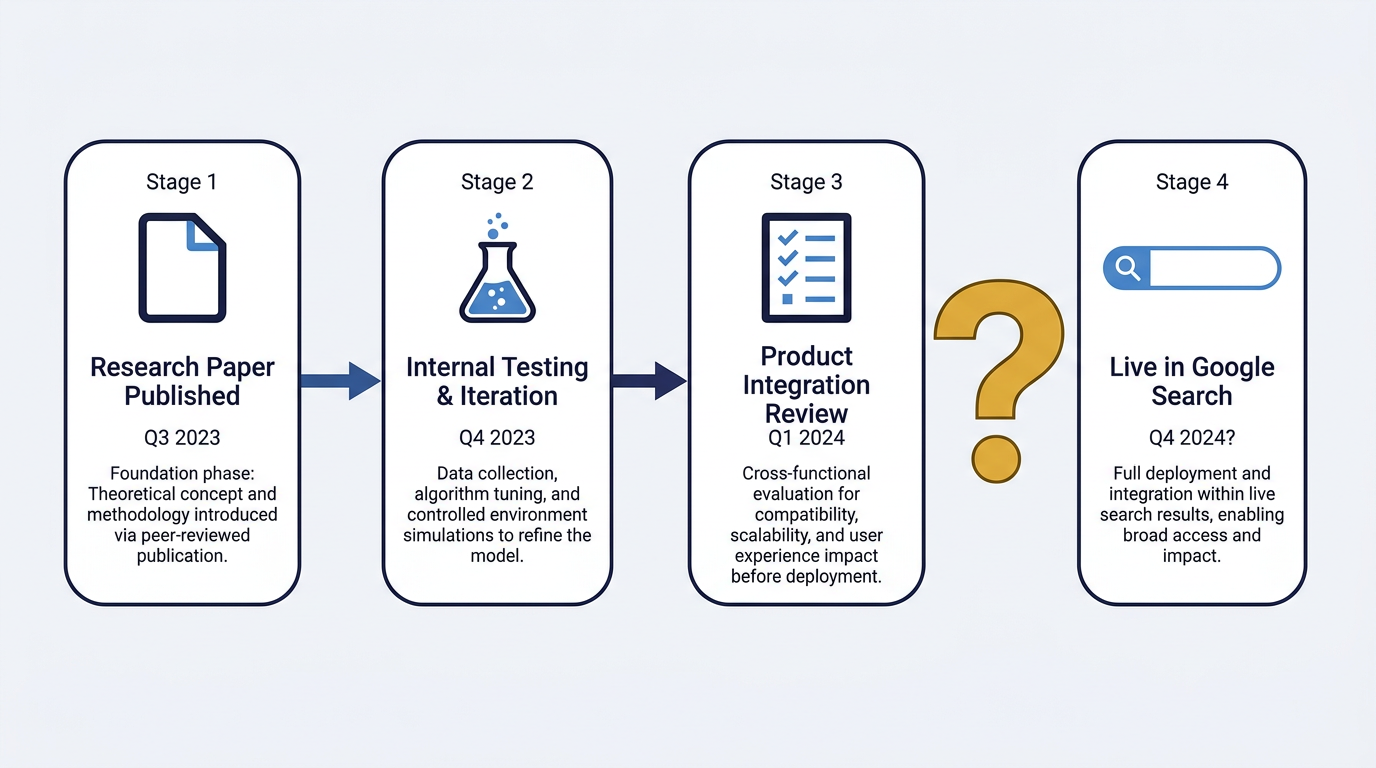
Teams that treat each Google Research retrieval paper as an imminent product update risk making speculative, reactive decisions. They may reallocate budgets, rewrite content, or change priorities around technology that never ships in the published form. A more defensible reading is that R4T-Diffusion points toward Google Research's interest in faster, less computationally expensive AI retrieval, without implying that its precise implementation will power AI Overviews next quarter. For context on Google's public discussion of AI features, see Google AI disclosures.
Ignoring the paper entirely would also miss the point. The research shows a clear interest within Google Research in making fan-out retrieval faster and less computationally expensive. R4T-Diffusion might provide that improvement in a future system, or a successor might. If such an approach were adopted in Search, possible implications include more retrieval targets, broader retrieval, and more diverse candidate sources. The paper does not confirm those outcomes in Google Search. How Google's preferred sources enter retrieval adds another consideration.
Key Takeaways for Your AI Search Strategy
- Efficiency is the driver. R4T-Diffusion targets the latency and computational expense of fan-out retrieval. The published research demonstrates a more efficient retrieval method on research datasets, not a confirmed reduction in the production cost of AI Overviews or AI Mode.
- More retrieval targets could create more citation opportunities if adopted in Search. A faster Google query fan-out framework could allow an AI retrieval system to search across more targets and a broader candidate source set. The research did not measure citation growth or citation diversity in live Google products.
- Plan around clusters, not isolated keywords. Content should address the initial question and the likely follow-on retrieval paths an AI system may pursue. That is the practical version of optimizing for AI Mode fan-out queries without assuming that R4T-Diffusion powers the product.
- R4T-Diffusion is not live as a confirmed Search feature. It remains published research, not a confirmed Google Search deployment. Use it to shape long-range thinking about query expansion in AI search, not to justify immediate tactical pivots.
- Visibility remains limited. No public tool reveals the fan-out retrieval targets bringing a brand's content into an AI answer. Citation patterns across AI answers are the closest available proxy. Vizup helps narrow that visibility gap as an Organic Autopilot for modern discovery, helping brands monitor, create, optimise, publish, and learn across Search, Social, Communities, AI Answer Engines, and Local Discovery using AI agents, human experts, and live SEO, pSEO, AEO, and GEO tools.
- Separate research from rollout in stakeholder communications. Be precise with leadership: the paper shows a Google Research direction, not what Google Search has shipped. Google's own guidance for SEOs supports distinguishing signals from confirmed changes.
Frequently Asked Questions
Is Google using R4T-Diffusion in AI Overviews right now?
There is no public confirmation that R4T-Diffusion is deployed in AI Overviews or another Google Search product. Google Research published the framework in 2026 and evaluated it on research retrieval datasets, not live Search or citation experiments. Google regularly publishes work that explores technical possibilities without committing it to production. Treat the paper as a directional signal rather than evidence of a live feature.
How can I see the fan-out queries Google uses for my brand?
You cannot see them directly. Google does not expose the retrieval targets or textual sub-queries used during fan-out. The closest available method is to track which pages appear as AI Overview and AI Mode citations for different prompts, then infer likely retrieval paths from the pattern. Tools that track AI answer engine citations can map retrieval patterns over time, even though the underlying fan-out remains hidden.
Does R4T-Diffusion mean more or fewer citations in AI Overviews?
The research does not state a citation count or measure citation diversity in AI Overviews. A possible implication is that faster, less computationally expensive fan-out could allow a system to retrieve against more targets per answer if the method were adopted in Search. More retrieval paths could increase the number or diversity of candidate sources, but that remains an SEO inference rather than a confirmed result.
What is the difference between autoregressive and diffusion models for query generation?
Autoregressive fan-out methods produce retrieval targets sequentially, with later outputs conditioned on what came before. This can preserve coordination across the set but creates a latency bottleneck. The distilled R4T-Diffusion retriever starts with noise in embedding space and iteratively refines a complete set of retrieval-target or content embeddings in parallel. It does not literally write multiple textual search queries at serving time. This parallel embedding-space process produced the reported 12 to 20 times speed improvement in Google's research evaluation.
How does this research on AI search retrieval cost affect my SEO budget?
It does not require a budget change today because R4T-Diffusion is not a confirmed live Search product. Over the longer term, the research suggests that fan-out retrieval can be made faster and less computationally expensive. If a related method were adopted in Google Search, comprehensive topic coverage and AI answer engine monitoring could become more relevant relative to traditional single-keyword ranking tactics.
